




Sign In to Your Account
Subscribers have complete access to the archive.
Sign In Not a Subscriber?Join NowBATTLESHIP AMERICA
The USS New Jersey Plies the Oceans of Crisis
Alexander Cockburn
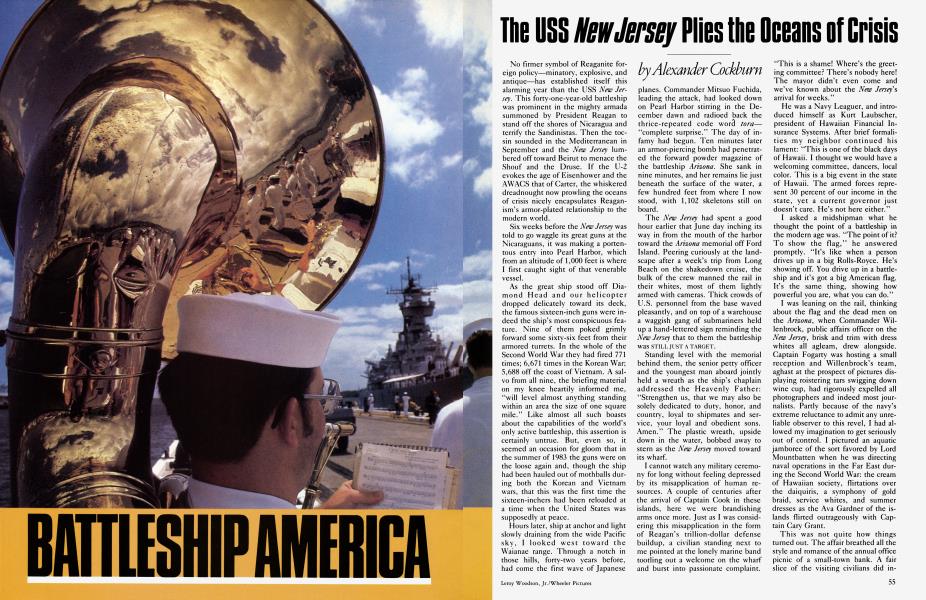
No firmer symbol of Reaganite foreign policy—minatory, explosive, and antique—has established itself this alarming year than the USS New Jersey. This forty-one-year-old battleship was prominent in the mighty armada summoned by President Reagan to stand off the shores of Nicaragua and terrify the Sandinistas. Then the tocsin sounded in the Mediterranean in September and the New Jersey lumbered off toward Beirut to menace the Shouf and the Druse. If the U-2 evokes the age of Eisenhower and the AW ACS that of Carter, the whiskered dreadnought now prowling the oceans of crisis nicely encapsulates Reaganism’s armor-plated relationship to the modern world.
Six weeks before the New Jersey was told to go waggle its great guns at the Nicaraguans, it was making a portentous entry into Pearl Harbor, which from an altitude of 1,000 feet is where I first caught sight of that venerable vessel.
As the great ship stood off Diamond Head and our helicopter dropped delicately toward its deck, the famous sixteen-inch guns were indeed the ship’s most conspicuous feature. Nine of them poked grimly forward some sixty-six feet from their armored turrets. In the whole of the Second World War they had fired 771 times; 6,671 times in the Korean War; 5,688 off the coast of Vietnam. A salvo from all nine, the briefing material on my knee heartily informed me, “will level almost anything standing within an area the size of one square mile.” Like almost all such boasts about the capabilities of the world’s only active battleship, this assertion is certainly untrue. But, even so, it seemed an occasion for gloom that in the summer of 1983 the guns were on the loose again and, though the ship had been hauled out of mothballs during both the Korean and Vietnam wars, that this was the first time the sixteen-inchers had been reloaded at a time when the United States was supposedly at peace.
Hours later, ship at anchor and light slowly draining from the wide Pacific sky, I looked west toward the Waianae range. Through a notch in those hills, forty-two years before, had come the first wave of Japanese planes. Commander Mitsuo Fuchida, leading the attack, had looked down on Pearl Harbor stirring in the December dawn and radioed back the thrice-repeated code wor3 tora— “complete surprise.” The day of infamy had begun. Ten minutes later an armor-piercing bomb had penetrated the forward powder magazine of the battleship Arizona. She sank in nine minutes, and her remains lie just beneath the surface of the water, a few hundred feet from where I now stood, with 1,102 skeletons still on board.
The New Jersey had spent a good hour earlier that June day inching its way in from the mouth of the harbor toward the Arizona memorial off Ford Island. Peering curiously at the landscape after a week’s trip from Long Beach on the shakedown cruise, the bulk of the crew manned the rail in their whites, most of them lightly armed with cameras. Thick crowds of U.S. personnel from the base waved pleasantly, and on top of a warehouse a waggish gang of submariners held up a hand-lettered sign reminding the New Jersey that to them the battleship was STILL JUST A TARGET.
Standing level with the memorial behind them, the senior petty officer and the youngest man aboard jointly held a wreath as the ship’s chaplain addressed the Heavenly Father: “Strengthen us, that we may also be solely dedicated to duty, honor, and country, loyal to shipmates and service, your loyal and obedient sons. Amen.” The plastic wreath, upside down in the water, bobbed away to stern as the New Jersey moved toward its wharf.
I cannot watch any military ceremony for long without feeling depressed by its misapplication of human resources. A couple of centuries after the arrival of Captain Cook in these islands, here we were brandishing arms once more. Just as I was considering this misapplication in the form of Reagan’s trillion-dollar defense buildup, a civilian standing next to me pointed at the lonely marine band tootling out a welcome on the wharf and burst into passionate complaint. “This is a shame! Where’s the greeting committee? There’s nobody here! The mayor didn’t even come and we’ve known about the New Jersey's arrival for weeks.”
He was a Navy Leaguer, and introduced himself as Kurt Laubscher, president of Hawaiian Financial Insurance Systems. After brief formalities my neighbor continued his lament: “This is one of the black days of Hawaii. I thought we would have a welcoming committee, dancers, local color. This is a big event in the state of Hawaii. The armed forces represent 30 percent of our income in the state, yet a current governor just doesn’t care. He’s not here either.”
I asked a midshipman what he thought the point of a battleship in the modern age was. “The point of it? To show the flag,” he answered promptly. “It’s like when a person drives up in a big Rolls-Royce. He’s showing off. You drive up in a battleship and it’s got a big American flag. It’s the same thing, showing how powerful you are, what you can do.”
I was leaning on the rail, thinking about the flag and the dead men on the Arizona, when Commander Willenbrock, public affairs officer on the New Jersey, brisk and trim with dress whites all agleam, drew alongside. Captain Fogarty was hosting a small reception and Willenbrock’s team, aghast at the prospect of pictures displaying roistering tars swigging down wine cup, had rigorously expelled all photographers and indeed most journalists. Partly because of the navy’s extreme reluctance to admit any unreliable observer to this revel, I had allowed my imagination to get seriously out of control. I pictured an aquatic jamboree of the sort favored by Lord Mountbatten when he was directing naval operations in the Far East during the Second World War: the cream of Hawaiian society, flirtations over the daiquiris, a symphony of gold braid, service whites, and summer dresses as the Ava Gardner of the islands flirted outrageously with Captain Cary Grant.
This was not quite how things turned out. The affair breathed all the style and romance of the annual office picnic of a small-town bank. A fair slice of the visiting civilians did indeed seem to be bank managers, though I cannot be sure about the Japanese gentleman I found sitting in the captain’s chair, looking thoughtfully toward the Waianae range. The extreme decorum of the proceedings was ably preserved by the pinkish, almost transparent fluid ladled out sparingly to the sparse assembly. The band played a jaunty tune, visiting navy officers congratulated Captain Fogarty on his command, and the sailors’ voices echoed up cheerfully from the quayside as they headed toward the coarser comforts of Honolulu. Willenbrock eyed with almost tangible pride the New Jersey's magnificently scrubbed teak deck spreading away for hundreds of feet, the towering superstructure bristling with the latest in electronic gadgetry, the mighty sixteen-inch guns. He laid a hand on my arm with the complicity of a man certain that his sentiments are shared: “Off the record, Mr. Cockburn, you do agree that she’s a beautiful ship, don’t you?’’
There was an unprofessional intensity in his voice, an almost excessive flash of ardor in his eye. Like so many of the all-volunteer crew I had spoken to that day, Willenbrock simply felt terrifically proud of the New Jersey, with all the ingenuous enthusiasm of the person who had announced in the press kit Willenbrock had stuffed under my arm that each of the great guns could hurl the equivalent of a Volkswagen twenty-three miles. The comical symbolism of Battleship America, besieged by foreign imports, firing back salvo after salvo of automobiles at its tormentors from the gun muzzles of a forty-one-year-old dreadnought had evidently not occurred to the publicist.
But then, large ships, and particularly battleships, have long had an allure that seems to vanquish critical faculties. Nikita Khrushchev, lamenting the desire of his own naval commanders for unnecessarily large craft, had a cynical reason: “Our naval commanders thought they [large ships] were beautiful and liked to show them off to foreigners. An officer likes to hear all the young sailors greet his command with a loud cheer. That always makes a big impression.”
It was true that Captain Fogarty did not seem dissatisfied with his situation, as each visitor got a snappy salute from the sailor at the head of the companionway. But in fact the navy had not been particularly keen on this third recommissioning of the New Jersey. Its original attitude to the proposal had been closer to that of a curator of the Metropolitan Museum, were he asked to go riding in Central Park in one of the equine armor sets from sixteenth-century Germany.
The third recommissioning of the New Jersey was in fact the brain spawn of a former pilot and Washington defense “consultant” called Charles Myers, who began pushing his cause back in the dog days of the Carter administration. But for the Reaganauts, massed beneath the banners of Renewal and Making America Great Again, one can see that the New Jersey must have had particular appeal. Swathed in armor a foot thick, its very structure spoke of an era when there was full employment in the mills around Pittsburgh, and the Volkswagen little more than a gleam in Hitler’s eye. Its guns retrieved an age of simple percussive prowess, innocent of basing systems, silo vulnerability, and the provisions of arms limitation treaties.
Although he gave every appearance of being an intelligent fellow, I feared, during his allocution, that Captain Fogarty had fallen victim to the complaint called “battleship mind-set.”
The occasion was a small press conference in his cabin, convened once the ship had been safely brought to anchor. After some pleasantries about the arrival in Hawaii the conversation turned to what military men like to call the “survivability” of the New Jersey under conditions of war.
Now the one thing firmly lodged in the minds of journalists about the realities of modern naval warfare is that during the Falklands war the Argentines fired an Exocet missile at a British destroyer called the Sheffield’ and gutted it.
Captain Fogarty was ready. “The question is asked, what would I do if an Exocet missile were to hit the ship. Before I answer that, let me precede it by telling you that there is not a more survivable ship in the world than the New Jersey. As for the Exocet, I would not worry about it at all. It would be like a bee sting to me. I recall Admiral Halsey’s statement when he was asked, What would you do if a kamikaze were to hit your ship? He replied, I’d probably pass the word: Sweepers, man your brooms. It’s similar. I’m not worried about Exocet missiles.”
It seemed, from the answers that followed, that Captain Fogarty stoutly believed that the New Jersey was indestructible by any force devised by man or God. “God forbid, Captain,” a man from a local television station finally burst out impatiently, “would one nuke take care of the New Jersey?" Captain Fogarty took the shot without blinking: “I don’t know. That is a question that is hypothetical and hard to answer because we haven’t really tested it.” Before we could absorb the full implications of this remark he hurried on. “I will say this, though. If I were given a choice to be aboard one ship during a nuclear attack, I would pick this one.”
It’s a modest comfort to think that in the event of outbreak of the Third World War at least 1,527 men aboard the New Jersey will feel that they could not do better by way of shelter, but even the Pentagon and Congress might have had reservations about spending $240 million in refitting a floating bomb shelter. So, what, in the last analysis, is the New Jersey for?
Captain Fogarty had a rather cryptic way of putting it, when I asked him. “I think perhaps we have been a little too defensive in our concept of operating ships. This ship is an addition to our fleet that is offensive. ...This ship is built to go in harm’s way.” Charles Myers has put it more bluntly, with the two words “forcible entry.”
As Myers has explained it and as Captain Fogarty was perhaps delicately hinting, one of the tasks the navy may be needed for in the 1980s is intervention in third-world countries. Assuming that the locals were not terrified into submission by the mere sight of the New Jersey, the battleship would lie offshore and pump rounds of protective fire over the heads of the marines splashing up the beach. Enemy marshaling yards, bridges, troop concentrations, and warehouses further inland would be hostage to these same big guns, and targets beyond their twenty-three-mile range could fall victim to the Tomahawk cruise missiles, tipped with either nuclear or conventional warheads.
Myers went about Congress with a fine model of a battleship of the Iowa class, to which the New Jersey belongs, in his briefcase. To senators such as Jeremiah Denton of Alabama, who had the misfortune to be shot down while trying to knock out the Thanh Hoa bridge in North Vietnam, Myers indicated that the bridge was within range of the New Jersey's guns and there should have been no need for fifty U.S. planes, Denton’s among them, to be shot down.
Some congressmen may have been interested, but the navy was far from enthusiastic. For one thing, a number of weapons designers and engineers opposed to the Myers scheme had a rather different estimate of the power of the New Jersey's sixteen-inch guns. By the time of the Vietnam War the myth had grown up that the mighty projectiles lobbed onto the Korean coastline from the New Jersey had been almost mininuclear in their devastating effect. Far from it, the critics said. Both shore-bombardment shell and armor-piercing shell tended to burrow into the ground on impact; the result was a deep crater and not much else.
The next problem was accuracy. Gunnery skills had been in decline since the Second World War, and the low trajectory of shells fired from sea level did not improve matters. A ship constantly shifting in position could not accurately adjust its fire, either. U.S. planes may have taken from 1965 to 1972 to drop the Thanh Hoa bridge—unused by the Vietnamese for the final three years anyway—but there was no record that naval gunnery had performed any better against such targets.
One of the arguments in favor of recommissioning the New Jersey for Vietnam had been the cheaply available stockpile of shells left over from Korea and World War II. When these cratermakers turned out not to be quite as useful as originally conceived, the navy started buying antipersonnel cluster shells, costing about $30,000 a round, which did kill a lot of civilians, thus firming up enemy morale, while leaving the soldiers secure in their foxholes. Meanwhile the navy was growing increasingly nervous at the thought of having nearly 2,000 men aboard a major ship within range of the Russian-supplied Komar fast boats with which the North Vietnamese were equipped. These boats had Styx missiles, which, whatever Captain Fogarty may say about the Exocet, could do the New Jersey a great deal of damage. After only six months’ active duty the New Jersey was once again inactivated on December 17, 1969.
As it now patrols the high seas, alert for “forcible entry,” the New Jersey seems prey to illusions about the past and the future. The forcible entries, that is, the contested landings of the Second World War, did not demand just one battleship firing a stately two rounds a minute from its big guns. Even after a curtain of softening fire from an entire fleet, the Japanese would emerge from their foxholes and wreak fearful destruction on the landing marines.
The future is embodied in the fancy electronic wares which eventually won the support of the navy and the large arms contractors for the recommissioning of the New Jersey, an event which finally occurred on December 28, 1982: the Tomahawk missiles, the Vulcan-Phalanx Close-In weapons system, the AN/SLQ-32 electronic warfare system, SPS-49 radar, and so forth. Festooned with the costly wares of General Dynamics, McDonnell Douglas Martin Marietta, Raytheon, and other concerns, the New Jersey may now be an emblem of the military-industrial-intellectual complex, but its actual prowess—both aggressive and defensive—may not have been significantly enhanced. It is now becoming widely accepted that complex and hence expensive electronic weaponry does not work particularly well, and the stuff aboard the New Jersey is no exception. The Vulcan-Phalanx, for example, is designed to fill the air with lead, 3,000 rounds of 20mm projectiles a minute, and thus explode an incoming missile. It’s a chancy business at the best of times, and matters are not improved by the fact that the relatively light ammunition can strike the incoming missile, ignite but not detonate it, and thus cause a flaming explosive warhead to hit the ship.
As it now patrols the high seas, alert for 'forcible entry,' the NewJersey seems prey to illusions about the past and the future
The vaunted Tomahawk cruise missile has performed dismally in its tests. The nuclear version relies on a TERCOM guidance system to steer it toward the target. This system, which relies on contour mapping programmed into its computer, becomes sadly confused over such featureless terrain as snow or thick foliage. The conventional warhead version needs a TV guidance system with image matching to home it in satisfactorily on the target. This has been causing the manufacturers dreadful problems, as has their inability to get the missile to rise near the end of its trajectory before taking a terminal dive into its target. A recent letter from the General Accounting Office to Secretary of Defense Caspar Weinberger remarked, apropos of the TLACM/C conventionally warheaded Tomahawk, “We recommend you direct the navy to limit its acquisition of these missiles to the forty-four already funded until an effective terminal maneuver capability can be demonstrated.” As things stand at the moment, the Tomahawk with conventional warhead can only hit the target horizontally, which means that the enemy has only to surround its target with chicken wire or trees—which will cause the warhead to detonate.
It seems slightly unfair to belabor the New Jersey with all these criticisms, rather like taunting a stately old bull. As the sailors aboard confessed, its purpose is essentially histrionic: to show the flag and strike terror into the foe. In a press conference on October 19, Ronald Reagan was repeatedly asked about the security of the marines in Beirut. The interrogator likened their situation to the French at Dien Bien Phu in 1954. “Maybe,” Reagan replied, “the French at Dien Bien Phu, in that terrible defeat, didn’t have a New Jersey sitting offshore as we do.” Four days later over 200 U.S. marines were blown up, and the New Jersey couldn’t do a thing about it. If a symbol has to be found for Reaganism in mid-course, plying the high seas of nostalgia and grim intentions, the recommissioning of the New Jersey serves well enough.
Subscribers have complete access to the archive.
Sign In Not a Subscriber?Join Now


