





Sign In to Your Account
Subscribers have complete access to the archive.
Sign In Not a Subscriber?Join NowLiving Without Work in Lorain, Ohio
Living Without Work in Lorain, Ohio
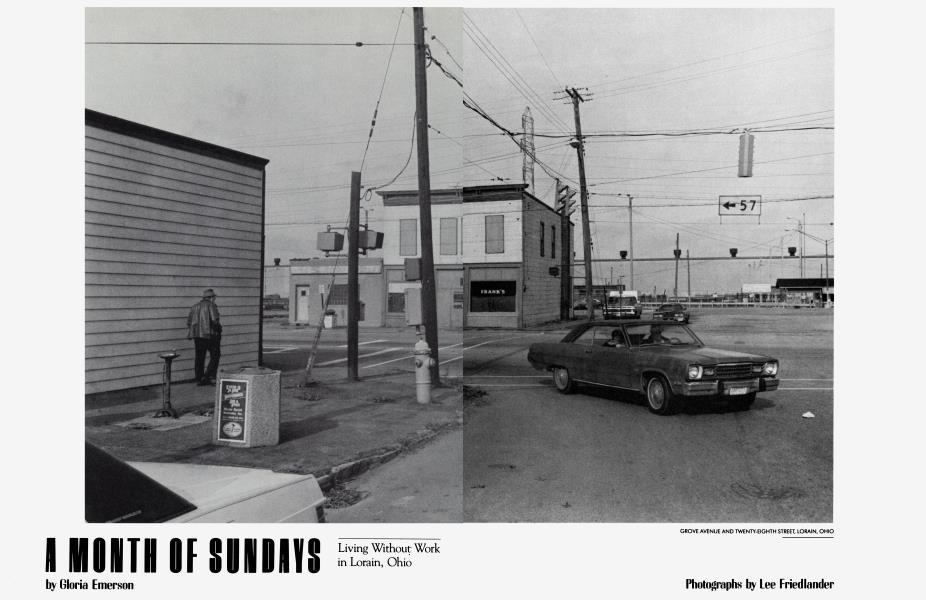
The layoffs in Lorain, Ohio, have cut so deep at the Ford assembly plant and at the U.S. Steel mill that a weekday has no meaning now. In the supermarkets the men are shopping in the afternoons, moving slowly up and down the aisles as if they do not understand what it is they need. You do not have to ask what’s so wrong. They are without their work; the rate of unemployment in Lorain County is 21 percent. A city of some 75,000 people, at the mouth of the Black River on Lake Erie, twenty-five miles west of Cleveland, Lorain is not unusual; its misery is quite familiar now. Other places hold as much pain and panic, and the numbers that measure all the American unemployed are recited so often on television that the casualty reports grow dull.
The reasons for this economic chaos are not clear. All of us have ideas, assign blame, nurse suspicions, suggest who is guilty. Some see the men and women who make automobiles and steel in places like Lorain as the villains, call the unions evil, and curse the workers’ good wages and benefits. Others hold the companies responsible, citing disastrous management decisions and the failure to modernize the plants when there was still time to make profits. In Lorain, people talk about the Japanese with bitterness, but agree it’s cheaper to produce cars and steel there. But they do not easily take the blame for our perilous economy. Ohio teaches you something new: the Ford and U.S. Steel workers are not spoiled; they are among the Americans who have always been in peril, the first to go down when their cyclical industries weaken. Many of them grew up poor and know how poverty damages people’s lives. What they face now is what all of us most want to avoid: a sense of helplessness.
What they tell you about their lives are small things, details described in voices that often break or falter, and it is not only women who must wipe their eyes as they try to make clear the people they used to be. Barry Whitfield, a thirty-four-year-old Ford worker in his third month of another layoff, is only a tiny pin on the map of disaster: one of 4,600 Ford workers on the active roll, of whom only 2,100 are still on the job. During the peak of production at Ford, in May 1979, 7,200 people were employed.
Mr. Whitfield does the family’s shopping at a chain called Fazio’s The Food People, at the store in the Oakwood Shopping Center. He goes there with his two younger boys when school is over. He is already beginning to be a little afraid of his own life and how it is changing him, but he says he does not mind cooking dinner nearly every night. It didn’t take him long to find out he couldn’t spend less than ten dollars to make dinner for the five of them. The three boys eat a lot and are used to meat. The children, the shopping, and the cooking take some of Mr. Whitfield’s time, but he still has hours to kill every day, so it is fine with him when one day a neighbor in South Lorain—a community of small and decent houses on very wide streets, with its own park of oak trees—asks his help in fixing a leaking roof before winter gives him grief. All the men in South Lorain fix things themselves. They wouldn’t consider calling a professional, for they usually learn about roofs, drains, motors, boats, and appliances as boys. So there is nothing unusual about three men fixing a roof on East Thirtieth Street except that it is Wednesday afternoon and too many people in the neighborhood are at home, their big cars bunched outside. The weather has held all week; the sky is pewter but not dark, the day stiff with breezes although the real wind from Lake Erie has not yet begun to bully people. No one here except schoolchildren ever walks anywhere, so Mr. Whitfield rides the short distance to his friend’s house on his 1974 Kawasaki KZ 400 motorcycle. Although he has a good word for the workmanship in his 1978 Buick Century, he complains that gas for it costs too much. The roofing work goes well, and Mr. Whitfield is glad to be in the company of other men, all of them young and unemployed. Then it is time for him to go home and wake his wife, Joyce, who works the night shift as a nurse’s aide.
“I let her sleep. I let her work,” he says, playing for a laugh. For a little while as he stands there smiling, his thick brown hair raised in a wild ruffle, you might not know he is wearing out and that his headaches are severe. He isn’t really touchy about his wife bringing home the only paycheck. A lot of women in Lorain work, most of them in poorly paid jobs. Joyce makes four dollars an hour, $240 take-home pay every two weeks. In a burst of bravura, Mr. Whitfield says that he is not going to work for that kind of money. Not after the nine years he put in at Ford taking home $350 each week. He doesn’t quite mean it; he only wants to show his faith that Ford will call him back.
From October 1980 to October 1981 he had only twenty-four weeks of work. In 1982 he worked from January to July. That summer the headaches became persistent; they were like a sharp slow drumming inside his skull. In this community, men don’t willingly go to doctors unless they are virtually unable to move. But since their jobs depend on their bodies they know how easily illness can make them useless. Mr. Whitfield was so alarmed by his headaches that he visited a psychologist in an Oberlin clinic twenty times in a three-month period. “At fifty dollars a click,” he says, all of it covered by his medical benefits from Ford. The psychologist, who said he was seeing a growing number of laid-off workers, described the effects of stress to him and taught him biofeedback techniques. The very idea of such treatment struck some of the Whitfields’ friends as weird and useless; some even seemed shocked.
“I was just so worried constantly,” Mr. Whitfield says as he sits in his kitchen, where the only luxuries are a Mary Proctor blender and a Brew Started coffee maker. “It made me feel better, it was relieving. You don’t have to be crazy to go there. I know a lot of men getting into trouble now. I would watch television because I didn’t have nothing to do. I had to watch soap operas during the day because there was not so much on. I would watch The Young and the Restless at 12:30—I would watch a man in it, he lost his job, he’s ready to cry, to fall apart, and I would see that’s what is really happening, the men are losing their jobs and women are picking up while men are crumbling . . .’’He doesn’t intend to crumble. He goes on about women as if he has made new discoveries about them every day. He is beginning to think that a lot of women might survive the bad times, but not the men, who seem to him frailer because of their pride. This is a popular assumption about women here; other men often say the same thing, sometimes in a humorous way, but they don’t take into account the many women who are on their own with families to support, the women who are shy and unschooled and unskilled. The truth is that these women know the same shame and confusion as the unemployed men.
Karen Sue Dellinger, thirty-eight, has lost three jobs in four years. On most days, her smile does not persuade as it once did; threads of her narrative split and fray as if her story has become too demanding to tell. It does her no good to be brave and devout and appealing when there is not enough money to live on. Bom in West Virginia, Mrs. Dellinger came to visit a sister in Lorain when she was nineteen, and met and married a Ford worker. She lives now with her seventeen-year-old daughter, Tracy, and Tracy’s two-year-old son, Jason. “Single parent” is not a phrase Mrs. Dellinger can bring herself to use about Tracy, not this woman with copies of the magazine of the Lutheran Church in her living room, who shows you where she is in a church photograph. So she puts it her own way: the strain in the family when her husband left, the divorce he wanted and got four years ago—these things affected Tracy deeply. The girl has heard it all; she is not much interested in this version, and she doesn’t look at her mother. The child, Jason, sturdy and adventurous, makes a commotion, and the two women, who sit carefully apart from each other on the couch, smile faintly at the urgency of the boy, the rumpus he makes. On some days, Karen Sue Dellinger continues, she’s had it so bad she once even used dishwashing liquid to wash her hair. Something southern and sweet is still at work in her, so she laughs a little at the story to lift the strain in the room.
A son, fourteen, was sent to his father’s household in September because Mrs. Dellinger could not feed or clothe him anymore. Tracy picked tomatoes last summer, but it is not clear whether she helped keep the household going with that bit of money. The food stamps, $78 a month, have stopped. The rent is $265; her unemployment benefits pay it.
Mrs. Dellinger had worked in cleanup at the Ford plant, and then for a few weeks on the assembly line, before being let go. For nine months she held a CETA job with the Catholic Youth Organization, visiting elderly shut-ins. Her last full-time job was at U.S. Steel. “I was a leadman,” she says. It was a hard job for her. She speaks of the coke furnaces, the thermal underwear she had to wear, the steel-toed work boots, some sign she saw in the mill that warned about cancer, and the day her hair caught fire even though she had worn the required headgear and a scarf. It was the CETA job that suited her best; she looks nearly peaceful remembering how glad people were to see her, and one old lady who was special to her. “I even did her hair sometimes,” Mrs. Dellinger says. “You weren’t supposed to, but it made her feel so good.”
The news that national unemployment rose to 10.8 percent last November—11,987,000 people jobless—does not rattle Mrs. Dellinger because she cannot envision her own despair multiplied so many times. Barry Whitfield, the Ford worker, is not shaken by statistics either: the figures change on television, but Mr. Whitfield is busy cooking dinner when the nightly news comes on. He has not heard that American factories are operating at their lowest capacity since 1948, he doesn’t follow the furious swings of the stock market, and he hasn’t read that the number of auto workers like himself on layoff reached 285,364 one week. None of it speaks to him or makes anything clearer. He talks about his bad luck in being transferred from commercial, where he worked on Econoline vans, to passenger. The Thunderbirds and Cougars weren’t selling well, so the layoffs were deepest in the passenger division. He had fifty weeks to go on his unemployment benefits, and there were SUB payments—Supplemental Unemployment Benefits, a system set up by the United Auto Workers and the Ford Motor Company to provide workers on layoff with a percentage of their base pay calculated on a system of credits. He and Joyce, who have rented a house while trying to save to buy their own, no longer take the children to McDonald’s twice a week. But Mr. Whitfield, who wants the boys to go further and be safer than he has ever been, can’t change all his habits. He still gives five dollars to a child who makes an A in school, even though his wife thinks this is dead wrong. He dropped out of high school. “I was not intelligent enough to keep in a college type of career,” he says. “I wasn’t pushing myself in school; I push my kids now. My parents never even knew what grade I was in because they never cared, they never had an education.”
His father, a Pennsylvania coal miner, moved the family to Cleveland when Barry was seven. Both parents, members of the Church of God, often called Holy Rollers, permitted no trace of frivolity, joy, sensuality, affection, or celebration in the household. His father died of black lung at the age of sixty-four. His mother—overweight by a hundred pounds and sickly because of “bad sugar,” he says—made him learn to cook as a boy. He and Joyce have always shared the chores, even when he was working. “She used to cook dinner, but on the weekends I would even run the sweeper,” he says. “It doesn’t take much for a man to run the sweeper. But most men won’t touch that; they say that’s a woman’s work.”
He began his working life as a spray-painter, and when, in 1973, there was a boom at Ford, he was hired and put on the line. He stood in one spot, painting the doorjambs and insides of car doors, working in twenty different colors with spray guns attached to long hoses that were pulled down and then released.
“It was hard,” he says. “I’ve seen people go in there at Ford and actually quit an hour later because they couldn’t take it. To work in an assembly line at Ford, in any auto industry, you have to be adaptable and industrious. You got to be able to do anything.” Another man sees it differently and says, “They trade people at Ford like they trade stamps.” But Barry Whitfield never minded that; he liked the variety.
After painting there were other jobs: unloading rail cars, putting seat belts in vans, attaching the plastic grilles where the headlights go—a minute and a half for each job—working on as many as sixty vans an hour. Now it makes him angry that, with all his abilities, all his fine dexterity, he is sitting at home.
Pork chops at Fazio’s cost $5.75 for 3.04 pounds; a box of Stove Top stuffing is 89¢, frozen beans, $1.65, a package of Chips Ahoy cookies, $1.89. In the kitchen, painted orange, with decals and plants, Mr. Whitfield goes to work on the pork chops, using tongs as he coats them with egg and bread crumbs. Sometimes he thinks about going to school to become a professional cook, but he guesses there’d be no job waiting for him. He tries for a certain engaging valiance, not wanting the grimness of his childhood to reappear and deform the life of this household. But on this night, with the dinner cooking, he must feel an unnamed dread coming closer. “I’m getting like an old woman,” he says, but so softly it seems more polite not to notice or make a reply.
There are other men who do not always recognize themselves. One of them is Michael Paslawski, twenty-nine; nothing about his old life would suggest the disorder of his existence now. Born in 1953, he graduated from Admiral King High School, named for Lorain’s most famous hometown boy, Ernest King, commander in chief of the U.S. fleet between 1941 and 1945. In 1977 Mr. Paslawski married Debbi Smithberger. They have two children, a daughter two and a half and a son ten months. His dismissal from Ford in September 1980 came after a six-month medical leave for a hiatal hernia and an imperfect heart valve. Mr. Paslawski insists that he reported back to work at the appointed time, but Ford disputes this. The head of the United Auto Workers Local 425 in Lorain says the union is pressing for Paslawski’s rehiring. Debbi Paslawski, who is expecting another child in April, says this one will be their last. She is quiet and calmer than her husband, watchful. He can barely describe his days:
“It’s just looking out the door and seeing nothing. It’s the same old thing every day, just look out and think—but what’s going to happen today? And, you know, the way it goes every day, you just wake up and you get out and you look outside, and after that there is nothing. All you can do is wait and see what happens every day. . . . You just get up in the morning, you dress, you wash your face, you brush your teeth, you eat, and you get ready to hit the world and then after that ...” Their daughter picks up her book, Big Helpers, with its pictures of shovels, trucks, derricks, dump trucks, and bulldozers. She wants someone to read to her.
Paslawski is waiting for a reprieve, an omen, a letter from Ford, or a triumphant call from Local 425, but so far nothing of the sort has come. The only work he can find is neighborhood jobs, the sort that any boy can do: cutting grass, cleaning yards, trimming trees, shoveling snow. Sometimes the elderly people who live nearby seem a little anxious about how much a grown man will charge for these chores. “I tell them by heart now, I say, ‘Whatever you can afford at the time—you bring it out, I’ll take it. Cash or food. Give me, I’ll take it. ’ ”
For Debbi Paslawski the hardest times are when her husband is in the house too long and the children are underfoot. It doesn’t help that the children, Jenny and Michael, Jr., are so fetching that strangers always moon over them. “His depression is when, you know, like the kids are screaming and I’m crying,” she says. “You know he’s not used to it, and I don’t think men can take it as well as women. It goes so much smoother for me when he is not at home.”
To her husband it seems as if he has become a man who attracts disaster, someone singled out for persistent punishment. Their old Oldsmobile is “on its last lump,” he says, and even the immaculate house he and his wife rent for $200 a month will become a source of trouble if their landlady makes good her threat to raise the rent. Mr. Paslawski earned $850 a month at Ford, and even more when he worked ten hours a day. They always planned to buy their own house and a new car.
The Paslawskis are eligible for $200 a month in food stamps; public assistance comes to about $327 a month. They get cartons of groceries from the Catholic Youth Organization; boxes of Stouffer’s Lean Cuisine sit in their freezer. The union meetings help keep him going. In the beginning of his unemployment, he and Debbi made a list of places where he might find work, even as a stock boy: Clarkins, Gold Circle, Gaylord’s, Fligner’s, all the auto parts stores, fifty places in all, and he’s still trying. “It can drive you to craziness, to kill yourself at times, the way I look at it,” Mr. Paslawski says. “I had a friend who just shot his wife two days ago. He got laid off in the shipyards.”
On his garage door there is a large UAW sign saying: BUY AMERICAN. “I just think about trying to make it, to see if we can’t stick it out, maybe them guys at Ford would give me a chance, I would come back and show them I could work again,” he says. It’s his refrain. If you’ve been out of work for over two years, the chances of being rehired at Ford are very thin.
Even single men, like twenty-five-year-old David Sokol, with no dependents and few responsibilities, share the humiliation of men whose wives and mothers are working when they cannot. A Ford worker out for two years, Mr. Sokol had to move back in with his mother, who lives on $350 a month from Social Security and a part-time job. “I’m a burden to her now,” he says, “that’s how I feel.” The young woman he intends to marry in July has her job, and they plan to live rent free in her grandmother’s furnished house. All these women are keeping him afloat, and it makes him sorrowful.
“I won’t lie to you, the other day I came home, I broke down and cried. I just felt there is nothing, nothing anymore. What did I do then? I talked to my dog, a hundred-pound Doberman, Samson. Me and him are just great friends. Sometimes, I tell you, I could use a couple of Valiums just to calm me down. My dad always told me when I was younger, if you want anything in this world you got to work for it. I worked for my first car. I worked for my second car. I worked for my third car. You know, some people are born with a gold spoon in their mouth, and I envy them. I want to work, but there’s no jobs, especially in this part of the country.”
His unemployment benefits are $63 a week. At times Mr. Sokol feels so stricken that he understands why his friend who used to drive with him to the Louisiana border of Texas to fish for bass and crappie shot himself after being laid off at Ford. “He was an older fellow. He was thirty,” Mr. Sokol says. “Even I was on the verge of.. .you know, you think seriously.. .that you don’t have . . . what the hell have you got to live for anymore? I mean it gets pretty depressing.. .you come close, you come close.”
There is not much talk of the Great Depression in Lorain; some of the younger people are not even sure when it happened. Its survivors say that welfare and unemployment benefits have made a world of difference between those hard times and these. But unemployment benefits run out, and families cannot easily be moved. People in Lorain are aware of a growing disparity between the America they thought they lived in and the one they really inhabit. One result of this awareness is a growing doubt among workers about the value of their unions and the amount of allegiance owed to them. Union loyalty is still strong, though, and men with long memories are still passionate. One letter in the local newspaper, the Journal, signed by Robert E. Roberts, said, “Look at what unions have given to the working man, it used to be only industrialists and bankers could enjoy the things we have.”
But there are other workers, like Dale Patterson, a twenty-five-year-old operator at U.S. Steel, who are not so sure they will stay out if there’s a strike at the mill this summer. Mr. Patterson, on layoff since April 1982, says that men like himself have been too well paid. He remembers taking home as much as $1,000 every two weeks. “I was making a ridiculous amount of money, I was! A thousand dollars take-home pay every two weeks? We got master’s degree teachers in there, that quit teaching, quit being professors at college and everywhere else, to work at U.S. Steel because they’re making more money there.” Patterson is now receiving $148 a week in unemployment. His wife, Barb, has been laid off by the Bonne Bell cosmetics factory, where she worked in production. Born-again Christians, the couple live in an apartment owned by Barb’s parents, and it is clearly a source of pride to them that they do not have any payments to make on a house, furniture, or a car. A self-assured man, Mr. Patterson says if everything went wrong and he had to go to work at McDonald’s, okay, then, he would make the best burgers they’d ever seen.
“People are in trouble because they bought their swimming pools and three cars and a house they can’t afford,” Mr. Patterson says. “Then the wives have to go out to work, then the husband gets laid off! The men were living on their overtime, see? About five people in our department, when we were working overtime, went and put in-ground pools in their backyards!” He guesses that this kind of pool costs $10,000. Patterson also complains of men in the mill who wouldn’t work, and of some of the “bosses,” whom he suspected of wanting to keep the workers and the foremen apart, of not wanting them to be friends, so management could “keep a whip on you.”
“You know what another problem is— every year they bring in college kids, engineers, but they don’t know nothing about steel mills. They didn’t learn nothing, they don’t have no common sense, and they read the book on how steel mills run, but a mill hasn’t been run by the book for fifty years. It’s too outdated.”
According to Patterson, U.S. Steel has approached some workers to see if they will cross the picket lines in the event of a strike this summer. Patterson says he knows one man in masonry who has already agreed, and says that some of the workers feel that the size of the mill (four miles long and one mile wide) would make it impossible for any hostile force to threaten strikebreakers. But at the same time he recalls that his friend had been warned by management: “ ‘You can quit anytime, if you’re sick of it, just go. But if you do, don’t forget the people outside the gate waiting for you.’ ” This was Patterson’s version, the scenario slightly thrilling to him. “I don’t hate the union,” he says, “but I have a wife to support, and you can’t depend on the union right now.”
Later, talking to a steelworker, one who works for the United Steel Workers local in Lorain, I mentioned that I knew of one young man who might defect if the mill is struck. “He’s only twenty-five,” I said. “And if he does, he won’t see twenty-six,” the other man replied. “Count on it.”
It was not a statement of intent, not a real threat yet, just a way American men tend to talk. But what I remember most now is not just the deep strain in the community, or even the fragility of people without work. What is so hard to forget is the longing of men and women to be given back what they once had, and how, one morning, Michael Paslawski told me about the Ford plant, how it felt to belong there.
“I used to get up at 4:30 or 5:00 A. M. ,” he said. “At the Ford plant it was just like a big dream. You are right in a big city. You walk in, still half asleep, and you see all the lights of this big city. And all of a sudden guys are saying, ‘How ya doing’ or ‘Hey, what’s going on, ’ and you got to know some of them like a bunch of brothers. . .”
As I write this, Barry Whitfield has gone back to work. None of the others are employed.
Subscribers have complete access to the archive.
Sign In Not a Subscriber?Join Now


