
Sign In to Your Account
Subscribers have complete access to the archive.
Sign In Not a Subscriber?Join NowThe El Western
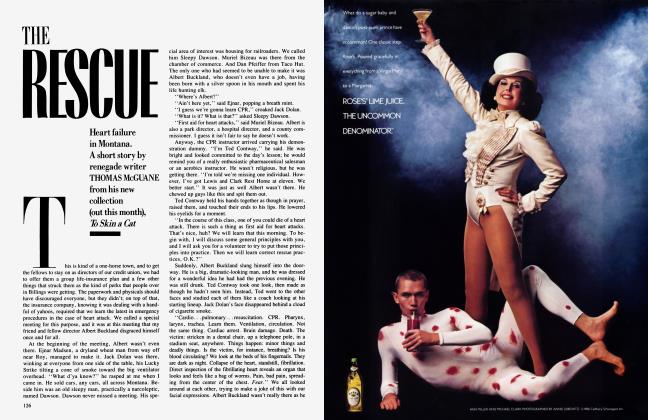
Thomas McGuane
Lucien’s father died down in Arizona the same year Lucien lost custody of his son. The old man had insisted that a member of the family call every day. He did not want to die and have someone discover his remains at the end of a long holiday. Yet that is exactly what happened. Lucien arranged a small funeral, left some money with the priest and came home. Snow whirled in the windows, and eating was just kind of hit and miss right up until Lucien was fairly unrecognizable. He couldn’t keep from thinking.
When the funeral was over and before he left to go back to Montana, Lucien stopped to see his brother and his wife. His brother had been pretty much of a goner since Parris Island. That was twenty years ago and Arizona hadn’t helped. His wife moved like a scared fly, and Lucien’s brother just kept smoking real slow and saying quietly, “I guess they’re all together now.” His fingers rested on the clouded glass top of a wrought-iron table. There were toys tipped over against the sliding door. No one seemed to know just how mad to be. The brother looked up at Lucien in his fogged-out way and said, “It’s like some deer hunter got him.”
When Lucien was very young, he read all of the sporting magazines; and one of these, he now remembered, had a feature called “This Happened to Me” in which awful things happened to sportsmen because of ice and cliffs and wild animals, things which were terrible but which the sportsmen survived by thinking of something fast and at just the right moment. Or they were saved by the inexplicable. For instance, the polar bear sees his mate float past on an iceberg and therefore releases your skull. These things were very much like divine intervention and were meant to leave you thinking that the sportsman is most directly exposed to feeling the big flywheel, the eternal gear. What gave “This Happened to Me” its special brimstone quality, apart from the illustrations of sportsmen dangling, sliding or being pursued, was that each segment was signed by the survivor. “Art Clancy, Acme, Michigan,” or somebody. And for a long time, Lucien identified himself with these nearly anonymous sportsmen, that is to say with all of them, and began seeking out ways of living which would produce civilian versions of “This Happened to Me,” combining the episodic, the anecdotal yield and, best of all, the deep and abiding smell of brimstone. When he tried to get away from that, he sensed nothing was going on; when he gave in to it, he found he required a steady, deepening effort in the episodes to produce a real “This Happened to Me” effect of sportsmen against the flywheel with a genuinely sulphuric atmosphere. Then everything happened to Lucien. He got rich and lost his family. He grew savage in his loss. He sought crimes against nature the way a normal man will roll a cart through the supermarket. But at the same time it held his attention, and after each purple connivance, Lucien would think, This Happened to Me.
Now, however, it had happened to him. Familiar remedies were not at hand. So he spent all his time out at the cow camp, as he called it, a cattle ranch with a small white house, whose high pastures were shattered by ancient earthquake faults and brush canyons that turned upon themselves like seashells. Inside these canyons the sun or moon rose and fell inside an hour’s time; a shadow would race at you like a guillotine. Insects were magnified in the angular light, and the rock walls seemed to have been cleaned with vinegar. Coyotes stole through the sequestered Byzantium, not knowing Lucien was there eating cold fried trout in these one-hour days which let him emerge into a larger day, feeling he had stolen time.
Lucien saw the sun move up toward him on the surface of the river. The river edged up in the bend as a cresting glare. His sedan was a luminous tear of terrific paint parked on the bank. If he rowed long enough he would be tired, and usually he was shaking. But he felt that there was only so much that his mind could do to him because he had arranged a weariness for himself that was as plain as he could make it.
He folded the oars within the gunwales and stepped out onto the bank with the bowline in hand. The drift boat ran off a bit on the eye of the current, then came to shore. He dragged the bow up on the cold pebbles and lit a cigar.
Lucien had taken the position that he was growing to meet himself, that he was ascending to a kind of rendezvous. He had placed himself on trial but would make the odd exception, because he had seen what little things break our parole from eternity. Last night’s paper revealed that a man had been badly beaten, then shot to death guarding a Royal Doulton Toby jug collection. A quiet type met his end in a welter of ceramics and lead. Everything that meant anything was being sold to guitarists and pants designers. He was going to fish quietly and sweat it out.
The road was hot. Birds had dusted in its course and disappeared once again into the brush along the creek. Aquatic insects drifted from the creek and speckled the windshield of the sedan moving between alternating panels of light, vegetation and sky. The sedan’s luster was magnificent with nature’s passing show. Lucien and a new friend were finishing a long night together; they didn’t quite know how.
“I’m going to shut it down here,” Lucien said. The woman sat across the front seat staring at him with a slightly swollen look about her lips. It was sunup.
Lucien lit a cigar and sighted around himself before directing its smoke toward the leafy staggered shadow from which the movement of cold water could be heard. He could feel himself speeding up. He felt he was being run to earth.
“Maybe I can catch a fish,” he told her and got out. He strung the line through the guides of the rod and stared at the brushy enclosure through which the moving water announced itself.
“There’s bugs,” she said from inside, her head displayed on the wiper arcs. “Now they’re on the dash. Can I play the radio while you do that?”
“Go ahead. Try and pick up the news.”
Blue duns drifted over the tops of the willows. By the time he waded to the spring he could no longer hear the radio. He caught four small cutthroats before turning his attention to the end of this small escape. He thought, I have only myself to blame. He closed the lid to the compartmented English fly box with its hundred treasures, and the escape was over.
“Did you get a fish?”
“I got three fish. Can you turn that thing down?”
“Three fish. That’s nice. You got three fish. There it’s down. Happy?”
“Yes, very.”
“That was a top ten crossover.”
“You see, it gives me no special feeling. It’s like being rolled around in a barrel.”
“Uh huh. Y’know, I just imagine my old man’s alarm went off about an hour ago.” To Lucien daybreak had made her look like one of the monuments at Easter Island. “But here’s the deal,” she said, opening her compact, then throwing it back into her purse hopelessly. “Let’s find a way to get this over with. My aunt will let me in through the garage. Nobody’ll be the wiser.”
Lucien started the car and moved down the road toward town. He tried to put some diplomacy and gratitude in his voice. “This sounds best for both of us,” he said.
“You sickening fuck,” she said. “I feel like a sewer.”
The ranch house had a springy floor. Lucien’s grandmother’s house in town also had a spring to it. When Lucien was a child he could run through the first floor and cause the china to tinkle in the cabinets for a minute and a half. A train on the bridge would do the same; and the second-story sitting porch trembled at traffic or even, it seemed, the shouts of the neighbors from down the street. But this was a different motion, less the consequence of human pounding than some catarrhal moan from the ground, borne through the timbers of the house.
Part of the problem was that Lucien had got rid of the furniture. There was plenty of it too. And behind the two mortifying unsprung beds, there were hair-oil spots on the wall. Lucien didn’t know who made the spots, but he thought, We’ve got plenty of haunts without this.
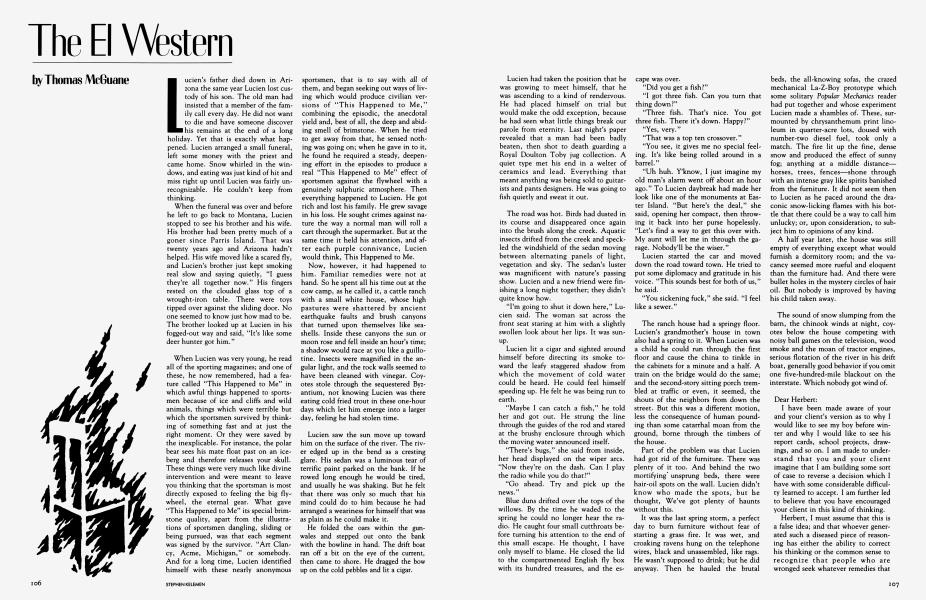
It was the last spring storm, a perfect day to burn furniture without fear of starting a grass fire. It was wet, and croaking ravens hung on the telephone wires, black and unassembled, like rags. He wasn’t supposed to drink; but he did anyway. Then he hauled the brutal beds, the all-knowing sofas, the crazed mechanical La-Z-Boy prototype which some solitary Popular Mechanics reader had put together and whose experiment Lucien made a shambles of. These, surmounted by chrysanthemum print linoleum in quarter-acre lots, doused with number-two diesel fuel, took only a match. The fire lit up the fine, dense snow and produced the effect of sunny fog; anything at a middle distance— horses, trees, fences—shone through with an intense gray like spirits banished from the furniture. It did not seem then to Lucien as he paced around the draconic snow-licking flames with his bottle that there could be a way to call him unlucky; or, upon consideration, to subject him to opinions of any kind.
A half year later, the house was still empty of everything except what would furnish a dormitory room; and the vacancy seemed more rueful and eloquent than the furniture had. And there were bullet holes in the mystery circles of hair oil. But nobody is improved by having his child taken away.
The sound of snow slumping from the barn, the chinook winds at night, coyotes below the house competing with noisy ball games on the television, wood smoke and the moan of tractor engines, serious flotation of the river in his drift boat, generally good behavior if you omit one five-hundred-mile blackout on the interstate. Which nobody got wind of.
Dear Herbert:
I have been made aware of your and your client’s version as to why I would like to see my boy before winter and why I would like to see his report cards, school projects, drawings, and so on. I am made to understand that you and your client imagine that I am building some sort of case to reverse a decision which I have with some considerable difficulty learned to accept. I am further led to believe that you have encouraged your client in this kind of thinking.
Herbert, I must assume that this is a false idea; and that whoever generated such a diseased piece of reasoning has either the ability to correct his thinking or the common sense to recognize that people who are wronged seek whatever remedies that there are available to them.
I know you will understand what I
am saying.
Sincerely yours,
Lucien Taylor
Wick Tompkins had his small law offices across from the monument to the fallen cavalryman, a grimacing bronze fighter already dead, falling on an already dead horse, seizing the shaft of the arrow which pierced his tunic, suggesting that the last man still left alive in the world was the bowman. Wick liked to point out that the chap would have had to be standing somewhere right close to his secretary’s desk when he got the trooper.
The secretary winked up from her new data processor, then rolled fresh boiler plate onto the screen. This machine had made Wick a man of leisure: Wick now weighed 240 pounds. He smiled all the time, and his smile said, This better be funny.
“Lucien, come in here and close the door. I don’t want anyone to see you. Your hat, give me your hat.”
Lucien reached his Stetson to Wick, who hung it on a trophy for the champion mare at the Golden Spike show in Utah.
“Herbert Lawlor informs me that you have threatened him with a letter.”
“I did not. I wrote him a letter.”
“I’ve seen the letter.”
“So you know that Herbert Lawlor is hysterical.”
“The letter has threatening overtones. It is a pissing fight with a skunk. It is the very thing you are not to do. You’re having fun out on your crummy cow camp, aren’t you?”
“I’m making repairs.”
“And you are floating on the river?”
“Almost every day.”
“I think that’s grand. Especially if you let me do the communicating with Mister Lawlor. It’s demeaning for you to take these things into your own hands. I am paid to demean myself, though I dream of glory as well as weight loss and sex miracles with strangers.”
“I’ll do better at everything if I can see my boy.”
“You will see him at Christmas and you’re going to have to get used to that.”
“Christmas.”
“That’s the next time, not the last time.”
“How do you know when the last time is?”
Wick Tompkins drew on his cigarette, made a tentative gesture to stub it out, decided that too much of it remained, and said, “I think that is a disastrous remark.”
“It’s not a remark. It’s what I think.”
“It’s a disaster.”
When young girls learn the new dances, thought Lucien, it is the last time the new dances are interesting. I am in town, thought Lucien, why not make the most of it?
He sat down at the counter at Pop’s Place, a hangout for people dramatically younger than himself, and drank coffee, the fastest beverage in the house. He drank as much of it as fast as he could and watched a two-by-four opening at the end of the room where the young girls danced together to a jukebox. Their movements were strange and formal, glassy and distant; and everything wonderful about their bodies was under twenty-four months old. They moved toward the bellowing music, then moved away, gazes crisscrossing. They arced toward the surrounding columnar tables and quick-swigged pop without losing the beat. Though much of this struck a deep chill in Lucien, part of him desired to be a shallow boy with a sports car. Anything he’d ever done seemed like old tickertape.
Lucien knew that he had to practice an upright existence. He was being watched, not by everyone as he imagined, but fairly closely watched.
When he emerged from Pop’s, he immediately spotted people he knew; and he felt as though his trousers were undone, or that his face and neck were a mass of hickeys. He saw two people he knew. One was the messianic Century 21 realtor, H. A. “Bob” Roberts. Bob cried out a greeting. He coasted past Lucien with a marathoner’s stride, but kept his face on a locked rotational axis in Lucien’s direction.
The other was Mrs. Hunt, Lucien’s mathematics teacher of years back. She had been retired for a long time and now stalked Main Street reproaching former students, some of whom were grandparents and had had quite enough of this from her over the years.
“Aren’t you a little old for that place?” she asked Lucien.
“I guess I am,” Lucien said, staring at a smile that revealed three-quarters of a century of cold fury. “I’m kind of chipper when I’m in a spot like that. What d’you think?”
“We’re talking about self-control, aren’t we, Lucien.”
It was the perfect setting. Lucien sat with her at the first table this side of the closed-circuit television screen, an immense thing which stood huge and pale in the dark room. Along the wall were dark, empty, intimate booths, and they seemed as infested with ghosts as Mexican catacombs. The bartender put so much shaved ice in the blender drinks that Lucien never knew why his head was numb and his wrists ached. All he had to go by was mood swing.
“What in God’s name am I doing here with you?” she said.
“I couldn’t guess.” He stared in fear at his drink.
“Did I tell you how glad I was you were able to catch a few fish the other day?”
“No you didn’t, but thank you.”
“So this is love.”
“Well, it’s very nice, isn’t it.”
“So this is your capital F love.”
“No, frankly, it’s not. But it has a nice side. Barkeep may I have a black olive?”
“For your margarita?”
“Precisely.”
The bartender arrived and dropped the olive from about two feet right into the Sno-Kone.
“Thank you,” said Lucien, staring straight at him.
She was actually pretty, except that, to Lucien, her neck seemed a little strong, a little sculptural. A blue vein crossed it like something hydraulic. Perhaps if her head had been a trifle bigger. . .Then everything else would have been out of whack. Lucien had been through this before: change shoe sizes, hollow the ankles a bit along the tendon line, rotate the ass a few degrees north. After that you might as well load it out in a wheelbarrow. The thing’s lost its magic. Then where are you?
“I ran into my old math teacher. She was cruel and made me feel old.”
“I’ve got a good buzz now.”
“I hadn’t been, doing anything wrong and she kind of nailed me.” Lucien watched her with a wary gaze.
“Le Buzz Magnifique!” she cried.
“So as to what you’re doing here, I don’t know and I don’t care. This old broad made me feel like a bum waiting for his heart to blow up in some bus station.”
She stared at Lucien for a long moment.
“Say my name.”
“Oh, darling.” Lucien felt panicky.
“ ’Cause you don’t know the goddamned thing, do you. What do you take me for, a Kleenex?”
Lucien made a smile. It looked right and understanding. It looked okay.
“Stay right there,” she ordered him. “Don’t move.”
She went to the bar and had a word with the bartender. He leaned on the hand that held a towel. From Lucien’s distance, the bartender looked like Father Time. He blinked while she talked to him, nodded, wiped at the bar suddenly, and she curved on back to the table.
“Don’t worry about a thing. I’ve got a late date with the bartender. He dearly loves to party.”
“So everything’s fine. . . ?”
“Yeah,” she said, feeling in her purse for a Virginia Slim. “Said it’d be about half an hour.”
A Kleenex. It was astonishing that she could make a remark like that, whatever her bitterness. Lucien, with not a little delusion, attempted to picture her husband, the background of the bitterness. Her husband belonged, by all Lucien could tell, to that class of people, usually vainglorious cuckolds, who chainsaw through trailer houses, use dump trucks for revenge upon their wives and girlfriends, and who are eventually captured, lambs with anomalous records, by baffled authorities, accorded treatment for stress, and released into a new world.
Lucien stopped at his office in the old railroad station to pick up his messages. Five sighs, fifteen hangups, some overdue bills, horrid beeps and strains upon the telephone system and the following unidentified voice. “Keep it up, fella. Just keep ’er on up.” He thought about that for a moment, then punched up another message. It was his estranged wife. Her beautiful, slightly teasing voice made him ache. “Lucien, it’s me. God, I hate these things. How much time have I got? After talking to Herbert Lawlor, I think you had better speak directly to me. Surely we can find something that will make you less unhappy.”
Lucien drove up the valley. The purling creeks glittered in the hillsides. It is still heartening, he thought, that the water goes on going downhill.
So he launched his drift boat again. He floated and smoked between the chalk cliffs. For a couple of hours, he let the river take him away, toward the bubble of the ocean, toward teeming populations with women who looked like they came from Egypt, who did not seem to have been raised on pancake mix. For a while, he felt the nation and its people coming to him, and then he dragged the boat out on a gravel bar, spooking eight fledgling ducks whose takeoffs failed. They pinwheeled into the reeds and disappeared.
I am a family man, thought Lucien, despite what you have stolen.
Please send one tall bottled spirits of oleander. The north wind is tearing this joint up. Please send one sentimental war memorial heated by the sun and suitable for emplacement on coastal Bermuda grass. Am anxious to review above-captioned properties with canal and floating coconuts as pistol targets. Guard dog an unnecessary extravagance, also dismantle hydroponic tomato system as I am in all respects devoid of a green thumb especially as it applies to my own life.
Lucien thought, Possibly I should not have thrown out all the furniture. The wind has a bit of a run at things as is, don’t you think? Of course it has. It’s like being left in the barn.
He sat bolt upright in the cane rocker, an amber shooter in his hand. The crudest thing I did on my father’s death was to request “no keening” of my relatives. We could start from there. Sixty-six years of his wreaking havoc did not seem an appropriate background for some loud Celtic attempt to grease the boy to heaven. I’ll take my lumps; he’ll have to take his. If he’s going to heaven, it will have to be as an exemplary criminal, a figure of pathos, there to give the chiaroscuro effect to happy souls who have everything.
As to my child, maybe I am doing no better. Perhaps I should deal with principals only, phone it in without too much English on it, looking at myself with the instrument to my ear in the wind-shuddering front window and ascending foothills enameled on the darkness. Punch in this yankee doodle area code, digits falling through the computer. If I get a boyfriend, I’ll sing how’s my ex treating you with castrati enthusiasm. Calm down.
“Suzanne?”
“Yes?”
“It’s me.”
“What time is it?”
“About eleven here. I can’t see my watch.”
“Huh. One here. What’s up?”
“Are you having company?”
“What’s up, Lucien?”
“I’m afraid I’ve been rude to your lawyer.”
“Oh, so I’d heard. You’re going to have to stop that.”
“I have already. On advice.”
“Where are you?”
“I’m out at my camp.”
“Did you ever get water in there?”
“Months ago.”
“Seemed like you were kind of torturing yourself going without running water. What time did you say it was?”
“Almost nine.”
“Huh. Must’ve dozed off.”
“Where am I?”
“What?”
“Where am I?”
“Lucien, I’m sure if you don’t know—”
“Remember years ago New Blue Cheer?”
“Yes—”
“They still make that stuff.”
“All right, pal. That’s enough.”
“I was playing our old tune, Suzanne.”
“What was our old tune?”
“ ‘My Girl.’ ”
“This is news to me.”
“Anyway, I listened to it and it was good. It was clear and it was good.”
“Okay.”
“I demand to see James.”
“You will have to demonstrate to a neutral party that you are worthy.”
“I ought to brain you.”
“See what I mean? Besides you’re in a completely other time zone. So that is a sick fantasy. It would be ill enough if you said it to my face, but this is ill-onill. And every time you light into my attorney you look slightly less good to neutral parties.”
“Am I to understand that I have to get a gold star from every potlicker who cares to evaluate me or I don’t see him?”
“That’s probably the best way for you to view it. James is not something which you picked out of a litter. He is a little person entitled to the usual assortment of human rights. It’s my job on earth to see that he gets them. It’s also my job to be at work in about seven hours. It’s not nine o’clock. Not here, not there. Not anywhere. I’m going before you get your tail into a worse crack than it’s already in. Goodbye.”
She hung up. There was no smack of black plastic, just the buttons going off, a regular hangup. Lucien could tell he had not particularly gotten under her skin. Then suddenly he was clear. What he had done had made it a little harder for him to see his child. It had been a long day and now it was over.
He called back.
“Sorry.”
“Okay, I accept, goodbye.”
Lucien put on his coat, went outside and felt for the porch rocker.
He sat in the dark with his hands in his sleeves and looked at the grayish silhouettes of cattle along the creek. He startled some bird when he first moved in the rocker, and the papery awkward rush of wings near his head made him nervous. All of him seemed out of the moonlight except his shoes, which shone disconnected before the rocker. He moved his eyes from the knuckles of his left hand to the knuckles of his right hand. There was a little light on them. I’m still here, he thought.
Before his father had died and he had asked everyone to refrain from keening, in fact many years ago, Lucien had gone on a fishing trip to the Bear Trap on the Madison River with his father, a man named Ben Rush and a man named Andrew McCourtney. Each night his father and Ben Rush would go to the bar and tell fish stories, then come home and pass out till halfway through the next morning. They’d wake up and tell fish stories right through their hangovers, which they would cure with bourbon chilled in the icebox. Andrew McCourtney was a fragile Irishman who had been shell-shocked, and his face had sudden unwilled movements. McCourtney seldom drank because it threw him into the Second World War and he’d screech about booby-trapped German cameras, snipers in bombed chateaus, and law school: he’d flunked his bar examination and become a salesman, working for Lucien’s father and Ben Rush, a former prizefighter from Chicago.
So McCourtney got up early while the other two slept, and awoke young Lucien to take him out for the morning mayfly hatch; and Lucien would be completely and unquestionably happy.
Lucien’s father and Ben Rush liked to play tricks on McCourtney and one night they took Lucien aside. Here’s a good one, they breathed on him: when McCourtney comes round in the morning, tell him you’re not in the mood to fish; tell him to find somebody else. Lucien lay up long after the two came crashing in, worrying about the joke. He assumed at least that his father knew what he was doing. So, when McCourtney came to the door, he piped, “I’m not in the mood to fish. Find someone else.” And McCourtney was gone.
He waited around the camp until his father and Ben Rush woke up and told them he had delivered the joke to McCourtney. Neither of the men could remember how it began. When McCourtney came back to camp with his rod and a full creel, Lucien hurried to explain the joke. “That’s all right, Lucien. We leave tonight.’’ But McCourtney was no longer there, not in his bright twitching expectant face of the early morning, or in any other way. His remoteness lasted Lucien indefinitely.
Tonight on the windy porch, features of the darkness began to emerge to his adjusting eyes. He thought, I wonder if this is it. He considered his child’s decent circumstances. I couldn’t do as good a job, he thought, and went inside for a drink. Find somebody else.
When he awoke, he could hear car engines starting just past the curtains. He didn’t know where he was, but this had happened before. He went to the window and looked out upon a parking lot and beyond to the jerky movement of early traffic. He sat on the edge of the bed, picked up the phone and dialed the desk.
“What’s the name of this place?” he asked.
“It’s the El Western,” said the voice. “This is the El Western. May I help you?”
Subscribers have complete access to the archive.
Sign In Not a Subscriber?Join Now


