
Sign In to Your Account
Subscribers have complete access to the archive.
Sign In Not a Subscriber?Join NowPUTTING PAINTING BACK ON ITS FEET
it into perfect accord with their temperaments. There is no getting through or around the authority of her vision and the intuitive logic of her means. Beyond beauty and ugliness, her work reverberates with a tough, lonely grandeur like that evoked in a poem by John Ashbery: "...an effigy / Of indifference, a miracle / Not meant for us, as the leaves are not / Winter's because it is the end."
I interviewed Susan Rothenberg this summer in her loft near the Hudson River in lower Manhattan, where she lives with her ten-yearold daughter, Maggie. Rothenberg was startlingly frank with me, partly because of our years of friendship, but mostly because of an ironic detachment from the events of her past and a splendid impatience with evasion. What unexpectedly emerges from this formal conversation is a personal testimony that is also a pretty fair paradigm of how an artist today—particularly a woman artist— "gets serious."
I used to think showing and selling work was a fluke. I thought I must be conning someone. Now I think intensity had something to do with it.
I had a normal upbringing in Buffalo. My father was a wholesale fruit and produce dealer who started a supermarket chain. He became a millionaire when I was in my teens. My mother was a housewife and chairwoman of the local Red Cross. We had a normal house—a normal fancy house when we got rich—and a normal summer house on Lake Erie. I have one older brother.
I can't remember a time when I wasn't drawing and being praised for it. My parents encouraged us in everything cultural. I had modern dance classes, piano lessons, and so on. One summer on Lake Erie, when I was seven or eight, I wanted a paint-by-number kit that was a picture of a bare-breasted woman. My mother was upset, but she bought it for me. I felt that this was a real vote in my favor.
I went to Cornell. From 1962 to 1965 I was in the sculpture department—because I thought I already knew how to paint. I became aware of art in New York. The pop and minimal artists didn't register for me at first, but I was attracted by Jasper Johns and especially Lucas Samaras. I made cement alarm clocks with spikes coming out of them. At the start of junior year, my sculpture professor flunked me. He said, "I don't think you have any talent whatsoever."
I let it wipe me out. I left school and went to Greece for five months, to Hydra because I heard there was an art colony there. There were drugs and alcohol and nude bathing and general international mayhem.
Then I went back to Cornell and graduated in 1967. I pretend not to remember much about the years between 1965 and 1969, but there is one year in there that I literally cannot remember. I had dropped out of the Corcoran School in Washington after two months of going for an M.F.A. That year I wandered in Spain, Israel, and other places. I was drinking a lot.
In the fall of 1969 I was back home, and somehow I made it to New York. Life began anew after four years of confusion. New York absolutely embraced me; I was given a whole new life. My circle of friends included Richard Serra, Philip Glass, John Duff, Steve Reich, Nancy Graves, Gordon Matta-Clark, Mary Heilman, Jeff Lew, Tina Girouard, Dickie Landry, and so on. I went to concerts, took dance classes with Deborah Hay, performed with Joan Jonas, and met George Trakas, the sculptor I married in 1971. I started doing "process art," the Eva Hesse type or California-type funky kind, with torn polyethylene and wire and net that I hung from the beams in my loft. I was trying to make the look of process art.
I was as much a groupie as anything else. I hung out a lot. When I realized that when people weren't partying they were home working, I started doing that too. It was like trying on other people's clothes.
Gradually I started using canvas again, ripped canvas hung from dowels. Then one day I realized I could draw the rip. John Duff, who has always been my main logician, encouraged that. He said there was almost no stretched-canvas painting going on, so it seemed logical to try it. I started a sort of pattern painting influenced by Brice Marden and one particular painting by Alan Saret, but messy. I have always adhered to Jasper Johns's kind of messiness.
I never got truly serious about me and my work until after Maggie was born in November 1972. I was terrified of being only George's wife and Maggie's mother, and I figured I better work since I had to stay with the baby and couldn't go out and play anymore. I worked while she was napping and used tempera paint so I could wash my hands quickly when she cried.
I was doing geometric pattern paintings and getting disgusted with them. I had no ideas for making abstract paintings. I knew there had to be an image. Then I did my first horse painting, a little one, mixing sienna and white to make a terracotta kind of color. It's just a doodle in a minimal format, with a dividing line down the middle and Frank Stella-type square notches in the corners. I was aware of "keep it flat," anti-illusionism all the way.
The first time I showed was in June 1974, in a new-talent show at A. M. Sachs. One big horse painting sold to Holly Solomon, my first sale. She even gave me a party for the hanging of it in her apartment. But Sachs decided not to take me on. I remember being really sad about that. Over a year went by with nothing happening. Then I showed at 112 Greene Street, the alternativespace gallery run by Jeff Lew. I had my first show at the Willard Gallery, which Miani Johnson was just starting to run, in April 1976. Miani and I have sort of grown up together in the art world. I trust her completely.
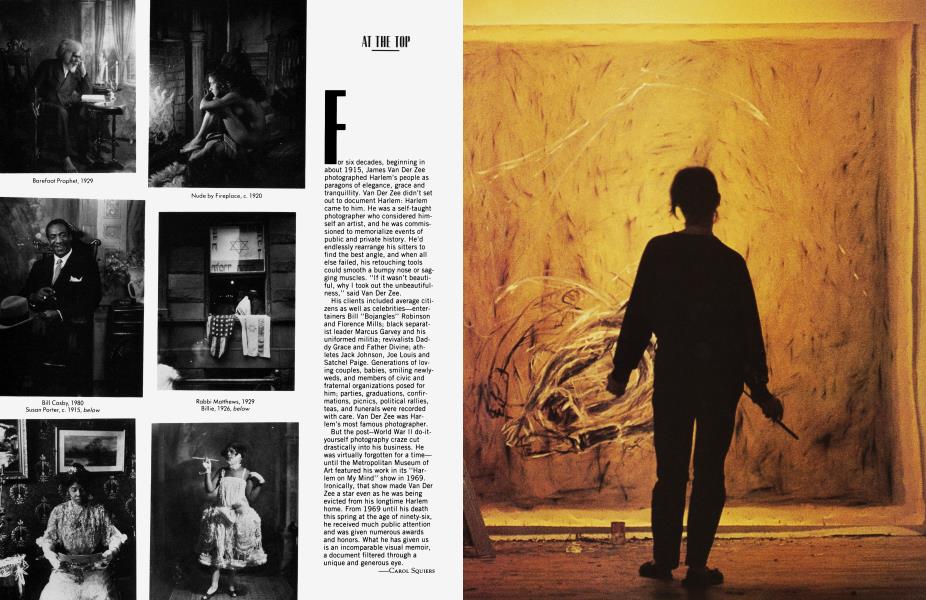
I painted three huge horse paintings especially for the 112 Greene Street space, the biggest I've ever done—nine and a half feet high by as much as twenty-three feet long. Over the years, I've heard so much about that show from people. My crowd at the time was mildly puzzled but supportive. The size of the paintings seemed to block out the crucial question of "Why a horse?" Maybe people mistook size for seriousness. Later, with five-by-seven and six-by-eight-foot sizes, the image became more visible because I was better able to control the paint and geometry.
When my Willard show opened, there was a positive two-paragraph review by Hilton Kramer in the New York Times. The show sold out, and I thought it was luck. But my show the next year—horses again—sold out too. All my shows have.
I never think about being a "success," but the sales and attention had consequences. I didn't lose friends, but I withdrew because I am as uncomfortable with praise as with criticism. I'm easily swayed by anyone with an opinion. My studio gets more private as years go by.
George and I separated in 1978 and got a divorce the next year. My work changed a lot about that time. I never wanted to paint the same painting twenty times with minor variations. Each painting has to have a different formal idea. At first I made it harder for the image to exist—with thicker, blacker, more forceful geometric elements, like a big X through the horse. I changed from sienna to black and white. For me, color seemed frivolous, decorative. It is a distraction from what concerns me: image, density of image, composition, interaction of subject matter, urgency.
The paintings in my third show took the horse apart. There was one called Cherry Pit with an upsidedown horse leg with a horse head jammed inside it like something caught in a throat. I was beginning to realize that the horses were selfportraits. I remember once telling my father I like animals better than people. He was horrified.
An important work for me in 1978 was an eight-foot-high painting of a nine-inch-high teddy bear. Talking about it might give an idea of how I work. The horses were dying out. I had lost my train of thought and fallen in a hole. The bear was a beautiful brown plush teddy bear that I had a feeling about, and I held it in my hand while I painted. I painted the bear image, then I put a big black circle around it, shortening two limbs to fit in the circle and changing the whole integration of the image and ground. The point is that by letting the formal element take over, having it modify the image rather than the other way around, I made it not be just a pretty bear picture. The changes brought about by the circle made it serious. Also, doing the painting in red and black made it serious. Red and black are hellish, devil colors, about wanting the painting to have a lot of heat. I seem to paint one red-and-black painting every one or two years.
About that time I felt that in my work I had nothing to do, nowhere to go, nothing was happening. I made a lot of little crayon drawings of heads and hands. I was thinking that all I have is a head and a hand to paint with, and eyes in my head. (You don't need a nose and mouth for painting, and you really only need one eye.) That's the justification I gave myself for those images, which carried over into big paintings. Some of the hands became fists superimposed on the faces—outlines of fists, which interested me because you think of fists as masses.
What I got out of those head-andhand paintings was different from the meaning of the images. It was about the atmosphere of the surfaces, the "weather." After that I left acrylics and tempera and went back to oil paint. Using oils has been like learning to paint all over again. My work used to be based on the figure/ground problem: advancing the ground, carving into it, and so on. Now that has changed into what I call "weather." The ground is no longer a ground. I spent last summer on Long Island, so the weather there, and the boats and swans I saw every day, got into the paintings.
Painters with direct importance to my work are Still and Giotto and El Greco and Munch and Mondrian. But now I'm also looking a lot at Monet. My art is about not taking anything for granted in this world. It is about how things aren't. In particular, they aren't what they seem. If you distrust appearances, you can reinvent things however you want. Of course, if I only distrusted and disbelieved, I couldn't have painted. I just had to know that painting isn't about the way things look. In terms of art history, I remember a terrific work by Robert Morris in the late '60s, a box that filled a whole room. It literally squashed you against the wall if you wanted to enter the room. It was like being forced out of participation with art. After something like that, you can only react, forcing your way back in.
Today is an anniversary. One year ago today I attended my first Alcoholics Anonymous meeting and quit drinking. Yes, "success" probably had something to do with the drinking—disbelieving people, getting more isolated. Moving from my ratty old West Broadway loft into this new one exacerbated the problem. Not
too many bad things happened, and no one thought I was a drunk. But every night I drank until I couldn't read the book in my hands because I was seeing double.
I don't paint my story, because I can't stand my story. I hated going to a psychiatrist, which I did for a while, for this reason. But some paintings begin with an experience. The painting called Overcoat, with a figure either putting on or taking off a coat, is about a specific man in my life and the question "Is he going to stay or go?"
My work has gotten stranger as the formalism has dropped away. A lot of people see it as very, very creepy. People think my paintings are lonely, almost sentimental, romantic, but real. Some people may pass through their lives without moments when they can identify with my work, but I don't think many do. What do I intend? To get to the heart of the matter. I want to catch one moment of one thing. It has to be simple.
I identify the content of my work strongly with spirituality, with a universal religious impulse. Paintings are a little like prayer, like sending up prayers: like with a Tibetan prayer wheel or wishing on a star. You know my black painting of a snowman with its head getting knocked off? I associate that with kind of bowing one's head in prayer, to bring one's head closer to one's heart. Though of course it's funny too.
Subscribers have complete access to the archive.
Sign In Not a Subscriber?Join Now

