Sign In to Your Account
Subscribers have complete access to the archive.
Sign In Not a Subscriber?Join NowTHE NUVLEAR JITTERS
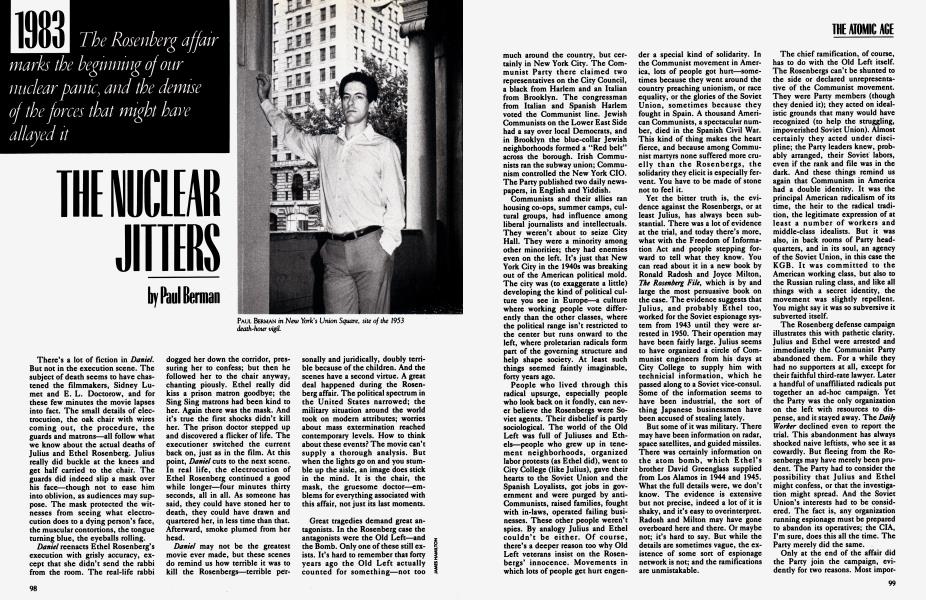
1983 The Rosenberg affair marks the beginnig of our nuclear panic, and the demise of the forces that might have allayed it
Paul Berman
There’s a lot of fiction in Daniel. But not in the execution scene. The subject of death seems to have chastened the filmmakers, Sidney Lumet and E. L. Doctorow, and for these few minutes the movie lapses into fact. The small details of electrocution, the oak chair with wires coming out, the procedure, the guards and matrons—all follow what we know about the actual deaths of Julius and Ethel Rosenberg. Julius really did buckle at the knees and get half carried to the chair. The guards did indeed slip a mask over his face—though not to ease him into oblivion, as audiences may suppose. The mask protected the witnesses from seeing what electrocution does to a dying person’s face, the muscular contortions, the tongue turning blue, the eyeballs rolling.
Daniel reenacts Ethel Rosenberg’s execution with grisly accuracy, except that she didn’t send the rabbi from the room. The real-life rabbi dogged her down the corridor, pressuring her to confess; but then he followed her to the chair anyway, chanting piously. Ethel really did kiss a prison matron goodbye; the Sing Sing matrons had been kind to her. Again there was the mask. And it’s true the first shocks didn’t kill her. The prison doctor stepped up and discovered a flicker of life. The executioner switched the current back on, just as in the film. At this point, Daniel cuts to the next scene. In real life, the electrocution of Ethel Rosenberg continued a good while longer—four minutes thirty seconds, all in all. As someone has said, they could have stoned her to death, they could have drawn and quartered her, in less time than that. Afterward, smoke plumed from her head.
Daniel may not be the greatest movie ever made, but these scenes do remind us how terrible it was to kill the Rosenbergs—terrible personally and juridically, doubly terrible because of the children. And the scenes have a second virtue. A great deal happened during the Rosenberg affair. The political spectrum in the United States narrowed; the military situation around the world took on modern attributes; worries about mass extermination reached contemporary levels. How to think about these events? The movie can’t supply a thorough analysis. But when the lights go on and you stumble up the aisle, an image does stick in the mind. It is the chair, the mask, the gruesome doctor—emblems for everything associated with this affair, not just its last moments.
Great tragedies demand great antagonists. In the Rosenberg case the antagonists were the Old Left—and the Bomb. Only one of these still exists. It’s hard to remember that forty years ago the Old Left actually counted for something—not too much around the country, but certainly in New York City. The Communist Party there claimed two representatives on the City Council, a black from Harlem and an Italian from Brooklyn. The congressman from Italian and Spanish Harlem voted the Communist line. Jewish Communists on the Lower East Side had a say over local Democrats, and in Brooklyn the blue-collar Jewish neighborhoods formed a “Red belt” across the borough. Irish Communists ran the subway union; Communism controlled the New York CIO. The Party published two daily newspapers, in English and Yiddish.
Communists and their allies ran housing co-ops, summer camps, cultural groups, had influence among liberal journalists and intellectuals. They weren’t about to seize City Hall. They were a minority among other minorities; they had enemies even on the left. It’s just that New York City in the 1940s was breaking out of the American political mold. The city was (to exaggerate a little) developing the kind of political culture you see in Europe—a culture where working people vote differently than the other classes, where the political range isn’t restricted to the center but runs onward to the left, where proletarian radicals form part of the governing structure and help shape society. At least such things seemed faintly imaginable, forty years ago.
People who lived through this radical upsurge, especially people who look back on it fondly, can never believe the Rosenbergs were Soviet agents. Their disbelief is partly sociological. The world of the Old Left was full of Juliuses and Ethels—people who grew up in tenement neighborhoods, organized labor protests (as Ethel did), went to City College (like Julius), gave their hearts to the Soviet Union and the Spanish Loyalists, got jobs in government and were purged by anticommunists, raised families, fought with in-laws, operated failing businesses. These other people weren’t spies. By analogy Julius and Ethel couldn’t be either. Of course, there’s a deeper reason too why Old Left veterans insist on the Rosenbergs’ innocence. Movements in which lots of people get hurt engender a special kind of solidarity. In the Communist movement in America, lots of people got hurt—sometimes because they went around the country preaching unionism, or race equality, or the glories of the Soviet Union, sometimes because they fought in Spain. A thousand American Communists, a spectacular number, died in the Spanish Civil War. This kind of thing makes the heart fierce, and because among Communist martyrs none suffered more cruelly than the Rosenbergs, the solidarity they elicit is especially fervent. You have to be made of stone not to feel it.
Yet the bitter truth is, the evidence against the Rosenbergs, or at least Julius, has always been substantial. There was a lot of evidence at the trial, and today there’s more, what with the Freedom of Information Act and people stepping forward to tell what they know. You can read about it in a new book by Ronald Radosh and Joyce Milton, The Rosenberg File, which is by and large the most persuasive book on the case. The evidence suggests that Julius, and probably Ethel too, worked for the Soviet espionage system from 1943 until they were arrested in 1950. Their operation may have been fairly large. Julius seems to have organized a circle of Communist engineers from his days at City College to supply him with technicial information, which he passed along to a Soviet vice-consul. Some of the information seems to have been industrial, the sort of thing Japanese businessmen have been accused of stealing lately.
But some of it was military. There may have been information on radar, space satellites, and guided missiles. There was certainly information on the atom bomb, which Ethel’s brother David Greenglass supplied from Los Alamos in 1944 and 1945. What the full details were, we don’t know. The evidence is extensive but not precise, indeed a lot of it is shaky, and it’s easy to overinterpret. Radosh and Milton may have gone overboard here and there. Or maybe not; it’s hard to say. But while the details are sometimes vague, the existence of some sort of espionage network is not; and the ramifications are unmistakable.
The chief ramification, of course, has to do with the Old Left itself. The Rosenbergs can’t be shunted to the side or declared unrepresentative of the Communist movement. They were Party members (though they denied it); they acted on idealistic grounds that many would have recognized (to help the struggling, impoverished Soviet Union). Almost certainly they acted under discipline; the Party leaders knew, probably arranged, their Soviet labors, even if the rank and file was in the dark. And these things remind us again that Communism in America had a double identity. It was the principal American radicalism of its time, the heir to the radical tradition, the legitimate expression of at least a number of workers and middle-class idealists. But it was also, in back rooms of Party headquarters, and in its soul, an agency of the Soviet Union, in this case the KGB. It was committed to the American working class, but also to the Russian ruling class, and like all things with a secret identity, the movement was slightly repellent. You might say it was so subversive it subverted itself.
The Rosenberg defense campaign illustrates this with pathetic clarity. Julius and Ethel were arrested and immediately the Communist Party abandoned them. For a while they had no supporters at all, except for their faithful third-rate lawyer. Later a handful of unaffiliated radicals put together an ad-hoc campaign. Yet the Party was the only organization on the left with resources to dispense, and it stayed away. The Daily Worker declined even to report the trial. This abandonment has always shocked naive leftists, who see it as cowardly. But fleeing from the Rosenbergs may have merely been prudent. The Party had to consider the possibility that Julius and Ethel might confess, or that the investigation might spread. And the Soviet Union’s interests had to be considered. The fact is, any organization running espionage must be prepared to abandon its operatives; the CIA, I’m sure, does this all the time. The Party merely did the same.
Only at the end of the affair did the Party join the campaign, evidently for two reasons. Most important was the Rosenbergs’ strength. Julius and Ethel showed they were made of steel and would never confess. At the same time a minor crisis broke out in the international movement. The Slansky trial took place in Communist Czechoslovakia. Eleven out-of-favor Communist leaders, eight of them Jews, were executed on charges of Zionism and other capital offenses in what was unmistakably a bigoted purge. The Slansky purge put Communism in a very bad light; Communism was conducting anti-Semitic frame-ups. The Rosenberg case, as Radosh and Milton notice, offered a chance to point a finger in a different direction. Within a few days of the Slansky executions, Communist parties around the world, including our own Party, joined the Rosenberg defense campaign, arguing that here, in America, was the real anti-Semitic frame-up, and there, in Eastern Europe, was proper justice.
The campaign was not attractive. People who followed the trial in the papers could see very well it wasn’t anti-Semitic (though it had every other kind of problem). But this was what the Party offered as a rallying point.
There were other false notes; the Rosenbergs themselves were a false note. Obviously they could never admit to their identity as underground Communists and Soviet agents. But what else could they pretend to be? For three years they improvised like mad, without ever coming up with something persuasive. They were apolitical businessman and housewife. Then they were superpolitical fighters for peace and justice. They were radical democrats, defenders of the American Revolution, the Declaration of Independence, the Bill of Rights. You can read certain of their letters and come away thinking they were martyrs for the ACLU. (Except that the real ACLU, in the person of the famous co-counsel Morris Ernst, was unspeakably vile in this affair and tried to infiltrate the Rosenberg defense as an agent of J. Edgar Hoover’s!)
Let us acknowledge that the Rosenbergs were heroic. You see it in the letters to their little boys—heartbreaking letters, marvels of self-possession and enlightened advice. Not once during their three-year agony did the Rosenbergs do anything weak or questionable, flirt with informing, for instance. If Julius’s knees buckled at the end, that was the only buckling they ever did. You have to admire them; many people always have. Their personal strength was one reason a large movement rose on their behalf.
But political movements must depend on more than personal strength, and here the Old Left, in gearing up to defend the Rosenbergs, ran into trouble. Movements need some kind of inspiring philosophy. What, by the early 1950s, could the Old Left claim as its own ideals, values, and philosophy— aside from “Save the Rosenbergs” and “We Are Innocent”? It was impossible to say. The movement drowned in its own anomalies. It was against anti-Semitic frame-ups in the United States—and for them in Eastern Europe. It was for democratic liberties and the Bill of Rights—except in countries where its own comrades came to power. For trade unions here—but not there. Ultimately it stood for the Soviet Union, and even this was a secret.
Something more than the Rosenbergs died in 1953. Working-class socialism had a long history in America. It began in the 1870s with the rise of modern industry. It went through numerous phases—the Haymarket anarchists, the Socialist Party, the IWW, the industrial unionists and anti-fascists of the ’30s and ’40s. Over the years it fought for workers’ rights, for free speech, for antimilitarism (with some lapses), for the right to oppose the American mainstream. It accomplished many things, but its last phase was dominated by the Communist Party, and this was a disaster. By the 1950s the movement was a walking corpse. The people who worked for the Rosenbergs, who wrote letters and attended picnics and rallies, who marched at the White House and gathered in protest at Sing Sing, the thousands who went to Union Square on execution night, sobbing and waiting with dread for 8 P.M.these people were the movement’s last hurrah. Then it was all over. With a little prodding from Joe McCarthy and the FBI, the long tradition of American proletarianism closed the coffin lid and lowered itself into the ground. All industrial countries have a working-class socialist movement today, except the United States.
The Bomb, however—the other antagonist in the case—survived its association with the Rosenbergs very well.
How much did David Greenglass’s information, forwarded by Julius to the Soviet vice-consul (it seems), mean to the Russians? Controversy on this question is no longer intense. Some knowledgeable people insist that the Rosenberg material had no significance at all. Others argue it might have aided the Soviet atomic program a little bit, mainly by confirming the really important spy information, which came from the Anglo-German physicist Klaus Fuchs. No one thinks any longer that the material was crucial. It may be that no one ever thought this, no one who knew about nuclear weapons. The crudest of the documents released under the Freedom of Information Act shows that in private the director of the Manhattan Project never did think the Rosenbergs had done much harm. He only said so in public for political reasons, and because he believed the Rosenbergs should be killed.
So the real meaning of the Rosenberg espionage wasn’t technical but political. Let us recall the political history of the Bomb. From 1945 to 1949 the United States enjoyed a monopoly of nuclear weapons, and the monopoly gave rise to the earliest and most primitive of nuclear doctrines. This was the idea that Abombs were the key to world domination. Bombs conferred omnipotence. With plutonium weapons in our planes, and none in the Soviets’, we could force the Soviet Union to curb its ambitions, refrain from invading neighbors, restrain its allies. Or we’d do to them what we did to Japan.
This was a dreadful theory, and the more you think about it, the more alarming it seems. A-bombs looked too much like gunboats in this theory. Sooner or later we’d have to dispatch some of these gunboats, just to show our bluster was for real. The doctrine seems practically a formula for future Hiroshimas. Yet its actual effect was quite different. Primitive bomb doctrine calmed us down. Monopoly and the promise of omnipotence assured us we had nothing to worry about. There was, of course, plenty of talk about nuclear war and dropping bombs here, there, everywhere. But we weren’t sufficiently disturbed to make actual preparations, not extensive ones anyway. It’s astonishing to recall that the Truman administration in the ’40s didn’t bother getting up mass production of these bombs. A handful seemed enough. In this sense the modern nuclear age hadn’t really begun. We still lived in the age of relative nuclear calm.
Yet the bitter truth is, the evidence against the Rosenbergs has always been substantial"
The real danger in the ideology of nuclear monopoly was what would happen when the monopoly ended. Having believed ourselves omnipotent before, we would surely feel on the verge of annihilation afterward. Believing we could control the Soviets before, we would surely think them uncontrollable after. We would panic. This is precisely what happened. The Soviet Union exploded a Nagasaki-type bomb in August 1949—the bomb that was blamed on the Rosenbergs, who were arrested within the year. And panic was instantaneous. A Red Scare, certainly. But also a Bomb Scare.
You can see the panic in Judge Irving Kaufman’s handling of the case, above all his handling of the sentencing decision. There was by no means a consensus on executing the Rosenbergs. The Supreme Court majority affirmed the guilty verdict but pointedly declined to affirm the sentence. Even the Justice Department took an ambiguous position. We know from the FBI files that capital punishment for Julius,, and especially for Ethel, was originally sought as a “lever”—the department’s word—on Julius to confess and inform. The direct evidence against Ethel was minimal (and quite dubious, as Radosh and Milton have discovered). Ultimately the department lost heart about executing her. Hoover himself initially thought it was wrong to kill a mother. He favored executing the Rosenbergs’ codefendant, Morton Sobell, instead, though the evidence against Sobell wasn’t much either.
Kaufman, however, was in the grip of the primitive Bomb doctrine. He was convinced the Rosenbergs had brought the nuclear monopoly to an untimely end, and saw this as one of the worst things that had ever been done, “worse than murder.” For by ending the monopoly, the Rosenbergs had destroyed American omnipotence and unleashed our previously cowed enemies to wreak death and destruction all over the world. The Rosenbergs had “caused,” in Judge Kaufman’s opinion, “the Communist aggression in Korea”—the Korean War. They were responsible for 50,000 casualties. Some day the Russians might attack us directly, which would make the Rosenbergs responsible for millions of casualties. The mounds of corpses in Kaufman’s imagination made electrocution inevitable, no matter what Hoover and Justice might recommend. Sobell, on the other hand, was never accused of anything atomic, and Kaufman gave him thirty years.
No aspect of the Rosenberg affair has come in for more criticism or ridicule than these lines about the Korean War, along with the judge’s throwaway remark about atheism— “the Russian ideology of denial of God”—which also figured in the sentencing decision. The Rosenbergs didn’t, after all, cause the Korean War. The judge must really have been beside himself. His panic was so great he made a false statement in the sentencing speech. He said he didn’t consult with the Justice Department, when, as FBI and other government files show, he consulted with Justice both on his own and by courier. He also discussed the sentence with the prosecutors during the trial, which, as Radosh and Milton say, was a violation of judicial standards. I’m told none of this was an indictable offense. But the judge must certainly have cringed when Congress passed the Freedom of Information Act.
Let it be said in the judge’s defense that his hysteria didn’t depart from the atmosphere of the times. The Bomb doctrine—therefore the panic—was widely accepted, indeed was regarded as political acumen. Eisenhower himself thought the Rosenbergs bore some responsibility for the Korean War. Nor was Kaufman’s double death sentence a particularly extreme response, not compared with what now began to happen militarily. For at this point the modern nuclear age began in earnest. Even as the Rosenberg affair unfolded, the H-bomb advanced toward production, the atomic arsenal started to expand substantially, construction of bomb shelters began, the preparations for actual war were made. The authentic nuclear jitters had begun.
It’s extremely depressing to contemplate the Rosenberg affair. Too many grim historical portents gathered around these people and their case. The Rosenberg affair marked the start of the nuclear arms race. Simultaneously it marked the end of the old-time working-class radicalism. The rise of the modern tinderbox—and the collapse of one of the traditional forces in society that might have put up opposition, might have braked in some degree the awful progress we have made. Nor was the trial a shining beacon of due process. In the face of what seemed at the time a nuclear crisis, this particular nicety went out the window. It is impossible to say anything good about the affair. The botched electrocution stands for the entirety. Every single aspect boded ill.
For more on the Rosenbergs —►
Subscribers have complete access to the archive.
Sign In Not a Subscriber?Join Now


