

Sign In to Your Account
Subscribers have complete access to the archive.
Sign In Not a Subscriber?Join NowRecalling Covarrubias
Al Hirschfeld
MEMOIR
OCTOBER
ARTS FAIR
Classic caricatures. Revamped Rockefeller. Revalued Tomlin. Heller's chutzpah. A Roosevelt in love. Art is all. All is fair.
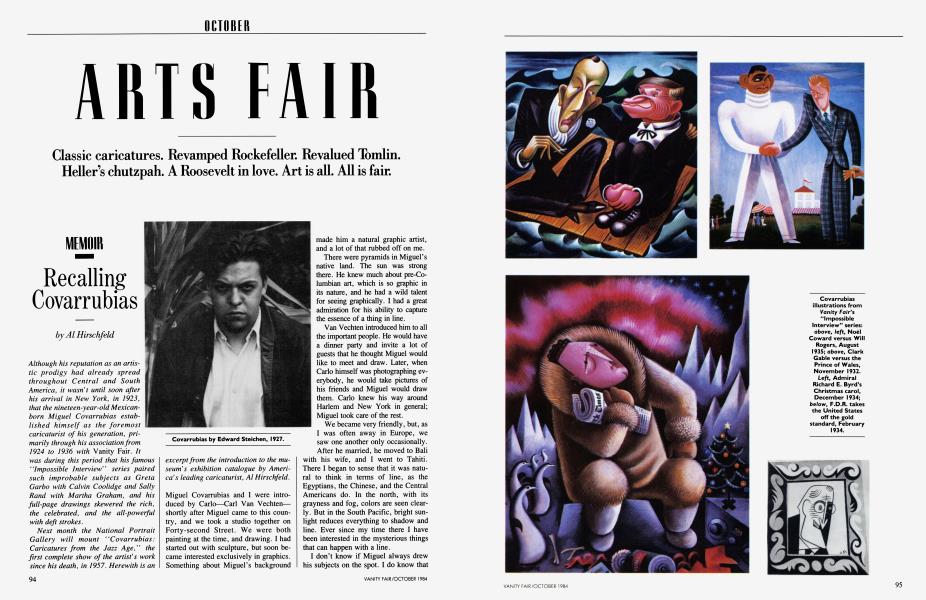
Although his reputation as an artistic prodigy had already spread throughout Central and South America, it wasn't until soon after his arrival in New York, in 1923, that the nineteen-year-old Mexicanborn Miguel Covarrubias established himself as the foremost caricaturist of his generation, primarily through his association from 1924 to 1936 with Vanity Fair. It was during this period that his famous "Impossible Interview'' series paired such improbable subjects as Greta Garbo with Calvin Coolidge and Sally Rand with Martha Graham, and his full-page drawings skewered the rich, the celebrated, and the all-powerful with deft strokes.
Next month the National Portrait Gallery will mount "Covarrubias: Caricatures from the Jazz Age,'' the first complete show of the artist's work since his death, in 1957. Herewith is an excerpt from the introduction to the museum's exhibition catalogue by America's leading caricaturist, Al Hirschfeld.
Miguel Covarrubias and I were introduced by Carlo—Carl Van Vechten— shortly after Miguel came to this country, and we took a studio together on Forty-second Street. We were both painting at the time, and drawing. I had started out with sculpture, but soon became interested exclusively in graphics. Something about Miguel's background made him a natural graphic artist, and a lot of that rubbed off on me.
There were pyramids in Miguel's native land. The sun was strong there. He knew much about pre-Columbian art, which is so graphic in its nature, and he had a wild talent for seeing graphically. I had a great admiration for his ability to capture the essence of a thing in line.
Van Vechten introduced him to all the important people. He would have a dinner party and invite a lot of guests that he thought Miguel would like to meet and draw. Later, when Carlo himself was photographing everybody, he would take pictures of his friends and Miguel would draw them. Carlo knew his way around Harlem and New York in general; Miguel took care of the rest.
We became very friendly, but, as I was often away in Europe, we saw one another only occasionally. After he married, he moved to Bali with his wife, and I went to Tahiti. There I began to sense that it was natural to think in terms of line, as the Egyptians, the Chinese, and the Central Americans do. In the north, with its grayness and fog, colors are seen clearly. But in the South Pacific, bright sunlight reduces everything to shadow and line. Ever since my time there I have been interested in the mysterious things that can happen with a line.
I don't know if Miguel always drew his subjects on the spot. I do know that he used to doodle a lot, and sketch on tablecloths and menus in restaurants, but he didn't spend a lot of time in front of his subjects. He was too restless for that. I introduced him to Chaplin, and I saw what happened there.
I first met Chaplin when I did some drawings for the Pathe film company. Later, when I had moved from Tahiti to Miguel's little house on Bali, Chaplin came through with his half-brother, Sydney, and they stayed with me. Back in New York, Chaplin, Covarrubias, and I met for a drink someplace on Fifty-second Street—I think it was "21." After fifteen minutes, Miguel had to leave—he had an "appointment" somewhere. Sheer nervous energy!
He had to be everywhere; he could never spend an evening just sitting down. You would be with him for half an hour and he would say, "Let's go down to the Village," or "Let's go up to Fifty-second Street," or "Let's go to Eddie's"—where we'd be until two or three o'clock in the morning. He had terrific energy and an insatiable appetite for life. What he saw, he interpreted, and when he was given an assignment, he observed the person and distilled the personality into his own kind of line.
Covarrubias was one of the artists responsible for making people think seriously about caricature. A lot of others have been cartoonists and have dealt with literary ideas, as Hogarth did, or Daumier. Daumier as well had a great gift for caricature—for revealing character with line. There is something almost religious in the pure magic of a line capturing a human character. There are symbols, of course, that are generally understood even in primitive art; certain gestures always express certain things. How this is accomplished I will never understand, any more than I can explain Miguel's talent. I can only see some of its roots. He was a very sweet fellow, incredibly fluent as an artist. He also became quite a serious anthropologist, and I doubt whether any scholar, even one who had spent his whole life with his subject, could have done better than Miguel in the field. Most of all, he loved the excitement of New York. He couldn't get enough of seeing people. The man was full of energy. He was a young man. We all were.
Subscribers have complete access to the archive.
Sign In Not a Subscriber?Join Now

