Sign In to Your Account
Subscribers have complete access to the archive.
Sign In Not a Subscriber?Join NowStuds on Studs
Bill Zehme
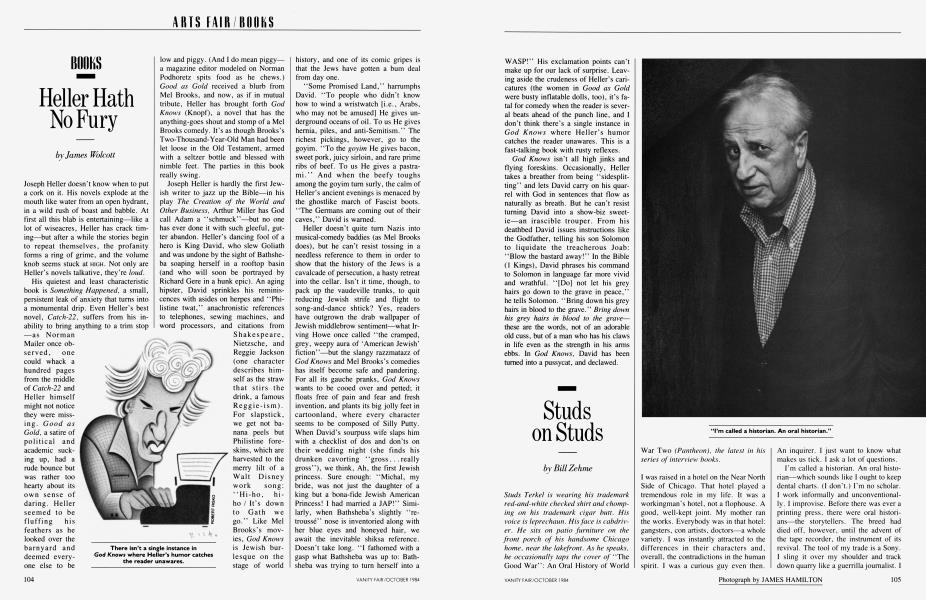
Studs Terkel is wearing his trademark red-and-white checked shirt and chomping on his trademark cigar butt. His voice is leprechaun. His face is cabdriver. He sits on patio furniture on the front porch of his handsome Chicago home, near the lakefront. As he speaks, he occasionally taps the cover of "The Good War": An Oral History of World War Two (Pantheon), the latest in his series of interview books.
I was raised in a hotel on the Near North Side of Chicago. That hotel played a tremendous role in my life. It was a workingman's hotel, not a flophouse. A good, well-kept joint. My mother ran the works. Everybody was in that hotel: gangsters, con artists, doctors—a whole variety. I was instantly attracted to the differences in their characters and, overall, the contradictions in the human spirit. I was a curious guy even then. An inquirer. I just want to know what makes us tick. 1 ask a lot of questions.
I'm called a historian. An oral historian—which sounds like I ought to keep dental charts. (I don't.) I'm no scholar. 1 work informally and unconventionally. I improvise. Before there was ever a printing press, there were oral historians—the storytellers. The breed had died off, however, until the advent of the tape recorder, the instrument of its revival. The tool of my trade is a Sony. I sling it over my shoulder and track down quarry like a guerrilla journalist. I get to know my terrain and those who inhabit it. In doing books about the Depression [Hard Times] or World War II, I'm always fighting one enemy: time. The clock. The calendar. Because the ranks of eyewitnesses are thinning.
See, I think most history books are cheats. They tell us the stories of the big shots—the kings, generals, and industrialists. But what was it like for the anonymous ones, the millions whose sinew and blood were there all the time, who endured and participated in events? We hear talk of how the Pharaohs built the pyramids of Egypt. Well, the Pharaohs didn't lift a damn finger. The pyramids were built by thousands of anonymous slaves who couldn't afford press agents.
And so it was with World War II. There had been scores of books about it. But what was the war like for those who fought it, who lived through it? I wanted to hear their stories. They were all pimply-faced kids at the time, but they remember every minute, every detail, like it was yesterday. You see, that war was a high moment, one of terror and exhilaration. Unlike Korea and the obscene adventure in Vietnam, it was a war with some justification to it: to stop Hitler and the Holocaust. The dissenters were few. Enthusiasm for it was overwhelming. In that sense, it became known as "the Good War,'' which I've made the title of the new book. I leave the quotation marks intact, however, because the noun and the adjective don't fit.
My own war experience was negligible. I had a perforated eardrum and did limited service Stateside. I was drafted in August 1942, when I was thirty, and got out a year later. Then I applied for the Red Cross, but was turned down and blacklisted. I always had a habit of signing petitions, you see. The McCarthyites caught up with me later—but that's another story. Nevertheless, I'd gotten through the basic training with all the twenty-year-old punks. I was an elder statesman of the barracks, along with a crooked ex-bailiff from New Orleans. Together we told stories and tried to make the kids happy. In the end, they got some civics lessons they would never get in school.
At first, a lot of people think they have nothing to say when I show up. It never occurs to them that they could be heroes of a book. But what I've found in doing all my books is that people do want to talk about a moment in their lives, on one condition: they must sense I'm interested. To feel needed is very important. In the early days, I screwed up a lot with the tape recorder. I'm not great technically. I can't drive a car. So the person I'd be interviewing would notice that my machine wasn't running. They'd start laughing and realize that I'm kind of goofy. A heartening realization.
Often the people who have never been interviewed before will stop me and say, "Play that back for me. . .1 want to hear my voice.'' And as you play it back that person says, "My God, I never knew I felt that way before!'' This has happened several times, and it is the most extraordinary experience I know. To be present at those revelatory moments is pretty goddamned exciting. I feel like a fellow passenger. And that, I suppose, is exactly what I am.
Subscribers have complete access to the archive.
Sign In Not a Subscriber?Join Now
