Sign In to Your Account
Subscribers have complete access to the archive.
Sign In Not a Subscriber?Join NowEudora, So Do We
Eudora Welty blushes on her seventy-fifth birthday
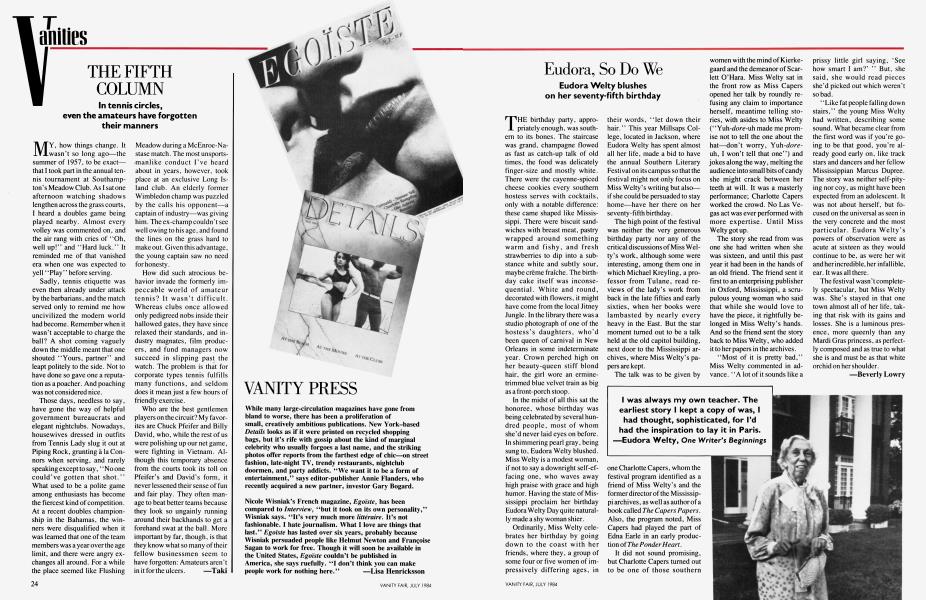
THE birthday party, appropriately enough, was southern to its bones. The staircase was grand, champagne flowed as fast as catch-up talk of old times, the food was delicately finger-size and mostly white. There were the cayenne-spiced cheese cookies every southern hostess serves with cocktails, only with a notable difference: these came shaped like Mississippi. There were biscuit sandwiches with breast meat, pastry wrapped around something warm and fishy, and fresh strawberries to dip into a substance white and subtly sour, maybe creme fraiche. The birthday cake itself was inconsequential. White and round, decorated with flowers, it might have come from the local Jitney Jungle. In the library there was a studio photograph of one of the hostess's daughters, who'd been queen of carnival in New Orleans in some indeterminate year. Crown perched high on her beauty-queen stiff blond hair, the girl wore an erminetrimmed blue velvet train as big as a front-porch stoop.
In the midst of all this sat the honoree, whose birthday was being celebrated by several hundred people, most of whom she'd never laid eyes on before. In shimmering pearl gray, being sung to, Eudora Welty blushed. Miss Welty is a modest woman, if not to say a downright self-effacing one, who waves away high praise with grace and high humor. Having the state of Mississippi proclaim her birthday Eudora Welty Day quite naturally made a shy woman shier.
Ordinarily, Miss Welty celebrates her birthday by going down to the coast with her friends, where they, a group of some four or five women of impressively differing ages, in
their words, "let down their hair." This year Millsaps College, located in Jackson, where Eudora Welty has spent almost all her life, made a bid to have the annual Southern Literary Festival on its campus so that the festival might not only focus on Miss Welty's writing but also— if she could be persuaded to stay home—have her there on her seventy-fifth birthday.
The high point of the festival was neither the very generous birthday party nor any of the critical discussions of Miss Welty's work, although some were interesting, among them one in which Michael Kreyling, a professor from Tulane, read reviews of the lady's work from back in the late fifties and early sixties, when her books were lambasted by nearly every heavy in the East. But the star moment turned out to be a talk held at the old capitol building, next door to the Mississippi archives, where Miss Welty's papers are kept.
The talk was to be given by one Charlotte Capers, whom the festival program identified as a friend of Miss Welty's and the former director of the Mississippi archives, as well as author of a book called The Capers Papers. Also, the program noted, Miss Capers had played the part of Edna Earle in an early production of The Ponder Heart.
It did not sound promising, but Charlotte Capers turned out to be one of those southern women with the mind of Kierkegaard and the demeanor of Scarlett O'Hara. Miss Welty sat in the front row as Miss Capers opened her talk by roundly refusing any claim to importance herself, meantime telling stories, with asides to Miss Welty (' ' Yulw/ore-uh made me promise not to tell the one about the hat—don't worry, Yuh-doreuh, I won't tell that one") and jokes along the way, melting the audience into small bits of candy she might crack between her teeth at will. It was a masterly performance; Charlotte Capers worked the crowd. No Las Vegas act was ever performed with more expertise. Until Miss Welty got up.
The story she read from was one she had written when she was sixteen, and until this past year it had been in the hands of an old friend. The friend sent it first to an enterprising publisher in Oxford, Mississippi, a scrupulous young woman who said that while she would love to have the piece, it rightfully belonged in Miss Welty's hands. And so the friend sent the story back to Miss Welty, who added it to her papers in the archives.
"Most of it is pretty bad," Miss Welty commented in advance. "A lot of it sounds like a prissy little girl saying, 'See how smart I am?' " But, she said, she would read pieces she'd picked out which weren't so bad.
"Like fat people falling down stairs," the young Miss Welty had written, describing some sound. What became clear from the first word was if you're going to be that good, you're already good early on, like track stars and dancers and her fellow Mississippian Marcus Dupree. The story was neither self-pitying nor coy, as might have been expected from an adolescent. It was not about herself, but focused on the universal as seen in the very concrete and the most particular. Eudora Welty's powers of observation were as acute at sixteen as they would continue to be, as were her wit and her incredible, her infallible, ear. It was all there.
The festival wasn't completely spectacular, but Miss Welty was. She's stayed in that one town almost all of her life, taking that risk with its gains and losses. She is a luminous presence, more queenly than any Mardi Gras princess, as perfectly composed and as true to what she is and must be as that white orchid on her shoulder.
Beverly Lowry
I was always my own teacher. The earliest story I kept a copy of was, I had thought, sophisticated, for I'd had the inspiration to lay it in Paris. —Eudora Welty, One Writer's Beginnings
Subscribers have complete access to the archive.
Sign In Not a Subscriber?Join Now