
Sign In to Your Account
Subscribers have complete access to the archive.
Sign In Not a Subscriber?Join NowUncourtly LOVE
This summer, the National Gallery of Art, Washington, D.C., marks Watteau's tercentenary with the first major exhibition of his paintings and drawings. ANITA BROOKNER looks at one rustic romp and sees the fashionable French coupling at a fete champêtre
ANITA BROOKNER
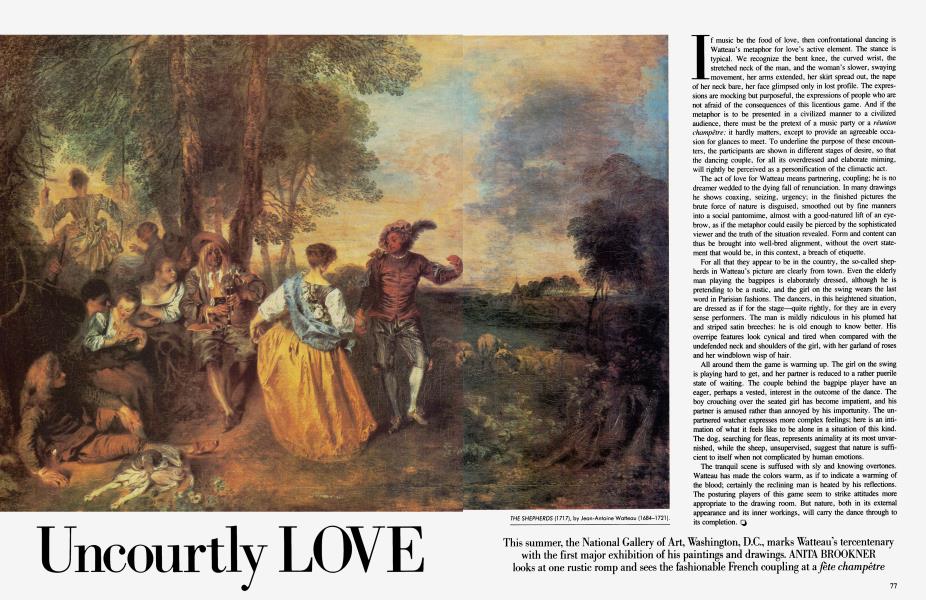
If music be the food of love, then confrontational dancing is Watteau's metaphor for love's active element. The stance is typical. We recognize the bent knee, the curved wrist, the stretched neck of the man, and the woman's slower, swaying movement, her arms extended, her skirt spread out, the nape of her neck bare, her face glimpsed only in lost profile. The expressions are mocking but purposeful, the expressions of people who are not afraid of the consequences of this licentious game. And if the metaphor is to be presented in a civilized manner to a civilized audience, there must be the pretext of a music party or a reunion champetre: it hardly matters, except to provide an agreeable occasion for glances to meet. To underline the purpose of these encounters, the participants are shown in different stages of desire, so that the dancing couple, for all its overdressed and elaborate miming, will rightly be perceived as a personification of the climactic act.
The act of love for Watteau means partnering, coupling; he is no dreamer wedded to the dying fall of renunciation. In many drawings he shows coaxing, seizing, urgency; in the finished pictures the brute force of nature is disguised, smoothed out by fine manners into a social pantomime, almost with a good-natured lift of an eyebrow, as if the metaphor could easily be pierced by the sophisticated viewer and the truth of the situation revealed. Form and content can thus be brought into well-bred alignment, without the overt statement that would be, in this context, a breach of etiquette.
For all that they appear to be in the country, the so-called shepherds in Watteau's picture are clearly from town. Even the elderly man playing the bagpipes is elaborately dressed, although he is pretending to be a rustic, and the girl on the swing wears the last word in Parisian fashions. The dancers, in this heightened situation, are dressed as if for the stage—quite rightly, for they are in every sense performers. The man is mildly ridiculous in his plumed hat and striped satin breeches: he is old enough to know better. His overripe features look cynical and tired when compared with the undefended neck and shoulders of the girl, with her garland of roses and her windblown wisp of hair.
All around them the game is warming up. The girl on the swing is playing hard to get, and her partner is reduced to a rather puerile state of waiting. The couple behind the bagpipe player have an eager, perhaps a vested, interest in the outcome of the dance. The boy crouching over the seated girl has become impatient, and his partner is amused rather than annoyed by his importunity. The unpartnered watcher expresses more complex feelings; here is an intimation of what it feels like to be alone in a situation of this kind. The dog, searching for fleas, represents animality at its most unvarnished, while the sheep, unsupervised, suggest that nature is sufficient to itself when not complicated by human emotions.
The tranquil scene is suffused with sly and knowing overtones. Watteau has made the colors warm, as if to indicate a warming of the blood; certainly the reclining man is heated by his reflections. The posturing players of this game seem to strike attitudes more appropriate to the drawing room. But nature, both in its external appearance and its inner workings, will carry the dance through to its completion.

Subscribers have complete access to the archive.
Sign In Not a Subscriber?Join Now
