



Sign In to Your Account
Subscribers have complete access to the archive.
Sign In Not a Subscriber?Join NowTHE OP-ED SET
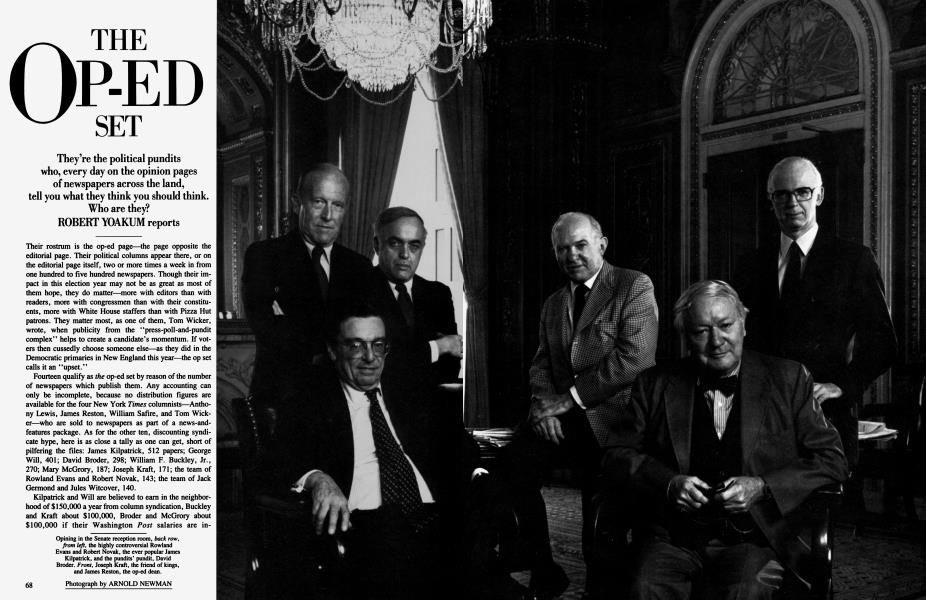
They’re the political pundits who, every day on the opinion pages of newspapers across the land, tell you what they think you should think. Who are they? ROBERT YOAKUM reports
Their rostrum is the op-ed page—the page opposite the editorial page. Their political columns appear there, or on the editorial page itself, two or more times a week in from one hundred to five hundred newspapers. Though their impact in this election year may not be as great as most of them hope, they do matter—more with editors than with readers, more with congressmen than with their constituents, more with White House staffers than with Pizza Hut patrons. They matter most, as one of them, Tom Wicker, wrote, when publicity from the “press-poll-and-pundit complex” helps to create a candidate’s momentum. If voters then cussedly choose someone else—as they did in the Democratic primaries in New England this year—the op set calls it an “upset.”
Fourteen qualify as the op-ed set by reason of the number of newspapers which publish them. Any accounting can only be incomplete, because no distribution figures are available for the four New York Times columnists—Anthony Lewis, James Reston, William Safire, and Tom Wicker—who are sold to newspapers as part of a news-andfeatures package. As for the other ten, discounting syndicate hype, here is as close a tally as one can get, short of pilfering the files: James Kilpatrick, 512 papers; George Will, 401; David Broder, 298; William F. Buckley, Jr., 270; Mary McGrory, 187; Joseph Kraft, 171; the team of Rowland Evans and Robert Novak, 143; the team of Jack Germond and Jules Witcover, 140.
Kilpatrick and Will are believed to earn in the neighborhood of $150,000 a year from column syndication, Buckley and Kraft about $100,000, Broder and McGrory about $100,000 if their Washington Post salaries are ineluded. Some of the pundits more than double their column income with lecture fees and TV appearances.
As categorized by their colleagues, the conservatives predominate, with six: Buckley, Evans and Novak, Kilpatrick, Safire, and Will. Five are seen as in the middle: Broder, Germond and Witcover, Kraft, and Reston. Only three— Lewis, McGrory, and Wicker—are perceived as unwavering liberals.
Which one pulls the most weight in Congress? In an unscientific survey, I asked senators and representatives which three or four carried the most clout—realizing, of course, that the Washington audience is most influenced by the Washington Post. David Broder came in first, with 58 votes, 7 ahead of George Will. The rest followed in this order: Reston, 23; McGrory, 21; Evans and Novak, 19; Kraft, 16; Germond and Witcover, 15; Safire and Wicker, 13 each; Kilpatrick, 10; Buckley, 8; and Lewis, 5.
George Will refused to take the compliment. “On a list of one hundred things that determine a congressman’s behavior, I’d bet that the most influential columnist comes in about eightythird, right below sunspots.’’
But most of Will’s colleagues disagreed with him. In fact, what the op-ed boys think about one another proved every bit as intriguing as what they think about everything else.
JAMES J. KILPATRICK
Pixieish is a word often used to describe the best-selling of the columnists, sixtythree-year-old James Kilpatrick, who is also known as Jack and Kilpo. Once a regular on the D.C. social circuit, Kilpatrick now leads a quiet life with his wife, Marie, in Rappahannock County, Virginia. Following triple-bypass surgery last year, Kilpatrick is down to a little tennis and gardening for recreation. But when the courtly country gentleman becomes irritated by some “liberal nonsense,” off come the glasses and away flies the amiability.
Over the years critics have charged that he was soft on certain scalawags with whom he shared right-wing dogmas—Senators Thomas J. Dodd and Joseph McCarthy, for example, who were censured even by their peers. He backed Nixon until August 1974. He also championed Clement Haynsworth and, worse, G. Harrold Carswell when Nixon wanted them on the Supreme Court. He was a leader of massive resistance to school integration, and there were unsavory racist overtones to his 1957 book, The Sovereign States.
Although Kilpatrick’s attitudes have changed over the decades, some people refuse to forgive. One columnist said he couldn’t even be a fair judge of Kilpatrick’s work: “I have a bad thing about him. I hold him sort of personally responsible for giving intellectual respectability to institutional racism in the fifties, when he was the father of interposition and all those other insane doctrines like massive resistance.”
George Will likes him. “He’s a Jeffersonian, Virginia, small-government, free-market, classic conservative. I’m a Hamiltonian conservative. He’s a Whig and I’m a Tory, which makes it fun.”
Kilpatrick is rated high for independence and style, even by some of his critics. “Kilpo is an amiable fake,” said one columnist. “I don’t think he does any work, any reporting. He spins the stuff out, and he’s so good at it, and he writes so well, and there’s such a market for that crap, that he’s widely used. They’re honest opinions. I don’t think he’s putting us on.”
Broder, an admirer, said: “He’s about as independent on issues and personalities as anyone I know.... And a marvelous writer. I envy the way his copy reads.”
Kilpatrick has written a new book on English usage which William Buckley calls “absolutely first-rate,” adding, “I’m a fan from every point of view.”
The most frequent complaint made by Kilpatrick critics is that he is out of touch. “He’s not really part of the flow of events,” said Hodding Carter, columnist and chief correspondent for the PBS program Inside Story. Robert Healy, the Boston Globe’s Washington-bureau chief: “He’s still read out in the heartlands by conservative people, but his influence is declining. He doesn’t get around. He wouldn’t know a piece of news today if he fell over it.”
Jules Witcover: “He’s an entertaining writer who doesn’t seem to talk to the news sources the rest of us do, and sees through a very narrow prism of his own outmoded ideology.”
DAVID BRODER
David Broder and George Will may vie for top honors among congressmen, but in the opinion of fellow journalists Broder is a nonpareil. Given that added clout, he is the most influential columnist in Washington.
“The first thing that strikes you about Dave,” said a friend, “is his posture. Six feet tall, and so erect he looks as though he has a broomstick up his ass. Then you notice that little smile, behind which is a very gentle man. Most guys in our business wouldn’t give a damn if they left nine bodies behind them, but Dave really cares about people. You wonder how he got so far. ’ ’
Broder, fifty-four, and his bright, articulate wife, Ann, who’s involved in local politics in Arlington, Virginia, have four sons. Broder stays in shape by hiking, jogging, and playing tennis— terribly, according to him.
Why do Broder’s words carry so much weight? Mainly because he is trusted as a fair reporter. “Broder,” says Kilpatrick, “has been everywhere, covered every campaign, has an incredible memory for events, dates, people, and political workings. He’s the best there is.”
Broder thinks of himself as a reporter. “In terms of time, effort, income, I am a political reporter for the Washington Post. The column was historically a shirttail to that work and represents less than 10 percent of the time I put in on my job. Twice a week I try to step back from reporting to write a column.”
Most people I interviewed see Broder as too much of a reporter, and too wedded to the political process, to proselytize for any candidate, party, or ideology. I asked Broder whether a canny reader could tell how he stood in presidential elections. “Yes. In the last week of the last two campaigns, but not before that, I tried to draw up a kind of balance sheet.” Those election-eve columns contained dispassionate assessments of each candidate, then a final paragraph that tilted ever so slightly toward Carter over Ford in 1976 and toward Carter over Reagan in 1980. The idea of Broder as nonpartisan is reinforced, ironically, by columnists from left and right who see him differently. William Buckley thinks he has moved to the left—a reflection, perhaps, of some Broder columns expressing impatience with President Reagan. “One of the enduring myths of American journalism is that Dave Broder is impartial,” says Buckley. “In the past months I’ve seen columns by him that were as partisan as anybody’s.”
But Hodding Carter sees Broder as “basically a centrist who is, in a funny way, a conservative. He really longs for the old days, when the party elders established the rules and picked the candidates. That process, in Dave’s mind, picked more qualified leaders than those chosen by the congeries of special-interest groups in the age of television.”
George Will says, “David is a force of nature. When he says something, it’s apt to be self-fulfilling. Someone with that kind of power has to be decorous, as he is.”
ROWLAND EVANS AND ROBERT NOVAK
Evans and Novak have attracted more controversy than any of the other twelve. This public dissonance is matched by personal disparity. They have been dubbed the Odd Couple, Batman and Robin, and, in an unproduced Watergate musical, Whiffenpoof and Six-pack. Evans, sixtythree, is aristocratic, suave, and trim. Along with the Buckleys and the Krafts, Rowley and Kay Evans—she’s editor of the influential Washington Journalism Review—are the most social of the op-ed set. Novak, fifty-three, is dark, brooding, and unkempt. He and his wife, Geraldine, live in the unfashionable Maryland suburb of Rockville.
The press is looked upon with such cynicism by the public these days that probably few readers note, and fewer resent, columns in which E&N serve as drumbeaters for friends. But the practice is a source of bitterness among some fellow journalists, who charge the columnists with lavishing praise on hard-nosed right-wingers and good sources. It’s not unprecedented to swap flattery in print for leaks over drinks, but E&N have carried it further than many journalists are comfortable with.
Thomas Griffith, in his Time-magazine “Newswatch” column, dissected an Evans and Novak piece that he said “deserves to be studied in journalism schools [as the work of] columnists who air their opinions in the guise of reporting.” Then, after summarizing the column in question, Griffith said: “The language... is as clumsy as the innuendoes are nasty. Cheap shot more suitably describes this kind of journalism.”
In 1981, during the early weeks of the Reagan administration, the Wall Street Journal ran a front-page story that made a similar accusation. Evans and Novak’s first choice for Treasury secretary had been William Simon, whose politics make most conservatives look like flaming liberals, but Simon’s abrasiveness lost him the job. E&N then touted New York businessman Lewis Lehrman, an ardent supply-sider for whom they had long been tub-thumping. When Lehrman wasn’t named, E&N pushed him for the number-two Treasury job. He didn’t get that, so they recommended him as chairman of the President’s Council of Economic Advisers. He didn’t get that. E&N then plugged him for council membership. When that didn’t come to pass, the irate columnists apparently went to Martin Anderson, Reagan’s domestic-affairs adviser, who told a colleague that the administration was under “tremendous pressure” to put Lehrman on the C.E.A. “Pressure from where?” the colleague asked. “Evans and Novak,” Anderson answered.
Some columnists who dislike what E&N write nevertheless praise them for their enterprise (“no one does more legwork... good, industrious, readable”) and consider them friends. Friendship counts for a lot in Washington. One critic of the team observed, “It’s really one of the wonders of Washington that, because of the social acceptability of the two of them, people simply let Evans and Novak get away with more than they possibly could otherwise.”
JOSEPH KRAFT
As former editor and publisher William Attwood and I sat waiting for takeoff in the Kennedy press plane somewhere in Texas during the 1960 campaign, we saw Joe Kraft, who was also on John F. Kennedy’s speech-writing team, gallop over to the “mother plane”—the one that carried Kennedy, Ted Sorensen, Pierre Salinger, and the other powers. One of us said, “Joe’s going to go far if he doesn’t have a coronary first.’’ The coronary came four years later; a second, eleven years after that. Kraft, fiftynine, must have been bom running.
What the op-ed boys think about one another proves every bit as intriguing as what they think about everything else.
He was thirty-five and unmarried when he met the wealthy divorcee Polly Stevens in 1959. He once said of his wife, who is now a successful painter, “She was everything I wasn’t. Warm, loving, enthusiastic, sparkling.’’ Kraft is aware that words like pompous and pretentious are more commonly applied to him.
“Joe saw himself as the successor to Walter Lippmann,” says Robert Healy. “I don’t know what happened to Joe, because he’s a goddamned fine reporter. If you read some of the stuff he did from abroad in The New Yorker, he’s as good as they come. But the columns don’t always tell you very much.”
Kraft maintains his self-assurance despite columns in which he called the publication of the Pentagon Papers “the nonevent of the year,” regularly praised John Connally, urged readers to vote for Nixon over Humphrey, hailed the nomination of William Rehnquist to the Supreme Court, expressed doubt that Ford could win big in Michigan in 1976 (Ford beat Reagan by a two-to-one margin), and publicly praised Wilbur Mills (friend of ecdysiast Fanne Foxe) to the point, some say, where Mills decided to run for the presidency.
He is regarded as suspect on domestic politics but as a force in foreign policy. “He’s the weather vane for whoever the foreign-policy establishment happens to be,” said one columnist. Jack Germond attributed to him “a lot of influence” on foreign policy—and zero on domestic. “He works hard and I give him credit, but he doesn’t have any street sense.”
Kraft works at the highest levels, where there is a tough trade-off at home or abroad. If you’re going to use Henry Kissinger as a regular source, as some columnists do, you have to make sure the relationship is a symbiotic one. Should you savage him for screwing up Chile, for example, it wouldn’t be reasonable to expect him to furnish leaks from the next commission he heads. Every journalist makes trade-offs, however, and though sometimes Kraft’s are painfully obvious, they are not more compromising of truth or ethics than those made routinely by Washington correspondents from the hinterlands who butter up or protect the senators from their state so as to be handed occasional scoops.
Reporting in such a rarefied atmosphere carries with it a problem beyond the inherent disadvantages of symbiosis: Joe Kraft isn’t alone among the columnists in his willingness to launch generalizations about the public mind, nor is he the only one in a peculiarly bad position from which to do so. Journalists like Kraft, who either don’t have time or don’t care to take the time to mix with the masses, lose touch with them.
They may also easily fall victim to hubris. “Joe really is incredible,” one columnist told me. “He expects that when he appears trumpets are supposed to be playing and the red carpet ready. ... If the king doesn’t invite him to tea, or if the prime minister doesn’t send his Cadillac for him, he’s mortally offended.” This colleague went on to say what most of the others echoed—that Kraft “redeems himself by writing an occasional thoughtful piece for The New Yorker, where he actually engages his brain for a little while. That’s the Kraft that was supposed to be the inheritor of Lippmann’s mantle, as opposed to being simply the inheritor of Lippmann’s place at the dinner parties.”
ANTHONY LEWIS
I asked Anthony Lewis how I should describe him. “Call me middle-aged and balding,” he said. The fifty-seven-year-old Lewis, who has been based in New York, Washington, and London for the New York Times, now lives in Cambridge, where he attended Harvard—he was managing editor of the Crimson—and which he finds more amenable and stimulating than any other American city. Lewis is divorced (the only other of the fourteen to have been divorced is Wicker). He fills his nonworking hours with music, theater, good food, and the company of his fiancee, an attractive lawyer named Margaret Marshall.
(Continued on page 116)
(Continued from page 73)
“Tony never seems to rest,” says a friend. Lewis paces while generating thoughts for his column or notes for his class on law and the press at Harvard Law School. Then he attacks his manual typewriter, making it perform like a machine gun.
Lewis won the first of his two Pulitzer Prizes at twenty-eight for articles on the federal loyalty-security program. Justice Felix Frankfurter said of Lewis’s Supreme Court coverage, “There are not two members of the Court itself who could get the gist of each decision so accurately in so few words.”
If Buckley is the lightning rod for attacks from the left, Lewis is the main recipient of thunderbolts from the right. It would be difficult to decide which attacks on Lewis were the most acid, those made when he went to report from North Vietnam in 1972 or those that have rained on him because of his censure of the Begin and Shamir governments in Israel.
Like Kraft, Lewis regularly interviews chiefs of state and foreign ministers, but he appears indifferent to red carpets and Cadillacs. And, more than any other of the columnists who write from abroad, he actually visits villages, not just V.I.P.’s. He goes to Europe and the Middle East every year, and to Africa every other year. Most of his columns, however, deal with law and politics in the United States.
Though thought by many to be the most liberal of the widely syndicated columnists, Lewis isn’t considered by the conservative pundits to be even as far left as, say, a social democrat in Europe. His conservative colleagues most often fault him for being too didactic. Buckley is the sternest: “Tony Lewis is shrewd in avenues he explores, and he makes interesting analytical inroads, but his dyspeptic passion has lost him considerable effectiveness. Sometimes, two-thirds of the way through, I wonder whether I’m going to finish.”
But others find his didacticism stimulating. George Will: “I like reading Tony. I like the high-octane error. No damned nonsense about tepidness there. We don’t often come out in the same place—we have a big difference on the •Middle East, for example—but he takes seriously what I take seriously.”
Jules Witcover: “He goes to the heart of problems as well as anybody. And he’s very influential.” Robert Novak, who disagrees with Lewis “on almost everything except the Middle East,” told me that Lewis produced “by far the best liberal column in the country.”
GEORGE WILL
“I do not produce grade-B columns,” George Will once said. “I write in longhand, and I work until I get it right. It was Auden, I think, who said a poem is never finished, it’s abandoned. But I don’t abandon columns. I finish them.”
The forty-three-year-old Will exercises by strolling while listening to taperecorded books on his Walkman, and he considers it a “fast, abusive month” if he dines out as much as twice. On television Will appears scrubbed, thinlipped, precise, and intimidating. He is as capable of nincompoopery as the next oped columnist, but his stem appearance persuades us that he must be making sense even when he isn’t. The other side of him—seen by his wife, Madeleine, an assistant secretary of education, their three children, and a few friends—is described by Neil Grauer in his book Wits & Sages: “Will is, behind his small, impassive Gioconda-like grin, a person with the rare talent to feel the insecurity, fear, and distress of others.”
ABC News announced in June that Will had signed on as a regular on its evening news program. As a result, he’s dropping Agronsky & Company but not This Week with David Brinkley or the occasional appearance on Nightline. Even before the ABC announcement, Robert Novak said, “George is unquestionably the biggest man since Lippmann, mainly because of his television omnipresence. The column is fine, the Newsweek thing is fine, but, boy, what makes him a big deal is that he’s on the bloody tube all the time.”
Novak went on to say that Will is “very, very unpopular in the press corps. In the first place, he’s not a reporter. George is a superb writer, but he didn’t earn his way up, which is very important to people in my business. And he doesn’t run with the media or belong to press organizations.”
Another reason for Will’s unpopularity with the press corps has to do with an episode of what someone called “hobnobbery journalism,” and with Will’s failure, initially, to admit all the facts: Several journalists were invited to help prepare Ronald Reagan for his debate with President Carter late in the 1980 campaign. Some declined, including William Safire, but Will accepted. Then, on the night of the debate, viewers of ABC’s Nightline—who knew nothing of Will’s role in assisting Reagan—saw him give Reagan what a Wall Street Journal article called “a rave review.” The outcry against Will increased when it was later learned that he had, during the debate rehearsals, seen the briefing papers prepared for President Carter and purloined for Reagan’s use. Will feels that the barrage of criticism directed at him—his column was dropped by the New York Daily News and seven other papers—was unfair.
Apart from questions of elitism and journalistic ethics, how do press people feel about Will and his work?
Most of those I interviewed thought he was an excellent writer. One columnist said, “When he came on the scene, he did definitely bring a cultivation and scholarship to conservative writing that had been lacking. Nobody could ever call Jack Kilpatrick a scholar. And Buckley is completely eccentric and personalized.”
Buckley says, “I think George is terrific. Passionate, erudite. I think he cultivates a crotchet or two to separate himself from the more identified conservatives in America.” Example? “He likes to say we’re undertaxed.”
WILLIAM SAFIRE
Back in the late 1940s and early 1950s William Attwood, then a foreign correspondent in Europe, was occasionally a guest on the Tex and Jinx show, where a very deferential young man named William Safire, he recalls, “would see to it that I was comfortable, bring coffee, make sure I had a chair under my ass when I sat down. I’m not so sure the chair would be there now.”
The brashest of the fourteen columnists, Safire was also the least forthcoming about himself. He did reveal, sotto voce, that his home in suburban Chevy Chase houses, in addition to his wife, Helene, and two children, a pair of dogs—a golden retriever, Rufus, and a German shepherd, Henry, named after Kissinger. For exercise, he said, “I walk them, sometimes fast.”
Safire, who is now fifty-four, honed his talents as a public-relations man (he claims credit for arranging the “kitchen debate” between Nixon and Khrushchev to publicize a client’s appliance display), a political flack, and finally as a speech writer for Spiro Agnew and Richard Nixon. Some people would devote the rest of their days to self-flagellation in an effort to be absolved of all that. Safire, though, was not only proud of his career but wove his op-ed nest on the New York Times out of the sassy, sarcastic, gimmicky prose that had made him so successful. He even advises columnists: “Create your own ‘constituency of the infuriated’ at the outset... .The most successful column is one that causes the reader to throw down the paper in a peak of fit.”
That’s the fifth of the “Ten Commandments of columny,” in which Safire provided advice to people seeking a formula for a hot newspaper column. It showed Safire at his best—pitching a mixture of puns, acerbic observations, dandy images, and sound advice.
The ninth commandment: “Carry a big schtick. Every column must have its special characteristic: Evans and Novak’s secret meetings, Reston’s long view, Will’s quotations, Kilpatrick’s fulminations, McGrory’s heavenward eye-rollings, Safire’s italicized enumerations, Buckley’s self-mocking rodomontade. A reader should be able to identify a column without its byline or funny little picture on top—purely by look or feel, or its turgidity ratio.”
It would be overdoing it to say that Safire remains as indifferent to facts as when he sold Ex-Lax, Good Humor, Roy Cohn, Agnew, and Nixon, but his chutzpah is of such Brobdingnagian dimensions that he turns back charges of inaccuracy with “Sure, sometimes I’m careless and sloppy,” and then goes on to quote Walt Whitman’s “Song of Myself”: “Do I contradict myself? Very well then I contradict myself.” Safire has the astonishing ability to make people who worry about facts feel like fussbudgets.
He has a couple of obsessions—Israel and Nixon. “I’m fascinated,” said Mary McGrory, “by Safire’s mission to prove that every president is just as rotten as Richard Nixon.”
“I like Safire a great deal,” said one of the columnists with whom he shares the Times op-ed page, praising him for concern over First Amendment issues. “But I do think he’s a slavish supporter of Israel, and, despite all the good investigative work he’s done, he tends to use innuendo and a kind of sly suggestion that he can’t really back up.”
Ben Bradlee, the Washington Post’s executive editor, put it more strongly: “He’s mean. He’s a master of the cheap shot, and he automatically impugns the motives of everybody he thinks is against him.”
But most of Safire’s fellow columnists expressed admiration for his increasing professionalism. Thomas Winship, editor of the Boston Globe, best summed up the elements that made admirers out of onetime antagonists: “Safire knows the art of column writing as well as anybody. He knows how to fool people_He’s got surprise, change of pace, style, and humor.”
JACK GERMOND AND JULES WITCOVER
Two of the brightest, wittiest men in Washington teamed up in 1977 to write a column called “Politics Today.” Jack Germond was a luminary at the now defunct Washington Star. He was joined by Washington Post reporter Jules Witcover, who is as tall and slim as Germond is short and rotund. Germond, fifty-six, has a deep laugh. Witcover, fifty-seven, has a wry smile that is supposed to let people know, one friend says, “that he’s from Union City, New Jersey, and that the Columbia University degree is so much bullshit.”
Germond-Witcover and Evans-Novak all agree that they have been “good friends” for many years, yet E&N look on G&W as “quite liberal, or at least more liberal than their reputation as hard-bitten political junkies without ideology.” And G&W feel that over the years E&N have become “increasingly hard-line and ideological.” But though Germond and Witcover often question Evans and Novak’s tactics as well as their sermonizing, their praise for one another is clearly heartfelt and reflects the admiration of one highly skilled middle-aged team for another.
“Politics Today” is well thought of in Washington. But how did Germond and Witcover, who are the only columnists among the fourteen not to have a New York Times or Washington Post outlet, do so well when I polled congressmen and newspaper editors about columnists’ influence? Because they are remembered for their reporting on the Star. Because of their columns in the National Journal and The Washingtonian. Because some people read them in the Baltimore Evening Sun. Because both appear on TV news shows, although only Germond is seen regularly (on The McLaughlin Group).
Then there is the friendship factor. Few of the boys on the campaign bus are more respected or better-liked by their peers. That kind of personal esteem translates into influence. Here’s Broder on the subject: “Germond and Witcover are buddies. They are two of the best goddamned reporters in the world. You’ve got to worry about what they know that you don’t know.’’
MARY McGRORY
When asked for their views of Mary McGrory’s work, many of her fellow columnists began, “I love Mary, but..
Robert Healy: “Mary has become more influential since she moved from the Star to the Post. She’s best when out doing the legwork. She has a facility for drawing people out like I’ve never seen in our business. She gives someone that little-old-lady, I-can’t-quitehear-you routine, and then she’s got the guy’s balls on the floor.”
Nearly everyone admires her style. Kilpatrick says: “Mary’s one of the best writers around. She gets my adrenals pumping, but in a way different from Tony Lewis. Every now and then she comes across with a beautiful phrase, and she has a way of throwing in offbeat pieces about her birds or her garden or whatever the hell she wants to write about. She’s a very astute observer.”
“Mary’s at her best,” said a buddy from the bus, “when she’s got something to shoot at. When she’s got some situation she can really loathe and write about. She was never better than when she was writing about the Vietnam War. And I admire her tremendously for all the legwork. Every day she trots around on those skinny little legs and gets the stories. She’ll drive you goddamn bananas because she’s become such a queen. Unless you’ve got half an hour to listen to her, you can’t say hello. But she really does her work.”
Never married, the tireless McGrory, sixty-six, relaxes by filling her apartment with friends for Sunday brunches and dinners. “The only way a conservative can get invited,” said her longtime friend Thomas Winship, “is to have a helpful ability, like playing the piano.”
JAMES RESTON
Press critic A. J. Liebling separated journalists as follows: (1) The reporter, who writes what he sees. (2) The interpretive reporter, who writes what he sees and what he construes to be its meaning. (3) The expert, who writes what he construes to be the meaning of what he hasn’t seen.
James “Scotty” Reston, dean of U.S. columnists, has been all three in his forty-five years at the New York Times, which he joined in London on the eve of World War II. Bom in Scotland, Reston was educated in the U.K. and at the University of Illinois. He and his wife, the former Sarah Jane “Sally” Fulton, have three sons, all of whom have practiced journalism.
Asked about the altered role of the columnist, he said: “When radio took away from the press the job of being the first purveyor of the news, and television took away the great descriptive story, newspapers have had to find another mission. And that mission is to analyze. The reporters are writing columns. In my generation we weren’t allowed to analyze the news, except in the ‘Review of the News’ on Sunday. Now twentythree-year-olds are doing it.”
Reston, at seventy-four, still commands respect from even the most disparate colleagues.
Thomas Winship: “The fashionable thing to say is ‘Scotty’s over the hill. Scotty has gone soft.’ But he still writes as well as anybody. He still writes like a sportswriter. And frequently it’s something that’s really important. A Kennedy or a Carter or a Kissinger will call him and give him a very important story. Of course, once in a while he gets used. We all do. And once in a while he uses them, too.”
William Buckley: “He can give you a feeling of what they were thinking in six or seven capitals last night.”
George Will: “Yes, I read Reston. It’s almost a generational thing. One of his themes is that the old folks ought to go away and let the young people run things. I think the young people ought to go away and let the old folks run it.”
WILLIAM F. BUCKLEY, JR.
“An entertainer who can’t resist writing a column that is iconoclastic and comic. He’s a performer out to shock and surprise. A mischievous wordsmith. He’s too intelligent to really believe what he writes,” says William Attwood of William Buckley.
One columnist put it this way: “Buckley’s a classy dilettante. He’s one of those debaters who can take the pro or the con, depending on which way he’s signed. I’ve debated him a couple of times, and you sense that he’s eager to score points on you. It doesn’t really matter how he scores; he just wants the judges to give him a higher total. I don’t feel there’s any deep conviction.”
Others see Buckley as altogether serious—not in manner, but in having a fixed philosophic compass. He is seen by these people, admirers and critics alike, as the predictable product of his upbringing, as one who, like his siblings, never strays far from the dictates of his conservative Catholic conscience or the comforts that come with inherited wealth. He and his socially ubiquitous wife, Pat, own three abodes: a country house in Stamford and two apartments, one in his native Sharon, Connecticut, the other on the Upper East Side in New York. His office is at the National Review, the conservative magazine he has owned and edited since 1955.
If the fifty-eight-year-old Buckley remains enigmatic, it isn’t because he has refused to let us enter his life. Indeed, two of his twenty-one books, Cruising Speed and Overdrive, are altogether about his life. It wasn’t necessary to ask Buckley, as I did the thirteen others, to describe his working habits. Here is the patrician Pepys on writing a column following a dinner speech in Toledo—a column that will be dictated to New York the next morning before the indefatigable author flies to Louisville to tape one of his Firing Line TV interview programs.
“The feeling, after lecturing, on regaining the occupancy of one’s own room is a delight whose resonances have been insufficiently sung. The sheer relief of silence is a part of the magic.... I disrobe, pour a vodka and grapefruit juice, and, since there is work to do, unzip the typewriter, this without relish.”
Perhaps the only consensus that emerged in interviews about this multifaceted man was that his column is one of the least influential of the lot. Both conservative and liberal colleagues agree on that.
Explanations varied. Thomas Winship said: “Buckley is fun to read, but is not taken seriously by the opinionmakers. Maybe it’s because he’s having so much fun massaging the language.” And another: “Buckley’s got hardening of the arteries. He’s living in the fifties and sixties, and on his past performance. He doesn’t identify with the New Right, which is now basically the dirty-fingemail type. He doesn’t want them on his yacht.”
The column aside, we are reminded by George Will that “Buckley has had a lot of influence as a founder, organizer, and inspiriter of a political movement. Before Reagan there was Goldwater. Before Goldwater there was the National Review. Before the National Review there was Bill Buckley with an idea. I wouldn’t go so far as to say no Buckley, no Reagan, but damn near.”
“Buckley is sui generis,” says Anthony Lewis. “And if you look at all of his activity, not so much the column but everything else, he’s had more influence than the rest of us put together. ’ ’
TOM WICKER
Tom Wicker’s book On Press is dedicated to Pamela Hill, a vice president of ABC News, whom he married in 1974. They live in an East Side Manhattan brownstone and do most of their socializing with TV and print journalists. An amiable bear of a man, the fifty-eightyear-old Wicker integrates southern charm, a fondness for good food and drink, and the intense concern for underdogs that we associate with urban liberals of the North. His soft humor saves him from self-righteousness. No one was spoken of with greater warmth by his peers. But the question of “whether Tom has lost his fastball” was a recurring one.
“I don’t really think he gets out enough,” said Robert Healy. “The guy was the best reporter in Washington. He cares a lot about the press, civil rights, and the downtrodden. He’s a classic populist writer, but to be a populist you’ve got to know what the hell’s going on with the populace.”
Another columnist friend: “Tom is talking to himself.” And another: “I don’t think he’s been as good since he left Washington. Now and then, though, he wakes up if the subject is prisons or the railroads or something else that makes his juices flow.”
Two newspaper editors took the opposite tack. Peter Prichard of USA Today said, “I had gotten tired of Wicker because I thought I knew what he was going to say, but in the last couple of years he’s gotten better again.” Thomas Winship said that Wicker “was in an awful slump three or four years ago, but now he’s come back. Tom is getting livelier.” When I replied that Winship appeared to be going against prevailing opinion, he said, “Oh, I know that. There’s a great time lag in a lot of our views. He’s had that rap on him as being a knee-jerk, but he began to do some legwork and got better.”
A story that Wicker tells about himself characterizes what so many people admire in the man. Back in 1949, when he was twenty-three, he worked for the Sandhill Citizen, in Aberdeen, North Carolina, population 1,603. One day he covered a divorce case that “involved one party futilely chasing the other with an ax. The story plaintively related from the witness stand by the complainant, a worn-out woman with a ZaSu Pitts voice, haggard eyes, and hair just beginning to go gray, was the human comedy at its most ribald and perverse— Moore County transported to Chaucer’s time and The Canterbury Tales.”
People in the courtroom, Wicker said, rocked with laughter. He wrote a humorous account of the case and printed it on page 1. “The next day, I had a visitor: a wom-out looking woman with a ZaSu Pitts voice, but whose once-haggard eyes were blazing....
“ ‘Mr. Wicker,’ she said without preamble, ‘why did you think you had the right to make fun out of me in your paper?’
“I have never forgotten that question—and I still can’t answer it. In 1949 I doubt if I even tried. I remember thinking I had not bargained for such awful moments when I had landed my first reporter’s job a few months before. Accurate though my story had been... it had nevertheless exploited human unhappiness for the amusement or titillation of others. I had made the woman in my office something less than what she was—a human being possessed, despite her misfortunes, of real dignity.
“Seeing that, I saw too that I had not only done her an injury but missed the story I should have written. This is one of the besetting sins of journalism— sensationalism at the expense of the dignity and truth of the common human experience.”
Subscribers have complete access to the archive.
Sign In Not a Subscriber?Join Now


