Sign In to Your Account
Subscribers have complete access to the archive.
Sign In Not a Subscriber?Join NowVintage Point
Vanities
All white now
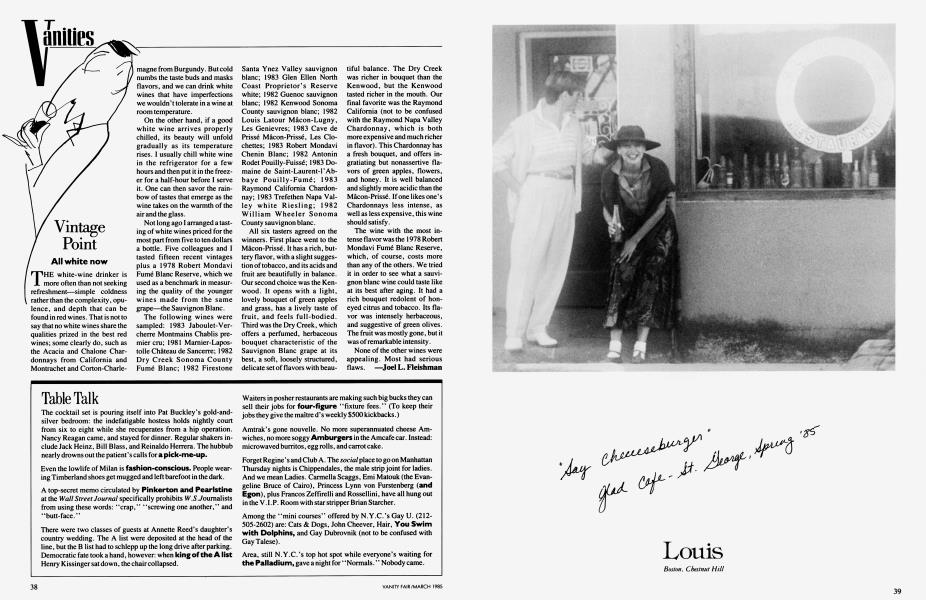
THE white-wine drinker is more often than not seeking refreshment—simple coldness rather than the complexity, opulence, and depth that can be found in red wines. That is not to say that no white wines share the qualities prized in the best red wines; some clearly do, such as the Acacia and Chalone Chardonnays from California and Montrachet and Corton-Charlemagne from Burgundy. But cold numbs the taste buds and masks flavors, and we can drink white wines that have imperfections we wouldn't tolerate in a wine at room temperature.
On the other hand, if a good white wine arrives properly chilled, its beauty will unfold gradually as its temperature rises. I usually chill white wine in the refrigerator for a few hours and then put it in the freezer for a half-hour before I serve it. One can then savor the rainbow of tastes that emerge as the wine takes on the warmth of the air and the glass.
Not long ago I arranged a tasting of white wines priced for the most part from five to ten dollars a bottle. Five colleagues and I tasted fifteen recent vintages plus a 1978 Robert Mondavi Fume Blanc Reserve, which we used as a benchmark in measuring the quality of the younger wines made from the same grape—the Sauvignon Blanc.
The following wines were sampled: 1983 Jaboulet-Vercherre Montmains Chablis premier cru; 1981 Mamier-Lapostolle Chateau de Sancerre; 1982 Dry Creek Sonoma County Fume Blanc; 1982 Firestone Santa Ynez Valley sauvignon blanc; 1983 Glen Ellen North Coast Proprietor's Reserve white; 1982 Guenoc sauvignon blanc; 1982 Kenwood Sonoma County sauvignon blanc; 1982 Louis Latour Macon-Lugny, Les Genievres; 1983 Cave de Prisse Macon-Prisse, Les Clochettes; 1983 Robert Mondavi Chenin Blanc; 1982 Antonin Rodet Pouilly-Fuisse; 1983 Domaine de Saint-Laurent-1'Abbaye Pouilly-Fume; 1983 Raymond California Chardonnay; 1983 Trefethen Napa Valley white Riesling; 1982 William Wheeler Sonoma County sauvignon blanc.
All six tasters agreed on the winners. First place went to the Macon-Prisse. It has a rich, buttery flavor, with a slight suggestion of tobacco, and its acids and fruit are beautifully in balance. Our second choice was the Kenwood. It opens with a light, lovely bouquet of green apples and grass, has a lively taste of fruit, and feels full-bodied. Third was the Dry Creek, which offers a perfumed, herbaceous bouquet characteristic of the Sauvignon Blanc grape at its best, a soft, loosely structured, delicate set of flavors with beautiful balance. The Dry Creek was richer in bouquet than the Kenwood, but the Kenwood tasted richer in the mouth. Our final favorite was the Raymond California (not to be confused with the Raymond Napa Valley Chardonnay, which is both more expensive and much richer in flavor). This Chardonnay has a fresh bouquet, and offers ingratiating but nonassertive flavors of green apples, flowers, and honey. It is well balanced and slightly more acidic than the Macon-Prisse. If one likes one's Chardonnays less intense, as well as less expensive, this wine should satisfy.
The wine with the most intense flavor was the 1978 Robert Mondavi Fume Blanc Reserve, which, of course, costs more than any of the others. We tried it in order to see what a sauvignon blanc wine could taste like at its best after aging. It had a rich bouquet redolent of honeyed citrus and tobacco. Its flavor was intensely herbaceous, and suggestive of green olives. The fruit was mostly gone, but it was of remarkable intensity.
None of the other wines were appealing. Most had serious flaws.
Joel L. Fleishman
Subscribers have complete access to the archive.
Sign In Not a Subscriber?Join Now