




Sign In to Your Account
Subscribers have complete access to the archive.
Sign In Not a Subscriber?Join NowHit Parade
The Vivian Beaumont Theater gets its act together
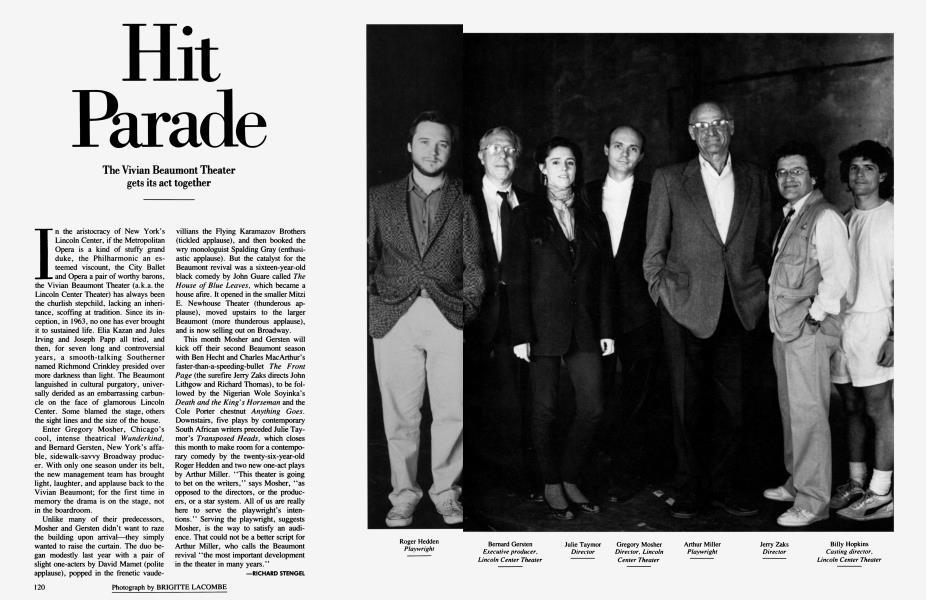
In the aristocracy of New York's Lincoln Center, if the Metropolitan Opera is a kind of stuffy grand duke, the Philharmonic an esteemed viscount, the City Ballet and Opera a pair of worthy barons, the Vivian Beaumont Theater (a.k.a. the Lincoln Center Theater) has always been the churlish stepchild, lacking an inheritance, scoffing at tradition. Since its inception, in 1963, no one has ever brought it to sustained life. Elia Kazan and Jules Irving and Joseph Papp all tried, and then, for seven long and controversial years, a smooth-talking Southerner named Richmond Crinkley presided over more darkness than light. The Beaumont languished in cultural purgatory, universally derided as an embarrassing carbuncle on the face of glamorous Lincoln Center. Some blamed the stage, others the sight lines and the size of the house.
Enter Gregory Mosher, Chicago's cool, intense theatrical Wunderkind, and Bernard Gersten, New York's affable, sidewalk-savvy Broadway producer. With only one season under its belt, the new management team has brought light, laughter, and applause back to the Vivian Beaumont; for the first time in memory the drama is on the stage, not in the boardroom.
Unlike many of their predecessors, Mosher and Gersten didn't want to raze the building upon arrival—they simply wanted to raise the curtain. The duo began modestly last year with a pair of slight one-acters by David Mamet (polite applause), popped in the frenetic vaudevilhans the Flying Karamazov Brothers (tickled applause), and then booked the wry monologuist Spalding Gray (enthusiastic applause). But the catalyst for the Beaumont revival was a sixteen-year-old black comedy by John Guare called The House of Blue Leaves, which became a house afire. It opened in the smaller Mitzi E. Newhouse Theater (thunderous applause), moved upstairs to the larger Beaumont (more thunderous applause), and is now selling out on Broadway.
This month Mosher and Gersten will kick off their second Beaumont season with Ben Hecht and Charles Mac Arthur's faster-than-a-speeding-bullet The Front Page (the surefire Jerry Zaks directs John Lithgow and Richard Thomas), to be followed by the Nigerian Wole Soyinka's Death and the King's Horseman and the Cole Porter chestnut Anything Goes. Downstairs, five plays by contemporary South African writers preceded Julie Taymor's Transposed Heads, which closes this month to make room for a contemporary comedy by the twenty-six-year-old Roger Hedden and two new one-act plays by Arthur Miller. "This theater is going to bet on the writers," says Mosher, "as opposed to the directors, or the producers, or a star system. All of us are really here to serve the playwright's intentions." Serving the playwright, suggests Mosher, is the way to satisfy an audience. That could not be a better script for Arthur Miller, who calls the Beaumont revival "the most important development in the theater in many years."
RICHARD STENGEL
Subscribers have complete access to the archive.
Sign In Not a Subscriber?Join Now
