
Sign In to Your Account
Subscribers have complete access to the archive.
Sign In Not a Subscriber?Join NowVIENNA IN VIRGINIA
In the Blue Ridge Mountains of Virginia, RICHARD MERKIN finds a treasure-house of Viennese style
RICHARD MERKIN
Late in his life, and long after the halcyon days of the Villa America in the South of France, Gerald Murphy (F. Scott Fitzgerald's friend who lived well as the best revenge) summed it up for all to remember. "For me," he said, "only the invented part of life was satisfying, only the unrealistic part."
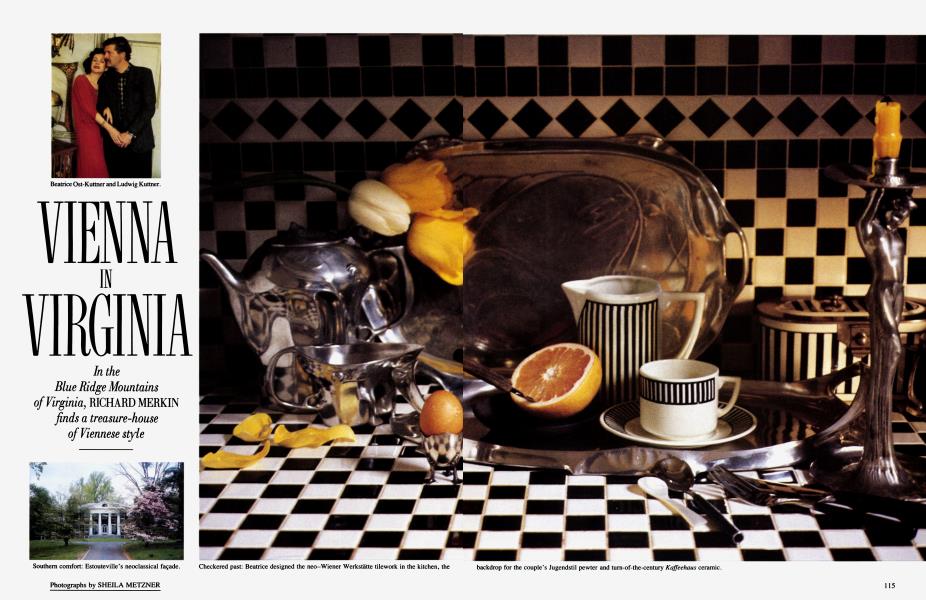
Seventeen miles from Charlottesville, Virginia, in the foothills of the Blue Ridge Mountains and a mere stone's throw from the hallowed halls of Jefferson's Monticello, there is a wonderful place called Estouteville. A historical landmark which dates back to the early nineteenth century (and indeed was built by one of Jefferson's crew), Estouteville is the realm of two transplanted Bavarians named Ludwig Kuttner and Beatrice Ost-Kuttner. The couple purchased it four years ago and have not only revived its past glory but endowed it with a new spirit of wonder and surprise.
Estouteville comprises five hundred acres of lawns and woods and pastures, most of which are guarded by a rambunctious bullterrier named Leopold—a moniker of monarchical association that he does his level best to uphold, despite his unfortunate tendency to get lost in the tall greenery while making his appointed rounds. There is also a functioning farm, replete with horses, cattle, chickens, rabbits, peafowl (a southemAmerican, not Teutonic, curiosity), and the most enormous sow that this traveler has ever seen.
In all, Estouteville is a charmingly eccentric little kingdom. And if the elegant Ludwig is its reigning monarch, Beatrice is its glamorous prime minister and chief philosopher-aesthetician. She is a surrealist painter who studied with Oskar Kokoschka in Salzburg, and her hand and dreams are at work throughout the estate. Beatrice's aesthetic owes its spirit to the style of the Wiener Werkstatte, the Austrian arts-andcrafts movement of Josef Hoffmann and Kolo Moser, which served as one of the bridges between Art Nouveau and the Bauhaus. Estouteville contains many fine examples of this Austrian movement—an off-white table-andchair set with delicate black-and-white upholstery, by Hoffmann; a full set of Jugendstil pewter by Kayserzinn, reposing upon neo-Werkstatte shelving designed (as much in the house is) by Beatrice. And everywhere the blackand-white checkerboard motif—in tile or in tapestry—the continuity in this palace of the serendipitous. Equally ubiquitous are various collections distributed throughout the Roman-revival house: collections of toy elephants and Egyptiana, Venetian Carnival masks and exquisite Viennese bow ties (that rival Gatsby's beloved shirts), Jugendstil vases and Clarice Cliff Deco ceramicware in colors that would confound the Dutch Boy. And bats! Glass bats and metal bats, gold bats and pewter bats, bats to be worn and bats to commune with, creatures of the night so favored by the master and mistress of Estouteville.
If the elegant Ludwig is Estouteville's reigning monarch, Beatrice is its glamorous prime minister and chief philosopher-aesthetician.
Estouteville is the product of an ingenious splice, where delicate frictions result from the collisions of styles.
On the surrounding lawns, Adirondack furniture and antique Italian statuary from Ischia sit side by side. And in the kitchen, itself a cross between American country and Viennese fin de siecle, an eight-foot aquarium houses a bizarre aggregation of denizens from Davy Jones's locker. In a guest room upstairs, a Biedermeier couch from Beatrice's childhood in Munich sits beneath Victorian children's frocks and an Early American crazy quilt that proclaims the motto of Estouteville: "Pleasing Dreams and Slumbers Light."
Like Beatrice's pictures, Estouteville is a dreamscape limned utterly realistically, a nest of Chinese boxes where the joy of surprise is the product of an ingenious and loving splice, where delicate frictions result from the gentle collisions of styles and dreams.
So Estouteville is not far removed from Murphy's Villa America, just a continent. It is a warm and enchanting European presence benevolently functioning in this, the very cradle of American history.
Subscribers have complete access to the archive.
Sign In Not a Subscriber?Join Now


