Sign In to Your Account
Subscribers have complete access to the archive.
Sign In Not a Subscriber?Join NowPhone Call from D.V
DIANA VREELAND
DIANA VREELAND talks tango with Brooks Peters
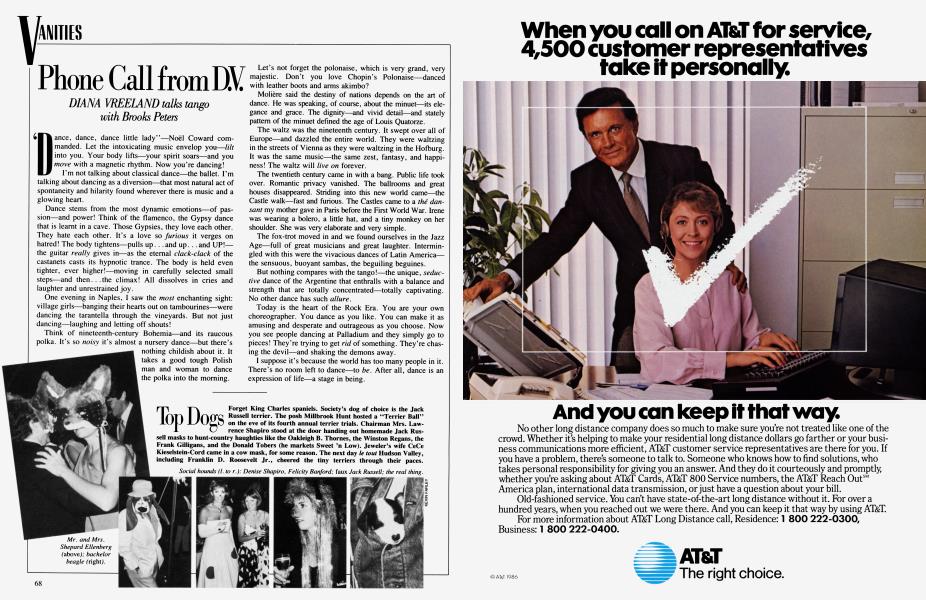
'Dance, dance, dance little lady"—Noel Coward commanded. Let the intoxicating music envelop you—lilt into you. Your body lifts—your spirit soars—and you move with a magnetic rhythm. Now you're dancing! I'm not talking about classical dance—the ballet. I'm talking about dancing as a diversion—that most natural act of spontaneity and hilarity found wherever there is music and a glowing heart.
Dance stems from the most dynamic emotions—of passion—and power! Think of the flamenco, the Gypsy dance that is learnt in a cave. Those Gypsies, they love each other. They hate each other. It's a love so furious it verges on hatred! The body tightens—pulls up. . .and up. . .and UP!— the guitar really gives in—as the eternal clack-clack of the castanets casts its hypnotic trance. The body is held even tighter, ever higher!—moving in carefully selected small steps—and then...the climax! All dissolves in cries and laughter and unrestrained joy.
One evening in Naples, I saw the most enchanting sight: village girls—banging their hearts out on tambourines—were dancing the tarantella through the vineyards. But not just dancing—laughing and letting off shouts!
Think of nineteenth-century Bohemia—and its raucous polka. It's so noisy it's almost a nursery dance—but there's
nothing childish about it. It takes a good tough Polish man and woman to dance the polka into the morning.
Let's not forget the polonaise, which is very grand, very majestic. Don't you love Chopin's Polonaise—danced with leather boots and arms akimbo?
Moliere said the destiny of nations depends on the art of dance. He was speaking, of course, about the minuet—its elegance and grace. The dignity—and vivid detail—and stately pattern of the minuet defined the age of Louis Quatorze.
The waltz was the nineteenth century. It swept over all of Europe—and dazzled the entire world. They were waltzing in the streets of Vienna as they were waltzing in the Hofburg. It was the same music—the same zest, fantasy, and happiness! The waltz will live on forever.
The twentieth century came in with a bang. Public life took over. Romantic privacy vanished. The ballrooms and great houses disappeared. Striding into this new world came—the Castle walk—fast and furious. The Castles came to a the dansant my mother gave in Paris before the First World War. Irene was wearing a bolero, a little hat, and a tiny monkey on her shoulder. She was very elaborate and very simple.
The fox-trot moved in and we found ourselves in the Jazz Age—full of great musicians and great laughter. Intermingled with this were the vivacious dances of Latin America— the sensuous, buoyant sambas, the beguiling beguines.
But nothing compares with the tango!—the unique, seductive dance of the Argentine that enthralls with a balance and strength that are totally concentrated—totally captivating. No other dance has such allure.
Today is the heart of the Rock Era. You are your own choreographer. You dance as you like. You can make it as amusing and desperate and outrageous as you choose. Now you see people dancing at Palladium and they simply go to pieces! They're trying to get rid of something. They're chasing the devil—and shaking the demons away.
I suppose it's because the world has too many people in it. There's no room left to dance—to be. After all, dance is an expression of life—a stage in being.
Subscribers have complete access to the archive.
Sign In Not a Subscriber?Join Now