
Sign In to Your Account
Subscribers have complete access to the archive.
Sign In Not a Subscriber?Join NowMIRÓ Joins the Masters
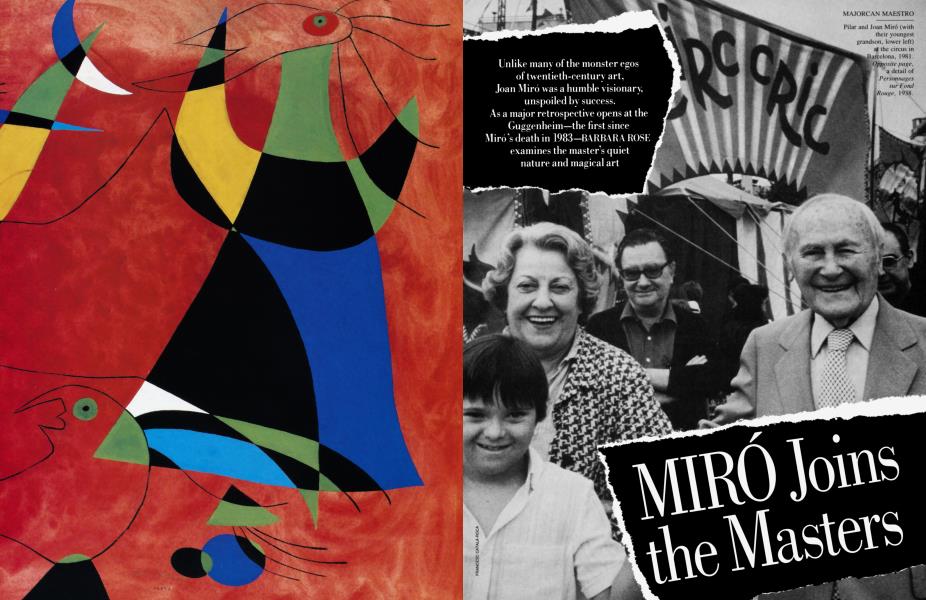
Unlike many of the monster egos of twentieth-century art, Joan Miró was a humble visionary, unspoiled by success. As a major retrospective opens at the Guggenheim—the first since Miró's death in 1983—BARBARA ROSE examines the master's quiet nature and magical art
BARBARA ROSE
An innovator like Picasso, a visionary like Matisse, the brilliant but unworldly Catalan painter Joan Miro created a mysterious, uncanny dreamworld, an imaginary playground for bizarre creatures and witty, whimsical hybrids of plants, animals, and people. The quiet, shy master has long been a favorite of American artists, particularly leading members of the New York School, like Gorky, Pollock, and Motherwell, and its second generation, like Frankenthaler and Louis. But this month all eyes are on Miro: a complete retrospective of his works has just arrived at the Solomon R. Guggenheim Museum in New York from Zurich and Diisseldorf, marking his final acceptance into the pantheon of modernists.
The small elite of Miro aficionados always included an array of international notables—Ernest Hemingway, Henry Miller, James Joyce, Ezra Pound, and ultimately King Juan Carlos of Spain—yet from the start his greatest fans were not Europeans but American critics and collectors. The poet-critic James Johnson Sweeney organized the first Miro retrospective, at the Museum of Modern Art in 1941, and there have been several since. But elsewhere, including his native Spain (where Miro's work was hardly seen for three decades—most of Franco's regime—because of his Republican sympathies and Catalan nationalism), Miro was relatively unknown until quite recently.
A reluctant revolutionary, the introspective, pensive artist was bom in 1893 in a prosperous middle-class neighborhood in the old Gothic quarter of Barcelona, where his father was a goldsmith. By the time he died, at the age of ninety on Christmas Day 1983, Miro had produced conceivably as large a body of painting, sculpture, ceramics, graphics, and public art as his lifelong friend and fellow Spaniard Picasso.
Picasso and Miro. An odd couple. Despite the enormous differences in their aesthetic aims and life-styles, the swarthy Andalusian and the fair Catalan shared a mutual respect and affection. (They conversed in French and in Catalan, though Miro jokingly complained that Picasso spoke Catalan "like a cop.") Picasso, the incorrigible womanizer, wondered at Miro's conventional fidelity—"always with the same 'little peasant girl,' " he remarked of Miro and his wife of fiftyfour years, Pilar Juncosa. Compared with the tempest of Picasso's affairs and string of illegitimate children, his posturing and narcissism, his princely estates, Miro's calm, well-ordered domestic life is hardly the material for a filmscript or pop novel. There were no scandals: Miro's name never became a household word like Picasso's, or that of Miro's fellow Catalan Salvador Dali. Like Dali, Miro was associated with the Surrealist group in Paris in the twenties (Masson, Tanguy, Breton, Ernst), but he distanced himself from their nocturnal high jinks and social climbing. While Dali was painting reactionary, academic pictures, Miro was inventing a pictorial space that resembled the infinite heavens in Romanesque Catalan frescoes more than the finite world of Renaissance easel painting. When, in the thirties, Dali claimed to be apolitical, Miro was selling posters to raise money for the Republican cause and painting a great mural— The Reaper, now lost—as a companion piece to Picasso's Guernica. Dali, a snob and a dandy, was the darling of cafe society; late in his life he chose to stay in a huge chandeliered suite at the Hotel Meurice in Paris (replete with motorcycle and pet giraffe), while Miro and Pilar preferred the comfortable but understated Pont Royal. Dali always adored money, and was dubbed (anagrammatically) "Avida Dollars" by Breton; Miro spumed materialism, and late in his life complained to me that he was "tired of my paintings being used as international bank notes. My art is for the people—it is for everybody. That is why, I suppose, my main interest recently is monumental sculpture, the public art."
Miró never set out to provoke anyone or stand apart, yet his unwillingness to join groups made him a perpetual outsider.
During the forties, Miro was unable to leave embattled France for America. Instead, he took refuge in Barcelona and on Majorca, the island where his wife and maternal grandparents had been bom. There, he said, "nobody ever bothered me, because nobody had ever heard of me"—there, he was Pilar Juncosa's husband. After the war he returned to Paris and made several important trips to New York.
On his first, in 1947, he met his admirer Jackson Pollock and the critic Clement Greenberg, who took one look at him and wondered, "What could have brought this bourgeois to modem painting, the Left Bank and Surrealism?" He also visited his old friend Alexander Calder, who, nearly a foot taller, towered over the diminutive Miro. Together, they looked like Mutt and Jeff. Miro remembered his arrival in New York, when he was met by Calder: "Everyone stared at us when we walked down Fifth Avenue—at him.. .of course."
Like Calder, Miro loved the circus. He was fascinated by children and had a great love of whimsy, and a gentle but ironic wit. He could also be extremely mischievous, drawn to extremes and to testing taboos. Once, while on a walk, he had an idea but no materials, and painted with his own excrement. Often he painted or applied lithographic ink with his hands with the delight and innocence of a child finger-painting. And he was fascinated by birds, which frequently appeared in his work, like the impudent, clownish sculpture Personnage et Oiseaux, commissioned by Texas developer Gerald Hines to go in front of I. M. Pei's Texas Commerce skyscraper in downtown Houston. When I asked him "Why birds?" Miro smiled his angelic smile: "Perhaps they are I. M. Pei and Gerald Hines flying away."
Birds symbolized freedom for Miro: "A human being is like a tree, planted in the ground. Birds fly into space—they can carry us away, off the ground into higher things, into the world of fantasy and imagination that is not earthbound." For Miro, man existed between heaven, toward which he aspired, and earth, in which he was rooted. He painted creatures whose enlarged bare feet were firmly planted in the soil; with their giant toes, Miro's creatures often have a L'il Abner, backwoods look. Which makes sense: he spent at least half of his life on his father's farm in Montroig (near Tarragona), to which he returned every summer from sophisticated Paris.
In 1956, when Miro moved back permanently to Majorca, he at last had the "big studio" he had always dreamed of, designed for him by his close friend the renowned Catalan architect Josep Lluis Sert. Near the studio stands the whitewashed house that he shared with Pilar, who still lives there, aged and ailing. The large painting studio is surrounded by terraces on which almond and green-olive trees are silhouetted against the distant view of bright-blue ocean. The walls of the studio are hung with objects Miro picked up on the beach—a starfish, fishing hooks, a sea horse—and the primitive toys, whistles, and natural forms he scavenged and saved. In his other studio, a three-hundred-year-old stone villa called Son Boter, Miro had a printmaking workshop which he called his "magic place." His schedule was always as regular as clockwork: up at six A.M., at work by seven, a half-hour of exercise at noon, then lunch, a siesta, and a walk. Then back to work again by three. Every day included physical exercise, something which obsessed him, probably because of his size. "All my life," he said, "I have worked to be physically strong." He relished talking about boxing with Hemingway at the old American Center in Paris (a match which one can't help visualizing as a contest between a sparrow and a bear), and even at the very end of his life in Palma he ran up and down stairs to keep in shape. Yet despite Miro's health consciousness, he enjoyed a few cigarettes after every meal, something Pilar was still complaining about even when her husband was eighty-eight.
(Continued on page 125)
(Continued from page 97)
Pilar Miro is as different from Picasso's temperamental women as her husband was from Picasso. She always maintained her dignity and separate identity; although respectful of her husband, she was neither dominated nor domineering. When I asked him if he intended to imitate the Surrealist habit of taking on mistresses or whether he would remain with one wife, Miro winked at Pilar and answered, "Well, for the time being.''
Beneath Miro's placid and polite exterior, the neat blue serge threepiece suits he wore with immaculate, starched white shirts and proper ties, was camouflaged a rebel as outrageously provocative—in his art, that is—as Picasso or Dali. Miro repeatedly insisted that he was not a Surrealist, but he was much affected by the Surrealist idea that painting should be as involved with images as poetry, and poets were among his closest friends. The Surrealists invented new forms, permitting the unconscious to express itself in "automatic'' writing, drawing, and painting, but Miro had no patience with their official pronouncements and manifestos. He insisted that his hallucinations were nothing he tried to provoke, but the unavoidable result of almost starving to death during his early days in Paris. "Those were pretty hard times: the panes of the window were broken, my heater that cost me forty-five francs in the flea market would not work. . . . Since I was very poor I could not afford more than one lunch a week: the other days I had to be contented with dried figs and I chewed gum.'' Whether the result of hunger-induced hallucinations or not, the amazing series of weird doodles combining animal, vegetable, and mineral forms in grotesque personnages that poured forth from his studio were a radical departure from the rational dissections of Cubism as well as the detailed academic monsters the orthodox Surrealists like Max Ernst were conjuring.
"The Surrealists... had nightmares because they couldn't paint too well,'' art critic Sidney Tillim once wrote. Miro, however, was a bom painter, who decisively influenced an entire generation, including the American color-field school. Miro's late paintings—giant expanses of a single color punctuated by a few trailing blots and explosions of pigment—were his response to their translations of his own atmospheric space.
Miro never set out to provoke anyone or stand apart, yet his unwillingness to join groups made him a perpetual outsider. He often hinted at how painful his solitude was; as a young man he suffered a minor nervous breakdown, apparently because he could not fulfill his father's ambition for him to become a clerk. This was just the first sign of his nonconformist nature. When the Surrealists attempted to integrate Miro into their group in the late twenties, he resisted with a typical silent tenacity. He enjoyed telling the story about the day some of them gathered in his Paris studio and decided to frighten him as a punishment for his lack of commitment to their movement. When he walked into the dark room, they ambushed him and threw a noose around his neck. They began to tighten it in earnest, to see at what point Miro would beg for clemency. He admitted having been scared to death, but pride kept him silent. His friend American Dadaist Man Ray commemorated the event in a photograph, and later Miro used the noose to make two collage paintings.
Picasso hoarded his own works and collected masterpieces by others, including Miro. But he also left no will, which resulted in chaotic litigation among his heirs. Miro, on the other hand, had already determined the destiny of his legacy long before he died. He made sure there would be no Miro mausoleum: he commissioned Sert to build the Joan Miro Foundation in Barcelona as a space for exhibitions and performances by living artists. His will bequeathed works to the foundation, but his intention was that they be sold to support the art of the next generation. The foundation also houses the artist's extensive archives—records of the thinking process of an artist who was far more critical of himself than of others. (While working there, I found an astonishing note in Miro's own hand: "Am a colorist, but hopeless at form. I can't tell a curve from a straight line. I only achieve a real sense of form by drawing from the sensation of touching something with my eyes shut.")
Another newly created foundation, named for Pilar and Joan Miro, will preserve the Majorcan compound—the painting studio, the house, Son Boter— as well as the objects and art left by Miro now belonging to Pilar. The couple's fifty-six-year-old daughter, Dolores (immortalized in a Balthus painting as an animated child with her father), lives nearby, as does David, Miro's oldest grandchild.
Last December, Pilar Miro auctioned off forty-two of her husband's paintings at Sotheby's, Madrid, to raise money for the new foundation. The sale grossed over $4 million. To the surprise of many, all the work stayed in Spain, proof that the great Spanish master was no longer an unrecognized prophet in his own country.
Subscribers have complete access to the archive.
Sign In Not a Subscriber?Join Now


