




Sign In to Your Account
Subscribers have complete access to the archive.
Sign In Not a Subscriber?Join NowREEBOK ON WHEELS
Cars
Cornelia Guest, Life's "Deb of the Decade," test-drives the modular Nissan Pulsar NX SE
MARK GINSBURG
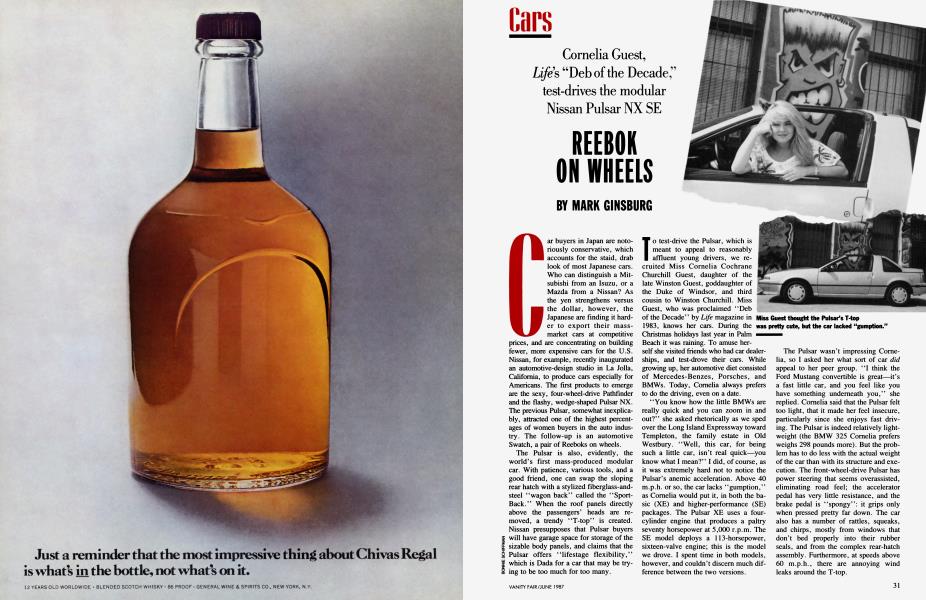
Car buyers in Japan are notoriously conservative, which accounts for the staid, drab look of most Japanese cars. Who can distinguish a Mitsubishi from an Isuzu, or a Mazda from a Nissan? As the yen strengthens versus the dollar, however, the Japanese are finding it harder to export their massmarket cars at competitive prices, and are concentrating on building fewer, more expensive cars for the U.S. Nissan, for example, recently inaugurated an automotive-design studio in La Jolla, California, to produce cars especially for Americans. The first products to emerge are the sexy, four-wheel-drive Pathfinder and the flashy, wedge-shaped Pulsar NX. The previous Pulsar, somewhat inexplicably, attracted one of the highest percentages of women buyers in the auto industry. The follow-up is an automotive Swatch, a pair of Reeboks on wheels.
The Pulsar is also, evidently, the world's first mass-produced modular car. With patience, various tools, and a good friend, one can swap the sloping rear hatch with a stylized fiberglass-andsteel "wagon back" called the "SportBack." When the roof panels directly above the passengers' heads are removed, a trendy "T-top" is created. Nissan presupposes that Pulsar buyers will have garage space for storage of the sizable body panels, and claims that the Pulsar offers "lifestage flexibility," which is Dada for a car that may be trying to be too much for too many.
"You know how the little BMWs are really quick and you can zoom in and out?" she asked rhetorically as we sped over the Long Island Expressway toward Templeton, the family estate in Old Westbury. "Well, this car, for being such a little car, isn't real quick—you know what I mean?" I did, of course, as it was extremely hard not to notice the Pulsar's anemic acceleration. Above 40 m.p.h. or so, the car lacks "gumption," as Cornelia would put it, in both the basic (XE) and higher-performance (SE) packages. The Pulsar XE uses a fourcylinder engine that produces a paltry seventy horsepower at 5,000 r.p.m. The SE model deploys a 113-horsepower, sixteen-valve engine; this is the model we drove. I spent time in both models, however, and couldn't discern much difference between the two versions.
To test-drive the Pulsar, which is meant to appeal to reasonably affluent young drivers, we recruited Miss Cornelia Cochrane Churchill Guest, daughter of the late Winston Guest, goddaughter of the Duke of Windsor, and third cousin to Winston Churchill. Miss Guest, who was proclaimed "Deb of the Decade" by Life magazine in 1983, knows her cars. During the Christmas holidays last year in Palm Beach it was raining. To amuse herself she visited friends who had car dealerships, and test-drove their cars. While growing up, her automotive diet consisted of Mercedes-Benzes, Porsches, and BMWs. Today, Cornelia always prefers to do the driving, even on a date.
The Pulsar wasn't impressing Cornelia, so I asked her what sort of car did appeal to her peer group. "I think the Ford Mustang convertible is great—it's a fast little car, and you feel like you have something underneath you," she replied. Cornelia said that the Pulsar felt too light, that it made her feel insecure, particularly since she enjoys fast driving. The Pulsar is indeed relatively lightweight (the BMW 325 Cornelia prefers weighs 298 pounds more). But the problem has to do less with the actual weight of the car than with its structure and execution. The front-wheel-drive Pulsar has power steering that seems overassisted, eliminating road feel; the accelerator pedal has very little resistance, and the brake pedal is "spongy": it grips only when pressed pretty far down. The car also has a number of rattles, squeaks, and chirps, mostly from windows that don't bed properly into their rubber seals, and from the complex rear-hatch assembly. Furthermore, at speeds above 60 m.p.h., there are annoying wind leaks around the T-top.
"Wow! Did you feel that?" inquired Cornelia as she drove onto a country lane. "I don't feel this is a cheap car, but when you go over a bump and stuff, you can really feel it. Like I'd hate to drive this car into Manhattan with all the potholes." The short suspension travel of the Pulsar NX creates a hard ride even over fairly modest bumps and tar strips. Indeed, this feature may have contributed to the rattles we heard. A fully loaded Pulsar would be an endurance test for the occupants.
Upon our arrival at Templeton we were greeted by an army of friendly dogs of all shapes and sizes. "I think it's a really cute car," Cornelia said, stepping out of the red vehicle into the barking throng. "For young kids it's a great car because of the T-top that whips off and the rear seat that folds down. It has a lot of flexibility, but it's too slow to really appeal to a younger market," she concluded. This is a pity, since the Pulsar NX is an attractive package inside and out. The diagonal striping of the taillights is a fresh theme that's successfully carried out in the velour upholstery and other interior trim items such as the rear-speaker grill covers. The interior of the NX is exemplary in its placement and layout of controls—the exceptions being door locks that are positioned too far down and back on the door panels, and a hatch lever that too closely resembles the seatback adjustment lever behind it. Dials are very easy to read, and glow at night with a soft Pearly-white The padded steering wheel is well proportioned and adjustable for height. Ventilation is superb: small vents in the doors are hinged and pop out to direct air at face level, and the air-recirculation lever works effectively to block out fumes from buses, trucks, and industrial pollution.
The driving position of the Pulsar NX is excellent—the XE and SE have identical interiors, with seats mounted high enough for a good view of the road. The front seats also offer lateral support, which, combined with the Pulsar's exemplary seat belts, means that the occupants aren't tossed from side to side during heavy cornering or on sharp curves. (However, the car sits low to the ground and is awkward to get out of, unless you are sixteen years old.) The seats themselves are somewhat small, and the rear seat is just a vinyl-covered bench suitable only for small children and pets. Conveniently, it folds down to create a cargo area that Cornelia calculated was spacious enough to harbor the multitude of suitcases, totes, and carryalls de rigueur for a Palm Beach weekend. The standard radio sounded good and was easily operated with its large, clearly marked buttons, though Miss Guest, who has long fingernails, prefers round knobs. We were both taken aback at the absence of a cassette player in our deluxe model.
At around $12,000, with another $715 for airconditioning, the Pulsar NX SE is not an economy car. The Volkswagen Fox retails for $5,690, while the genuinely sporty VW GTI sixteen-valve with five-speed transmission sells for $12,240, and the larger fuel-injected four-door Jetta GL, also with five speeds, for $10,340. These cars, which are among the most popular imports in America, offer a measure of performance and handling that surely outweighs the Pulsar NX's "lifestage flexibility." How many times would an owner really go to the trouble of using the $900 wagon-back appendage? Wouldn't most homeowners find cheaper to rent a wagon or mini-van when moving bulky items? In short, the car's modular capacity is a gratuitous sales feature that most likely accounts for the majority of the squeaks and rattles we heard. Without it, we are left with an overpriced car with considerable charm, an eye-catching design, and an excellent cabin interior. At lower speeds, the Pulsar NX is also fun to drive. It shifts easily and precisely, and takes comers without too much roll. Though the car very maneuverable in traffic, the wide rear pillars create blind spots.
The Pulsar's true flexibility lies with the T-top; though it was responsible for wind noise, it was still a joy. The vehicle's aerodynamics enable one to drive in comfort with thq roof panels off and
moderate amount of heat switched on during chilly weather. The panels are extremely easy to remove and install, and are fairly lightweight.
Leaving Old Westbury, Cornelia pulled into a Carvel for a cup of soft vanilla ice cream with chocolate sprinkles. Back in the driver's seat, she spoke about another Nissan deficiency. "There aren't any flat surfaces to put our cups on," I had remarked on hearing her plastic spoon scrape the bottom. "Exactly," she concurred. "There's no place to put a drink or anything. I had a car in Florida that had a long center console. An ashtray was built into it, and the lid flipped over to become a cupholder. It was the greatest thing I've ever had in a car, 'cause in the summer and stuff I always have a drink with me."
Back on the open road, Cornelia summed up the Pulsar's attraction. "It's a great car for going to the beach in; it's great in the summer and to go bombing around in on country roads. But I don't think it's a car to drive for long distances." She added, "If Nissan wants to appeal to a younger market, then the car should be a lot faster. If it's trying to be a sports car, it's just not fast enough. You know how there are some cars you want to drive, and some cars you just want to sit in and let them drive themselves? This car inspires you to get into a lane and stay there."
MANUFACTURER'S
SPECIFICATIONS:
Nissan Pulsar NX XE and NX SE
• Vehicle type: front-engine, front-wheel-drive, two-plus-twopassenger, three-door coupe.
• Price: XE, $10,599; SE, $11,799.
• Options (partial list): automatic transmission (XE only), air-conditioning, Sport-Back.
• Engine type: in-line four-cylinder, fuel injection.
• Transmission: five-speed manual.
• Acceleration 0-60 m.p.h.: XE, figures unavailable; SE, 10.3 seconds (estimated).
• Projected E.P.A. fuel economy: XE, 26 m.p^, city; 32 m.p&, highway. SE, 23 m.p^ city; 30 m.p«., highway.
Subscribers have complete access to the archive.
Sign In Not a Subscriber?Join Now
