Sign In to Your Account
Subscribers have complete access to the archive.
Sign In Not a Subscriber?Join NowA PASSAGE TO WILBURY
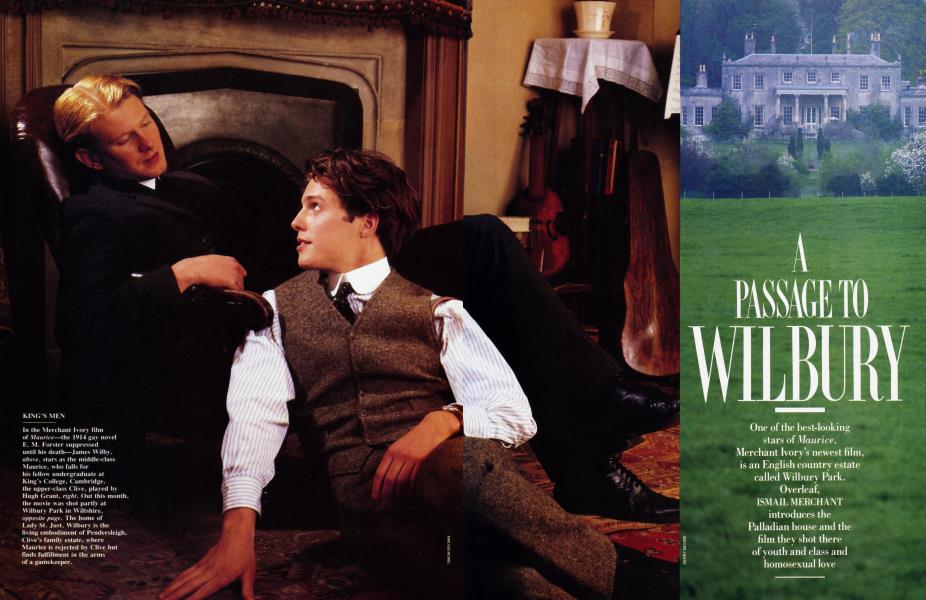
One of the best-looking stars of Maurice, Merchant Ivory's newest film, is an English country estate called Wilbury Park. Overleaf, ISMAIL MERCHANT introduces the Palladian house and the film they shot there of youth and class and homosexual love
ISMAIL MERCHANT
Jim Ivory and I first saw Wilbury Park in October 1979. Henry Herbert, the Earl of Pembroke, had invited us to a ball honoring the birth of his son, the heir apparent to the Pembroke title. The guests included Prince Charles and his retinue, who filled all the guest rooms at Wilton, so Henry Herbert arranged for us to spend the weekend with his friend Lady St. Just at her neighboring country house. Such was our introduction to the earliest and one of the most beautiful Palladian houses in England, built by William Benson in 1710. We were instantly struck by the palatial structure, the perfect landscape, the well-proportioned rooms filled with daylight shimmering through the tall windows. That impression stayed with us, and Wilbury Park is now one of the prime locations of our new film, Maurice.
Our relationship with E. M. Forster dates back to 1959, when Jim, at the urging of an Indian friend of Forster's, wrote asking to meet him in Cambridge. In 1977 the provost of King's College, Bernard Williams, invited me to lunch to talk about A Passage to India, which was to be directed by Satyajit Ray. I was to produce the film. For some reason Ray lost interest, and Jim and Ruth Jhabvala and I moved on to other things, including Heat and Dust. I asked King's College to let the three of us do A Room with a View instead of A Passage to India, and Forster's trustees immediately agreed. Next we chose Maurice, Forster's novel about homosexual love—forbidden subject matter in 1914, when he wrote it. Maurice Hall, the hero, falls in love with Clive Durham, a friend at Cambridge, and later with Alec Scudder, a gamekeeper on the Durhams' country estate, called Pendersleigh Park in the film.
Locations have become integral parts of our films, and we knew that Wilbury Park was perfect for Pendersleigh. The setting is so evocative and romantic that one feels that something—sex probably—is going to burst through the trappings of Edwardian manners and mores the moment Maurice arrives there. Although most of the furnishings at Wilbury were right for the film, certain rooms had to be refurbished with period wallpaper and some Edwardian pieces which are now out of style. Maria St. Just, who has been affiliated with show people for many years, as an actress and more recently as a trustee of Tennessee Williams's estate, was most generous in lending her house to us for four weeks. It was not surprising that she became exasperated at times to have a small army tramping through her home six days a week, but for the most part she was good-humored and cooperative. And so Wilbury Park became Clive's Pendersleigh.
One hallmark of Merchant Ivory productions is the glittering social occasion, be it a tea party or a ball. In Maurice it is a dinner party at Pendersleigh. As the guests in period costumes speak Forster's witty lines, the scene shines as brightly for me as the silver candelabra and centerpiece lent to us by Garrard's of London. One of the guests is Lady St. Just herself, feeding bits of toast to her dogs from the table,
telling them, "This is pate de foie gras, this is a fat par tridge, and this, my darlings, is caviar."
Subscribers have complete access to the archive.
Sign In Not a Subscriber?Join Now


