






Sign In to Your Account
Subscribers have complete access to the archive.
Sign In Not a Subscriber?Join NowMOODY MUSIC MAN
Music
Carlos Kleiber, opera's most volatile conductor, makes his debut at the Met
HELENA MATHEOPOULOS
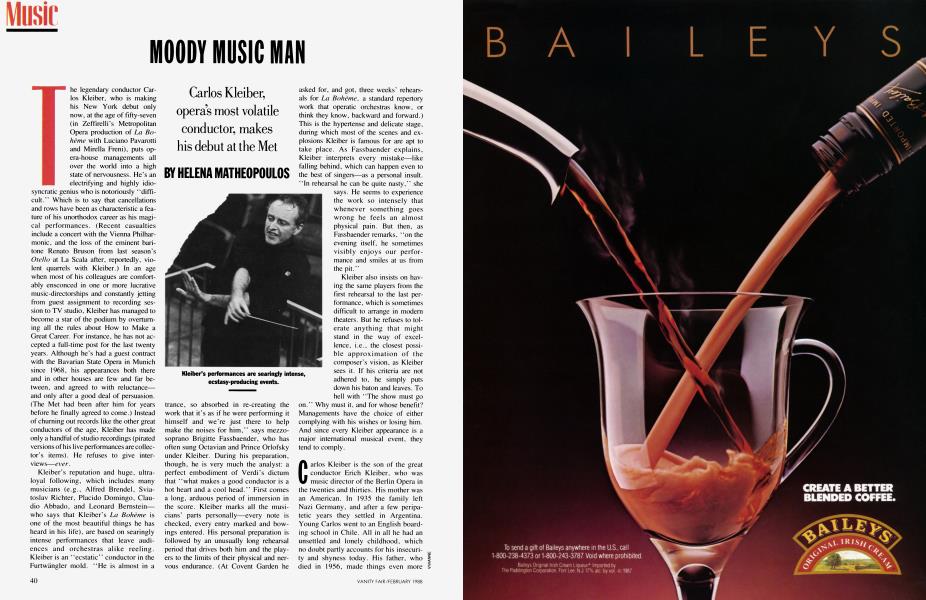
The legendary conductor Carlos Kleiber, who is making his New York debut only now, at the age of fifty-seven (in Zeffirelli's Metropolitan Opera production of La Boheme with Luciano Pavarotti and Mirella Freni), puts opera-house managements all over the world into a high state of nervousness. He's an electrifying and highly idiosyncratic genius who is notoriously "difficult." Which is to say that cancellations and rows have been as characteristic a feature of his unorthodox career as his magical performances. (Recent casualties include a concert with the Vienna Philharmonic, and the loss of the eminent baritone Renato Bruson from last season's Otello at La Scala after, reportedly, violent quarrels with Kleiber.) In an age when most of his colleagues are comfortably ensconced in one or more lucrative music-directorships and constantly jetting from guest assignment to recording session to TV studio, Kleiber has managed to become a star of the podium by overturning all the rules about How to Make a Great Career. For instance, he has not accepted a full-time post for the last twenty years. Although he's had a guest contract with the Bavarian State Opera in Munich since 1968, his appearances both there and in other houses are few and far between, and agreed to with reluctance— and only after a good deal of persuasion. (The Met had been after him for years before he finally agreed to come.) Instead of churning out records like the other great conductors of the age, Kleiber has made only a handful of studio recordings (pirated versions of his live performances are collector's items). He refuses to give interviews—ever.
Kleiber's reputation and huge, ultraloyal following, which includes many musicians (e.g., Alfred Brendel, Sviatoslav Richter, Placido Domingo, Claudio Abbado, and Leonard Bernstein— who says that Kleiber's La Boheme is one of the most beautiful things he has heard in his life), are based on searingly intense performances that leave audiences and orchestras alike reeling. Kleiber is an "ecstatic" conductor in the Furtwangler mold. "He is almost in a trance, so absorbed in re-creating the work that it's as if he were performing it himself and we're just there to help make the noises for him," says mezzosoprano Brigitte Fassbaender, who has often sung Octavian and Prince Orlofsky under Kleiber. During his preparation, though, he is very much the analyst: a perfect embodiment of Verdi's dictum that "what makes a good conductor is a hot heart and a cool head." First comes a long, arduous period of immersion in the score. Kleiber marks all the musicians' parts personally—every note is checked, every entry marked and bowings entered. His personal preparation is followed by an unusually long rehearsal period that drives both him and the players to the limits of their physical and nervous endurance. (At Co vent Garden he asked for, and got, three weeks' rehearsals for La Boheme, a standard repertory work that operatic orchestras know, or think they know, backward and forward.) This is the hypertense and delicate stage, during which most of the scenes and explosions Kleiber is famous for are apt to take place. As Fassbaender explains, Kleiber interprets every mistake—like falling behind, which can happen even to the best of singers—as a personal insult. "In rehearsal he can be quite nasty," she says. He seems to experience the work so intensely that whenever something goes wrong he feels an almost physical pain. But then, as Fassbaender remarks, "on the evening itself, he sometimes visibly enjoys our performance and smiles at us from the pit."
Kleiber also insists on having the same players from the first rehearsal to the last performance, which is sometimes difficult to arrange in modem theaters. But he refuses to tolerate anything that might stand in the way of excellence, i.e., the closest possible approximation of the composer's vision, as Kleiber sees it. If his criteria are not adhered to, he simply puts down his baton and leaves. To hell with "The show must go on." Why must it, and for whose benefit? Managements have the choice of either complying with his wishes or losing him. And since every Kleiber appearance is a major international musical event, they tend to comply.
Carlos Kleiber is the son of the great conductor Erich Kleiber, who was music director of the Berlin Opera in the twenties and thirties. His mother was an American. In 1935 the family left Nazi Germany, and after a few peripatetic years they settled in Argentina. Young Carlos went to an English boarding school in Chile. All in all he had an unsettled and lonely childhood, which no doubt partly accounts for his insecurity and shyness today. His father, who died in 1956, made things even more difficult for him by attempting to prevent him from becoming a conductor— or, indeed, a musician at all. Although he had begun composing when he was nine, he wasn't permitted to study music until very late—when he was twenty— and even after Kleiber pere was persuaded to relent and became convinced of his son's talent, he continued to humiliate him by making sarcastic and deprecating remarks both in private and public. Francesco Siciliani, formerly the artistic administrator at La Scala, and an admirer of both Kleibers, recalls an occasion when Erich "humiliated Carlos by saying he didn't think he would ever be able to conduct Viennese waltzes with the right rhythms. Needless to say, Carlos sought to conduct Der Rosenkavalier at the earliest opportunity, and proved himself a superb conductor of Viennese waltzes."
Kleiber had been studying chemistry for two years at the Technische Hochschule in Zurich before he began his music studies, and in the meantime had found an outlet for his frustrated artistic impulses in writing. He is unusually articulate for a conductor. In rehearsals he "talks all the time," says Bram Gay, the orchestra director at Covent Garden, "and he can get away with it. He doesn't bore
the musicians." Before each performance, Kleiber sends small, handwritten notes known as "Kleibergrams" to singers, players, and chorus masters reminding them of things that he would like them to take special note of or that they did wrong at the last performance.
11 leiber's ability to communicate with Wk his musicians is extraordinary. Oral chestral players, usually notorious conductor bashers, speak of him in terms verging on the rhapsodic. "He manages to make an orchestra and each individual player reach more deeply into the music to create a whole new world of fantasy," says Anthony Camden, principal oboe of the London Symphony Orchestra. "For an orchestral musician, this is an experience that comes only a few times in one's life." They are equally enthusiastic about him as a technician. "Kleiber's stick technique is very good, very clear, quite unmistakable," says Harold Nash, the first trombone at Covent Garden. ''In Otello, for instance, he wanted a short, precise chord from us, the brass, which is technically very hard to do. Normally, he conducts with his right hand, of course, but for this big chord his left hand would come
sweeping down very precisely, like a guillotine, spot on, leaving you in no doubt at all about what he wanted. He also loves taking chances—tremendous rubati—which is fine, because his chances always come off. In Otello, there were several instances where everything was jogging along quite cheerfully and suddenly he would stop for maybe two beats and then continue at the speed he'd just left. This is very clever indeed, because it keeps you on your toes: you have to keep watching him all the time, wondering when it's going to happen next. This is why I call his conducting 'impromptu,' even though it's exceedingly well rehearsed— to the nth degree. There is this wonderful sense of freedom about it, this unpredictability." Pavarotti, who sang Rodolfo in Kleiber's Boheme at La Scala, is convinced that Kleiber does this sort of thing to keep the temperature high. "Although we had worked the role out in minute detail," he recalls, "at every performance some timings were different." But wasn't that unnerving? "Not at all," says Pavarotti. "Maestro Kleiber experiences the emotions of every character so vividly and intensely that if you look at his face you cannot make a big mistake."
Not surprisingly, though, Kleiber's fanaticism sometimes makes collaboration with great soloists problematic. One of his most famous cancellations, in the seventies, was a recording of the Beethoven Emperor Concerto with the equally ' 'difficult" Arturo Benedetti Michelangeli. The two collaborated as one spirit for a concert, but when it came to recording the work, disaster struck. John Mordler, director of the Monte Carlo Opera and then a producer with EMI Records, recalls that at one point "the first cello asked Michelangeli, 'Maestro, what speed would you like?' and that was it. Kleiber walked out, and by the time the break was over, he was already on the plane to Munich."
Kleiber's conception of the conductor as custodian of the composer's work makes for especially delicate relations with stage directors. In John Copley's Covent Garden production of La Boheme, for instance, Musetta was supposed to sob into her handkerchief at Mimi's death. "Must she do that?" Kleiber snapped. "It sounds as if she is blowing her nose." Copley was upset but kept quiet about it, "because one's brief is to keep him happy at all costs, and even if he drives us all mad for a while, his magical performances make you forget everything." But August Everding, who directed the Bayreuth production of Tristan und Isolde that propelled Kleiber to international fame, found working with him frustrating. "He dried me up completely. I just couldn't think anymore. He interfered with my instructions to the singers, and I got the impression he would like to be his own stage director and just get someone to design the sets and costumes for him."
Otto Schenk, who directed the historic Bavarian State Opera productions of Der Rosenkavalier and Die Fledermaus, was glad to have Kleiber present at all rehearsals (most conductors show up only for the last two stage rehearsals). "He explained the music to me in great detail—why it is so, what it relates to in a previous act, and so on—and said he wanted me to be 'the translator of the music' in terms of singing and acting. It's really a pity that he doesn't conduct more, because he could conduct everything."
In fact, Kleiber has a very small repertoire, a point his critics carp on. In recent years he has concentrated on a few concert pieces and a handful of operas: Elektra, Der Rosenkavalier, Die Fledermaus, Wozzeck, Otello, La Traviata. La Boheme, Madama Butterfly, Carmen, and Tristan und Isolde. (Plans for a new production of Falstaff in Munich seem, sadly, to have fallen through.) To be sure, he knows a vast number of scores and conducted many operas during his twelve years as a staff conductor at the Deutsche Oper am Rhein in Diisseldorf (1956-64), the Zurich Opera (1964-66), and the Wurttemberg State Theatre in Stuttgart (1966-68). But he doesn't seem much interested in conducting works that he doesn't like or for which the right cast either is not available or doesn't exist. ("Find me a Salome," he told someone years ago when asked why he wouldn't conduct that opera.)
Another, less likely, reason for Kleiber's work habits is the one he gave Leonard Bernstein. He said that he doesn't like to work and would be quite happy doing nothing. "I want to be a vegetable. I want to grow in a garden, sit in the sun, eat, drink, sleep, make love, and that's it." Another time, when a recording executive was trying hard to persuade him to agree to a specific project, he replied, "I have enough to eat, my fridge is full, why should I conduct?" But Jeremy White, a viola player at Covent Garden, probably put his finger on it when he pointed out that Kleiber simply could not do much more and stay sane. "It's that intensity of his. Red hot. How could he keep that up? It would kill him."
Subscribers have complete access to the archive.
Sign In Not a Subscriber?Join Now

