




Sign In to Your Account
Subscribers have complete access to the archive.
Sign In Not a Subscriber?Join NowLOOKING FOR LORD LUCAN
BRIAN MASTERS
The deepening mystery of the murdered nanny and the disappearing lord
Books
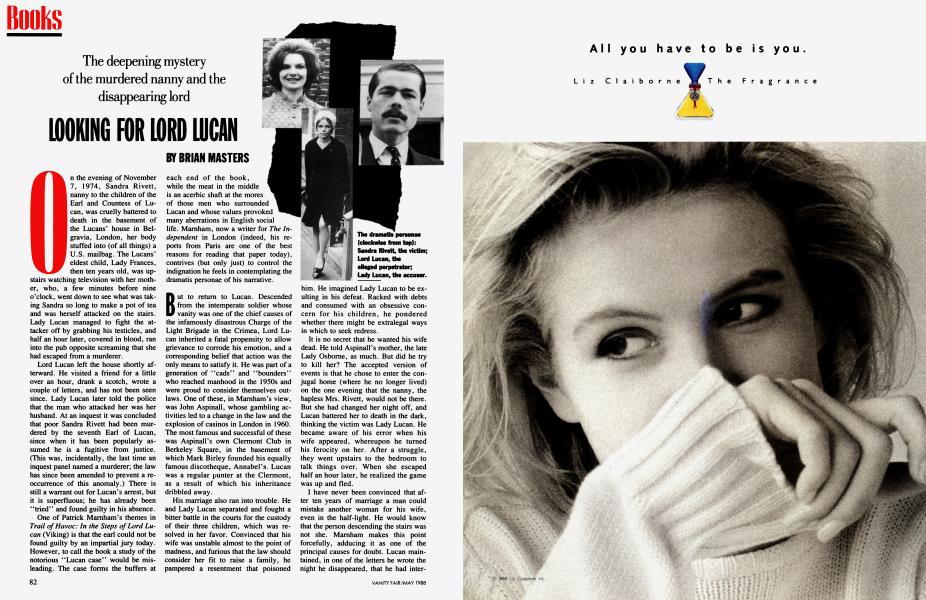
On the evening of November 7, 1974, Sandra Rivett, nanny to the children of the Earl and Countess of Lucan, was cruelly battered to death in the basement of the Lucans' house in Belgravia, London, her body stuffed into (of all things) a U.S. mailbag. The Lucans' eldest child, Lady Frances, then ten years old, was upstairs watching television with her mother, who, a few minutes before nine o'clock, went down to see what was taking Sandra so long to make a pot of tea and was herself attacked on the stairs. Lady Lucan managed to fight the attacker off by grabbing his testicles, and half an hour later, covered in blood, ran into the pub opposite screaming that she had escaped from a murderer.
Lord Lucan left the house shortly afterward. He visited a friend for a little over an hour, drank a scotch, wrote a couple of letters, and has not been seen since. Lady Lucan later told the police that the man who attacked her was her husband. At an inquest it was concluded that poor Sandra Rivett had been murdered by the seventh Earl of Lucan, since when it has been popularly assumed he is a fugitive from justice. (This was, incidentally, the last time an inquest panel named a murderer; the law has since been amended to prevent a reoccurrence of this anomaly.) There is still a warrant out for Lucan's arrest, but it is superfluous; he has already been "tried" and found guilty in his absence.
One of Patrick Mamham's themes in Trail of Havoc: In the Steps of Lord Lucan (Viking) is that the earl could not be found guilty by an impartial jury today. However, to call the book a study of the notorious "Lucan case" would be misleading. The case forms the buffers at each end of the book, while the meat in the middle is an acerbic shaft at the mores of those men who surrounded Lucan and whose values provoked many aberrations in English social life. Mamham, now a writer for The Independent in London (indeed, his reports from Paris are one of the best reasons for reading that paper today), contrives (but only just) to control the indignation he feels in contemplating the dramatis personae of his narrative.
But to return to Lucan. Descended from the intemperate soldier whose vanity was one of the chief causes of the infamously disastrous Charge of the Light Brigade in the Crimea, Lord Lucan inherited a fatal propensity to allow grievance to corrode his emotion, and a corresponding belief that action was the only means to satisfy it. He was part of a generation of "cads" and "bounders" who reached manhood in the 1950s and were proud to consider themselves outlaws. One of these, in Mamham's view, was John Aspinall, whose gambling activities led to a change in the law and the explosion of casinos in London in 1960. The most famous and successful of these was Aspinall's own Clermont Club in Berkeley Square, in the basement of which Mark Birley founded his equally famous discotheque, Annabel's. Lucan was a regular punter at the Clermont, as a result of which his inheritance dribbled away.
His marriage also ran into trouble. He and Lady Lucan separated and fought a bitter battle in the courts for the custody of their three children, which was resolved in her favor. Convinced that his wife was unstable almost to the point of madness, and furious that the law should consider her fit to raise a family, he pampered a resentment that poisoned him. He imagined Lady Lucan to be exulting in his defeat. Racked with debts and consumed with an obsessive concern for his children, he pondered whether there might be extralegal ways in which to seek redress.
It is no secret that he wanted his wife dead. He told Aspinall's mother, the late Lady Osborne, as much. But did he try to kill her? The accepted version of events is that he chose to enter the conjugal home (where he no longer lived) on the one evening that the nanny, the hapless Mrs. Rivett, would not be there. But she had changed her night off, and Lucan battered her to death in the dark, thinking the victim was Lady Lucan. He became aware of his error when his wife appeared, whereupon he turned his ferocity on her. After a struggle, they went upstairs to the bedroom to talk things over. When she escaped half an hour later, he realized the game was up and fled.
I have never been convinced that after ten years of marriage a man could mistake another woman for his wife, even in the half-light. He would know that the person descending the stairs was not she. Mamham makes this point forcefully, adducing it as one of the principal causes for doubt. Lucan maintained, in one of the letters he wrote the night he disappeared, that he had interrupted a struggle and the intruder made off, but that he knew his wife would be bound to accuse him. This at least accords with the disquieting fact that man and wife spent half an hour talking in the bedroom before she flew out of the house; Lady Lucan has never satisfactorily disclosed what was said on that occasion.
Marnham's thesis is that Lucan employed a hit man to do the job for him, and that such a man could easily confuse one woman with the other. This of course does not make Lucan any less guilty, but it does acquit him of the actus reus and explain how the wrong corpse could end up stuffed in a mailbag. (That is another mystery: U.S. mailbags are a rare item in England. How did he come by one?) Another book on the case, Lucan: Not Guilty, by Sally Moore, which was published in England last fall at about the same time that Trail of Havoc appeared there, reaches a different conclusion by a more complex route, suggesting that the murder weapon could have been a truncheon, and the wielder thereof a policeman. In any case, Moore agrees that it is impossible Lucan could have been in the house at the time of Mrs. Rivett's death just before nine o'clock; he was seen in Berkeley Square seconds earlier.
Lord Lucan is now either prostrate at the bottom of the English Channel or in hiding somewhere abroad. Every few months there is some dotty "sighting" of him in Upper Greenville or Tierra del Fuego, which the sillier newspapers invariably treat with respect. One place he is not is in the belly of one of Aspinall's tigers (Aspinall is renowned for his pioneering work at two private zoos). Mamham repeats the daft rumor that "Aspinall's tigers were known to be partial to human flesh." Of the more than three hundred that he has bred, only one tigress (which, anyway, was imported from Canada) has proved delinquent, and she showed no interest in eating her two victims.
Some months after the murder, Dominick Elwes, a talented portrait artist and wit who was close to the circle which included Lucan, Aspinall, et al., drew a picture of a set of gamblers at the Clermont that he sold to The Sunday Times and that was used to accompany an unfriendly article by James Fox. The fraternity accused him of betrayal and ostracized him with what Mamham calls "schoolboy cruelty." Elwes committed suicide. Mamham then wrote a piece in the iconoclastic satirical magazine Private Eye entitled "All's Well that Ends Elwes," in which he mistakenly named the financier Sir James Goldsmith as being present at a luncheon given by Aspinall the day after Lord Lucan disappeared and at which various schemes to assist Lucan were discussed. Goldsmith consequently not only brought civil action for libel but also instigated a rare suit for criminal libel which, had he pursued it, might have resulted in terms of imprisonment for the editor of the paper, Richard Ingrams, and for Patrick Mamham himself. He dropped the case once his point had been made, but was victorious in several other actions against Private Eye.
Why should Goldsmith, at the time eager to own a London newspaper, be so determined to make enemies in Fleet Street? Mamham opines that he was gallantly protecting the honor of his friend Lady Falkender, who as Marcia Williams was Harold Wilson's secretary and who had herself been lashed by the irreverent scorn of Private Eye. Rumors were then flying around that many of Wilson's friends had shady pasts and that even Wilson himself was a K.G.B. mole. These stories were leaked to Private Eye by sources within MI5, the British secret service, and as Spycatcher has since corroborated, they were hatched by disaffected right-wing civil servants. So we had the odd spectacle of ultraconservative Jimmy Goldsmith supporting a socialist government in preventing independent journalists from investigating whether or not that socialist government was corrupt. The ironies tumbled over one another.
This brings us a long way from Lord Lucan, and even farther from the miserable end of Mrs. Rivett. Mamham connects all the threads plausibly enough, assuming that the disparate events reveal a malaise at the heart of English life, where men devoted to an archaic sense of honor and bent on the protection of that privilege which they deem to be their due are ready either to subvert the law or to contort it for selfish ends. But in sheer logic he may have stretched his connections too far. Never mind. Trail of Havoc is a splendid piece of sustained analysis. It is avowedly partisan, and doubtless Lucan's friends could answer it, if they chose, with parallel conviction and spirit. That does not detract from the pleasure one derives in reading it.
Subscribers have complete access to the archive.
Sign In Not a Subscriber?Join Now

