



Sign In to Your Account
Subscribers have complete access to the archive.
Sign In Not a Subscriber?Join NowBEHIND THE TIMES
A timely critique of New York Times critics
JAMES WOLCOTT
Mixed Media
Under executive editor Max Frankel, the good gray lady known as The New York Times has begun to relax the stays of her corset and apply some color to page-one coverage. Soft news features have usurped the space formerly devoted to U.N. resolutions. The paper has even I resorted to cute headlines, a ploy that would have been unthinkable during the fearsome reign of Frankel's predecessor, A. M. Rosenthal, who emanated all the warmth and latitude of Otto Preminger in Stalag 17. Two years ago Rosenthal retired his riding crop and took up feathered quill in his new role as pundit on the paper's oped page; his platform was called "On My Mind." But so chummily did Rosenthal wag his jowls at confused readers that the column soon came to be known as "Out of My Mind.'' ("Oh, and one little personal note," he wrote in his inaugural piece. "When I was bom, my mother really did not cry out 'Harry, let's call him A.M.' The initials and dots in my name were put there long ago by an editor who gave me my first byline but thought my first name was not quite, or maybe too quite." A month later he flew to Ecuador to file a philosophical report on the sunning habits of iguanas.) But if there has been a thaw on the front page in the era of post-Rosenthal glasnost, the cultural mission at the Times still resembles a captive wasteland where the cold wind erases all traces of hope and human endeavor. Inside, the inmates have the shivers.
Take Janet Maslin, for example. A film critic, Maslin must have splinters from all the fences she's straddled. Unless a movie is so small that she can squash it with impunity or so big that she can bask in its aura of prestige, she seems afraid of going on record with a clear-cut call. "I'm a-scared," says the quaking voice beneath her smooth non sequiturs. Vincent Canby, Maslin's senior colleague on the movie aisle, doesn't shy away so demurely from his likes and dislikes, but his sweet tooth for atrocious comedies and French piffle makes him an unreliable taste-tester. He tries to suave his way through every review.
Although the Times' s TV critic John J. O'Connor also has a faulty laugh track in his cranium (he praised CBS's stinko sitcom Eisenhower and Lutz), he tends to be tickled by British imports. "As usual, the British do this sort of thing better" is a typical burp in his reviews. O'Connor is capable of slicing through cant, quite neatly spearing Spalding Gray when Gray fondled his psyche on HBO, but too many years at the same pop stand have made O'Connor blah and tetchy. Writing about TV for the Times from a more political perspective is John Corry, a neoconservative ninny and complete nonentity. He's there to cover the Times's right flank.
By contrast, the Times's music critics have been bathed and baptized in the mineral waters of progressivism. They're so knowledgeably catholic in their appreciation of everything from blues to show tunes to string quartets to ambulance sirens piped through a Styrofoam cup that the cumulative effect is of undifferentiated nonstop sonic slush. There is no inchoate churning of the guts that they can't tidy up with a modernist cliche.
Frank Rich and Mel Gussow are the Big Halsy and Little Fauss of drama reviewing, one going in for blunderbuss overkill, the other for pip-squeak understatement. The chief dance appreciator is Anna Kisselgoff, and with Kisselgoff I confess to suffer from a fatal distraction. A few years ago I attended a performance of excerpts from a new ballet about Dracula that was to be followed by a panel discussion chaired by Kisselgoff. Choreographed by James Kudelka, this Dracula was a hotsy-totsy, humpy affair, with proud bare breasts and brazen bare buttocks. Or perhaps it was bare brazen breasts and bare proud buttocks. Either way, there was a lot going on. And at the end of this vampire mambo a wonderful thing happened. As the spotlight dimmed on Dracula's marbled, muscled ass, one cheek arched in defiance, a spotlight at the side of the stage brightened on Anna Kisselgoff's genial face. From Dracula's ass to Anna Kisselgoff's face—what a transition! Since then I haven't been able to read Kisselgoff without Dracula's half-moon eclipsing the view.
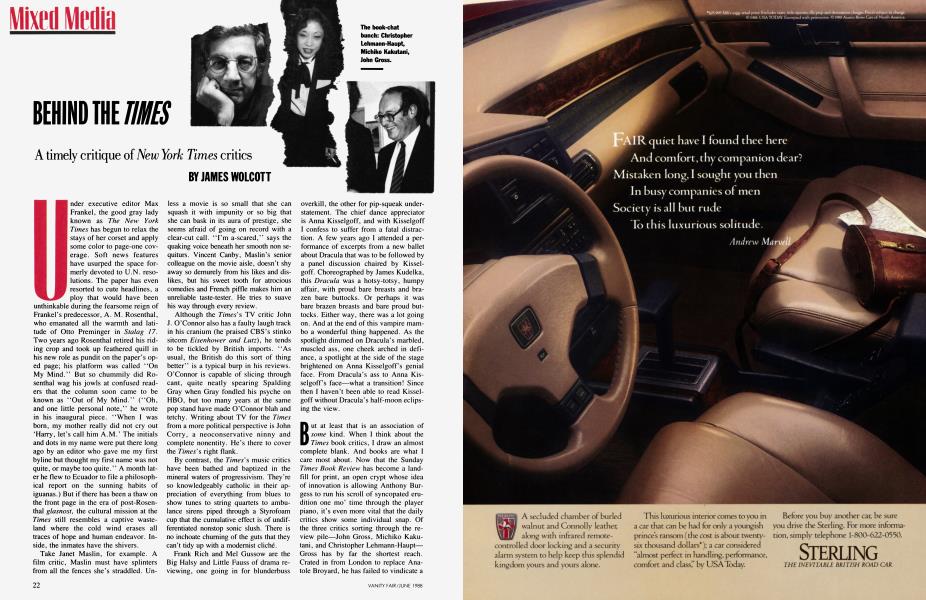
1% ut at least that is an association of K some kind. When I think about the Ir Times book critics, I draw an almost complete blank. And books are what I care most about. Now that the Sunday Times Book Review has become a landfill for print, an open crypt whose idea of innovation is allowing Anthony Burgess to run his scroll of syncopated erudition one mo' time through the player piano, it's even more vital that the daily critics show some individual snap. Of the three critics sorting through the review pile—John Gross, Michiko Kakutani, and Christopher Lehmann-Haupt— Gross has by far the shortest reach. Crated in from London to replace Anatole Broyard, he has failed to vindicate a change in the lineup card. Despite his phallocratic airs and playing of personal favorites, Broyard was a serious pro who often had a silky rapport with the novel under review. Unlike Broyard, an epicurean of touch and palate, Gross is more of an ideas man. He's a Syntopicon with credentials. Having served as editor of The Times Literary Supplement in London, he is the author of a scholarly and creditable survey of The Rise and Fall of the Man of Letters (1969). Ironically, it is as one of the last remaining dodoes, a man of letters, that Gross attracted the attention of the Anglophiliac New York Times. His name had patina. But it is as a man of letters that Gross has been, I think, a complete fizz-out. When not skimming lightly over pop subjects with which he has no affinity (the fiftieth anniversary of Superman, for instance), he portions his interest out to university-press books that have a paraphrasable content and require nothing in the way of personal response. Gross has the soul of an academician, straight from Dullsville. He's a consensus of one. His reviews resemble the
anonymous notes that used to appear in the old T.L.S. and assumed the Druidic tone of a kindly but comprehensive don daintily removing bones from his fish.
Perhaps the reason Gross's reviews are so deficient in chi is that he has so little leftover energy to expend. For John Gross is no sleepy don nodding over the claret. He is a tame but persistent party animal. In a recent issue of London's Tatler, he contributed an overview of the "theory and practice of parties" in which he sought to explain the long hours he has logged in hell. "As a hardened party-goer, I have often found myself asking 'Why?', 'What exactly am I doing here?', 'What exactly are you doing here?' And while I have managed to avoid coming up with one big basic theory that is meant to explain everything, a relatively small number of explanations have pressed themselves on me with increasing regularity." From that jerky windup, it's hardly a surprise that what dribbles across the plate are commonplaces on the order of "Hope springs eternal across a crowded room." In that same issue Gross was listed among those partygoers "who stay till the end."
When not occupying party space at the best addresses as a fern, a fixture, a
potted plant, Gross advises and conducts the exclusive seances of Brooke Astor's literary cenacle, whose members include Anne Bass, Anna Murdoch, and the scary ballerina Heather Watts. Nothing wrong with lacing your social life with literary uplift—it beats power lunches and liposuction. Besides, writing can be a lonely biz. As Gross so pithily quotes from Aristotle in his Tatler article, "Only a god or a wild beast can endure solitude." But solitude is what writing truly requires, and the evidence of Gross's work for the Times is that he's not getting enough of it. He's too busy being a swizzle stick for the smart set.
No danger of Michiko Kakutani being found soaking in bathtub gin or climbing down a fire ladder in an elephant's pajamas. A graduate of Yale, she's the ultimate A student and allnighter, an industrious ant who does her homework by the light of the harvest moon. Ant? Perhaps one should say mouse, because the concentrated clout she wields at the Times has made Michiko Kakutani the Mighty Mouse of American letters. When Esquire drew up its fever chart of the literary establishment, it positioned Kakutani in criticism's red-hot center. Unlike Gross, she reflects a larger consensus. Her influence derives from being an establishmentarian to the core, a wet finger to the wind of Received Wisdom. Despite a title inspired by a goofy stanza in Wallace Stevens (who beckons the poet to "Play the present, its hoo-hoo-hoo, / Its shoo-shooshoo''), Kakutani's The Poet at the Piano, published this month by Times Books, is a no-nonsense almanac of orthodox opinion.
In her introduction, Kakutani claims that what unifies this collection of Times clippings "is a glimpse of an artist—a writer, a playwright, a musician, a director, or an actor—at work." But in fact there's very little on-site inspection in these pages. As she concedes, most of the meetings took place after the work was done and the artist was ready if not eager to push his product. Indeed, an interview session with Michiko Kakutani has become a standard pit stop on the promotional tour. (When John Updike's Henry Bech has a new novel to plug in Bech Is Back, he hits the trifecta of book hype: "Bech was photographed by Jill Krementz, caricatured by David Levine, and interviewed by Michiko Kakutani.") Because writing on tight deadline hinders Kakutani from spending extended time with her subjects and observing them in a variety of moods (a number of interviews were conducted in a single session), the visits to the poet at the piano don't read like improvisations, hoo-hoo-hoo or no hoo-hoo-hoo, but formal sittings.
Saul Bellow, for example, seems to be unveiling a marble bust of himself on the august occasion of The Dean's December. Philip Roth measures himself for a spot on Kafka's rack, and John Updike sheds bright amounts of angel fluff. The always fun and vivacious Joan Didion provides Kakutani with a familiar road map of her shattered nerves. Pondering the imponderables and the eternal verities, William Styron fills his gasbag and empties his moral bladder. "Why is it that the human animal, unlike other creations in the framework of nature, is the only entity capable of destroying itself and its fellows?" Not all of the sittings are so stiff. The director Billy Wilder hasn't lost his salt, and Norman Mailer always has quotable copy on tap. But these quickie portraits lack the intimate rub of New Journalism profiles or the tart asides of the best Paris Review interviews. And when Kakutani doesn't have a text to consult, as in her show-biz
tributes to Liza Minnelli and Lena Home, she succumbs to newspaperese: "At sixty-three, Lena Horne has been in show business for nearly five decades, and for black entertainers in particular, it has been a half century of remarkable change." And that's her opening sentence! Kakutani's not a writer, really, diligent as she is; she's an alchemist in reverse—she turns gold into cheap metal. No, the best that can be said of these celebrity briefings is that they're like cram notes for a college quiz, quick yet covering all the bases. In each case Kakutani has carefully combed the syllabus. But she brings to her reading no special gleam of incision.
And she never questions the syllabus. It never seems to cross Mighty Mouse's mind that Harry Crews baring his calluses in such novels as All We Need of Hell and Car may someday leave a far more lasting impression on American lit than Zuckerman bound or unbound. Or that Charles Portis's comic classic The Dog of the South might be rollicking along long after Sophie's Choice has been covered with moss. Innocent of idiosyncrasy, she adheres entirely to the standard repertory of the East Coast literary scene, never citing critics out of tenor with the times or the Times. In short, she upholds the big-name hierarchy. Her strict obedience to the command structure was brought home most blatantly when Larry Heinemann's post-Vietnam novel, Paco's Story, whupped Toni Morrison's Beloved for the best novel in the National Book Awards, an upset win. In the stunned aftermath Kakutani shot off an uncharacteristically harsh "Critic's Notebook" in the Times which cast Heinemann as a fumbling cub and Morrison as a majestic lioness. She pinned Paco's Story to the canvas and went into free-fall rapture over Beloved. It wasn't simply a contest of book versus book. With her ocean roll of rhetoric and powerful connections in the publishing community, Toni Morrison occupies a regal seat in the literary world. What Kakutani expressed in her "Critic's Notebook" was the Establishment's dismay— The we wuz robbed!—over their beloved's Belovedwields being bested by a book by this, this nobody.
Never mind that Beloved was far from unanimously admired. (Stanley Crouch's all-out blitz on the novel in The New Republic was pretty incinerating.) Never mind that Philip Roth's The Counterlife, which had earned as many raves as Beloved, had also lost to Paco's Story. (And Roth's fans hadn't staged a snit fit.) Never mind that Heinemann, who what the hell served in Vietnam, had earned an hour of triumph without the Times taking it out of his hide. (The Times may have been smarting over its tardiness in reviewing the book.) As the mascot of the official mind-set of the book-chat establishment, Kakutani plumped the pillows under Morrison's sore ego and shooed Heinemann from the sanctum sanctorum. Mighty Mouse to the rescue!—registering not a personal squawk but a squeak of institutional pique. And the pique paid off. By showcasing Kakutani's complaint and the inane petition by those black writers demanding that Morrison be given an award, any award, the Times was able to pimp a Pulitzer Prize for Beloved.
A ompared with Gross and Kakutani, I who chloroform culture into a state V of suspended animation, Christopher Lehmann-Haupt has come to seem quite an eye-opener. Which in itself is a curious development. Years ago he-man street toughs like Jimmy Breslin used to
mock Lehmann-Haupt as a sissy who parted his name in the middle. One pictured Breslin and his pals on the comer with chewed-off stubs in their mugs shouting at Little Lord Fauntleroy in short pants: "Oh, Chris-to-pher, hurrying home to practice the piano?" Aw, leave me alone, guys. But over the years Lehmann-Haupt has become rather upright and foxy. For the last year or so he's been on a superb run. He let the hot air out of Lewis H. Lapham's haughty Money and Class in America. He refused to be browbeaten by the guilthammering homilies of Jonathan Kozol's book on the homeless. Following the cue of Frederick Crews's brilliant dissection of John Updike in The New York Review of Books, he pinpointed the suave misogyny of Updike's S. "In the end, the letter S also seems to stand for
The concentrated clout she wields at the Times has made Michiko Kakutani the Mighty Mouse of American letters.
slut." His only egregious misstep was his suck-up review of Donald Trump's The Art of the Deal, which uncorked the wince-inducing blurb "Mr. Trump makes one believe for a moment in the American dream again." Writing twice a week, Lehmann-Haupt's allowed an occasional blooper.
The unfortunate thing is that he's better in dissent than in assent. He hasn't really "broken" any new writers, the way that his former colleague John Leonard did before perforating his mind with feel-bad foibles. (Fran Lebowitz and Maxine Hong Kingston were two of Leonard's launches.) But an alert dissent is to be respected amid the catatonia of kind intentions, that passes for cultural coverage at the Times. Lehmann-Haupt isn't lending his voice to the chorus, like Kakutani, or muting it to an offstage mutter, like Gross. Don't let me overdo it. Christopher Lehmann-Haupt doesn't have the ornery attack or restless appetite of Jonathan Yardley in The Washington Post, probably the country's best book critic on a daily paper. He has perceptions, however, and perceptions are what The Poet at the Piano doesn't have. Mighty Mouse prefers platitudes. At the Times the critical mice wish to be nice.
Subscribers have complete access to the archive.
Sign In Not a Subscriber?Join Now


