





Sign In to Your Account
Subscribers have complete access to the archive.
Sign In Not a Subscriber?Join NowTHE HOUSE OF SALLE
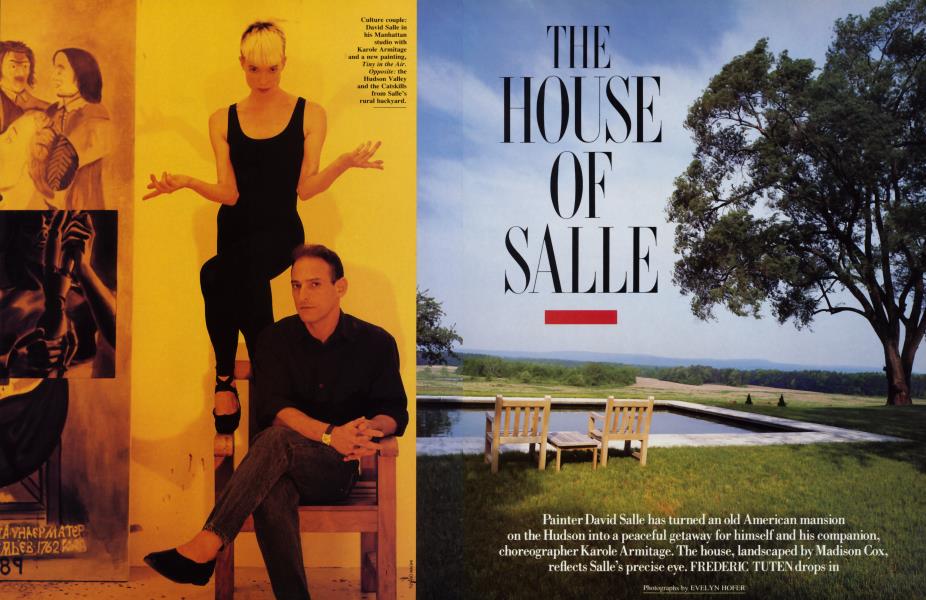
Painter David Salle has turned an old American mansion on the Hudson into a peaceful getaway for himself and his companion, choreographer Karole Armitage. The house, landscaped by Madison Cox, reflects Salle's precise eye. FREDERIC TUTEN drops in
The house was built afew years after Whitman issued his Learn of Grass and Moby Dick had flowed from Melville's pen.
In 1986, David Salle summered in a rented yellow house in Bridgehampton, Long Island. It was a comfortable old house, and at night you could hear the ocean across the dunes. Friends came by often, and David's companion, the choreographer and dancer Karole Armitage, bused in from New York City, where she was rehearsing, staying for weekends or even longer when she and her company were performing nearby. It was a floppy place where you could live off guard in graceful ease, and after people left, you could read through the snug night with the sea as your companion. For all its homeyness, it still had one problem: there was no space large or private enough for David to paint. He ended up renting a studio some distance away, which is fine if you keep, as do some artists, regular working hours, but which is not so convenient when you feel like scumbling paint at 2:15 in the morning. That summer he searched for a house to buy, one large enough for a home, studio, and dance space where Karole could rehearse and train. What David needed was a place spacious enough to stretch to his needs yet still close to Manhattan. But to find such a house in the Hamptons is to require more than a painter's good fortune.
The house David finally bought, near Kinderhook, New York, wears more than a thin coat of history. It was built in the late 1850s, a few years after Walt Whitman issued his Leaves of Grass and Moby Dick had flowed from Melville's pen (at one time, both Hawthorne and Melville lived and wrote in their own homes not far away, in Pittsfield, Massachusetts). You need not know the architectural provenance of Salle's house to feel, as you drive up to it along the private, apple-orchard-lined road, its quiet historical claim. The aura is antebellum, pastoral New England, the center point of the American Renaissance. And the house is but the marrow of the surrounding landscape, a forty-acre enclave in an open, unpopulated stretch of land. The west side of the house looks across a tilled valley and the hill-like Catskills, beyond which runs the Hudson. The river is out of view, an unseen character, but its presence resonates over the terrain and echoes through the house—not the present-day river of rusting barges and sweaty tankers, with factories scarring its banks, but of sloops and sluggish yawls, the virgin, broad, and deep Hudson of Washington Irving and Thomas Cole. Kinderhook, Dutch for "children's corner," is Rip Van Winkle country in reverse: you fall asleep under a great tree, waking to find the pastoral of a century earlier and yourself hopelessly outof-date.
Heedless of all cautions to beware of love at first sight— in real estate as well as in romance—David and Karole fell for the house on their first visit. It reminded them of the grand but mined house they had seen in Satyajit Ray's film The Music Room, a place spacious and empty, where you could live undistractedly. There was room in the house for imagination, and with the help of a Boston architect and a local contractor, David went about turning his ideas into a material ideal of simplicity and restraint.
What began as a simple act of repair, the fixing of porch stairs and other touchings-up, became a major commitment to the house's restoration. To start, David had the ceilings in the living room and kitchen put back to their original height of eleven and a half feet, and uncovered plaster moldings in the main hall and two upstairs rooms. He tore out the kitchen's fluorescent lights, and, with some beaded-tongue-andgroove Douglas fir taken from an old bam, redid the kitchen walls, cleaning and bleaching the wood and bringing it to an antique satin finish—matte, like every painted thing in the house. He reconstructed a screened porch adjoining the master bedroom, enlarged it, and added a few daybeds to accommodate more guests. The interior was painted and repainted several times, until the colors took in David's mind. In what was once the caretaker's wing, he built his studio—spare, white, implacably ascetic.
Houses invite dreams, eat money, and devour time (the rented house is just the nomad's rush hut left behind at the break of camp). In the three years since he bought the Kinderhook house, David has gone through a metamorphosis. In changing from renter to owner, he discovered that what had started as his creating a home in which to work became in itself a work of his creation. The house is another version of his art—elegant, lyrical, formal, and colloquial, a cohering mixture of unexpected elements.
Some of Salle's canvases set painted areas beside materials such as fabrics or wood, or even have chairs, umbrellas, and globes affixed to or suspended from them. The house contains no such radical, disquieting juxtapositions—the furniture is generally sedate, comfortable High Country—but he did cover classic Adirondack twig chairs with pre-Second World War Japanese plaids (which look very much like the plaid trousers the figure of Karole Armitage wears in Salle's 1986 painting of her, Pastel), and illuminate the screened porch facing the Catskills with thirty-two colored light bulbs and two metal-blade ceiling fans, giving the room a hint of a French cafe in the Caribbean.
When David first arrived at his house, he found an anarchy of vegetation. It was the painter Jennifer Bartlett who introduced the garden designer Madison Cox to David, proposing that Cox and he work together in designing the property. It was a successful match—Cox, a soft-spoken man, sharing with David a dream of purpose and reason, the aesthetics of living and growing forms. They might as well have been talking of painting, except that David didn't yet know the identities of all the trees Cox referred to. Sometimes Cox would draw or show David a photo of a tree he had in mind for planting; sometimes the two would go off to nurseries to do the selecting. David took to himself the task of reading and learning all he could, and soon he began thinking in terms of shade, scale, color, shape, volume, perspective. Much of what was planted depended on how a tree or shrub would be seen through a window: For example, a pair of hinoki cypresses was chosen to flank the steps leading away from the back porch because of their particular spiral effect.
Continued on page 276
On their first visit, the house reminded David and Karole of the grand but ruined one they had seen in Satyajit Ray's The Music Room.
Continued from page 214
The fundamental work of restoring and reinventing the house is nearly complete. However, some items still require attention: a bam large enough to accommodate a small family of Piper Cubs stands waiting for its conversion to David's main studio, and Karole's dance space is poised for construction.
While the house itself is virtually finished, as a home away from home it remains in limbo. Both David and Karole work and travel abroad, together and separately, for months on end, and they haven't spent as much time in Kinderhook as they'd like. But last Thanksgiving may have been a preview of the lively character the place will assume.
Having always wanted his house to be a haven for friends, David and Karole invited a few close ones, including members of Karole's company, the artists April Gomik and Eric Fischl, and the anthropologist Dr. Dooley Worth, to stay for a few days. David cooked and fed everyone on a grand scale (there were five different pies for dessert), a bit like in the days when he first came to New York and cooked in a downtown artists' restaurant. Over the weekend, he orchestrated nothing but the meals, tennis matches, and skeet shoots. Strolls, naps, kitchen raids were anarchic affairs. You were also on your own to rummage through David's library, watch videos (Russ Meyer's films seemed always to be ready for projection), or study the few items on the walls—a Fischl oil sketch, a small Alex Katz painting, a Ross Bleckner drawing, another by Terry Winters.
Some fourteen years ago, when David came to live in New York after having finished his M.F.A. at the California Institute of the Arts, there was nothing but his talent to predict what changes he would bring to American art. The late seventies were an uncertain time for painting and for figuration especially. His first one-person show, at the Mary Boone Gallery, in 1981 (along with the shows of his contemporaries Eric Fischl and Julian Schnabel), spelled the return of painting with a freshness of provocative imagery last seen in the canvases of the Pop artists. Salle's swift and continued ascent piqued many who saw only the meteoric rise and not his hard-won originality. His career and life now seem of a piece: rich, varied, brilliant—charmed. Indeed, his house is another facet of that image.
Subscribers have complete access to the archive.
Sign In Not a Subscriber?Join Now


