Sign In to Your Account
Subscribers have complete access to the archive.
Sign In Not a Subscriber?Join NowRICHARD BURTON'S BIG ACT
Books 2
Burtons Notebooks, revealed in Melvyn Braggs new biography, show the superstar's unsuspected side
JOHN LAHR
In his Notebooks, Richard Burton recounts a piece of overheard backstage bitchery about another household name of English acting: "Michael Redgrave is in love with himself, but he's not sure if it's reciprocated." Burton loved the joke and well understood it. He himself was a particularly potent combination of self-congratulation and self-loathing. "I am stupendously disappointed in myself," he confided in one of his Notebooks, which he kept for much of his life and which are quoted extensively for the first time in a new biography by Melvyn Bragg, out this month from Little, Brown. "I am, I think, sublimely selfish." The twelfth of thirteen children, bom Richard Jenkins in 1925 to a feckless Welsh coal miner and a barmaid who died when he was two. Burton inevitably became the object of his own affection, a man blessed with great intellectual and physical gifts who could never be certain he was loved. "I am sure that wherever I go I shall not be wanted," he wrote in an early diary, which he showed to the man who educated him and got him out of the poverty trap of the Welsh valleys and whose surname he took. Burton rampaged through his life, conquering women, the stage, and, as a movie mega-star, the public. In his generation of actors, he was the most gifted, the most famous, and the most lost.
Burton was a man hoist on his own P.R., whose courtship of the public trivialized his talent while it increased his bank balance. He sought fame as a way of controlling life and keeping the world from abandoning him as capriciously as his parents had. He brought to his life a child's sense of wonder and also a child's desire to have everything all the time. "My life," Noel Coward told him, one Swiss tax exile to another, "has been an extravaganza." So too was Burton's. He lived all his adulthood in the glare of publicity and ruefully watched it kill him. He escaped his artistic guilt and the guilt for all those he betrayed for his own self-aggrandizement in what he called "the sweetly melancholy euphoria" of drink. But when sober. Burton sat in fierce and articulate judgment on himself. "I am prosecutor and defender," he wrote in his Notebooks of the dark division in his nature, which was too often displaced as vitriol toward others, "Satan and Saint."
Burton, like all stars, was his own most grandiose creation. From an early age, he styled himself as a hero and lived out a destiny of daring. He was a rambunctious Welsh boyo who talked back to the headmaster, who stepped out with the ladies, who kicked back wartime government coupons to friends when he worked briefly as a haberdasher's assistant, who was an International-standard Rugby player, who had "a knack" for acting. He invented himself and his sense of a future. As a student, Burton was the first member of the Jenkins family to get himself a scholarship to the best local grammar school and later to Oxford. He changed his speech. He changed his family—was adopted by a teacher named Philip Burton, who tutored him both for Oxford and for a life in the theater. (When he was told his father had died, Richard Burton replied, "Which one?") He changed his aspirations. Burton's life was a sensational search for new arenas in which to display his mastery: first as manna giver to his impoverished family, which numbered twenty-nine, then as inspired actor, then as consort to "the most beautiful woman in the world," then as film superstar, and finally, in an unrealized ambition, as writer and academic. Conquest was all that concerned him. "I am a natural winner," said Burton, who became "morose if I'm a loser." Burton seemed always to be pushing at an open door. At Oxford, he was spotted by John Gielgud in his first
show, a production of Measure for Measure. After a stint in the R.A.F., he was signed in 1947 by the West End impresario Binkie Beaumont to a princely £500-a-year contract whether he worked or not. He worked. Burton's rise was meteoric. His talent was as prodigious as his energy. He charmingly summarized the beginning of his lifetime of vindictive triumph: "Came out [of the R.A.F.] on a Monday, in a play on a Tuesday, star on a Wednesday: never looked back."
Burton brought more than his restless and abundant sexuality onto the stage. He was a man of sensibility, an obsessive reader who got through up to three books a day. His interpretations of the big bowwow Shakespearean roles were as bold as his presence. Wrote Kenneth Tynan of Burton's Prince Hal: "His playing. . . turned. . . speculation to awe as soon as he started to speak.. .. Burton is a still brimming pool... at twenty-five he commands a repose and can make silence garrulous." But once Burton had conquered the English stage, become the heir apparent to Olivier and Gielgud, with the pick of the best classical and modem plays, he grew bored. Acting was a knack, but the endless repetition, the waiting, the long runs, the mindless backstage badinage, the fact of being often imprisoned by "tedious lines written by some boring man" took their toll. He was dismissive of theatrical fame. An actor is an interpretive artist, and Burton, the aspiring writer, longed to pronounce himself to the world in more distinctive ways. He found his answer in Elizabeth Taylor.
He encountered Taylor in 1953 on his first trip to Hollywood, in his first visit to a glamorous Hollywood home. In his Notebooks, Burton describes working
the poolside audience with his Welsh charm: "Wet brown arms reached out of the pool and shook my hand. I was enjoying this small social triumph, but then a girl sitting on the other side of the pool lowered her book, took off her sunglasses and looked at me. She was so extraordinarily beautiful that I nearly laughed out loud. . . She sipped some beer and went back to her book. . . . She was lavish. She was a dark unyielding largesse. She was, in short, too bloody much, and not only that, she was totally ignoring me. I became frustrated almost to screaming." From the outset, Taylor was Burton's image of abundance. She was, to the 1 emotionally impoverished Burton,
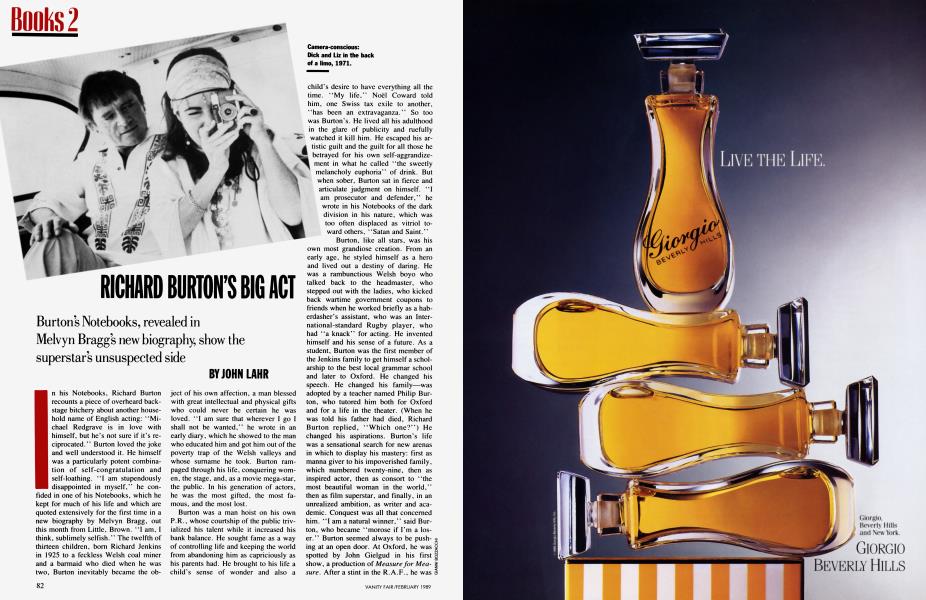
. a mysterious sexual and emotional I cornucopia whose bounty he later described as "a prospectus that can never be catalogued, an almanack for Poor Richard." In love, Burton was fanatical: "You must use everything you possess—hands, fingers, speech . . . always with a demoniacal passion." Their romance, begun while shooting Cleopatra in 1962, was a love that spoke its name in banner headlines around the world. In Congress, a bill was introduced to ban Burton and Taylor from entering the United States. Their scandalous affair and their subsequent sensational ten-year marriage turned them into epic romantic figures acting out a melodrama of their own creation on the world stage. "I'm just a broad," said Taylor, who herself had a piquant turn of phrase, calling her man "the Frank Sinatra of Shakespeare." "I didn't know I was destroying a famous actor." She didn't. Burton's obsession with fame, in which he sought to project an idealized instead of an authentic self to the world, was by its nature self-destructive. Burton's submersion into the world of pure money and pure stardom bore witness not to his dynamism but to his panic, not to a love of life but to a fear of it.
The famous are stars of free enterprise, multinational corporations of one, whose display of wealth dramatizes both their power and their separation from others. Esteem, Veblen said, is awarded on evidence, and the famous show off their spectacular survival through conspicuous waste. No one in the sixties seemed quite as conspicuous as the Burtons in their wastefulness or in their consumption. "I want to be rich, rich, rich," he said, seeking to do in the world what, as a Don Juan, he had once
done to women: make himself "inviolate, untouched." Burton hated being touched, and the enormous wealth that his fame provided maximized the distance between himself and others. In the capitalist sweepstakes, nobody played the game of ownership more flamboyantly than the Burtons, who went through $30 million during their marriage. He bought his "Miss Tits" a jet plane ("She was not displeased"), a yacht, assorted houses and Impressionist paintings. In seeking to reflect his own perfection, Burton wanted Taylor to be "the best" and showered her with important gems, including the Krupp diamond and the Cartier-Burton diamond (a mere $1,050,000). Burton fought with property. "Now the Battle of the Rubies is on," he wrote in the Notebooks after press reports of Aristotle Onassis's gift of rubies to Jackie Kennedy whetted Liz's desire. "I wonder who will win. It will be a long attritive war and the idea has already been implanted that I shouldn't let myself be outdone by a bloody Greek. I can be just as vulgar as he can, I say to myself. Well, now to get the money." Money, not art, gave life a mission and a sure confirmation of prowess. The money was always there, and so was the massive entourage which cocooned them. The Burtons traveled with assorted children, animals, a secretary, the secretary to the secretary, Taylor's personal photographer, hairdresser, makeup man, tutor, governess, nurse, and bodyguard. In this kind of barbarous isolation, no wonder the director Mike Nichols found Burton "the loneliest man I had met" and Burton himself waged a constant war against boredom.
Burton nicknamed Taylor "Ocean." To him she was boundless, oceanic, the concupiscent tart/mother whose beauty awed him as if nothing so beautiful could ever be touched by evil. She taught him to respect film acting, and he taught her to respect her intelligence. In the Notebooks, Burton wonders if "E. and I have the strength of mind to give up being famous." Their minds had nothing to do with it; their egos needed constant confirmation of their omnipotence. They walked through streets and entered restaurants to the applause of strangers. Liz admired a horse owned by the Mexican General Marcelino Garcia Barragan, and he gave it to her. They got studios to rearrange production schedules, and producers to toss in bonuses of jewels or around-the-clock limousines. The Burtons lived for the capitulation of the public to the potency of their presence, and if it was not forthcoming, the Burtons could get stroppy. They inspired envy and fed off it. When Liz made "sheep's eyes" at Frank Sinatra and Old Blue Eyes took no notice, Burton confessed himself "furious that he didn't respond."
The Burtons' romance came to its first end in 1974, when they divorced. The separation, like the seduction, took place in public. Taylor issued a letter to her public that announced their split: "Wish us well. Pray for us." She continued to plead in the press for Burton to return: "I love you, Richard, and I leave it up to you. Please answer." The marriage was a victim of the exhaustion of a life of tyrannical willfulness and winning. "I see nothing ahead of me but long grey waste," Burton wrote in the Notebooks. The Burtons kept the cliffhanger of their romance going in 1975 when they reconciled and briefly remarried. It didn't work. Both sought escape in their chronic boozing from the boredom of life without a struggle. Taylor herself suffered poor health and grew addicted to drugs. Her career was faltering, while Burton's popularity was on the upswing. They divorced again, and what Burton called his "Elizabethan period" was finally and forever over.
There were still headlines to be grabbed and honors to be received, but they were never quite satisfactory. Burton, who said the only award he wanted was a D. Litt. and to be a Fellow of All Souls, Oxford, ended up being made a Commander of the British Empire (C.B.E.) and "disappointed" that it was not "the bigger prize" of a knighthood. Along with Peter O'Toole, he was the most nominated actor for an Academy Award (seven times) never to win one. Burton wanted to write with the acerbity and elegance of Evelyn Waugh, but he never faced up to the writer's challenge of solitary perseverance. (From the evidence of Burton's Notebooks, he had more energy than ability.) He made two more marriages and a handful of movies. But mostly he drank, escaping the emptiness of a life of self-aggrandizement. He died in 1984 at the age of fiftyeight. Beside his bed was a notepad on which, before his brain hemorrhaged, he'd written, "Our revels now are ended." Burton's life had been one long revel. He never lost his fame, but in pursuing it he'd lost his soul. Fame was the Faustian bargain, the passport to the good life that belittled human endeavor while seeming to epitomize it. "I am Faustus," he said. It was yet another of Burton's grandiose notions that to his cost came true.
Subscribers have complete access to the archive.
Sign In Not a Subscriber?Join Now

