


Sign In to Your Account
Subscribers have complete access to the archive.
Sign In Not a Subscriber?Join NowEditor's Letter
Searching for the Real Winnie
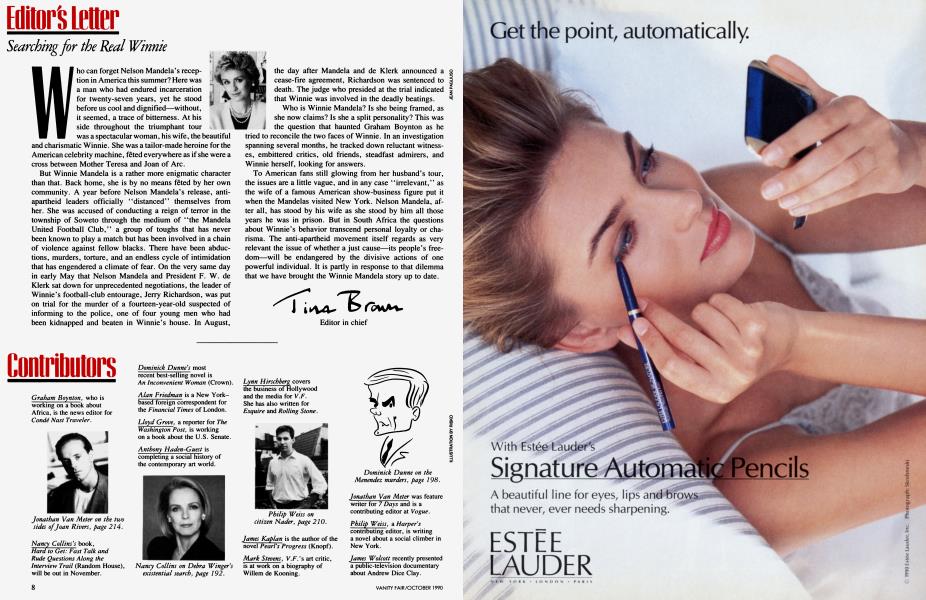
Who can forget Nelson Mandela's reception in America this summer? Here was a man who had endured incarceration for twenty-seven years, yet he stood before us cool and dignified—without, it seemed, a trace of bitterness. At his side throughout the triumphant tour was a spectacular woman, his wife, the beautiful and charismatic Winnie. She was a tailor-made heroine for the American celebrity machine, feted everywhere as if she were a cross between Mother Teresa and Joan of Arc.
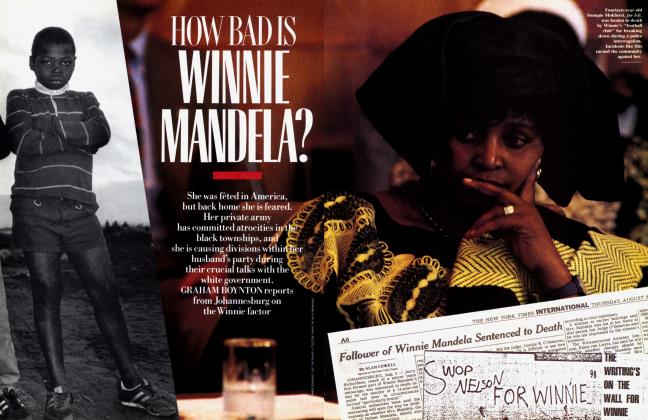
But Winnie Mandela is a rather more enigmatic character than that. Back home, she is by no means feted by her own community. A year before Nelson Mandela's release, antiapartheid leaders officially "distanced" themselves from her. She was accused of conducting a reign of terror in the township of Soweto through the medium of "the Mandela United Football Club," a group of toughs that has never been known to play a match but has been involved in a chain of violence against fellow blacks. There have been abductions, murders, torture, and an endless cycle of intimidation that has engendered a climate of fear. On the very same day in early May that Nelson Mandela and President F. W. de Klerk sat down for unprecedented negotiations, the leader of Winnie's football-club entourage, Jerry Richardson, was put on trial for the murder of a fourteen-year-old suspected of informing to the police, one of four young men who had been kidnapped and beaten in Winnie's house. In August, the day after Mandela and de Klerk announced a cease-fire agreement, Richardson was sentenced to death. The judge who presided at the trial indicated that Winnie was involved in the deadly beatings.
Who is Winnie Mandela? Is she being framed, as she now claims? Is she a split personality? This was the question that haunted Graham Boynton as he tried to reconcile the two faces of Winnie. In an investigation spanning several months, he tracked down reluctant witnesses, embittered critics, old friends, steadfast admirers, and Winnie herself, looking for answers.
To American fans still glowing from her husband's tour, the issues are a little vague, and in any case "irrelevant," as the wife of a famous American show-business figure put it when the Mandelas visited New York. Nelson Mandela, after all, has stood by his wife as she stood by him all those years he was in prison. But in South Africa the questions about Winnie's behavior transcend personal loyalty or charisma. The anti-apartheid movement itself regards as very relevant the issue of whether a just cause—its people's freedom—will be endangered by the divisive actions of one powerful individual. It is partly in response to that dilemma that we have brought the Winnie Mandela story up to date.
Editor in chief
Subscribers have complete access to the archive.
Sign In Not a Subscriber?Join Now