Sign In to Your Account
Subscribers have complete access to the archive.
Sign In Not a Subscriber?Join NowTHE NEIL BUSH BAILOUT
How did Neil Bush buy so easily into the Denver establishment? And why was Washington so slow to blow the whistle on Silverado?
ALAN FRIEDMAN
Letter from Denver
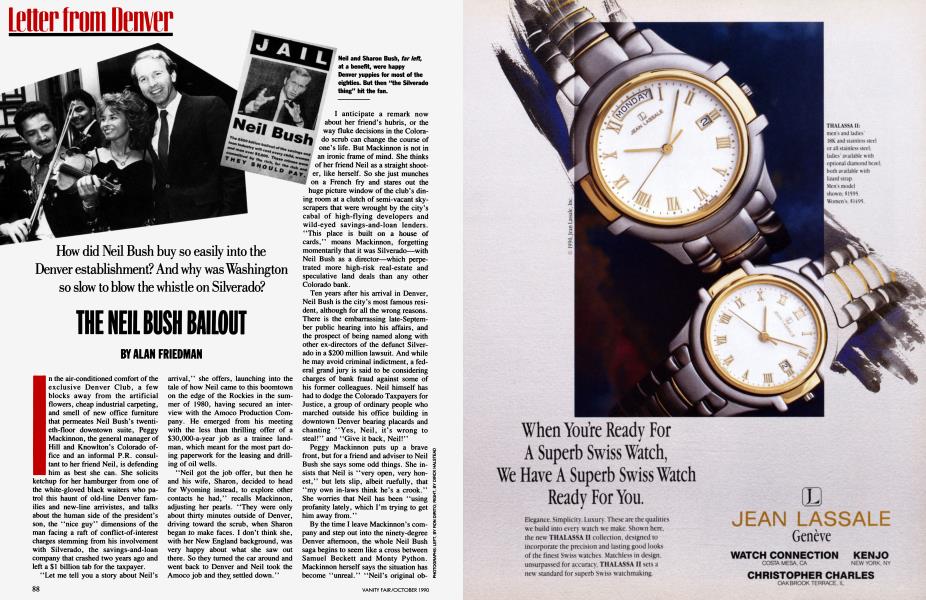
In the air-conditioned comfort of the exclusive Denver Club, a few blocks away from the artificial flowers, cheap industrial carpeting, and smell of new office furniture that permeates Neil Bush's twentieth-floor downtown suite, Peggy Mackinnon, the general manager of Hill and Knowlton's Colorado office and an informal P.R. consultant to her friend Neil, is defending him as best she can. She solicits ketchup for her hamburger from one of the white-gloved black waiters who patrol this haunt of old-line Denver families and new-line arrivistes, and talks about the human side of the president's son, the "nice guy" dimensions of the man facing a raft of conflict-of-interest charges stemming from his involvement with Silverado, the savings-and-loan company that crashed two years ago and left a $1 billion tab for the taxpayer.
"Let me tell you a story about Neil's arrival," she offers, launching into the tale of how Neil came to this boomtown on the edge of the Rockies in the summer of 1980, having secured an interview with the Amoco Production Company. He emerged from his meeting with the less than thrilling offer of a $30,000-a-year job as a trainee landman, which meant for the most part doing paperwork for the leasing and drilling of oil wells.
"Neil got the job offer, but then he and his wife, Sharon, decided to head for Wyoming instead, to explore other contacts he had," recalls Mackinnon, adjusting her pearls. "They were only about thirty minutes outside of Denver, driving toward the scrub, when Sharon began to make faces. I don't think she, with her New England background, was very happy about what she saw out there. So they turned the car around and went back to Denver and Neil took the Amoco job and they settled down."
I anticipate a remark now about her friend's hubris, or the way fluke decisions in the Colorado scrub can change the course of one's life. But Mackinnon is not in an ironic frame of mind. She thinks of her friend Neil as a straight shooter, like herself. So she just munches on a French fry and stares out the huge picture window of the club's dining room at a clutch of semi-vacant skyscrapers that were wrought by the city's cabal of high-flying developers and wild-eyed savings-and-loan lenders. "This place is built on a house of cards," moans Mackinnon, forgetting momentarily that it was Silverado—with Neil Bush as a director—which perpetrated more high-risk real-estate and speculative land deals than any other Colorado bank.
Ten years after his arrival in Denver, Neil Bush is the city's most famous resident, although for all the wrong reasons. There is the embarrassing late-September public hearing into his affairs, and the prospect of being named along with other ex-directors of the defunct Silverado in a $200 million lawsuit. And while he may avoid criminal indictment, a federal grand jury is said to be considering charges of bank fraud against some of his former colleagues. Neil himself has had to dodge the Colorado Taxpayers for Justice, a group of ordinary people who marched outside his office building in downtown Denver bearing placards and chanting "Yes, Neil, it's wrong to steal!" and "Give it back, Neil!"
Peggy Mackinnon puts up a brave front, but for a friend and adviser to Neil Bush she says some odd things. She insists that Neil is "very open, very honest," but lets slip, albeit ruefully, that "my own in-laws think he's a crook." She worries that Neil has been "using profanity lately, which I'm trying to get him away from."
By the time I leave Mackinnon's company and step out into the ninety-degree Denver afternoon, the whole Neil Bush saga begins to seem like a cross between Samuel Beckett and Monty Python. Mackinnon herself says the situation has become "unreal." "Neil's original objective," she told me with utter sincerity, "was to go into politics, but I guess his objective has now changed." Indeed, he doesn't seem to have a politician's instincts. His choice of words is unerringly unfortunate. For instance, he admitted that the $100,000 loan he accepted from Ken Good, a land developer who was his business partner and later one of Silverado's biggest borrowers, was "an incredibly sweet deal." Good forgave the loan six years ago, but Neil Bush only recently decided to declare it on his 1990 income-tax return. The "sweet deal" gaffe followed a similar blooper before a congressional committee when he acknowledged that the $100,000 loan "sounds a little fishy."
Mackinnon broke into a laugh when I told her that Neil's lawyer sayS the reason the loan was canceled formally for tax purposes six years after it was actually forgiven was that "they didn't even think about it."
"Politics," said Neil's friend, "is all about favors. I mean, nobody would give me a $100,000 loan. But I'm not here to pass judgment."
If the third son of George and Barbara Bush has become the reluctant symbol of America's $500 billion savingsand-loan scandal—the biggest stickup in U.S. financial history—he appears to have no one to blame but himself. In downtown Denver, the consensus is that while Neil Bush may be a genuinely "nice guy" he was also an enthusiastic, albeit small-time, player in the greedy and speculative Far West of American finance that reigned supreme in the 1980s.
During the eighties, Denver provided the garish and shimmering skyline for the opening sequence of Dynasty, the TV serial about western financial follies. Today the city is a pale, if sun-washed, shadow of that once confident self, but its incestuous political and business practices remain pretty much intact. "This is a very small state," drawls Wally Stealey, one of Colorado's shrewdest political consultants, a selfstyled "cowboy Democrat" with white hair and a whale of a paunch. "We're all jes' mixed together here in one saltand-pepper shaker."
The salt-and-pepper shaker that is Denver wants very much to be a modem metropolis, but this city of half a million people (the number jumps to 1.8 million if outlying towns are included) is still, as one departed Denverite puts it, "a cow town with skyscrapers." Like the office tower that houses the United Bank of Denver, the biggest commercial bank in the state, which seems to symbolize Denver's aesthetic and business values. Designed by Philip Johnson in the shape of a fifty-two-story rose-colored cash register, the building has elevators that are lined with marble slabs, each explicitly labeled as coming from Sicily or Spain. It suffered the architectural indignity in 1985 of having a fourteen-storyhigh glass atrium, also cash-registershaped, fastened onto it as a bridge to an adjoining edifice that had been designed by I. M. Pei in the 1950s.
Indeed, the changes that have occurred in Denver over the past ten to fifteen years are incredible, in some ways more radical than the modernities wrought in bombed-out German and Japanese cities during the postwar era.
The old Denver is another matter. It is typified by the stately Brown Palace Hotel, an extraordinary triangular structure built of Colorado red granite in 1892, just before the great Silver Panic bankrupted its backers the way the real-estate crisis struck in the 1980s. Here one finds Denver ladies taking their afternoon tea to the strains of harp music in a Victorian atrium that sweeps upward past six tiers of wrought-iron balconies to a 2,800-square-foot stained-glass ceiling.
The Old Guard of Denver likes to meet for a drink at the Brown Palace or luncheon at Ellyngton's, one of the hotel's restaurants. Ellyngton's is just a stone's throw from Seventeenth Street, the Establishment's financial district. Seventeenth Street houses the red brick fortress of Boettcher & Company, the city's quintessential^ conservative old investment firm, as well as the Ioniccolumned Colorado National Bank. The old Denver used to see all its leading financiers ambling along Seventeenth Street; Marvin Davis, the wealthy oilman who left for Hollywood a few years ago, would stand on a comer chatting with his friends. And as recently as the 1960s the chairmen of two large banks met for lunch each Wednesday and amiably set interest rates between themselves.
In the late 1970s and early 1980s, howlever, the Old Guard of Denver was challenged by a renegade establishment of developers, bankers, lawyers, political fixers, and assorted influence peddlers. Two of the most prominent newcomers were both highly visible Denver Jews who riled the old Wasp crowd and may have even triggered a bit of anti-Semitism. Their names were Norman Brownstein and Larry Mizel, the former being a hugely influential real-estate lawyer and political fund-raiser, mainly for pro-Israeli causes and Democrats such as Gary Hart, and the latter being a supporter of both Ronald Reagan and George Bush. Mizel is the chairman of M.D.C. Holdings, a Wall Street-listed company that was a major Silverado shareholder and the target of a probe by the Securities and Exchange Commission.
Neil Bush wanted to get rich quick and prove himself to his family. And Denver's high-flying developers saw him coming.
A year ago the S.E.C. levied sanctions against M.D.C. for failing to account properly for profits from several land deals. M.D.C. engaged in a variety of transactions with Silverado, including selling it, between 1984 and 1988, 5,900 homesites, hundreds of acres of empty land, and more than $100 million worth of mortgage loans. M.D.C. invested millions in Silverado, mainly by handing over speculative real estate such as the above. Some of these transactions were alleged to be "daisy chain'' deals—a claim emphatically denied by M.D.C.—that allowed Silverado and real-estate developers to shunt semiworthless real estate back and forth at inflated prices in order to show a profit on paper.
Larry Mizel, a wirehaired terrier of a man with tousled gray hair and a passion for cocktail parties, tried to buy control of Silverado before the bank was shut down by federal regulators in December 1988. Representative Henry Gonzalez, chairman of the House Banking Committee, said Mizel's M.D.C. was "integrally involved" with Silverado. But then, M.D.C. also had extensive dealings with the California-based Lincoln Savings, the thrift that crashed with a $2 billion price tag for taxpayers, having been pumped up by the notorious Charles Keating, benefactor of five U.S. senators known as "the Keating Five."
In 1986, Mizel staged a luncheon fund-raiser in Denver that honored President Reagan and raised a cool $1 million. And as recently as last December he hosted another fund-raiser that was attended by President Bush, with son Neil at the head table, and, surprisingly enough, Neil's former oil-company partner Bill Walters, who was also a top Silverado borrower and grand defaulter and whose dealings form the basis of one of the government's conflict-of-interest charges against Neil.
Denver's ' ' salt-and-pepper shaker' ' effect is well illustrated by the interaction of the players in the Silverado affair and their associates. Norman Brownstein, a friend of former junk-bond king Mike Milken's, has been an active member, along with Larry Mizel, of the Alliance for Capital Access, a Washington trade association and lobbying group for junksters. Brownstein is also a member of the board of Mizel's M.D.C., for whom Milken's Drexel Burnham Lambert raised $700 million in junk bonds, and his firm has at times represented both Ken Good and Bill Walters. Brownstein serves as a trustee of several of Ken Good's private trusts arid was a member of the board of Good's Florida real-estate business until earlier this year. From 1983 until 1988, when Silverado was seized by the government, Brownstein's law firm did work on a series of real-estate-loan transactions for Silverado. The firm meanwhile earned $2.2 million in fees from 1984 to 1988 thanks to M.D.C.
In August, state investigators
launched a probe into improper campaign contributions allegedly made by M.D.C. executives at the local and national levels by laundering the money through some of the company's subcontractors, who then submitted phony bills to M.D.C. and were reimbursed. The subcontractors say they were forced by M.D.C. to make the payments or lose M.D.C. business. All of this occurred at a time when Silverado and M.D.C. owned a prime 877-acre parcel of land that straddles the planned main access road to Denver's new $2.9 billion airport, and it is alleged that the campaign contributions were to encourage politicians to make sure the new airport used the land.
M.D.C. denies this and claims it is conducting its own investigation of the laundered contributions, but according to The Denver Post Mizel "acts as if he is bulletproof because he raises so much money for Republicans in power." Indeed, Mizel's political clout was symbolized on a Saturday morning two years ago when Denver mayor Federico Pena, Colorado governor Roy Romer, U.S. Senators Tim Wirth and Bill Armstrong, and State Senate president Ted Strickland all gathered at an east-Denver synagogue to celebrate... the Bar Mitzvah of Mizel's thirteen-year-old son, Cheston.
How did Neil Bush fit into the "saltand-pepper shaker" atmosphere of contemporary Denver? Pretty well, it appears. Never mind that his own lawyer now says that "Neil had trouble understanding the difference between accounting methods used at Silverado. He never did understand all that financial stuff." When Bush arrived in Denver he was welcomed with open arms.
Marvin Buckels, a senior executive at the parent company of Bank Western, one of the few well-managed thrifts, is as conservative a banker as they come. He points out that Neil Bush "didn't have a business reputation; he had a name." Buckels says Neil was immediately surrounded by sharks. "He was the darling of the young, yuppie social set, the local charity-ball set. He and his wife both photographed well at cocktails." Neil and Sharon's set included the Brownsteins, the Walterses, the Goods, and several leading "up-and-comers" in town. When Neil withdrew last year from JNB Exploration, the oil company he had formed in 1983, he moved temporarily into offices at Norman Brownstein's law firm. When Neil bought a new $550,000 house in the exclusive Cherry Hills section of Denver last fall, he bought it from a company then controlled by Mizel's M.D.C. Last December, Neil and Sharon were spotted arriving in the company of Mr. and Mrs. Norman Brownstein and Mr. and Mrs. Larry Mizel at Collector's Choice, a tony party to benefit the Denver Art Museum. Friends say the joint arrival was a mere coincidence, but in any case the Brownsteins and the Mizels are very much a part of the company Neil began to keep shortly after he and Sharon turned their car around in 1980 and decided to settle in Denver. Neil wanted to get rich quick and prove himself to his family. And Denver's high-flying developers saw him coming.
"Neil's original objective," says a friend, "was to go into politics, but I guess his objective has now changed."
Bill Walters and Kenneth Good, both former clients of Norman Brownstein's firm, were the original investors in JNB Exploration, which drilled thirty dry holes before Neil pulled out. Walters, who at one time claimed his net worth was $200 million and whose supposedly poverty-stricken default is somewhat in question now that he has been found to be living in the lap of luxury in Southern California—in houses registered in his wife's name— was Mr. Magic in Denver. Good, whose Dynasty-style tastes led him to build a $10 million mansion with an indoor tennis court, was another high roller. An Aspen-based friend of Good and Walters remembers that the two were once $100,000 apart on a property Walters was buying from Good. "They settled the difference in a Las Vegas casino when Good suggested they just cut a deck of cards for the money."
Lawrence Phipps III, the bespectacled fifty-six-year-old scion of one of Denver's oldest old-money families (his grandfather worked with Andrew Carnegie and J. P. Morgan when U.S. Steel was put together in 1901, and his family used to own the Denver Broncos), scoffs at people like Good and Walters. "They weren't Seventeenth Street. Never ever." Phipps recalls Good coming to him with a series of proposals in the late seventies and early eighties. "He was in default then and didn't know what to do. He had a turkey piece of land out by the County Line Road, a thousand acres. Good said I could take over his position and he'd reward me with some cash and then take over a problem property I had myself. It was supposed to be the old switcheroo. My problem was that I was just too well known for switcheroo deals." The deal wouldn't have been illegal, but the genteel Phipps showed Ken Good the door.
By 1985, when Bush was offered a spot on the Silverado board by Michael Wise, the company's chairman, the Denver real-estate market was heading for collapse, and nearly a third of downtown office space was vacant. But Silverado was continuing to lend, sometimes on condition that borrowers take out an extra-large loan and reinvest part of the money in the bank by using it to buy stock. This helped to bankrupt some of the loan-for-stock land speculators, while it artificially inflated Silverado's net worth, even though with the bank's own money.
A friend of Bill Walters, who was able to ride out the local recession only by teaming up with Silverado on more than $200 million worth of deals, describes Neil's role on the board as "strictly window dressing," but the Office of Thrift Supervision in Washington has accused him of more than that. Neil will have to respond in public to the charge that while a Silverado director between August 1985 and August 1988 he voted rather than abstained on Silverado loans to Walters that totaled $106 million. Walters was financing Neil's JNB business at the time, both as a direct investor and by way of a $1.75 million line of credit from the Cherry Creek National Bank, which he controlled. (This August, Cherry Creek itself was declared insolvent and sold. Federal regulators attributed the bank's wreckage to problems stemming from the Walters era.)
The second charge against Bush is that in 1986 he lobbied Silverado for a $900,000 line of credit for Ken Good that would have directly benefited an oil venture in Argentina he and Good were planning.
The third and perhaps most serious charge is that in December 1986 Silverado allowed Ken Good to default on $ 11 million in loans and make only a $3 million cash payment to the bank to settle. While Neil Bush didn't vote on this transaction, he did sit in on the board meeting in which it took place, and he somehow neglected to mention to his fellow Silverado directors that Good had meanwhile offered him another $3 million in investment in his oil company. Neil's lawyer argues that "the information wasn't material." A little over a year later, however, Neil's ties to Good expanded when he joined the board of Gulfstream, Good's Florida real-estate company.
Neil Bush claims today that he never traded on his name in the incestuous world of Denver business. He even claims he employed something he calls the Smith Smell Test to evaluate whether a deal would be offered to him if his name were Neil Smith rather than Bush. But he clearly enjoyed being the vice president's son, and, if one listens to Jim Nesland, his lawyer, he doesn't mind being a son of the president, either.
"I'll give you an example of what Neil is like," says Nesland, a slick South Dakotan who describes himself as a "loner" and walks with a swagger that matches his western roots. "We were walking from the White House across Lafayette Park a few months ago and suddenly Neil stopped and began chatting with ordinary people for thirty or forty minutes.
Continued on page 109
Continued from page 100
He approached them and said, 'Hi! I'm the president's son. Nice to meet you!' He's just really friendly."
Neil may be friendly, but then, so were the savings-and-loan regulators at the Federal Home Loan Bank in Topeka, Kansas, the regional regulators charged with monitoring Silverado. Although the F.H.L.B. found a horrendous situation as early as 1986—87 and imposed stiff conditions on Silverado, it has been alleged that the presence of Neil Bush on the board caused them to go easy. James Moroney, a former supervisory analyst at the F.H.L.B., claimed last year that Silverado was insolvent as far back as 1986. He said his district superiors' concern about Neil Bush "was a material part of unconscionable delays in taking over Silverado."
Mowbray's failed memory has been described as the Silverado equivalent of the erased eighteen minutes on the Watergate tapes.
One man who ought to know something about this is Kermit Mowbray, the former president of the Topeka branch of the F.H.L.B. So good were relations between Mowbray's regulatory agency and Silverado that Silverado chairman Mike Wise, who also hailed from Kansas, was named to the F.H.L.B. board.
Seated in the living room of his modest two-story house in Topeka, Mowbray insists he has never met Neil Bush. Acutely sensitive to criticism that he was lax in his dealings with Silverado, Mowbray, who was fired as F.H.L.B. president shortly after Silverado was closed in December 1988, vehemently denies that Bush's presence on the board of the Denver thrift had anything to do with "what we did or did not do." Neil Bush had resigned from Silverado in August 1988, explaining later that since the thrift was under regulatory scrutiny "I didn't want the regulators to feel my presence on the board would have any impact on their progress going forward."
Mowbray became famous in this story when he testified under oath last June that officials in Washington had phoned his office with orders to wait for forty-five days in 1988—until after Election Day—before closing down Silverado. The delay was ordered despite an urgent request in late October from the Colorado state S&L commissioner to seize the thrift immediately. Silverado had been officially bust since August, with a $62 million negative net worth and $198 million in previously undisclosed losses.
Mowbray, who was subpoenaed to testify in front of the House Banking Committee after refusing to appear voluntarily, said he could not remember who in Washington made the call. In the
event, he forwarded the recommendation that Silverado be placed into receivership just one day after George Bush was elected president.
The gray-haired fifty-six-year-old Mowbray seems worn down by all the talk of lawyers, congressional committees, and Neil Bush. Clad in a blue-andgreen checked shirt and khaki trousers, he serves up a mug of coffee, tells Jock, his large black poodle, to keep quiet, and settles back onto a couch, looking wary, skeptical, and nervous. His recollection is that the call from Washington was taken by one of his senior aides and that he accepted the request for a delay at "face value."
Mowbray, whose failed memory has been described by some as the Silverado equivalent of the erased eighteen minutes of White House tape recordings in the Watergate saga, recollects that the call came in late October. His other recollections about what he was doing in late October 1988 are anything but fuzzy: he remembers spending a couple of days at a meeting of bankers in Boston, then going with his wife to Honolulu for three days of vacation just before the start of the Hawaii meeting of the U.S. League of Savings Institutions, and
later returning to Kansas and being hospitalized for knee surgery. But he says the call from Washington, which came just before he set out on his travels, was taken by a supervisory agent. Wouldn't the aide have poked his head into Mowbray's office and told him about a call of such importance? ''He might have." And wouldn't he have mentioned whom the call came from? ''He might have." And was the call an innocent bureaucratic matter or part of a political cover-up? Mowbray shuffles restlessly on the sofa and then allows that ' 'there is the possibility that somebody in Washington requested we hold off to protect somebody lower down." And did that happen? "It is possible that it was politically motivated, but I still believe it was not," he insists.
Aside from the burning question of whether anyone in Washington tried to cover up the extent of the Silverado mess until after the 1988 presidential election, the other lingering political question is whether anyone in Washington tipped off officials at Silverado that the government was planning to step in on December 9, 1988. S&L regulators last year asked the Justice Department to investigate allegations that Stuart Root, who headed the Federal Savings and Loan Insurance Corp., might have given advance word of the seizure to Silverado. Root has denied doing so. Kermit Mowbray says he has no idea if the Silverado gang was alerted that the Feds were about to shut them down, but he is aware of concern that someone may have done just that.
Confusion, conflict-of-interest charges, and a lack of total recall: these are the ingredients of the allAmerican mystery that has wrecked Neil Bush's tenth Denver summer. And while Saddam Hussein has taken the public's mind off Silverado and the S&L crisis temporarily, there are few who think the issue will just go away, especially since midterm elections are coming up in November.
What did Neil Bush know about the concept of conflict of interest and when did he know it? Who made the call from Washington that delayed the seizure of Silverado until just after George Bush was elected president, and was it mere bureaucracy or a bona fide cover-up? The answers to these questions may be found in the corridors of Washington, but they are just as likely to lie in the great expanse of the American heartland, in proud old cow towns with names like Denver and Topeka.
Subscribers have complete access to the archive.
Sign In Not a Subscriber?Join Now


