




Sign In to Your Account
Subscribers have complete access to the archive.
Sign In Not a Subscriber?Join NowDull Poets Society
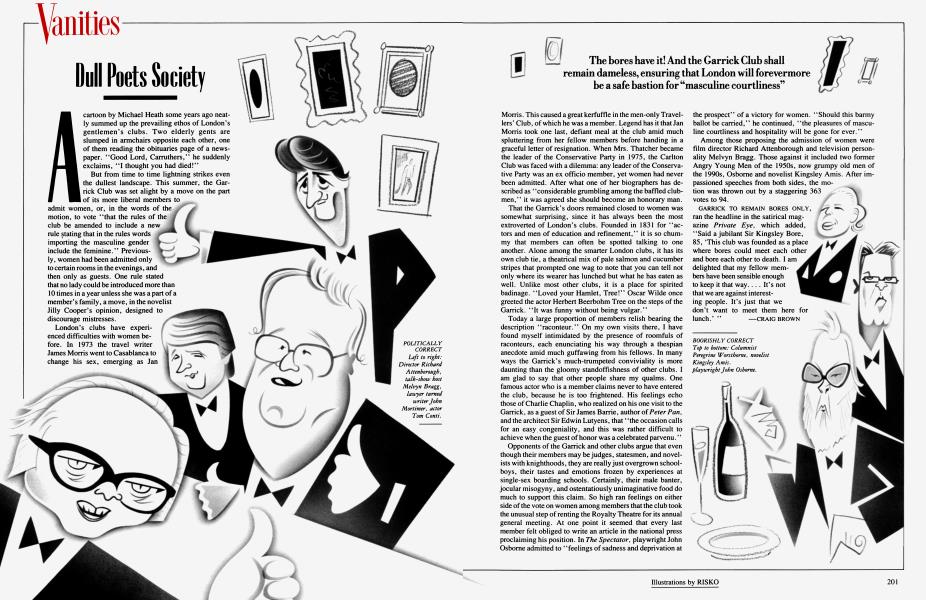
A cartoon by Michael Heath some years ago neatly summed up the prevailing ethos of London's gentlemen's clubs. Two elderly gents are slumped in armchairs opposite each other, one of them reading the obituaries page of a newspaper. "Good Lord, Carruthers," he suddenly exclaims, "I thought you had died!''
But from time to time lightning strikes even the dullest landscape. This summer, the Garrick Club was set alight by a move on the part of its more liberal members to admit women, or, in the words of the motion, to vote "that the rules of the club be amended to include a new rule stating that in the rules words importing the masculine gender include the feminine." Previously, women had been admitted only to certain rooms in the evenings, and then only as guests. One rule stated that no lady could be introduced more than 10 times in a year unless she was a part of a member's family, a move, in the novelist Jilly Cooper's opinion, designed to discourage mistresses.
London's clubs have experienced difficulties with women before. In 1973 the travel writer James Morris went to Casablanca to change his sex, emerging as Jan Morris. This caused a great kerfuffle in the men-only Travellers' Club, of which he was a member. Legend has it that Jan Morris took one last, defiant meal at the club amid much spluttering from her fellow members before handing in a graceful letter of resignation. When Mrs. Thatcher became the leader of the Conservative Party in 1975, the Carlton Club was faced with a dilemma: any leader of the Conservative Party was an ex officio member, yet women had never been admitted. After what one of her biographers has described as ' 'considerable grumbling among the baffled clubmen," it was agreed she should become an honorary man.
The bores have it! And the Garrick Club shall remain dameless, ensuring that London will forevermore be a safe bastion for "masculine courtliness"
That the Garrick's doors remained closed to women was somewhat surprising, since it has always been the most extroverted of London's clubs. Founded in 1831 for ''actors and men of education and refinement," it is so chummy that members can often be spotted talking to one another. Alone among the smarter London clubs, it has its own club tie, a theatrical mix of pale salmon and cucumber stripes that prompted one wag to note that you can tell not only where its wearer has lunched but what he has eaten as well. Unlike most other clubs, it is a place for spirited badinage. ''Loved your Hamlet, Tree!" Oscar Wilde once greeted the actor Herbert Beerbohm Tree on the steps of the Garrick. ''It was funny without being vulgar."
Today a large proportion of members relish bearing the description ''raconteur." On my own visits there, I have found myself intimidated by the presence of roomfuls of raconteurs, each enunciating his way through a thespian anecdote amid much guffawing from his fellows. In many ways the Garrick's much-trumpeted conviviality is more daunting than the gloomy standoffishness of other clubs. I am glad to say that other people share my qualms. One famous actor who is a member claims never to have entered the club, because he is too frightened. His feelings echo those of Charlie Chaplin, who realized on his one visit to the Garrick, as a guest of Sir James Barrie, author of Peter Pan, and the architect Sir Edwin Lutyens, that "the occasion calls for an easy, congeniality, and this was rather difficult to achieve when the guest of honor was a celebrated parvenu. ' '
Opponents of the Garrick and other clubs argue that even though their members may be judges, statesmen, and novelists with knighthoods, they are really just overgrown schoolboys, their tastes and emotions frozen by experiences at single-sex boarding schools. Certainly, their male banter, jocular misogyny, and ostentatiously unimaginative food do much to support this claim. So high ran feelings on either side of the vote on women among members that the club took the unusual step of renting the Royalty Theatre for its annual general meeting. At one point it seemed that every last member felt obliged to write an article in the national press proclaiming his position. In The Spectator, playwright John Osborne admitted to "feelings of sadness and deprivation at the prospect" of a victory for women. "Should this barmy ballot be carried," he continued, "the pleasures of masculine courtliness and hospitality will be gone for ever."
Among those proposing the admission of women were film director Richard Attenborough and television personality Melvyn Bragg. Those against it included two former Angry Young Men of the 1950s, now grumpy old men of the 1990s, Osborne and novelist Kingsley Amis. After impassioned speeches from both sides, the motion was thrown out by a staggering 363 votes to 94.
GARRICK TO REMAIN BORES ONLY, ran the headline in the satirical magazine Private Eye, which added, "Said a jubilant Sir Kingsley Bore, 85, 'This club was founded as a place where bores could meet each other and bore each other to death. I am delighted that my fellow members have been sensible enough to keep it that way. ... It's not that we are against interesting people. It's just that we don't want to meet them here for lunch.' "
CRAIG BROWN
Subscribers have complete access to the archive.
Sign In Not a Subscriber?Join Now
