Sign In to Your Account
Subscribers have complete access to the archive.
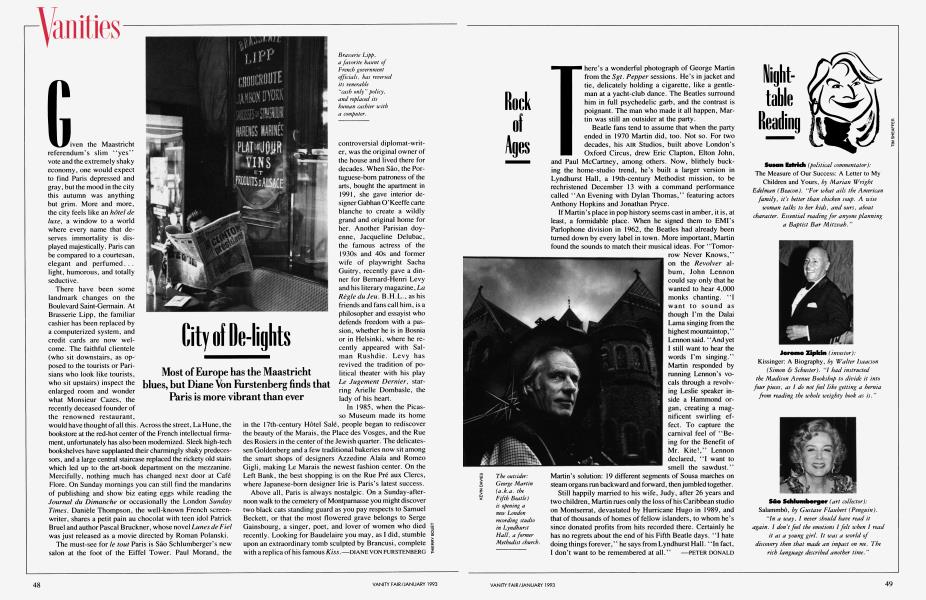
Sign In Not a Subscriber?Join NowCity of De-lights
Most of Europe has the Maastricht blues but Diane Von Furstenberg finds that Paris is more vibrant than ever
Civen the Maastricht referendum's slim "yes" vote and the extremely shaky economy, one would expect to find Paris depressed and gray, but the mood in the city this autumn was anything but grim. More and more, the city feels like an hotel de luxe, a window to a world where every name that deserves immortality is displayed majestically. Paris can be compared to a courtesan, elegant and perfumed... light, humorous, and totally seductive.
There have been some landmark changes on the Boulevard Saint-Germain. At Brasserie Lipp, the familiar cashier has been replaced by a computerized system, and credit cards are now welcome. The faithful clientele (who sit downstairs, as opposed to the tourists or Parisians who look like tourists, who sit upstairs) inspect the enlarged room and wonder what Monsieur Cazes, the recently deceased founder of the renowned restaurant, would have thought of all this. Across the street, La Hune, the bookstore at the red-hot center of the French intellectual firmament, unfortunately has also been modernized. Sleek high-tech bookshelves have supplanted their charmingly shaky predecessors, and a large central staircase replaced the rickety old stairs which led up to the art-book department on the mezzanine. Mercifully, nothing much has changed next door at Cafe Flore. On Sunday mornings you can still find the mandarins of publishing and show biz eating eggs while reading the Journal du Dimanche or occasionally the London Sunday Times. Daniele Thompson, the well-known French screenwriter, shares a petit pain au chocolat with teen idol Patrick Bruel and author Pascal Bruckner, whose novel Lunes de Fiel was just released as a movie directed by Roman Polanski.
The must-see for le tout Paris is Sao Schlumberger's new salon at the foot of the Eiffel Tower. Paul Morand, the controversial diplomat-writer, was the original owner of the house and lived there for decades. When Sao, the Portuguese-bom patroness of the arts, bought the apartment in 1991, she gave interior designer Gabhan O'Keeffe carte blanche to create a wildly grand and original home for her. Another Parisian doyenne, Jacqueline Delubac, the famous actress of the 1930s and 40s and former wife of playwright Sacha Guitry, recently gave a dinner for Bemard-Henri Levy and his literary magazine, La Regie du Jeu. B.H.L., as his friends and fans call him, is a philosopher and essayist who defends freedom with a passion, whether he is in Bosnia or in Helsinki, where he recently appeared with Salman Rushdie. Levy has revived the tradition of political theater with his play Le Jugement Dernier, starring Arielle Dombasle, the lady of his heart.
In 1985, when the Picasso Museum made its home in the 17th-century Hotel Sale, people began to rediscover the beauty of the Marais, the Place des Vosges, and the Rue des Rosiers in the center of the Jewish quarter. The delicatessen Goldenberg and a few traditional bakeries now sit among the smart shops of designers Azzedine Alaia and Romeo Gigli, making Le Marais the newest fashion center. On the Left Bank, the best shopping is on the Rue Pre aux Clercs, where Japanese-born designer Irie is Paris's latest success.
Above all, Paris is always nostalgic. On a Sunday-afternoon walk to the cemetery of Montparnasse you might discover two black cats standing guard as you pay respects to Samuel Beckett, or that the most flowered grave belongs to Serge Gainsbourg, a singer, poet, and lover of women who died recently. Looking for Baudelaire you may, as I did, stumble upon an extraordinary tomb sculpted by Brancusi, complete with a replica of his famous
DIANE VON FURSTENBERG
Subscribers have complete access to the archive.
Sign In Not a Subscriber?Join Now