Sign In to Your Account
Subscribers have complete access to the archive.
Sign In Not a Subscriber?Join NowPolice Mod
Vanities
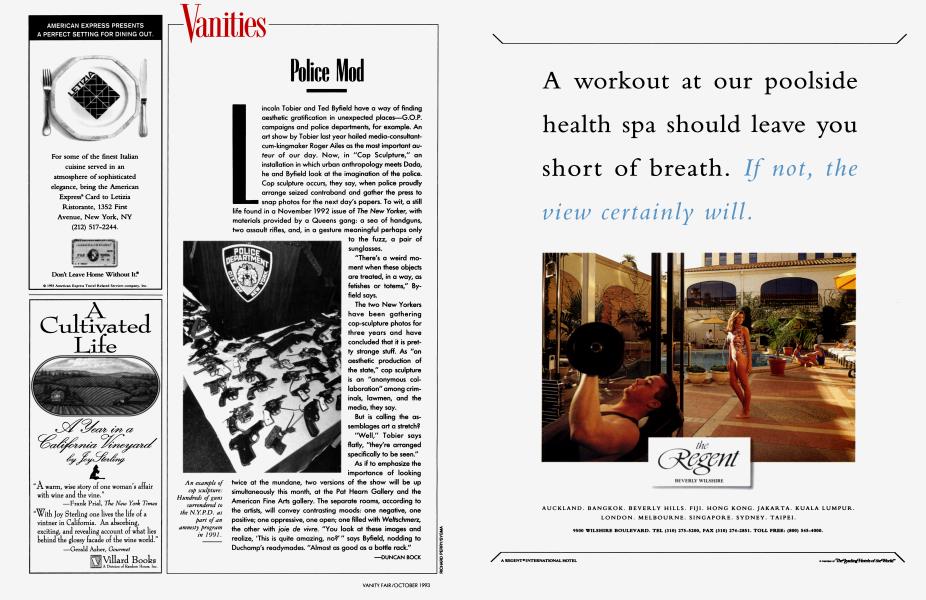
Lincoln Tobier and Ted Byfield have a way of finding aesthetic gratification in unexpected places—G.O.P. campaigns and police departments, for example. An art show by Tobier last year hailed media-consultantcum-kingmaker Roger Ailes as the most important auteur of our day. Now, in "Cop Sculpture," an installation in which urban anthropology meets Dada, he and Byfield look at the imagination of the police. Cop sculpture occurs, they say, when police proudly arrange seized contraband and gather the press to snap photos for the next day's papers. To wit, a still life found in a November 1992 issue of The New Yorker, with materials provided by a Queens gang: a sea of handguns, two assault rifles, and, in a gesture meaningful perhaps only to the fuzz, a pair of sunglasses.
"There's a weird moment when these objects are treated, in a way, as fetishes or totems," Byfield says.
The two New Yorkers have been gathering cop-sculpture photos for three years and have concluded that it is pretty strange stuff. As "an aesthetic production of the state," cop sculpture is an "anonymous collaboration" among criminals, lawmen, and the media, they say.
But is calling the assemblages art a stretch?
"Well," Tobier says flatly, "the/re arranged specifically to be seen."
As if to emphasize the importance of looking twice at the mundane, two versions of the show will be up simultaneously this month, at the Pat Hearn Gallery and the American Fine Arts gallery. The separate rooms, according to the artists, will convey contrasting moods: one negative, one positive; one oppressive, one open; one filled with Weltschmerz, the other with joie de vivre. "You look at these images and realize, 'This is quite amazing, no?'" says Byfield, nodding to Duchamp's readymades. "Almost as good as a bottle rack."
DUNCAN BOCK
Subscribers have complete access to the archive.
Sign In Not a Subscriber?Join Now