
Sign In to Your Account
Subscribers have complete access to the archive.
Sign In Not a Subscriber?Join NowHype & Glory
HENRY ALFORD
Seat of grandeur: the glamorous, intriguing life of one little gold chair in New York City
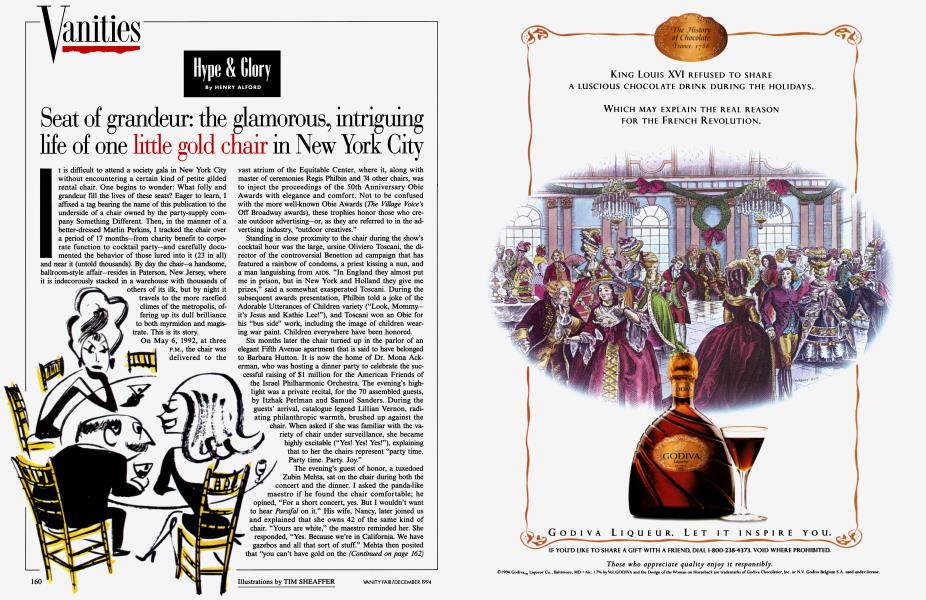
It is difficult to attend a society gala in New York City without encountering a certain kind of petite gilded rental chair. One begins to wonder: What folly and grandeur fill the lives of these seats? Eager to learn, I affixed a tag bearing the name of this publication to the underside of a chair owned by the party-supply company Something Different. Then, in the manner of a better-dressed Marlin Perkins, I tracked the chair over a period of 17 months—from charity benefit to corporate function to cocktail party—and carefully documented the behavior of those lured into it (23 in all) and near it (untold thousands). By day the chair—a handsome, ballroom-style affair—resides in Paterson, New Jersey, where it is indecorously stacked in a warehouse with thousands of others of its ilk, but by night it travels to the more rarefied climes of the metropolis, offering up its dull brilliance to both myrmidon and magistrate. This is its story.
On May 6, 1992, at three P.M., the chair was delivered to the vast atrium of the Equitable Center, where it, along with master of ceremonies Regis Philbin and 74 other chairs, was to inject the proceedings of the 50th Anniversary Obie Awards with elegance and comfort. Not to be confused with the more well-known Obie Awards (The Village Voice's Off Broadway awards), these trophies honor those who create outdoor advertising—or, as they are referred to in the advertising industry, "outdoor creatives."
Standing in close proximity to the chair during the show's cocktail hour was the large, ursine Oliviero Toscani, the director of the controversial Benetton ad campaign that has featured a rainbow of condoms, a priest kissing a nun, and a man languishing from AIDS. "In England they almost put me in prison, but in New York and Holland they give me prizes," said a somewhat exasperated Toscani. During the subsequent awards presentation, Philbin told a joke of the Adorable Utterances of Children variety ("Look, Mommy— it's Jesus and Kathie Lee!"), and Toscani won an Obie for his "bus side" work, including the image of children wearing war paint. Children everywhere have been honored.
Six months later the chair turned up in the parlor of an elegant Fifth Avenue apartment that is said to have belonged to Barbara Hutton. It is now the home of Dr. Mona Ackerman, who was hosting a dinner party to celebrate the successful raising of $1 million for the American Friends of the Israel Philharmonic Orchestra. The evening's highlight was a private recital, for the 70 assembled guests, by Itzhak Perlman and Samuel Sanders. During the guests' arrival, catalogue legend Lillian Vernon, radiating philanthropic warmth, brushed up against the chair. When asked if she was familiar with the variety of chair under surveillance, she became highly excitable ("Yes! Yes! Yes!"), explaining that to her the chairs represent "party time. Party time. Party. Joy."
The evening's guest of honor, a tuxedoed Zubin Mehta, sat on the chair during both the concert and the dinner. I asked the panda-like maestro if he found the chair comfortable; he opined, "For a short concert, yes. But I wouldn't want to hear Parsifal on it." His wife, Nancy, later joined us and explained that she owns 42 of the same kind of chair. "Yours are white," the maestro reminded her. She responded, "Yes. Because we're in California. We have gazebos and all that sort of stuff." Mehta then posited that "you can't have gold on the (Continued from page 160) lawn." His wife agreed, "We don't like gold in California. That's the way New York does it, but not us." After this exchange I inquired, "You're au naturel?" "Well," Mrs. Mehta said, hesitating, "we're not gold." Eventually, the maestro proudly announced, "We're white!" Mrs. Mehta looked at her husband indulgently and explained, "We have a lot of trees."
(Continued on page 162)
(Continued from page 160)
Five weeks later, on December 15, the chair arrived at 3 West 51st Street, where The Sporting News was sponsoring a symposium on the state of professional baseball. Empty for the first half-hour of the panel discussion, the chair later became the roost of Dick Ebersol, the president of NBC Sports, who is married to Susan Saint James. While seated, the restless Ebersol exhibited a variety of gestural nuances and activities, including lip massage, temple caressing, and earlobe appraisal. When asked for a chair appraisal, he confessed, "I'm much more of a couch kind of guy. My shoes stay off most of the day." Then, with a vague note of threat in his voice, "I even take my shoes off at other people's homes."
Some five months later, on May Day, the chair was surrounded by works by Rembrandt, Picasso, and ToulouseLautrec in the Fifth Avenue apartment of investment banker Amnon Barness and his wife, Caren, who were renewing their wedding vows. "I get so tired standing up at these things," said the formidable lawyer William Goodstein shortly before sitting in the chair for a postceremony feeding. Currently listing among his clients Liz Smith, Reggie Jackson, and Georgette Mosbacher, Goodstein—who talks on the phone an average of 180 times a day—proved to be highly restive; during the meal he got up repeatedly for telephone mania, placing or returning calls to George Steinbrenner and Liz Smith, Willie Randolph, Steve Carlton, and Julie Newmar.
Eight months later, on January 9, it was no surprise to find the chair—and Mr. Goodstein—back in the Barness apartment. The chair, placed in the main hallway, provided an ideal vantage point from which to view the gathering's main event: a rabbi performing a circumcision, to usher the Barnesses' newborn grandson into the Jewish community. The tension that the circumcision ceremony created among the male guests in attendance was palpable; Mr. Goodstein launched into a frenzy of phone calls to Liz Smith, Reggie Jackson, Steve Carlton, restaurateur Buzzy O'Keeffe, and book editor Judith Regan.
But it was not the Barness grandson's entry into the Jewish faith that was the only source of good tidings that day. Also celebrated was talk of Mr. Barness's two sons' joining professional forces with Mr. Goodstein. Thus, I left the chair surrounded by images of progress and birth: A Jewish grandson. A newly configured law firm. A wealth of phone calls to baseball players. The chair its perpetual witness, Manhattan nightlife teems on.
Subscribers have complete access to the archive.
Sign In Not a Subscriber?Join Now
