



Sign In to Your Account
Subscribers have complete access to the archive.
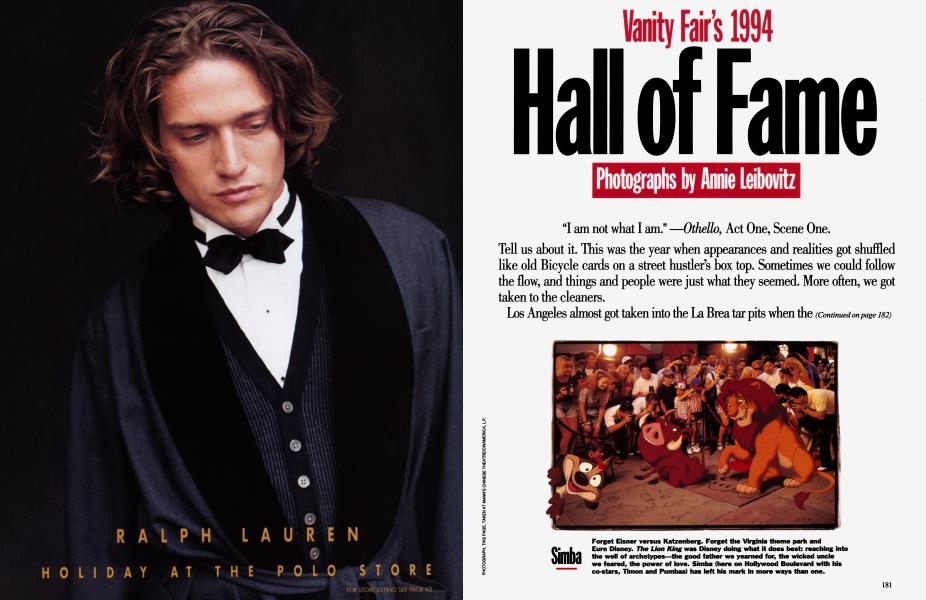
Sign In Not a Subscriber?Join NowVanity Fair's 1994 Hall of Fame
"I am not what I am."—Othello, Act One, Scene One.
Tell us about it. This was the year when appearances and realities got shuffled like old Bicycle cards on a street hustler's box top. Sometimes we could follow the flow, and things and people were just what they seemed. More often, we got taken to the cleaners.
Los Angeles almost got taken into the La Brea tar pits when the earth itself proved to be unreliable. If you can't trust the crust, what can you rely on? While it might have been a fit ending for a city of illusionists, think of the consequences: If L.A. disappeared, what would become of the American legal system? Or the Nielsens? But the city survived, the Menendez brothers saw (injustice done, and the O.J .dammerung began. The phrase "show trial" acquired a new meaning, as Court TV became the fifth network. Judge Ito, Michael Ovitz on line two.
(continued on page 182)
(Continued from page 181)
When the shaking stopped, the bouncing began: Guber from Sony, Diller from QVC, Katzenberg from Disney. And then the rebounding, as a trio of lost boys—Katzenberg, Spielberg, and Geffen—founded their own Hollywood never-never land. The battle for Paramount was the trash-talking free-for-all that set the tone for a year of tsuris in the studios. Businessmen acted like bad sports, while whole sports acted like bankrupt businesses. Fox, the first people to base a show on a family named Simpson, snatched Sunday football from CBS. Maybe if Murdoch had shown an interest in baseball, we would have had a real pennant race. Instead, we had to watch Ken "I Shoot the Bettmann Archive" Bums: Ty Cobb, athlete for the 90s. After the World Series that wasn't, the hockey season didn't begin. It almost seemed natural to tune in to the Federated Department Stores Parade on Thanksgiving Day.
Whereas the digitocracy provided action, Washington was the city where nothing happened. The Clinton health plan, which once looked unstoppable, became untouchable. Hillary, queen of the career-obsessed Uberboomers, retired to lick her wounds, while her husband tried to find dictators he could discipline. We were so confused—is the crisis in Somalia or Cuba or North Korea or Haiti?—it was almost comforting to see a familiar face: Hello, Saddam! In Arkansas, which only seems like a foreign country, congressman and sweater-set model Jim Leach tried to figure out whether Whitewater was really the crime of the millennium or just the way they do bidness down there. To make up for these dead ends, the nation's capital gave us some double helpings: two secretaries of state, Jimmy Carter and the real one; the two lives of C.I.A. turncoat Rick Ames; plus the second coming of Marion Barry.
Some of the calls were hard. Forrest Gump looked like an idiot, but he was really wise. Unless he really was an idiot (Arthur Schlesinger Jr. called the movie "North American magical realism"). The only things real about Woodstock II were the hype and the mud. But did that make it any different from Woodstock I? Mr. and Mrs. Donald Trump recovered from their wedding, and Mr. and Mrs. Michael Jackson walked down the aisle. Soon-to-be Mr. and Mrs. Ivana Trump announced their marriage, and Mr. and Mrs. James Carville spun theirs. Never had the other options, from celibacy to adultery, looked so respectable.
Some calls were clear. Rwanda was a real horror, making us mindful of our limitations as a nation, and as a species. For distraction, we turned to Four Weddings and a Funeral, a real charmer, to Quiz Show, a real scandal, and to Pulp Fiction, really messy. Megalomodel Anna Nicole Smith got a real rock (not from QVC). Howard Stem and William Bennett had real best-sellers—though they turned out to be fake politicians.
Cartoons that told the truth, saints who sold us a bill of goods, and, here and there, someone doing an honest day's work, living an honest day's life: real and surreal, they are the 1994 Hall of Fame.
RICHARD BROOKHISER
FOR DETAILS, SEE CREDITS PAGE
Subscribers have complete access to the archive.
Sign In Not a Subscriber?Join Now


