


Sign In to Your Account
Subscribers have complete access to the archive.
Sign In Not a Subscriber?Join NowMAJOR'S SCHOOL FOR SCANDAL
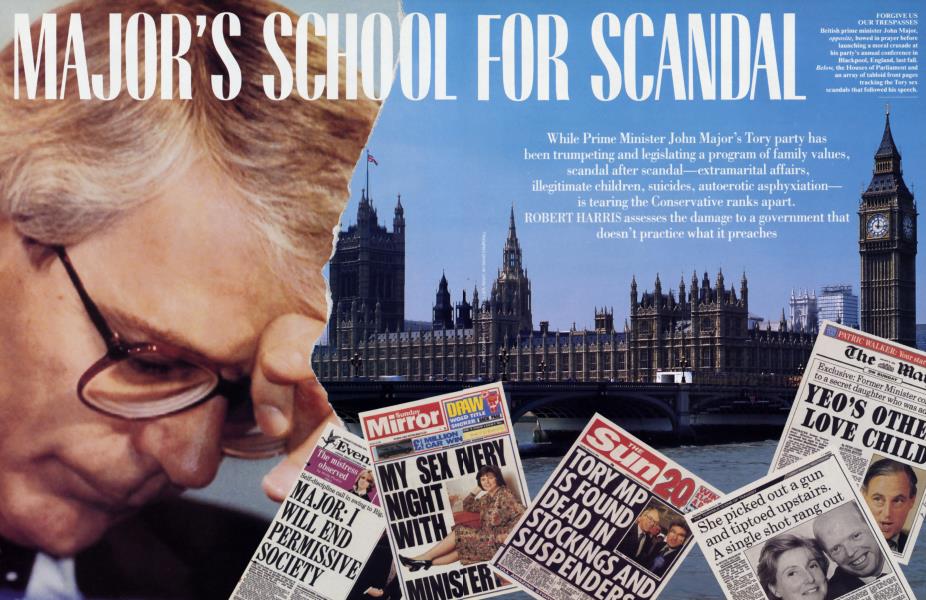
While Prime Minister John Major s Tory party has been trumpeting and legislating a program of family values, scandal after scandal—extramarital affairs, illegitimate children, suicides, autoerotic asphyxiation— is tearing the Conservative ranks apart. ROBERT HARRIS assesses the damage to a government that doesn't practice what it preaches
ROBERT HARRIS
'We can now say Milligan was wearing 'women's solitary man walks down a London street. It is a Saturday night, around six o'clock, toward the end of the English winter. Darkness has just fallen. The shops are closing. People are hurrying home.
The man is in his mid-40s, casually dressed in blue sweater and blue trousers. He is carrying a cream-colored plastic bag. His is a distinctive face. He has a noticeable squint in his left eye and a shock of graying hair. People recognize him, not just as a neighbor, but as a public figure, a Conservative member of the House of Commons. Why, he was on television only the other night, loyally defending "Back to Basics," the British government's tough new moral line. Milligan is his name. Stephen Milligan.
The man turns right, off King Street, in Hammersmith, and into Black Lion Lane, a pretty row of small Victorian houses near the river Thames. Once, these were "workmen's cottages." Today they cost a quarter of a million dollars and the "workers" are mostly white-collar and middle-class. Yellow sodium street lighting shines on blackened brick and old wisteria vines. The man goes into his house and closes the door. He is never seen alive again.
The idea that Stephen David Wyatt Milligan was about to do something which would bring yet more shame and ridicule down on the Conservative government would have been unthinkable to anyone who knew him. In the four months since the party's annual fall conference, John Major's government had been shaken by one sexual scandal after another. A minister of transport had been discovered to have no fewer than five mistresses. A minister of the environment, already married, was revealed to have fathered a "love child" with a Conservative local politician and was forced to resign. A third minister had spent Christmas apart from his wife after she learned of his relationship with another woman. Shortly afterward she put a shotgun to her head and blasted her brains out—whereupon he, too, left the government. By January, the Tory party, which has held power in Britain for nearly 15 years, had degenerated into farce. One male member of Parliament had admitted sharing a bed with another man while on holiday—but only, he insisted, in order to save money on his hotel bill. Yet another had confessed that, yes, an affair with a House of Commons secretary had resulted in a child ... On and on it went. There seemed no end to it.
But Milligan—so straight, so loyal, so, well, frankly, creepy that his colleagues had long since christened him "Millipede"—was the very last politician you would expect to embarrass the Conservative Party. His whole life had been devoted to doing the "right thing": public school, Oxford University, president of the Oxford Union debating society, editor of the Britain section of The Economist, foreign editor and Washington correspondent of the London Sunday Times, and European correspondent for the BBC. Few men seemed more dependable than the representative for Eastleigh, who, with a recent promotion to parliamentary private secretary at the Ministry of Defense, looked bound for high office. True, at the age of 45 he was still unmarried, a disadvantage in politics, but it was said that he was desperate for a wife, desperate enough to have joined an expensive dating agency.
Tonight, however, after the door closes, he is alone.
At some point over the next few hours, Milligan—this "boringly normal" man, as one of his friends calls him— does the following things. He removes all his clothes. He goes into the kitchen. He puts on a pair of black stockings. He inserts into his mouth a small orange (or possibly a satsuma, or maybe a tangerine: the precise variety of the fruit and its role in the proceedings were to be the subject of some debate). He covers his face with a third stocking. He hoists himself up into a sitting position on the kitchen table and ties a length of electric cord around his left leg. Over his right hand he pulls a fourth stocking. Over his head he places a black plastic bag. The cord trailing up from his leg he now wraps around his neck three or four times, securing the bag in place. Clasping the free end of the cord in his left hand, he lies back on the table, his legs dangling over one edge, his head over another, and pulls hard, tightening the cord around his neck.
clothing and lie had a ph
How long he stayed alive in this position nobody will ever know. According to the government pathologist, Dr. Iain West (who also performed the autopsy on the media tycoon Robert Maxwell), Milligan died from "asphyxiation due to compression on the neck by a ligature" sometime between the evening of Saturday, February 5, and the following morning. Traces of dried semen on his body indicated that he had ejaculated.
It was to be at least 30 hours before his body was discovered. The legislator did not attend the Eucharist at his local church on Sunday, as was his habit, nor did he show up for a pre-arranged round of golf at his club, the Royal Mid-Surrey. Attempts to call him were intercepted by his telephone answering machine. Finally, on Monday afternoon, alarmed by his failure to turn up at the House of Commons, his secretary, Mrs. Vera Taggart, decided to drive over to his house. Mrs. Taggart, a middle-aged woman who had worked for Milligan since his days at the London Sunday Times, was described by colleagues as "a second mother" to him. She arrived to find the curtains drawn and the deliveries of milk and newspaper undisturbed. Using a spare key which she had been told by Milligan's former girlfriend lay hidden in the garden, she let herself into the darkened house. The only light came from the kitchen. As she walked toward it, her first thought was one of mild irritation: Who, she wondered, had dumped a mannequin on the table?
■ there was nothing more the British establishment could do that would surprise us.
If the grotesque death of Stephen Milligan did nothing else, it did at least serve to remind us in Britain (or most of us) of how touchingly innocent we still are, of our residual capacity, despite everything, to be shocked by the human comedy. For until the headlines of Tuesday, February 8 (TORY MP is FOUND DEAD IN STOCKINGS AND SUSPENDERS), we had begun to feel that
It was not always like this. For the first two-thirds of the 20th century, there were no major sexual scandals in British politics. As long as a statesman did not divorce, he was free to do as he pleased, safe in the knowledge that the press would never dare print a word. Certainly, the most libidinous of all British prime ministers, David Lloyd George ("The Welsh Goat"), did not let a little matter like the negotiations after the First World War come between him and the girls. When asked in 1919 if he intended to take his wife to the Versailles Conference, he replied incredulously, "Would a man take a sandwich to a banquet?"
The first really public sex scandal involving a government minister did not occur until 1963, when Jack Profumo, the Conservative war minister, was found to be sharing a girlfriend with the Russian naval attache. Thereafter, scandal erupted at roughly 10-year intervals. In 1973 a junior defense minister, Lord Lambton, another Conservative, was filmed through a two-way mirror having sexual intercourse with a pair of prostitutes. When talking about his activities afterward, Lambton displayed the aristocratic sangfroid of an earlier age: "I can't think what all the fuss is about. Surely all men patronize whores." Nevertheless, he was obliged to resign, as was Earl Jellicoe, the Tory leader of the House of Lords, who had a penchant for hiring girls from 'fescort" agencies.
In 1983 it was the turn of Cecil Parkinson, chairman of the Conservative Party. The then prime minister, Margaret Thatcher, had intended to appoint him foreign secretary, even though he had told her that he had been having an affair with his former secretary Sara Keays. But bebefore Thatcher could make any announcement, or so she recalled in her memoirs, "I received a personal letter from Sara Keays's father. It revealed that she was pregnant with Cecil's child. When Cecil arrived I showed him the letter. It must have been one of the worst moments of his life."
Conservatives may simply have m ire easli
Oddly enough, if Parkinson had stuck to his promise and left his wife, all might have been well. Instead he turned his back on Ms. Keays, who responded in the most devastating fashion by disclosing details of his vacillations to The Times. Parkinson was effectively laughed out of office.
It was in 1991 that this relatively sedate incidence of sexual scandal began to accelerate. The director of public prosecutions, Sir Allan Green, was forced to resign from one of the most important legal offices in the land after police caught him soliciting a prostitute in a seedy area near King's Cross Station in London. He and his wife separated; a year later she killed herself.
The next ministerial victim was the bumptious new secretary of state for the national heritage, David Mellor. In the summer of 1992, Mellor was enjoying an affair with an actress, Antonia de Sancha, who had previously appeared in The Pieman, a soft-pom movie in which she played a onelegged prostitute who has fairly graphic sex with a pizza deliveryman. As with Parkinson, it was ridicule which finished Mellor. "You have absolutely exhausted me," he told de Sancha in a (bugged) telephone call. "I feel seriously knackered."
In retrospect, that year was a watershed. Two factors made it different. The first was the sheer viciousness with which the normally loyal tabloid press turned on the Tory government. A few weeks before Mellor's departure, its slavish propaganda had helped ensure John Major's reelection as prime minister. Now, like children who had become tired of their creation, the newspapers proceeded to tear it to bits. Who needed the Tories anyway? Major was boring. The Labour Party was finished. The battle against socialism was over. It was time to have some fun.
The other new dimension was the dawning realization that the members of the royal family were, if anything, even more flawed than the political establishment. The Duchess of York was photographed lounging beside a swimming pool on the French Riviera, having her toes sucked by her American "financial adviser," Johnny Bryan. Andrew Morton's book revealed that the "fairy-tale romance" of the Prince and Princess of Wales had been a sham from the start. The Sun printed a transcript of Diana's conversation with her friend James Gilbey ("Oh, Squidgy, I love you, love you, love you . . . "). Finally, a reeling nation learned that the heir to the throne had fantasies of reincarnation as his mistress's tampon ("My luck to be chucked down a lavatory and go on and on forever swirling round on the top, never going down . . . ").
It is hard to tell precisely how much effect the breakdown of the Yorks' and Waleses' marriages had on the public mood, but I suspect the answer is a great deal, especially among the solid, respectable working and middle classes, the traditional supporters of the Tory party, famously celebrated by G. K. Chesterton in "The Secret People":
spend on love nests, hotel and call girls.
Smile at us, pay us, pass us; but do not quite forget.
For we are the people of England, that never has spoken yet.
In 1993 they started to speak. Their anger was not directed specifically against the House of Windsor, but rather against what it had come to represent: a lack of moral fiber, selfishness, irresponsibility, the breakdown of the traditional family unit—a collapse in personal standards of morality. The problems of the royal family were seen to mirror and, to some extent, explain such disturbing phenomena as the soaring crime rate and the vast increase in the number of illegitimate children.
John Major undoubtedly sensed this mood in the spring and summer of last year. He agreed with it. He saw it as an opportunity to unite the Conservative Party around a distinctive set of values. All he needed was a catchy slogan, something which would draw these strands togetherjust three or four words would do.
It was at this point, as so often in this story, that an element of the ridiculous crept in. Just before the Tory party conference, Major and his wife had lunch with the 92-year-old romantic novelist Barbara Cartland, at her country mansion, Camfield Place, in Hertfordshire. According to Dame Barbara, she led him over to her bookshelves and gestured to her life's work, some 570 novels, with titles such as The Taming of Lady Lorinda and Little White Doves of Love.
"This is what people want," she told him. "Good oldfashioned morality tales. Good manners, men opening doors for women, love, love, love, not sex, sex, sex. We have descended into rudeness, disagreeableness, nobody keeps their word anymore."
She told The Sunday Telegraph afterward (and Downing Street has not disputed her version of what happened), "I pointed him to 'back to basics.'"
Sure enough, when the Conservative Party conference opened in Blackpool a few weeks later, its theme was "Back to Basics."
The good old-fashioned British political sex scandal requires three ingredients. It must involve deception (of wife, colleagues, or family—or, better still, all three). It must have an element of the comic or the bizarre. And there should be what Alfred Hitchcock called a "MacGuffin": some device which launches the story and keeps the plot going. Traditionally in British scandals the MacGuffin was the threat to national security: what if an errant minister, a Profumo or a Lambton, should be blackmailed by a foreign power? Nowadays the MacGuffin is hypocrisy. It was the charge of hypocrisy which legitimized the revelations about Charles and Diana and Andrew and Fergie. Why, the argument ran (and it is a valid point), should the world be sold a story about perfect marriage when the reality is utterly different?
This was the trap John Major and his ministers blundered into with "Back to Basics" as one after another they lined up to sing from the same pious hymn sheet. Here was David Hunt, the employment secretary: "We must do more to reassert and reaffirm the moral basis of everything we do." And Michael Portillo, rising star of the Tory right: "We prize the individual who demonstrates a sense of duty to family." And, of course, Major: "It is time to get back to basics: to self-discipline and respect for the law, to consideration for others, to accepting responsibility for yourself and your family." Given the seamy world of Westminster and the rapacious British press, it was like watching ducks demand the start of the hunting season.
For the Tories, although traditionally the upholders of "family values," have also been the party most associated with sexual scandal. Perhaps feeling guilty about sex makes doing it more appealing. Perhaps the danger of being caught is itself the aphrodisiac. Or maybe Conservatives simply have more money than their political opponents—more cash to spend on all the paraphernalia of mistresses, love nests, hotel rooms, and call girls; more temptations; more opportunities. Whatever the reason, they have always tended to talk clean but live dirty, and never more so than over the past six months.
"Back to Basics" has so far involved three resignations, nine girlfriends, one close male friend, two violent deaths, and two (to use the fashionably quaint phrase) "love children." In all, there have been seven separate scandals, all featuring, it has to be said, rather plain middle-aged men. Some of the scandals have been comic, or at least nonviolent. For example, it was revealed that a transport minister, Steven Norris, had left his wife and had affairs with four different mistresses, each of whom believed she was the only woman in his life. {The Sun—"'We told you we'd find her, folks"—eventually turned up a fifth woman, "wined and dined by the cheating MP for eight years.")
Hartley Booth, a Methodist lay preacher and Tory member of Parliament, was caught sending love poetry to a young political researcher who had once—oh, the shame of it!—posed nude for an art class ("When the hours pass and a hundred other interests take us down other paths / We can recall the daisy chain you made . . . "). The two spent several nights together, but, rather pitifully, Booth insisted no impropriety took place—echoing his colleague David Ashby, who admitted sharing a French hotel bed with a male friend but denied any sexual intent.
Some stories were not so funny. Tim Yeo, an environment minister, had just fathered an illegitimate child by Julia Stent, a lawyer and Conservative councillor. For two weeks after the press published the story he clung desperately to his job, supported by both his wife and the prime minister. In the end, it was officials of his local party who forced him to resign—an unprecedented and humiliating rebuff to John Major and an ominous indication of the forces "Back to Basics" had unleashed. By the start of 1994, the slogan had turned into a moral monster, threatening to destroy everything in its path.
And then came two tragedies. The Earl of Caithness, the aviation-andshipping minister, had enjoyed a longstanding relationship with Jan FitzalanHoward, a former secretary to Princess Anne. He and his wife had been trying to save their marriage, and had been seeking professional advice, but the situation had become hopeless. At 6:30 P.M. on Saturday, January 8, Caithness and his young daughter were downstairs at the family house in Oxfordshire when they heard the sound of a gunshot. The earl ran up to their bedroom and found his wife dead. It was the eve of their 19th wedding anniversary.
In a different moral climate, in a different country, in a different time, it would perhaps have been possible to separate Caithness the perfectly competent minister from Caithness the man with a wretched private life. But this was John Major's Britain, a nation going "Back to Basics." Caithness resigned at once. After the funeral, where he was publicly shunned by his late wife's parents, his life seems to have descended into a perfect hell. Not a wealthy man, the earl depended on his ministerial salary of £45,000 ($66,000) a year. A month after his resignation he was reportedly obliged to put the family house up for sale and was seen claiming £44 ($65) a week in unemployment benefits. The story received some coverage, but not, perhaps, as much as it might have done, for it was published in the same week that Vera Taggart discovered the body of Stephen Milligan.
Then John Major called on everyW one to exercise greater "self-discipline," it is doubtful that he had in mind, or, indeed, had even heard of, the practice of autoerotic asphyxiation, or "scarfing"—"the most dangerous sex game in the world," according to the former Los Angeles County coroner Thomas Noguchi. Yet, in Britain alone, it is estimated that it kills between 150 and 200 people a year. One of them was Milligan.
The most common reaction among his friends, apart from sadness and shock, was "How on earth did he know what to do?" It was unbelievable. It was grotesque. It was inexplicable. The BBC couldn't even bring itself to report the details. Not until 18 hours after the tabloids had gone to press did the corporation's managers finally issue the following memorable guideline to their staff: "We can now say that he was wearing 'women's clothing,' we can say he had a plastic bag on his head, and we can mention that he was bound with flex [electrical cord]—but on no account mention fruit." (Incidentally, to clear up the question of fruit in this context, "scarfers" often place an object, such as an orange, into their mouths; it allows air to pass freely around it, enabling them to breathe if they accidentally black out, a precaution which tragically failed in Milligan's case.)
(Continued on page 176)
(Continued from page 140)
Major himself appeared to be in deep shock. He fluffed his lines badly during prime-ministerial questions in Parliament, and appearing on a radio phone-in program two days later he refused even to refer to Milligan. When the show's host persisted, he would say only that the M.P. "must have been pretty unhappy, pretty miserable"—as if Milligan had staged a particularly elaborate and humiliating suicide. The dead man's family was furious. "With respect to the Prime Minister," began a letter to The Times written by Milligan's cousin, a judge, two days later, "Stephen was neither miserable nor unhappy. On the contrary, he was thoroughly fulfilled and happy ..."
As I write, the government is bracing itself for further revelations. I have been told the names of two ministers, both supposedly homosexual, both said to be on the point of resignation. But then, every journalist has been told at least two names. And all the names are different. This is what it must have been like in Salem during the witch-hunts, or in Moscow during the Stalinist purges, or in Washington during the McCarthy era. There is an atmosphere of suppressed hysteria as people wait to see who will be next.
That one of Milligan's final appearances on national television was to argue in support of "Back to Basics" is a painful irony the Conservative Party could have done without. Sir Norman Fowler, the Tories' chairman, spent a disagreeable two hours in the Hammersmith police station on the night the body was discovered (at one point, according to The Sunday Times, a busker with a guitar who was waiting in the same room "burst into a self-composed song about 'another dead Tory'"), but he emerged, unbelievably, to insist that "Back to Basics" was in no way affected. A death like Milligan's, he said, "could take place in any party, or in any organization."
To which one can only gasp in reply, Well, yes, Sir Norman, but it didn't, did it? It happened in the Conservative Party in the middle of a moral crusade. And in its solitariness and furtiveness there was not only something very British about Milligan's death, but also something peculiarly redolent of his class and party: of the stiff-upper-lipped public-school boy who was not allowed out of school to cry at his mother's funeral, of the buttonedup student politician, of the person who so equated sex with guilt that when masturbating he preferred to lose consciousness at the moment of orgasm.
No other political party—certainly in Britain, and possibly in the entire Western world—has experienced such a tragic and farcical series of sexual scandals in such a short space of time. And why? Because no other party is as hung up about sex as the British Conservatives. To that extent, Stephen Milligan was the perfect spokesman for "Back to Basics," the embodiment of his party's schizophrenia. As we await the next act in this lurid melodrama, the words of that cynical Tory premier (and womanizer) Benjamin Disraeli have seldom seemed more apt. "A Conservative Government," he once observed, "is an organized hypocrisy."
Subscribers have complete access to the archive.
Sign In Not a Subscriber?Join Now


