


Sign In to Your Account
Subscribers have complete access to the archive.
Sign In Not a Subscriber?Join NowHype & Glory
JULIE BURCHILL
The Gloria and the dream: feminism's First Daughter is hot on the trail of her inner child
Overpaid, oversexed, and over here: time was when British soldiers said this of American G.I.'s gearing up for D-day in dear old flighty Blighty. These days, however, substitute "overpaid" for "oversexed" and it is often heard from English feminists only half-jokingly—of their Stateside supersisters.
Since the 1970s, small but perfectly informed British publishers have produced a consistently interesting and original stream of new feminist theory. But with typical understatedness, they have shied away from the personalities and packaging which seem essential to the intellectual blockbuster. There is a scene in Nora Ephron's Heartburn, the book, when a friend of Rachel's complains that his wife has run off with a woman. Did you know she was a lesbian? he asks her. No, says Rachel, "if anything, I would say that she isn't quite attractive enough to become one." These days, you could swap "lesbian" for "feminist," examining all those dewy-fresh, glorious Technicolor spreads of radiant Wolf, coltish Faludi, and dazzling Hite.
To hear people talk, there was only one Lib Looker between Pankhurst, Christabel, and Wolf, Naomi: Gloria Steinem. With her streaky blond hair and aviator shades, she looked like a Greek millionaire's second-best girl on a ski trip. Even as a child in the 70s, I soon got wise to the fact that whereas unpleasant men didn't mind plain women espousing feminism, pretty women who held the very same views made them highly uneasy. That was the beauty of Steinem, the Liberty Belle.
But now, like her contemporaries Friedan, Millett, and Greer, she is what polite people call a senior citizen and what kids call a geezer. Hers was a generation of eternal daughters; with the exception of Friedan they have not reproduced, but yet they still seem like grandmothers. And as grandmothers do, in recent years they have become rather dotty old ladies. This is not sexist; their sparring partners, from Norman Mailer to Oliver Reed, have long since become loony old men.
There is a difference, though; these men have always been buffoons, whereas these women were once heroes. Steinem— so cool, so capable—was perhaps the most heroic of the lot. When she so flamboyantly fell apart a few years ago over the hundreds of pages of Revolution from Within, it was a shocking spectacle to behold. After all that brilliance, it turned out that Steinem had always been exactly the sort of unhappy woman the anti-feminists pray we are; all she really wanted was to—yes!—fmd her inner child! I'm sure I wasn't the only therapy-hostile English feminist who muttered that if ever they found their inner child they'd get a termination tout de suite.
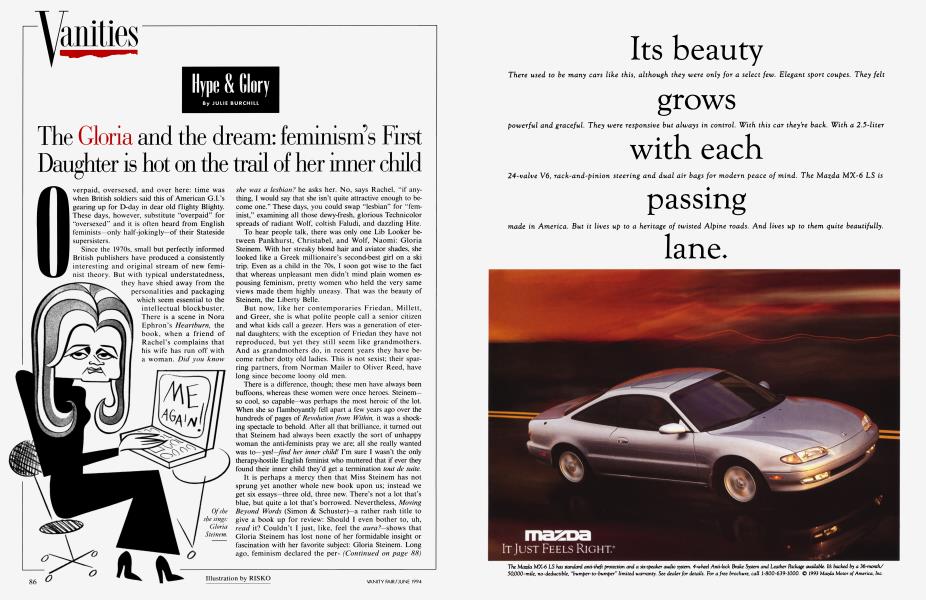
It is perhaps a mercy then that Miss Steinem has not sprung yet another whole new book upon us; instead we get six essays—three old, three new. There's not a lot that's blue, but quite a lot that's borrowed. Nevertheless, Moving Beyond Words (Simon & Schuster)—a rather rash title to give a book up for review: Should I even bother to, uh, read it? Couldn't I just, like, feel the aura?— shows that Gloria Steinem has lost none of her formidable insight or fascination with her favorite subject: Gloria Steinem. Long ago, feminism declared the personal to be political, and it sounded quite progressive at the time. But these days the line between egoism and engagement has been lost, trodden down by a thousand weary American feet sick of marching and eager to cocoon. The self has become the final frontier of too many feminists. Perhaps every feminist writer—like every masculinist one—should ask herself just one question before she sits down at that blank screen each morning: Just how fascinating am I?
(Continued on page 88)
(Continued from page 86)
The opening essay, "What if Freud Were Phyllis?," started life as a speech, and many of these pieces smell not of the midnight oil but of the midnight, postprandial podium. You feel she is playing to the balcony, incessantly checking her laugh levels. Out come the tired old What if... ? routines: What if men menstruated? What if Freud had been a woman? What if Gloria Steinem had a sense of humor? (I made that last one up.)
The trouble is that Steinem has too much faith in the power of the punch line. This technique of turning the tables—what she calls "reversals"—creates "empathy" and exposes "injustices that seem normal." If we all practiced Gloria's What if... ? routine in front of the mirror for 15 minutes every day, she seems to say, we would start to see things from the other guy's point of view—and voila, world peace! Unfortunately, she's not joking.
The essay "Doing Sixty" is an excruciating smorgasbord of overtherapized self-acceptance: "I'm beginning to see that life after 50 or 60 is itself another country." Yes, that's right— your teeth fall out and people beat you up more. But don't worry. Out There, secure in her high-rise tax bracket, Gloria has experienced an "edge-of-the-world sensation of entering new territory with the wind whistling past my ears." This sounds like the title song of Oklahoma!, which I've always adored. But when Steinem offers such examples of rockingchair wisdom as "The only lasting arms control is how we raise our children" (our inner children, surely?) you wonder whether the wind wasn't whistling between her ears as well.
Elsewhere we get women bodybuilders (good), advertising (bad), and money (bad for men, good for women—especially considering the price of blond streaks and aviator shades these days). There's nothing new or startling, just the overall impression of a media dowager with some prime time to fill. Put it this way: if the letter / on her keyboard ever breaks down, Miss Steinem's going to be in a lot of trouble.
Like beautiful and spirited daughters who fill their mothers with envy, the new wave of post-70s feminists appears to have had a horrible effect on these childless grandmothers, who have suckled the enervating incubi of their inner children with an overcompensating vengeance which looks a lot like regret. It has goaded them on to greater and greater acts of exhibitionism and machismo, for all the world like old men threatened by young ones. For women who have spent so much of their lives absorbed in the quest for selfknowledge, it is strange that they seem to know everything about themselves except the one thing that most of us cotton on to very quickly. That is, their limitations.
Subscribers have complete access to the archive.
Sign In Not a Subscriber?Join Now
