Sign In to Your Account
Subscribers have complete access to the archive.
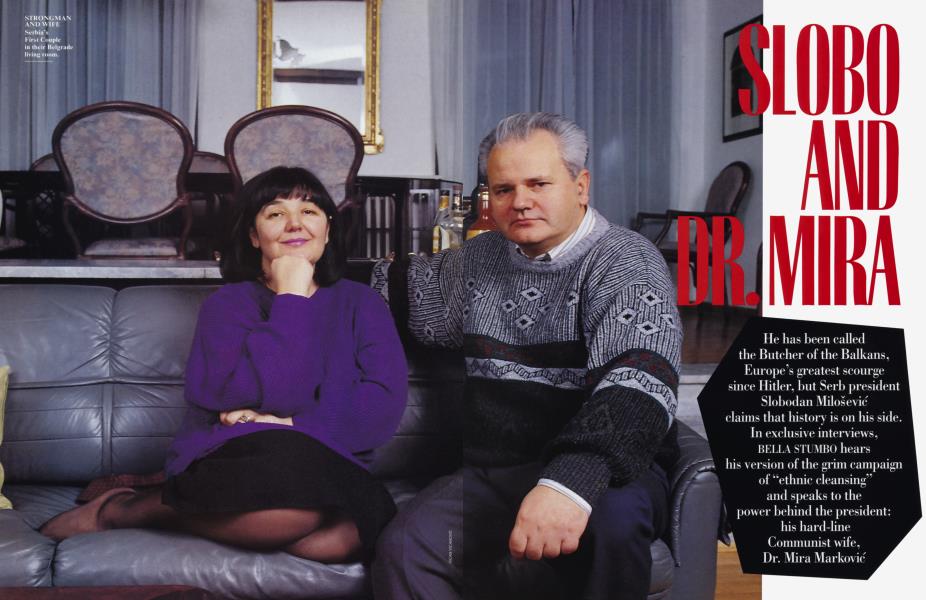
Sign In Not a Subscriber?Join NowSLOBO AND DR. MIRA
He has been called the Butcher of the Balkans, Europe's greatest scourge since Hitler, but Serb president Slobodan Milošević claims that history is on his side. In exclusive interviews, BELLA STUMBO hears his version of the grim campaign of "ethnic cleansing" and speaks to the power behind the president: his hard-line Communist wife, Dr. Mira Marković
BELLA STUMBO
Serbian president Slobodan Milosevic is alone inside his office in Belgrade's historic presidential palace. A large, elegant room of 20-foot ceilings, burnished dark wood, muted lamps, overstuffed leather chairs, and rich Oriental carpets, it is so tastefully and timelessly done that it makes the Oval Office look like an Ethan Allen showroom. No remnants of the recent Communist era remain, no portraits of the late Josip Broz Tito adorn the walls. No armed soldiers patrol the marble corridors; no sulky, dark-suited secret-police goons with telling bulges under their armpits menace visitors. The peace is complete. Only one pretty, stylish middle-aged secretary stands guard outside the president's door.
The room is immense, but Slobodan Milosevic doesn't wait for his visitor to approach. Instead, like a man greeting an old friend, he hurries forward, hand extended, smiling. How nice of Vanity Fair to drop by, he murmurs. Why don't we sit here? he asks, gesturing to an intimate seating arrangement in a far corner of the room.
So this is the man who has been called the Butcher of the Balkans, the father of "ethnic cleansing," the worst scourge of Europe since Adolf Hitler. The fellow half of the Western world wants to see swinging from the gallows for allegedly masterminding the Yugoslav wars, causing at least 200,000 Serb, Croat, and Muslim deaths. A leader so reclusive that some fanciful Western reporters, who may have read too much le Carre, have described him as living in an underground bunker with his family, a prisoner in his own land, forever in fear for his life.
A solidly built, pleasant-looking man of 52 with a full mop of well-groomed silver hair, dressed in a conservative gray suit, bright-white shirt, and properly subdued maroon tie, Slobodan Milosevic (or "Slobo," as his supporters call him) looks more like the banker he once was than the president of one of the world's most troublesome little republics. His features are small and perfect, but like a tiny patch of pansies centered in an acre of lawn, they are almost lost in the broad, fleshy canvas. Having no competition, the sharp hazel eyes are a mesmerizing force, winking little pinpoints of light commanding total attention. It's quite seductive, really—something on the order of what Dracula presumably did to the ladies of neighboring Romania a century ago. In fact, they say Slobodan Milosevic's most devoted constituents today are middle-aged women. Less sexy are his ears. The lobes, larger than most, literally flip upward, like little duck tails framing his face.
Milosevic speaks perfect English—but not because he lived in the United States for several years, as his own minister of information assured me just the day before. "Oh yes," Minister Milivoje Pavlovic had told me, "President Milosevic lived in the United States, in New York City, for six years." (A spokesman at the U.S. Embassy was equally certain: "Milosevic lived in Boston, for eight years.")
"No, of course not," Milosevic says now, looking amused. "We never lived in America. The longest we stayed was for a fortnight. But I visited the U.S. many times."
No wonder Serbia is losing the public-relations war, I remark.
He agrees, laughing. "You know now how I am in such a bad situation, when even my minister of information is not well-informed.
"We had an International Monetary Fund and World Bank meeting in Toronto in 1982," he recalls, "and we were traveling by car from New York to Toronto. It was a very nice trip. ... It is a very beautiful country."
The usual, obligatory Turkish coffee is summoned; Milosevic lights an unfiltered cigarillo from an ornate tin, politely offering one. There is such a genteel old-world feel to it all that I can only wonder when the Strauss waltzes will begin.
The less pleasant reality, of course, is that, only a few hundred miles away on this icy winter day, Serb, Muslim, and Croat fighters are doing their mutual best to slaughter each other. Serbs are driving enemy civilians from their homes; Muslims and Croats are destroying each other in Mostar. Besieged Bosnian towns with names like Gorazde, Tuzla, and Srebrenica remain flash points for what many fear could lead to World War III. The United Nations and NATO are issuing ultimatums which Bosnian Serbs routinely defy, relief convoys are being blocked, planes are being shot down on both sides. The war rages on.
Even nearer, just outside Milosevic's window, well over 100,000 people—mostly Serbs, but Croats and Muslims too—are now war refugees who spend their days aimlessly wandering the streets of Belgrade or living in makeshift camps, wearing donated clothes and vacant expressions as they play chess or simply sit on park benches, whiling away the time. They have lost everything. Homes, farms, families, even pets—all have been erased in the rubble of distant villages, once lush places of red-tiled whitewashed cottages, clean streams, and brilliant golden sunflower fields. For them, especially the weathered middle-aged men who have never known idleness, there is no future left.
There's not much of a present either. Since the U.N. slapped its general embargo on Serbia two years ago, the average Serb in Belgrade counts himself lucky if his kids eat meat once a week, and a king if his bathroom has toilet paper. The ordinary monthly salary is $37, although a gallon of gas costs $6. And God forbid the family has a medical problem. Patients must bring their own medicines, robes, and food to hospitals—and sometimes even their own syringes—and few are accepted unless it's an emergency. The suicide rate is also dramatically up, mainly among old people who refuse to spend their last years struggling for a fresh orange or the bus fare to visit a grandchild across town.
"Ah the media war against Serbia," Milosevic says
"Would you like more coffee?" the president asks.
No. What I really want is to know how Slobodan Milosevic feels about his role in the bloody collapse of Yugoslavia.
Milosevic doesn't even flinch. Instead, he actually pulls his chair closer. He is as interested in taking my measure as I am in taking his. Western journalists seem to fascinate him. "Ah, the media war against Serbia," he says with an expansive sigh. "They have produced mountains of lies! And the average American believes media. They are not informed at all. [Yugoslavia] is a moral failure not only of journalism, it is as well, indirectly, a moral failure of democracy."
Milosevic's face begins to pinken. "You know, practically, what happened was Yugoslavia was disintegrated with the pressure of different foreign factors which were following their interests," he says. "They supported disintegration, they supported secession! And in the same time, they have punished loyalty to your home country. Who is guilty? All who are fighting for integration, for preservation of integrity to their country, were punished."
When Slovenia voted to secede from Yugoslavia in 1990, followed by Croatia in 1991, says Milosevic, the resolution should have been a strictly internal Yugoslav matter. Instead, he continues, glowering, Germany rushed to recognize the breakaway nations and the whole Western world quickly followed. "Serbs," he insists, "have not started this war." In fact, Serbia is not even at war. Bosnia is. That is the war of Bosnian Serb president Radovan Karadzic and General Ratko Mladic, among others.
But isn't he supplying weapons, money, and moral support for that war?
"We don't oppose the right to self-determination to any people in Yugoslavia," he says, evading the question. "Everyone is free to decide his destiny—but the same right applies to Serbs. But it happened that that right was not respected." The thousands of Serbs living in Croatia and Bosnia, Milosevic feels, were given no alternative. "Were they just supposed to shrug it all away and say, 'Oh, O.K., so now I will become a Croatian'?"
No way. Especially considering the atrocities Croats and Germans committed against Serbs, loyal Western allies during both World Wars. As everyone knows by now, more than half a million Serbs were killed, mainly in concentration camps, by the Croat Ustashi (the Croat counterpart of Hitler's SS), along with Jews and Gypsies.
Or does everyone know?
Milosevic pauses mid-sentence, suddenly stuttering, fumbling for direction. You can almost hear the cogs of his mind turning, searching for some way to reduce modem Yugoslav history to one, third-grade-level paragraph any American can understand. Christ, what the hell do they teach in American schools anyway, that even college graduates know nothing of Croat concentration camps, of the Ustashi? And why, Milosevic wonders aloud, are Americans so eager to condemn the Yugoslav civil war when they suffered such a murderous one of their own less than 150 years ago?
Milosevic drains his tiny coffee cup, looking for all the world like a man who might love a shot of something stronger.
Ethnic cleansing is of course the most sensational issue of this war, and the most hateful to Serbs. When I ask Milosevic how he feels about being blamed for the genocide of hundreds of thousands of people, he shows only weary contempt. Just look at the facts, he snaps. "Only from Serbia is nobody running away!" Instead, Serbia is now overflowing with war refugees—including Croats and Muslims. And where do they live? Some in camps, but most in the homes of Serbs. "Our people take them in! In Serbia there is no policy of ethnic discrimination. We have at least 40 different nationalities, all living here together, in peace!" (Milosevic ignores his country's dramatic brain drain; at least 200,000 of Serbia's best and brightest have reportedly fled since the war began.)
Ethnic cleansing is the original invention not of Serbs, Milosevic says, nor even of Croats or Muslims, but of Albanians living in the southern Serb province of Kosovo, where they outnumber Serbs nine to one. "The first time we faced ethnic cleansing was in Kosovo a decade ago," Milosevic insists. "Their separatist movement publicly proclaimed their aim of ethnic purity and also their desire to become united again with Albania."
Worse, he claims, the Albanians were succeeding. "They were burning Serb fields, destroying our monasteries, even digging in Serbian graves! At least 40,000 Serbs left from Kosovo during those years."
Until the Serbs struck back in 1990, when Belgrade amended its constitution to strip Kosovo of its autonomy. And so, today, it is the Albanians who claim gross violations of their human rights. Among other things, thousands of Albanians from hospital directors to janitors were fired overnight.
Not incidentally, Kosovo was also the political birthplace of President Slobodan Milosevic. Formerly just another Communist Party chieftain, he was the first post-Tito leader to recognize the potential of the simmering ethnic unrest in Kosovo, to clearly understand that it didn't matter if only 100, or 10, or even no Serbs lived in Kosovo— it was, and must always remain, Serb.
Having no real history or national martyrs even 400 years old, Americans can perhaps never fully understand the Serb phenomenon of Kosovo. But, to Serbs, Kosovo is far more than just another lush, beautiful agricultural region of rolling hills and mountains. It is also regarded as the cradle of Serb culture, ever since the day in 1389 when, so Serb history goes, about 70,000 heroes, in a lastditch defense of their homeland, were massacred in a single day by a Turkish army—leading to five centuries of Muslim Ottoman rule, until World War I. (The Croats, in the meantime, had been similarly overrun by the Catholic Austro-Hungarian empire.)
with a sigh. "They have produced mountains of lies!"
"Maybe Milosevic didn't start this war, and maybe now
Kosovo has been Serbia's Holy Land ever since, its Gettysburg and Alamo all in one. Today, marking the battle site on a grassy knoll overlooking the capital city of Pristina is a stark, four-story tower elaborately inscribed with Serb verses of that bygone time.
And in what is now seen as either a brilliantly cynical political move on Milosevic's part or a true measure of his Serb heart, it was to Kosovo that he came in 1987 to address 15,000 supporters. Most local Serbs can still recite Milosevic's speech by heart. "He promised us that no more would Serbs be beaten and cheated and driven away by the Albanians," one Kosovo farmer recalls. "It was the first time since Tito that anybody told us to be proud that we were Serbs. Before, we were forbidden to even speak of our ethnic origins because Tito said it was not harmonious for the nation." Most important, "Milosevic also swore to us on that day that Kosovo would never be Albanian, because it had been paid for with Serb blood."
From that day forward, Slobodan Milosevic was a Serb star, elected president soon afterward. He returned in 1989, on the 600th anniversary of the Battle of Kosovo, and this time the Serb throng stretched as far as the eye could see. But today he shrugs Kosovo away. The words he spoke there, he says, "had nothing at all in common with Serb nationalism."
His mood switches dramatically at the mention of the United Nations embargo. Not only is the embargo "counterproductive" and "genocidal," he says with disgust, it will never work. Serbia is too strong.
In another sleight of hand, Milosevic ignores some devastating realities: last year, for example, Serbia's economy was such a hyperinflationary mess that prices were rising three to four times a day. A common joke around town was "Pay for your coffee first because it will probably cost more before you finish it." The government couldn't print money fast enough to keep up with inflation. Before the most recent economic collapse earlier this year, the Treasury was printing 50-billion-dinar notes—which was as many zeros as a dinar note could hold.
But now, claims Milosevic, looking seriously cheered, the economy has stabilized. The complex conversion from Communism to a free-market economy is well under way. Yugoslavia was always more advanced than other Easternbloc nations, he says, and regardless of political systems, the future holds even greater promise. "We are a poor country, but we also have very good possibilities for development," he says. "We have very powerful agricultural production. We can produce twice or maybe three times more than what we need. . . . We also have a very developed system of energy production. Before the war, we were producing more than one-half of all the energy of Yugoslavia! And we are also a very important bridge between Europe and the Middle East. The Danube, you know, as a main water communication to Europe, is passing almost 600 kilometers through our country!
he can't even stop it—but he damned well better try."
"And so, you see," he finishes, ever so softly, "we can't be blocked. For a thousand years, maybe, [an embargo would have an effect]. But for a couple of years? It's nothing!'" He looks positively amused at the stupidity of the West. "No, it's a way to press Serbs into giving up their national interests. And that is absolutely impossible. Because we don't have a reserve homeland. We must live here! We have to survive. There is no other way!"
Milosevic may be just another macho Serb who will be in ruins or shackles tomorrow. But it's easy to see why so many Serbs voted for him. He's got more moxie than Rambo and Ross Perot combined.
So where does it all end? With a "Greater Serbia"? With a union of Serbia and Montenegro (the only two original republics remaining of the former Yugoslavia), combined with the two new Serb-proclaimed republics of Krajina and Srpska (the former consisting of about 30 percent of Croatia, now held by Serbs; the latter, about 70 percent of Serb-occupied Bosnia)?
Judging from the light in his eyes, Milosevic clearly does count those two new republics as part of any future Yugoslavia. But he won't say so. "Greater Serbia? Oh, no," he demurs, suddenly so coy he seems about to wink. "Serbia cannot be great. We are such a small country."
If Milosevic is at all concerned with his current situation, it sure doesn't show—despite the fact that his harshest enemies hope he will end up just like his neighbor, former Romanian president Nicolae Ceau§escu, whose people finally rebelled and had both him and his wife, Elena, executed by firing squad. "Maybe Milosevic didn't start this war," says one Western diplomat, "and maybe now he can't even stop it—but he damned well better try. Because in the end, somebody's got to be held accountable for this carnage. Somebody's ass has got to be held out to dry—and he's the best candidate I can think of."
But Milosevic only laughs at such drumbeats. "Well," he says with another of his level gazes, "as always in life, if somebody is saying something which is not true at all, then it cannot hurt you. Who can be hurt by something which does not exist at all? Propaganda! And I cannot live with their propaganda. I must live in my country, with my real life and not with their propaganda."
(Continued on page 166)
(Continued from page 131)
He orders more coffee. But then his private phone rings. It is his wife. She had arranged this interview in the first place. Now she has apparently decided that it should end.
"Yes, yes," the president of Serbia is heard to apologetically reply. The American, he assures her, is just leaving.
He returns. "I'm sorry, but I have a very important meeting with my foreign minister now," he lies sheepishly.
The gossip is the same all over Belgrade: Slobodan Milosevic isn't really wearing the pants in the family. The Little Woman is. When she says "Jump," according to the rumormongers, the Most Dreaded Man in Europe simply asks, "How high?" Everywhere, the question is the same: Is this woman Hillary, Nancy, Raisa, Elena, or some combination of them all?
Either way, don't call her Mrs. Milosevic, please, or even the First Lady. Her name is Dr. Mira Markovic and has been ever since she married her college sweetheart nearly three decades ago. She is a person in her own right, thank you: a professor at the University of Belgrade ("Dr." comes from a Ph.D. in sociology), a columnist for a popular local magazine named Duga, and, not least, a leader of the remnants of the Yugoslav Communist party—which obviously takes tenacity, since Communism went out of style in Yugoslavia at the same time as the fall of the Berlin Wall. Even Dr. Markovic's husband has renamed himself a Socialist.
Most recently, Dr. Markovic, 51, also became a book author; the state-controlled television claims her new compendium of magazine columns, Answers, provides brilliant answers to the current Balkan situation. Like any other writer the world over, Dr. Markovic is also interested in book sales, which is apparently why she agreed to an interview with an American in her Communist-party office, a spartan place furnished with one desk and two plastic chairs and a large blackand-white portrait of Tito in his famous sheep's-wool cap.
The scene is straight out of an old 1950s Cold War movie. The building itself is a cheap, peeling, 23-story structure of the sort Communists threw up all over Eastern Europe after the war, forever blighting the historic skylines of many of the world's most majestic cities. Until recently, the entire building was occupied by the Communist party, but now Dr. Markovic and her small band of followers have only part of one floor.
Even the security guard looks like something out of a low-grade Joseph McCarthy pamphlet—a grizzled, thickheaded Igor on the morning after, already reeking of vodka, with his last three shirt buttons undone, his gray jacket flecked with old food particles, pink belly hanging out.
Mira Markovic looks the part of a comrade too, albeit a clean and sober one. A small, rounded woman who might be pretty if she smiled, which she almost never does, she wears a nondescript, loose-fitting black smock and no makeup. In her only concession to vanity, she dyes her short hair ink black—although Belgrade's smirking harpies point out that she often wears a plastic rose in her hair, too.
"Is Vanity Fair a women's magazine?" is the first question she asks. "Because," she says, without the slightest trace of levity, "I don't give interviews to women's magazines."
Logically enough, I hope this will lead to a friendly preliminary discussion of feminist issues. No such luck. Her position is as swift and final as a rattlesnake bite: "Women who want to be ladies will never become human beings," she snaps through a translator. "And 90 percent of women now want men to take their chairs for them, to call the plumber when there is something wrong with the faucet, and want their husbands to listen when they talk rubbish. . . . My personal experience is that men are not an obstacle to equality. To the contrary, educated men esteem the women around them—it is a prejudice of women that men like women who are second-class citizens."
Go, Mira.
But, alas, Dr. Markovic has absolutely no sense of humor, and contrary to her advance press billing as a tougher-thannails female, she is either painfully shy or impossibly wary. For the next two hours she sits immobile, frozen as a field mouse, answering questions in a tiny, little-girl voice. Compounding the barrier, everything except eye contact must come through the translator.
But Markovic's opinions are certainly worth attention, especially since many Serbs suspect that she's actually running the country. So let's get right to it: Why is she still sitting in this little office, clinging to an ideology most people have buried?
Her dark eyes flash purest anger. Communism, Dr. Markovic assures me, is far from dead. It has simply suffered a setback, due mainly to the shortsighted thinking of European Socialists (she uses the terms interchangeably). She blames Communists for their own failures: they did not live up to their own promises. And so the dream remains unrealized, the utopia unachieved. "A new world, richer and more just, is still some time away," she says. "We never had Communism. It did not exist. It was just a project for the future." But Markovic is more hopeful than ever. "I usually say that I am a leftist for the 21st century, because Communism is the only new idea in this century. But a new left will be born," she predicts, "and will one day change the face of the West."
Only later on do I discover at least part of the reason for her intensity: Markovic, according to her book, is the daughter of World War II Communist partisans, and shortly after her birth her mother was shot by the Nazis. To this day, many assume the daughter is still crusading to correct a terrible, painful wrong.
So what does Dr. Markovic think about her husband's defection—of his current title as Serbian Socialist Party president?
For the briefest moment, she looks as if she might suddenly relax, kick off her shoes, and maybe even have a cigarette. She studies me with dark, wary eyes. But she cannot make the leap from her world to mine. She looks away and speaks impersonally to the translator. "The dissolution of Yugoslavia and socialism brought misery to all the people of Yugoslavia," she lectures. "And this Socialist Party, like all others, doesn't struggle for a socialist society. Their ideas, as a matter of fact, are just to make some accommodations to repair bourgeois society, to make it more humane, to make it richer . . . but they have no program for implementation of their ideas."
In another seeming conflict with her husband's policies, Markovic also condemns all Yugoslavs, Serbs included, for taking their nationalism too far. All Yugoslavs, she says firmly, should be held accountable in a court of law for their war crimes.
But, surprisingly, she hasn't given up on the idea of a reunited Yugoslavia. "Anger is justified," she says. "But, so many times in history, enemies became friends again and started new alliances. I think that once the war stops, once the international community stops mixing in our internal affairs, then perhaps all former Yugoslav republics can again renew their relationships. And I don't think, as they say about me, that I'm a dreamer."
And so, does she tell all this to her husband over dinner every night? Is it true, as they say all over Belgrade, that everyone—even political analysts in the U.S. Embassy—faithfully reads her magazine columns in order to determine what her husband may do next?
The question chills her eyes again. Why shouldn't she be an intelligent predictor of Yugoslav affairs, she asks. "I am, after all, a sociologist. I deal with science, and I am very well-informed politically, and very active politically. So when I link together my scientific research and my political activities, then it's not difficult to be a prophet."
Great. But go tell it to the Serbs in the streets outside, many of whom bitterly wonder why they can't buy a new copy of a favorite Serb author, while stacks of Markovic's book, printed by the state and priced at about $14—nearly half the average Serb's monthly income—are available even at newsstands. "Yes," she brags, "people have no money, but they are buying it anyway."
Markovic's Marie Antoinette streak has stirred widespread resentment on other levels as well. "For example," a Serb housewife tells me, "in a column just last week she was criticizing a member of the political opposition for having greasy hair. Her point was that Serbs should pay more attention to hygiene. I wanted to scream. Doesn't she know that, even to buy a bar of soap, Serbs must now go to the black market and pay five times the price or, if we can find the gas, drive six hours to Budapest? Here's this woman preaching Communist ideology, but I often wonder if she ever walks through the streets of Belgrade."
Many think that it may be Slobodan Milosevic's wife who will bring him down sooner than anything else. Her contradictions are maddening: on the one hand, like her husband, she now claims to be a sincere opponent of the war, of ethnic divisions; on the other hand, it was she in her magazine column who first wrote about the "degradations" being suffered by Serbs in Kosovo. Above all, she promises Serbs, free for the first time in 50 years of Communist domination, a return to Communism.
And what does she think about her American counterpart, Hillary Clinton? For the first time in two hours, Mira Markovic almost smiles, although she hides it as best she can by turning her face away to study the snow on the windowpane. "I like that she's equal in political activities with her husband," she says. "Sometimes I think that she's more than equal." And, she adds, flushing, "it's high time. The time of male domination is past. Men must pass the baton to the other sex, for they have done and said what they wanted for centuries. And look where it's gotten us."
Now for the obligatory domestic chitchat. Serbs seem to know surprisingly little about their First Family's personal life, other than that there are two children, one a female journalist, the other a teenage boy who drives racecars. Some journalists have also reported that Slobodan Milosevic's parents were a priest and a schoolteacher who both committed suicide.
Markovic barely reacts to personal questions. But, for the record, she says, the truth is this: "My mother-in-law was a private-school teacher; my father-in-law was a professor of Russian language at a high school." And she claims neither committed suicide.
Furthermore, she adds heatedly, tales of the Milosevic family's reclusive lifestyle are a joke to anybody who knows them. "We are not isolated, without communications," she says. "We have a lot of friends. In fact, my husband sometimes says I've made a restaurant out of our house. Our home is always full of various people, primarily my colleagues from the university."
And what about Kosovo? Did she write that famous 1989 speech for her husband?
Dr. Markovic stares at me carefully in complete silence for at least 10 seconds. Finally, she smiles slightly, but "No comment" is all she says.
Then, abruptly, for reasons known only to herself, Markovic announces that she has decided that her husband should grant me an interview. Without another word, she leaves the room and then returns, three minutes later.
"Go now," she commands. Her eyes contain only the same dark, uninviting blankness. By this time, I know better than to even try to thank a woman this distant.
"Go," she repeats. "But only for 10 minutes."
Despite Slobodan Milosevic's reputation as one of the world's leading arch-villains, in Serbia the verdict is far from unanimous. While the independent liberal press of Belgrade regularly attacks him as a warmonger and a lousy domestic leader, he is even more often assailed by the very hypernationalist forces he unleashed. They routinely denounce him as a pussycat, selling out to the West. Not even the state-controlled Socialist press can ignore such furious rightwingers as Vojislav Seselj, the leader of the growing Serbian Radical Party in Parliament, who constantly accuses Milosevic of cutting deals with NATO—or, worse, of being led around by the nose by his leftist, bleeding-heart wife.
(Continued on page 170)
(Continued from page 167)
Seselj is certainly one of the most ominous characters in Serbia today. A billowing blond of middle age, formerly a Sarajevo University professor of political science, he supposedly served several years in prison during Tito's reign for inciting domestic unrest and, at the outset of the 1991 war with Croatia, organized a paramilitary group named the Chetniks, who are now accused of committing some of the worst war crimes against civilians. True or not, everyone in Belgrade can identify a Chetnik on sight: they're often foulmouthed, stringy-haired slobs, many overweight and most inclined to wearing gigantic Orthodox crosses around their necks. In a word, they're the Hell's Angels of Serbia.
Seselj himself so loathes Western reporters that he demands a $500 fee for interviews, so we will not be hearing from him here; suffice it to say, he once publicly yearned to carve out the eyes of all Muslims and Croats "with a rusty spoon." He is so militant that the local peaceniks finally abandoned attempts to make him check his pistol in the cloakroom during legislative sessions.
"It used to be that criminals had to commit real crimes," ZJwga-magazine editor Duska Jovanic tells me. "Once, in this country, if you committed a single murder, you went to prison. Now if you commit 1,000 murders for the war, you go to Parliament instead." For a recent story, Jovanic interviewed "real Yugoslav criminals," and, she says, laughing despite herself, "they're so angry now because their skills have become obsolete. Today in Belgrade, you don't have to rob a bank with a gun—you just sign some fraudulent papers. The professional criminals really feel cheated."
Belgrade today resembles nothing more than a Balkan version of Hanoi or Dodge City. Black-market millionaires and swaggering warriors from the Bosnian and Croat battlefields dominate local cafes. None, of course, are "official" Yugoslav army soldiers, but who cares? These guys are hotshots, heroes—and some are entirely out of control. It got so risky that many civilians stopped visiting their favorite bistros about a year ago for fear that some playful, drunken Serb would blow up the place in a frisky demonstration of how hand grenades work. In fact, several people were killed just that way. "God, all of this is so crazy," a Muslim journalist says. "Yugoslavia today reminds me of some kind of cross between Schindler's List and Jurassic Park"
And now, let us go on a lovely, sunny Belgrade afternoon and sit on the patio of a busy downtown cafe with two of the most notorious and perhaps most influential characters in Serbia.
One is Zeljko Raznjatovic, better known as Arkan. A handsome, clean-cut 42year-old, he was reputedly in his youth one of the most debonair bank robbers in all of Europe, a fellow with such flair that, according to some reports, he used to leave bouquets of roses for the tellers he was terrorizing. In another, uglier rendition of his past, Arkan is rumored to have been a hit man, commissioned by Tito to eradicate his most annoying political enemies throughout Europe. "How stupid!" Arkan explodes. It's all just more press lies. "But you can write that, as a boy, I was very naughty—all the time."
Like so many in Yugoslavia today, Arkan came to fame thanks to Slobodan Milosevic's war. In the name of Serb patriotism, he organized the White Tigers, a rival group to Seselj's Chetniks. The Tigers are widely considered to be better-trained, more disciplined professionals. As Arkan himself brags, his men are invariably trim and fit, with hair so closely cropped it's almost a trademark. They are not allowed to drink alcohol, even on private time. If they are caught violating the rules, says Arkan, "although you will call it uncivil," they are stripped and given 25 lashes.
Many people dread the Tigers, so deadly is their wartime reputation, so steely is their manner. "If you meet a Chetnik in a cafe," one Serb tells me, "you feel free, like you can talk to them. But if you see a Tiger, you just feel afraid. Their eyes are so cold and they never laugh."
Everybody in Serbia has heard of the breathtaking viciousness of the Tigers in the early days of the Croat war. Allegedly, even the Yugoslav army, which was then still officially involved, stood back in awe of the fury of this brigade of killers. It is said they razed entire villages throughout Croatia and Bosnia, raped scores of women, and shot every nonSerb civilian they could find on sightwomen and children included. Today even Arkan boasts that "in the beginning, Arkan's Tigers had no uniforms or even weapons. We went to war to defend our Serb brothers armed only with little pistols. The rule was that you had to take your rifle from a dead Croat."
But he hotly denies that his men ever killed a civilian or raped women. "They don't have to rape anybody," Arkan says. "Serbian women adore Tigers." International human-rights groups, based on their own multiple eyewitness reports, beg to differ. If a war-crimes tribunal is ever convened, Arkan will be at the top of the Western hit list, along with Seselj and Milosevic.
In addition, unconfirmed rumors persist that Arkan dares not leave Yugoslavia because of outstanding Interpol warrants. And therein may lie his appeal to many Serbs, who do love their warriors. Zeljko Raznjatovic is to many Jesse James, Che Guevara, and James Bond all rolled into one. Two years ago, they even elected him to Parliament.
Last fall, Arkan organized a new, rabidly nationalist political party, Serbian Unity, which was endorsed by Milosevic. Despite a $2 million Western-style campaign, Arkan's ticket lost in the December elections. But he still hopes to be president someday. He says he has 226 offices in Serbia, and unlike any other Serb politician, he has even opened a headquarters in Bosnia, in anticipation of a "Greater Serbia." In the next election, he predicts, his party will win at least half of the seats in the Serb Parliament.
In the meantime, he has gained a lot of local mileage from his meetings with Russian ultra-nationalist Vladimir Zhirinovsky. The two of them were recently featured kissing on the cover of a Belgrade magazine. "But not on the mouth," Arkan hisses. "One reporter wrote that!" Still, the pair are certainly ideological bedfellows. "I would like all Serb women to have four children if possible," says Arkan, to offset the Albanians, "who produce like rabbits." Furthermore, if any nation, especially Germany, "dares to arrest any Serb, then Arkan's Tigers will arrest one of them immediately!"
In addition to his political passions, Arkan is widely regarded as one of the richest men in Yugoslavia today. Though he describes himself as a legitimate "import-export businessman," many suspect he is a state-approved kingpin of the black market spawned by the embargo.
The other fellow at this cafe table is equally colorful and maybe even wealthier. His name is Giovanni (a.k.a. John) Di Stefano. Italian-born but raised in England, Di Stefano was, by his own admission, once jailed for three years in England for fraudulent trading and later deported from the United States along with his crony Giancarlo Parretti, whose 1990 buyout of the Metro-Goldwyn-Mayer/United Artists studios ended in a scandal.
Today, Di Stefano claims he has just submitted another bid, of $500 million, for MGM—which he now intends, he says, to relocate to either Paris or Belgrade. Why, just this week, says Di Stefano, who can't control an impulse to name-drop, "I spoke to Dustin [Hoffman], who wants to make The Graduate II if we can ever figure out who the hell owns the rights." (An MGM spokesman says the company "wouldn't even pick up the phone" if Di Stefano was on the other end; Hoffman's agent says the actor has never spoken to Di Stefano about such a project.)
Di Stefano has been a flamboyant presence in town since, only months after his arrival, his Serb partner, known as Yugoslavia's Donald Trump, was shot to death only yards from the office Di Stefano now occupies. The crime remains unsolved.
Most fascinating of all, Di Stefano now carries a Yugoslav passport, which he loves to show off to reporters, bearing the home address of—who else?—Slobodan Milosevic: Tolstoyei 33.
But how can this be?
"Well, maybe the president just thinks, for reasons of his own, that I'm worth it," Di Stefano says cunningly.
"Heh," his pal Arkan snorts. After which the two, like a pair of puppies at play, clad almost identically in expensive black leather jackets (the only difference being that Arkan is also wearing a diamond-studded Rolex), engage in a bit of banter about who is richer.
"He is," Di Stefano declares, pointing at Arkan. "Naw, he is," Arkan insists.
"Well, I did donate $1 million to your [last parliamentary] campaign," volunteers Di Stefano. "But just think," he adds, taunting his friend, "if I gave you that much, how much do you think I contributed to Milosevic?" After all, Di Stefano says, "as every good businessman knows, it's not a question of who you're standing with. The only important question is 'Who's left standing?'' "
So, this is the former Yugoslavia. This is Serbia. This is Slobodan Milosevic's empire. And after a few days there it's easy enough to understand why so many Serbs protest less about the unending war and the deprivations of the U.N. embargo than about the unfairness of the world toward them.
Many Serbs bitterly complain that romantic Western reporters are so determined to turn Bosnia into their generation's Spanish Civil War, their Prague Spring, their Hamburger Hill, that they sacrifice facts for drama. "Take rapes," remarked one Serb wryly. "For Serbian soldiers to rape as many women as your press says, they would have no time to do anything else!"
And from the most liberal to the most conservative Serbs, the central refrain is generally the same.
"It's all so sad. Yugoslavia used to be the most advanced of all the Eastern-bloc Communist nations," a Serb actress tells me. "We had more freedom of expression, our standard of life was higher. We were European! But now, thanks to your embargo, you've turned us into the most primitive of nations. We are prisoners. I feel so lonely."
"And what the West always forgets," adds her husband, "is this: if Tito created Milosevic, then Milosevic created guys like Arkan and Seselj. Why do you push us to that?"
But there is no stronger force at work here than nationalism. For decades, Serbs were unable to tout their national pride under Tito. Then along came Slobodan Milosevic, who changed the rules. Today, ask any schoolkid on the streets of Belgrade what happened in 1389 and he's going to tell you, probably in a trembling voice and near tears, all about the massacre on the plain of Kosovo and the fate of Prince Lazar, whose head was taken that day and delivered to Istanbul as evidence of Ottoman victory. Take a tour of Serbia and what you will find in nearly every town along the way is a memorial to Serbs massacred by the Ustashi, to Serb rebels who tried to overthrow the Turks. In one city there is even a stunning little church, erected around a tower the Turks built centuries ago, studded with the skulls of more than 900 Serbs beheaded in a battle for independence.
Ask the average citizen on the streets of Belgrade today, even a supposedly liberal journalist, whether he is a Yugoslav or a Serb and, odds are, he's going to give you a fierce glare and snap, "Serb!"
"Just remember this," an official close to Milosevic tells me. "We Serbs have finally learned our lesson. Contrary to all the talk now about the vicious dark-eyed Serbs with daggers in their teeth, the truth is Serbs have been among the most passive populations on earth for centuries. But no more! From now on, we're going to act just like the Jews. The Croats can live next door to us, but none of them are going to live among us—never again!"
Even Patriarch Pavle himself, the supreme priest of the Serb Orthodox Church, is militant about Serb rights. "Ah, you know I am not a politician," Father Pavle says one snowy morning, his bright 80-year-old eyes dancing between his foot-long gray beard and his foot-high black hat. The barren room is icy, but His Holiness isn't interested in creature comforts: this morning, he is interested only in the politics of Serbia.
"Daughter," he says to me, shrugging, openhanded, "if you ask me whether I think Serbs in Bosnia must now give up all they own, all that they have worked for all their lives, then what shall I tell you? Do I think that killing is wrong? Of course! But do I think an honest man should surrender to thieves?"
The old man's eyes shine with an inborn defiance. "If that is the choice, then I must tell you that, yes—then I will be a politician too, for I believe Serbs must fight, now as never before, to save not only the church but themselves."
Subscribers have complete access to the archive.
Sign In Not a Subscriber?Join Now


