Sign In to Your Account
Subscribers have complete access to the archive.
Sign In Not a Subscriber?Join NowEditor's Letter
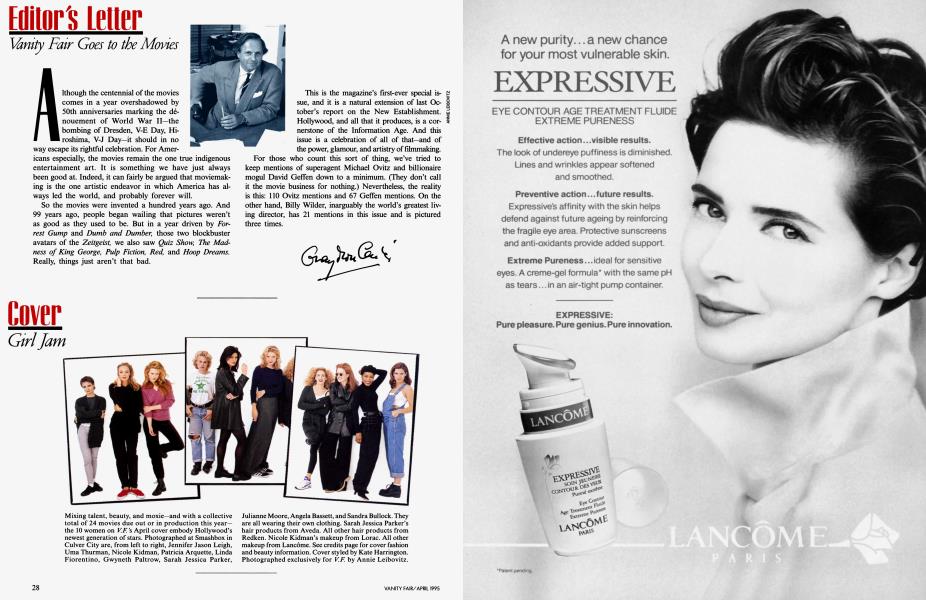
Graydon Carter
Vanity Fair Goes to the Movies
Although the centennial of the movies comes in a year overshadowed by 50th anniversaries marking the dénouement of World War II—the bombing of Dresden, V-E Day, Hiroshima, V-J Day—it should in no way escape its rightful celebration. For Americans especially, the movies remain the one true indigenous entertainment art. It is something we have just always been good at. Indeed, it can fairly be argued that moviemaking is the one artistic endeavor in which America has always led the world, and probably forever will.
So the movies were invented a hundred years ago. And 99 years ago, people began wailing that pictures weren't as good as they used to be. But in a year driven by For-rest Gump and Dumb and Dumber, those two blockbuster avatars of the Zeitgeist, we also saw Quiz Show, The Madness of King George, Pulp Fiction, Red, and Hoop Dreams. Really, things just aren't that bad.
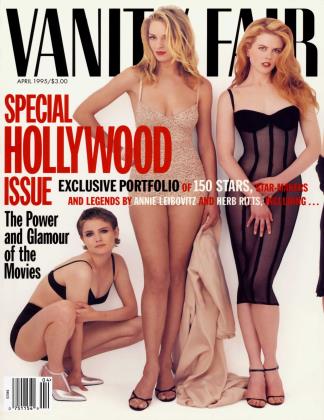
This is the magazine's first-ever special issue, and it is a natural extension of last October's report on the New Establishment. Hollywood, and all that it produces, is a cornerstone of the Information Age. And this issue is a celebration of all of that—and of the power, glamour, and artistry of filmmaking.
For those who count this sort of thing, we've tried to keep mentions of superagent Michael Ovitz and billionaire mogul David Geffen down to a minimum. (They don't call it the movie business for nothing.) Nevertheless, the reality is this: 110 Ovitz mentions and 67 Geffen mentions. On the other hand, Billy Wilder, inarguably the world's greatest living director, has 21 mentions in this issue and is pictured three times.

Subscribers have complete access to the archive.
Sign In Not a Subscriber?Join Now