


Sign In to Your Account
Subscribers have complete access to the archive.
Sign In Not a Subscriber?Join NowHEROINE CHIC
Movies
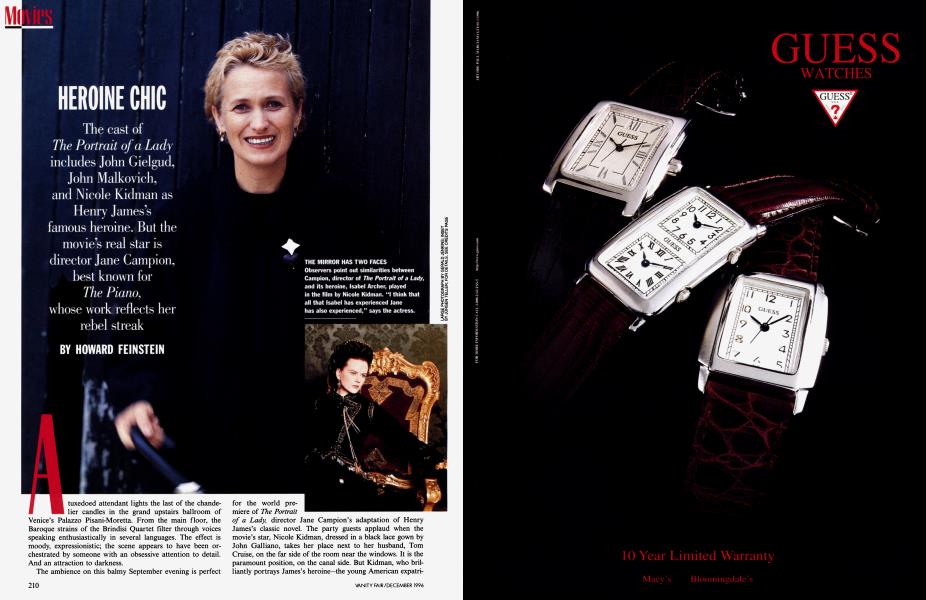
The cast of The Portrait of a Lady includes John Gielgud, John Malkovich, and Nicole Kidman as Henry James's famous heroine. But the movie's real star is director Jane Campion, best known for The Piano, whose work reflects her rebel streak
HOWARD FEINSTEIN
Atuxedoed attendant lights the last of the chandelier candles in the grand upstairs ballroom of Venice's Palazzo Pisani-Moretta. From the main floor, the Baroque strains of the Brindisi Quartet filter through voices speaking enthusiastically in several languages. The effect is moody, expressionistic; the scene appears to have been orchestrated by someone with an obsessive attention to detail. And an attraction to darkness.
The ambience on this balmy September evening is perfect for the world premiere of The Portrait of a Lady, director Jane Campion's adaptation of Henry James's classic novel. The party guests applaud when the movie's star, Nicole Kidman, dressed in a black lace gown by John Galliano, takes her place next to her husband, Tom Cruise, on the far side of the room near the windows. It is the paramount position, on the canal side. But Kidman, who brilliantly portrays James's heroine—the young American expatriate Isabel Archer—would be the first to acknowledge that Campion, sitting a few tables back, deserves the spotlight tonight.
FOR DETAILS, SEE CREDITS PAGE
Jane Campion, best known for The Piano, which earned her an Oscar for best original screenplay, has created a film in which all of the elements—actors, props, lighting, editing, and music (superb compositions by Wojciech Kilar, Schubert, and Strauss)—are perfectly conjoined. The movie is a fine example of what Wagner called the Gesamtkunstwerk, the completely organic work of art. Campion's detractors, who accuse the film-school grad of pretentiousness, self-consciousness, and static tableaux, may not be silenced by the new film, but will be temporarily mollified by the intelligence, emotion, and sweeping grandeur of the beautifully assembled work.
A driven woman ambivalent about her own unruly ambitions, Campion chose to debut her challenging picture out of competition at the Venice International Film Festival. The choice was logical: most of the action occurs among American and British expatriates in Florence in the 1870s. (Co-star Barbara Hershey, citing the 10 location moves during filming, calls Portrait of a Lady "a Victorian road movie.")
The film tells the story of an American innocent through whom a group of sophisticated "admirers" live out their own complicated desires. It centers on the recently orphaned Isabel, who leaves America for England and her wealthy uncle and aunt, the Touchetts (played by Sir John Gielgud and a subdued Shelley Winters). After Isabel rejects several suitors, the Touchetts' tubercular son, Ralph (Martin Donovan), a man with no future of his own, arranges for his beloved cousin to inherit a fortune, in effect setting her free in the world. The decadent Madame Merle (Hershey in an extraordinary turn) befriends Isabel and steers her toward a disastrous choice: marriage to the manipulative dilettante Gilbert Osmond (John Malkovich). The meaning of the conclusion of James's novel, which leaves Isabel used but wiser, has been debated for generations. Campion's ending, though perhaps more hopeful, maintains the ambiguity.
"Jane Campion is reasonably manipulative. She is intensely competitive. She has always managed to get what she's wanted. She will do absolutely what she wants to do."
The director makes the material her own, heightening sexual possibilities that James merely suggests. The movie opens with a group of modern women dancing with their arms linked a la Matisse, signaling the fact that Campion is reviewing the material from a more contemporary vantage. Near the beginning, Isabel rejects three prospective suitors only to later imagine them rolling around her bed, caressing her as she becomes aroused. This Isabel Archer is, at least in part, driven by sex. Campion breaks other conventions, too. She diverges from her sumptuous, exquisitely detailed period locales throughout the movie, most notably in a black-and-white cinematic travelogue that serves as a sort of home movie of Isabel's travels, complete with references to Bunuel (food in a bowl is transformed into talking lips) and sloppily coiffed heroines who would send Merchant and Ivory running for hairpins. Reportedly, Campion also filmed an ending which completely deviates from James and which unites Isabel with her downtrodden stepdaughter, Pansy. It was eventually abandoned.
"When you choose a novel like Portrait of a Lady, you aren't trying to win a popularity prize," says Campion, who is notoriously thin-skinned about criticism, despite her words. "It's not middle-of-the-road cinema. You know you're out there anyway, so you might as well do what you want to do. There's a lot of film out there for a more medium-ground audience."
She says she chose to "physicalize what James only implied." A major scene in the novel, in which Osmond confronts Isabel, becomes, in the film, a study of the sadistic sexual undercurrents in the couple's relationship. "I like the experience of going deeply into the emotions of the scene," says Campion, "to lose yourself. James comes after Jane Austen. I don't like the Austen adaptations. I think they're very soft. James is very modern in relation to her work, because he's already tearing apart the fairy tale. He's saying, 'Look, be real. Life is hard. . . . Nobody's going to get the right person.'" Given this attitude, it is no surprise that Campion looked for inspiration not to period romances but to Francis Ford Coppola's Apocalypse Now and The Godfather, elegant films with bold, hyperrealistic images and notably nonromantic sensibilities.
As a young woman, Campion studied art in Venice and Italian in Perugia. She says that her experience informed her take on James. "I think I had the best time of my early life and then also some of the darkest times. I couldn't find anywhere to stay in Venice, so I was staying with people out in Treviso, and one of my friends was arrested for cocaine trafficking. I had no idea that that was even going on. I just thought, I'm going to be arrested and put in jail, and no one is going to listen to me. I felt that I really had the confidence knocked out of me. ... I think I was close to a breakdown.
"I believe this was helpful to me in understanding Italy's 'winter spirit.' It's very dark. Very dark. Rome can be like that, too, and I was very strong about making sure we had a real darkness to the movie's Rome stuff" (the sad period following Isabel's marriage).
Campion is an attractive, solidly built woman with prominent cheekbones, beautiful blue eyes, and short, bleachedblond hair. She qualifies, but does not deny, the extent of her kinship with her heroine, Isabel. "I love her," she begins, "though now it is more distant. I love the fact that she's a courageous, wrongheaded young woman, and a strongheaded woman. When I meet young women like that, I love and feel for them and know what they've got to go through. The more sensible girls, I like them too, but you know they're not going to learn the hard way."
Most who know Campion also see Isabel. Some see more. "I think that all that Isabel has experienced Jane has also experienced at some stage in her life," says Nicole Kidman. "Isabel said that what she wants from life is chances and dangers. And I think that's also Jane." Another longtime associate adds, "Jane is Isabel Archer—but she's also Madame Merle. She's reasonably manipulative. She is intensely competitive. She has always managed to get what she's wanted. She will do absolutely what she wants to do, in her life and in her movies."
This same observer points to the tragic death of Campion's 12-day-old son, just after the director won the top prize at Cannes for The Piano, as a life-changing experience: "The irony of Jasper dying at the moment of winning the Palme d'Or is that you learn that what you want is not always under your control." The Portrait of a Lady, in which Isabel Archer also loses a baby, is dedicated to the boy.
"It seems Jane exhaustively draws everything she can from an actor," says Richard E. Grant, "and to recycle them into another role is of little interest."
Jane Campion was born 42 years ago in Wellington, New Zealand. Her mom and dad, who divorced after nearly 40 years of marriage, were theater people of means who founded the New Zealand Players. When Campion was 16, her parents gave up the company to become farmers; she later moved back to Wellington to study anthropology before relocating to Australia.
"Jane was an extremely good athlete," says her mother, Edith Campion, a former actress. "She was a good hurdler, a high jumper, and a sprinter." But, Edith says, the aspiring athlete chose to give up athletics. The pressure she put on herself was too stressful, and she had other interests. "She was an extremely good child artist too. I've framed quite a few of the things she did when she was 12 or 13. They're very idiosyncratic. There's one of a man sitting on a park bench, and his hand is enormous. I think she has a very particular eye on the world. You might not like it, but she doesn't want to please everybody."
"I loved putting on plays when I was young," says Jane Campion. "I did it all the time, compulsively. But when I got older, I was very against the whole lovey side of theater. It's a very New Zealand kind of reaction, you know. I thought my parents and their friends were very pretentious, and I didn't want to have any part of it." She breaks into one of her endearing widemouthed laughs, an unusually horizontal display of very white teeth. Her smile, in fact, resembles a piano keyboard.
Her father was also a director. "I watched my dad a bit," she remembers. "He's not someone who suffers about the details of things much, which I do. But he makes the actors feel they've discovered it themselves, which I think is very important. Mum's very big on that one, too, you know—the idea that the best way for an actor to discover a role is to help them, to lead them towards their own understanding of it, not to be the clever one yourself." Barbara Hershey says Campion learned well from her parents. "Jane spent two days with me before the shoot, creating the character. She showed me her visual notes, talked about her life. It created a right path for me."
Nicole Kidman agrees. "It's so great to work with a director who has compassion and love for actors," she emphasizes, while frankly admitting her initial hostility to the director, who had promised her the role of Isabel, then rescinded her decision until Kidman proved herself in auditions. "I did get angry; I got upset too. I suppose that's when we hit a new level and knew we could work together. A director of that stature doesn't want to be put on a pedestal."
Richard E. Grant, who plays Lord Warburton, describes Campion's method this way: "Here is the key to her personality and way of working—the conspiracy of great friendship that has its own secrets. When someone has been as open and vulnerable as she is, you respond in kind. This total trust means that anything she asks you to try, you do, knowing that she is on your side. It also enables her to be as confrontational and challenging as you dare to be with a best friend.
"She is the only director I know who can act," he adds. "If a scene is not working, she improvises and joins in."
(Continued on page 229)
(Continued from page 214)
Peter Long and Kate Ellis, friends of Campion's from Melbourne, shot a revealing behind-the-scenes documentary entitled Portrait: Jane Campion and The Portrait of a Lady. They observe her whispering encouragement to the actors, hugging Kidman ("Just have faith, O.K.?"); kissing Malkovich; diplomatically urging Shelley Winters to stop kvetching (the autumnal Winters was, at one point, replaced by a stand-in); and wiping machine-made raindrops off the face of Barbara Hershey with a warm towel. It seems loving, motherly.
But Campion rarely uses a performer more than once. "It seems she exhaustively draws everything she can from an actor," says Grant, "and to recycle them into another role is of little interest. Not that you feel in any way used. Privileged, rather."
She works differently with her nonacting creative team—screenwriters, directors of photography, editors—many of whom reappear on Campion's credit rolls. "It's a deeply intimate experience when Jane works with actors. Time is compressed," says Laura Jones, who wrote the screenplay. "But with writing, it happens over a couple of years, so you have to settle in for the long haul. So maybe I didn't get my face wiped as much as Barbara Hershey."
Jane Campion films often center on quirky, outsider female characters, the kind which do not tend to intrigue executives at major studios. Campion's early short A Girl's Own Story features an awkward teen who traces a man's penis in an anatomy book and innocently practices kissing with a girl schoolmate. The childlike—and insane—title character in Sweetie wears just about anything she can attach to her body and licks the body of any man who will lie still long enough. Holly Hunter's Ada in The Piano is stubborn, mute by choice. Campion loves to show us intensely private scenes from her women's lives; she often reveals erotic moments of a sort rarely glimpsed on-screen. According to Kim Williams, head of Twentieth Century Fox in Australia and an early supporter of Campion's, "There's a lot of intimate detail in her films which is sort of strikingly personal, the sort of stuff you're more used to seeing in novels or articles." To this end, Campion plans to produce, along with husband Colin Englert and Nicole Kidman, an adaptation of Susanna Moore's violently erotic novel, In the Cut.
"If Jane hadn't done anything, I think she might have become a great criminal," says her mother. "She's up to mischief."
"I think it is something I do consciously," says Campion. "It's so strange, having areas that are shameful, or supposedly shameful, or private. There's a kind of major group pretense that it never happens—a kind of consensus reality which isn't really reality—a part of what I think separates us and makes me lonely."
The artistic vision of Jane Campion is much darker than those of other directors who live in Australia, and Portrait of a Lady is chillier than her earlier work. "I'm moving towards a darker vision," she acknowledges, "but I don't feel that personally." The darkness stems in part from Campion's New Zealand heritage.
"A lot of artists and filmmakers come out of New Zealand," says Laura Jones. "That sense of isolation, growing up in a tiny place on the edge of the world, not having that fence of history around you . . . makes for original voices."
"Jane grew up in a country where there was barely a film industry, where there was barely even television until 1966," says John Maynard, who produced Sweetie. "She came to film quite late and really fresh." Bridget Ikin, who produced An Angel at My Table, says, "The legacy that we grow up with in New Zealand is repressive about personal matters, and sex is a big part of that. There is a curious, sort of cheeky side of Jane—almost iconoclastic. It hits right at the core of those subjects taboo for good Kiwi girls. She always likes to think of herself as a naughty girl."
"Well, look, it comes down to New Zealand, the look of the country and the way it was settled, you know?" says Campion. "New Zealand was a utopian settlement, based on utopian ideas of equality, which has its great side and its bad side, because if everybody's equal, then nobody can excel, either." She laughs. "It has a kind of flat quality. And it's also very uncelebratory. You know, they used to have a program on TV in New Zealand, That's Fairly Interesting. That's the title of it. In America, it's That's Incredible! New Zealand is really a country of enormous understatement."
'In her quiet way, Jane's quite a sexual creature," says a colleague. This person mentions the time when Campion recounted an episode in film school when she had an editing table in the house she shared with her boyfriend. "She said sometimes an idea would come to her at the most inappropriate times. She cited one occasion when she was in bed, just about to have sex, and she suddenly had this wonderful idea, and she said to her partner, 'Excuse me, I have to go,' and she ran downstairs."
"Her major life is in her work," says another colleague. "I don't think it exists in the domestic sphere."
In the past, Campion has been romantically involved with several rather exotic people. She lived for years with Gerard Lee, who codirected and co-wrote one of her shorts, Passionless Moments, and co-wrote Sweetie. He is described as "deeply and profoundly eccentric," and "one degree off center." They broke up and she later had a fling with Scottish transplant Billy MacKinnon, a handsome, suave, creative, and high-energy producer and screenwriter. He eo-produced and co-wrote his brother Gillies's 1995 film, Small Faces, and worked on a currently unproduced screenplay of Christopher Isherwood's My Guru and His Disciple for Campion. By all accounts, Colin Englert is more low-key than Campion's previous partners. He has been an on-camera reporter and is a former television director. On Portrait of a Lady, he served as second-unit director and consultant researcher. The couple live in the exclusive Vaucluse section of East Sydney with their young daughter, Alice.
Campion gardens, hikes, reads, spends time with her close friends, and, all agree, adores girl talk about guys, hairdos, and the like. "She's a girl—a very complicated one, but a girl nevertheless," says pal Holly Hunter. "I really enjoy that part of her." Campion plans to take the next year and a half off "to be a mother," before embarking on her next directorial task, filming a contemporary script ("Yay!" she shouts) about a young woman and a much older one set in Australia and India that she has been writing with her sister, Anna Campion, who is also a filmmaker.
There's a dichotomy here: as Jane Campion's own life becomes more and more sedate, her films move into darker and more explosive realms. Can the two co-exist? Those who know her best doubt that anything can quell the rebellion inside the director. "If Jane hadn't done anything, I think she might have become a great criminal," Edith Campion says with a laugh. "She's up to mischief. She likes to set things into action and see what happens. But then, that's rather like being a movie director."
Subscribers have complete access to the archive.
Sign In Not a Subscriber?Join Now


