




Sign In to Your Account
Subscribers have complete access to the archive.
Sign In Not a Subscriber?Join NowDon DeLillo's sprawling, brainy new novel explores the landscape of his Italian-American childhood, when the '51 Dodgers-Giants game made baseball history. At 832 pages, Underworld is this fall's big book, in every sense of the word
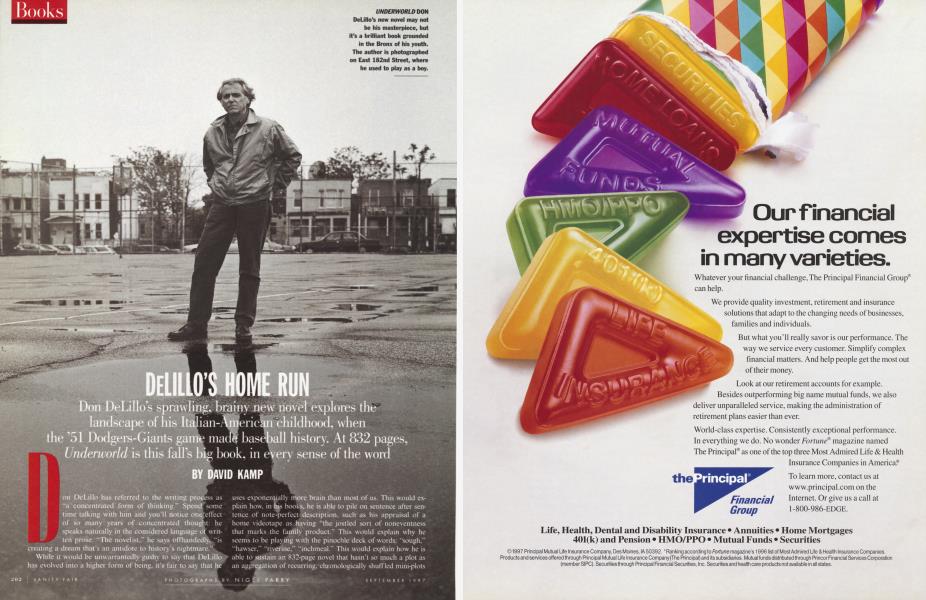
Don DeLillo's sprawling, brainy new novel explores the landscape of his Italian-American childhood, when the '51 Dodgers-Giants game made baseball history. At 832 pages, Underworld is this fall's big book, in every sense of the word
Don DeLillo has referred to the writing process as "a concentrated form of thinking." Spend some time talking with him and you'll notice one!effect of so many years of concentrated thought: he speaks naturally in the considered language of written prose. "The novelist." he says offhandedly, "is creating a dream that's an antidote to history's nightmare."
While it would be unwarrantedly gushy to say that DeLillo has evolved into a higher form of being, it's fair to say that he uses exponentially more brain than most of us. This would explain how, in his books, he is able to pile on sentence after sentence of note-perfect description, such as his appraisal of a home videotape as having "the jostled sort of noneventness that marks the family product." This would explain why he seems to be playing with the pinochle deck of words: "sough." "hawser." "riverine." "inchmeal." This would explain how he is able to sustain an 832-page novel that hasn't so much a plot as an aggregation of recurring, chronologically shuffled mini-plots about subjects as disparate as garbage, infidelity, heroin, the Cold War, urban blight, Lenny Bruce, graffiti, the art market, and the World Wide Web—all somehow refracted through the most famous baseball playoff in history, the '51 Dodgers-Giants game in which Bobby Thomson hit his pennant-clinching homer, the Shot Heard 'Round the World.
The new novel is Underworld, to be published by Scribner this October after months of eager anticipation in the literary world. The book is strewn with elements of past DeLillo works—Lira's fixation on the Kennedy assassination, Mao II's stadium crowds, White Noise's toxic waste—but it's also the first book of the 60-year-old author's career to draw heavily from his own background as an Italian-American who grew up in the Bronx in the 50s. "I've done things backwards, no doubt," DeLillo says. "As a first-generation American, I started out wanting to embrace the larger culture—it's not an accident that my first novel [published in 1971] was called Americana. But at some point I realized that if I wanted to go back to the Bronx of the 1950s, I'd have to deal with things I hadn't dealt with, like ethnic identity."
"The novelist, DeLillo says, "is creating a dream that's an antidote to history's nightmare."
Underworld's origins lie in a novella DeLillo started six years ago about the Dodgers-Giants game, "Pafko at the Wall," published to ecstatic response in Harper's in 1992. The author derived so much pleasure from writing the story, he says, "that it compelled itself to extend into time and space." Perversely, he chose not to develop the novella's most thoroughly realized characters—among them, jabbery, fictive versions of Frank Sinatra, Jackie Gleason, and Toots Shor, plus a wholly invented character named Cotter Martin, a Harlem kid who'd sneaked into the Polo Grounds to watch the game—but instead fixed on a nameless figure, a Bronx teenager listening to the game on the radio. This boy became Nick Shay, Underworld's protagonist, in his adult life an executive with a waste-management firm; "Pafko at the Wall," in somewhat altered form, became Underworld's prologue.
Underworld represents DeLillo's happiest creative experience, in that its Bronx scenes unlocked long-dormant memories whose fluid rush allowed him to write "in a looser vein, not as controlled as Mao II and Libra." This is not to say that the novel is sentimental. As usual, every page brims with portent, and DeLillo makes you work hard. There are difficult, experimental passages that read like demented fugues of Nick Shay's internal thoughts, with phrases tossed out, responded to, then repeated, then re-responded to. There are also purely exhilarating moments of invention, such as a sequence in which DeLillo creates not just a "lost" Sergei Eisenstein film called Unterwelt, but also the middlebrow Manhattanite frenzy surrounding it: "a nice, tight hysteria" over a "movie you probably never heard of until the Times did a Sunday piece."
The sheer bulk and breadth of Underworld will intimidate a lot of people into thinking it's Don DeLillo's masterwork. It isn't. It is what DeLillo says it is, "a large novel leading in a number of dimensions"—a strange, sprawling double album of a book, widely varied in pace and texture, mostly satisfying, occasionally staggering, cumulatively a joy.
Subscribers have complete access to the archive.
Sign In Not a Subscriber?Join Now
