Sign In to Your Account
Subscribers have complete access to the archive.
Sign In Not a Subscriber?Join NowEditor's Letter
In the Company of Women
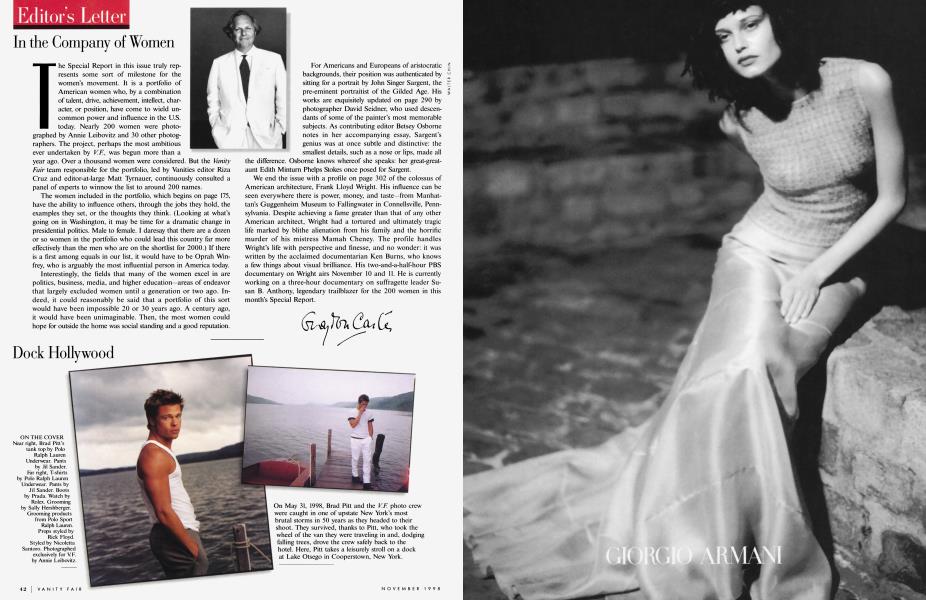
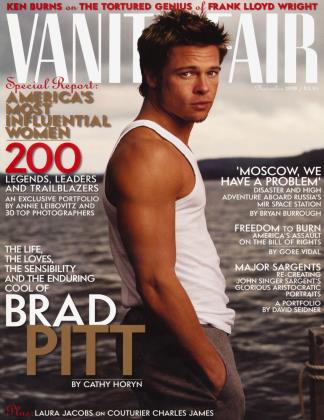
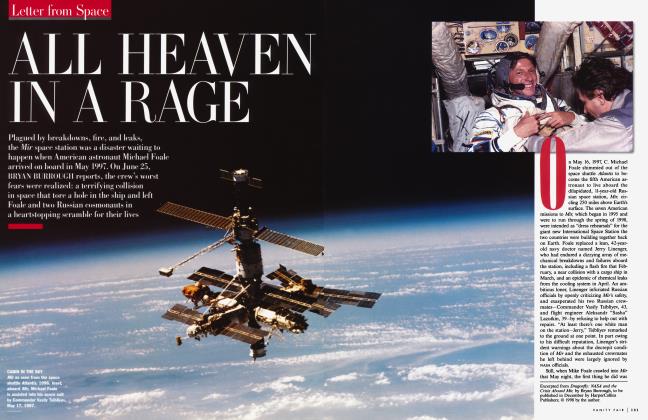
The Special Report in this issue truly represents some sort of milestone for the women's movement. It is a portfolio of American women who, by a combination of talent, drive, achievement, intellect, character, or position, have come to wield uncommon power and influence in the U.S. today. Nearly 200 women were photographed by Annie Leibovitz and 30 other photographers. The project, perhaps the most ambitious ever undertaken by V.F., was begun more than a year ago. Over a thousand women were considered. But the Vanity Fair team responsible for the portfolio, led by Vanities editor Riza Cruz and editor-at-large Matt Tyrnauer, continuously consulted a panel of experts to winnow the list to around 200 names.
The women included in the portfolio, which begins on page 175, have the ability to influence others, through the jobs they hold, the examples they set, or the thoughts they think. (Looking at what's going on in Washington, it may be time for a dramatic change in presidential politics. Male to female. I daresay that there are a dozen or so women in the portfolio who could lead this country far more effectively than the men who are on the shortlist for 2000.) If there is a first among equals in our list, it would have to be Oprah Winfrey, who is arguably the most influential person in America today.
Interestingly, the fields that many of the women excel in are politics, business, media, and higher education—areas of endeavor that largely excluded women until a generation or two ago. Indeed, it could reasonably be said that a portfolio of this sort
would have been impossible 20 or 30 years ago. A century ago, it would have been unimaginable. Then, the most women could hope for outside the home was social standing and a good reputation.
For Americans and Europeans of aristocratic backgrounds, their position was authenticated by sitting for a portrait by John Singer Sargent, the pre-eminent portraitist of the Gilded Age. His works are exquisitely updated on page 290 by photographer David Seidner, who used descendants of some of the painter's most memorable subjects. As contributing editor Betsey Osborne notes in her accompanying essay, Sargent's genius was at once subtle and distinctive: the smallest details, such as a nose or lips, made all the difference. Osborne knows whereof she speaks: her great-greataunt Edith Mintuurn Phelps Stokes once posed for Sargent.
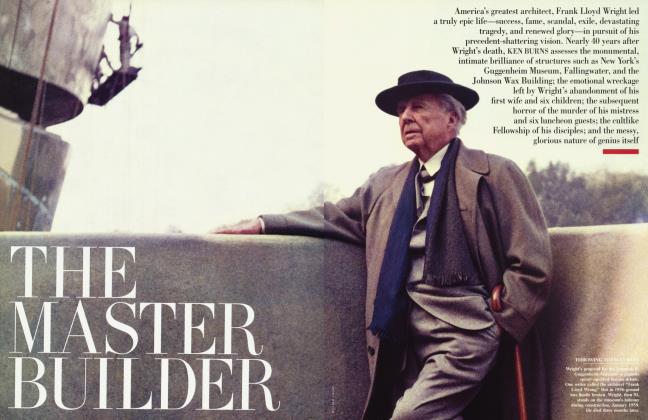
We end the issue with a profile on page 302 of the colossus of American architecture, Frank Lloyd Wright. His influence can be seen everywhere there is power, money, and taste—from Manhattan's Guggenheim Museum to Fallingwater in Connellsville, Pennsylvania. Despite achieving a fame greater than that of any other American architect, Wright had a tortured and ultimately tragic life marked by blithe alienation from his family and the horrific murder of his mistress Mamah Cheney. The profile handles Wright's life with perspective and finesse, and no wonder: it was written by the acclaimed documentarian Ken Burns, who knows a few things about visual brilliance. His two-and-a-half-hour PBS documentary on Wright airs November 10 and 11. He is currently working on a three-hour documentary on suffragette leader Susan B. Anthony, legendary trailblazer for the 200 women in this month's Special Report.
Subscribers have complete access to the archive.
Sign In Not a Subscriber?Join Now