Sign In to Your Account
Subscribers have complete access to the archive.
Sign In Not a Subscriber?Join NowSTATE OF THE UNION
Letters
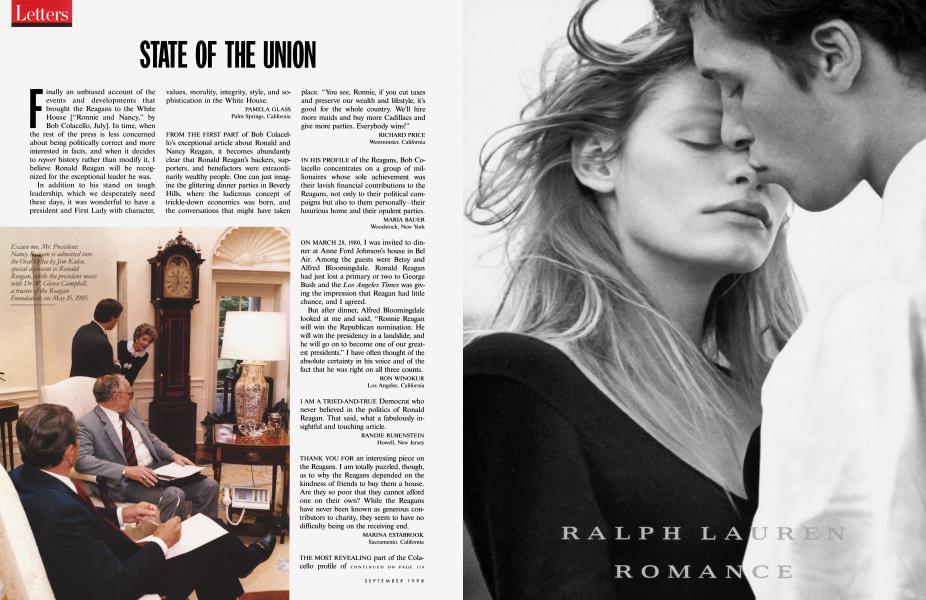
Finally an unbiased account of the events and developments that brought the Reagans to the White House ["Ronnie and Nancy," by Bob Colacello, July]. In time, when the rest of the press is less concerned about being politically correct and more interested in facts, and when it decides to report history rather than modify it, I believe Ronald Reagan will be recognized for the exceptional leader he was.
In addition to his stand on tough leadership, which we desperately need these days, it was wonderful to have a president and First Lady with character, values, morality, integrity, style, and sophistication in the White House.
PAMELA GLASS Palm Springs, California
FROM THE FIRST PART of Bob Colacello's exceptional article about Ronald and Nancy Reagan, it becomes abundantly clear that Ronald Reagan's backers, supporters, and benefactors were extraordinarily wealthy people. One can just imagine the glittering dinner parties in Beverly Hills, where the ludicrous concept of trickle-down economics was born, and the conversations that might have taken place. "You see, Ronnie, if you cut taxes and preserve our wealth and lifestyle, it's good for the whole country. We'll hire more maids and buy more Cadillacs and give more parties. Everybody wins!"
RICHARD PRICE Westminster, California
IN HIS PROFILE of the Reagans, Bob Colacello concentrates on a group of millionaires whose sole achievement was their lavish financial contributions to the Reagans, not only to their political campaigns but also to them personally—their luxurious home and their opulent parties.
MARIA BAUER Woodstock, New York
ON MARCH 28, 1980, I was invited to dinner at Anne Ford Johnson's house in Bel Air. Among the guests were Betsy and Alfred Bloomingdale. Ronald Reagan had just lost a primary or two to George Bush and the Los Angeles Times was giving the impression that Reagan had little chance, and I agreed.
But after dinner, Alfred Bloomingdale looked at me and said, "Ronnie Reagan will win the Republican nomination. He will win the presidency in a landslide, and he will go on to become one of our greatest presidents." I have often thought of the absolute certainty in his voice and of the fact that he was right on all three counts.
RON WINOKUR Los Angeles, California
I AM A TRIED-AND-TRUE Democrat who never believed in the politics of Ronald Reagan. That said, what a fabulously insightful and touching article.
RANDIE RUBENSTEIN Howell, New Jersey
THANK YOU FOR an interesting piece on the Reagans. I am totally puzzled, though, as to why the Reagans depended on the kindness of friends to buy them a house. Are they so poor that they cannot afford one on their own? While the Reagans have never been known as generous contributors to charity, they seem to have no difficulty being on the receiving end.
MARINA ESTABROOK Sacramento, California
THE MOST REVEALING part of the Colacello profile of the Reagans was the anecdote about how Nancy Reagan and Washington Post publisher Katharine Graham became friends. I had to read it twice to make sure I understood correctly: their having been introduced by author Truman Capote was such a source of embarrassment to them that they "didn't think it was suitable" for discussion and have kept it "a dark secret" all these years. That speaks volumes—sad ones—about both women.
CONTINUED ON PAGE 114
CONTINUED FROM PAGE 108
STEVE TARAVELLA Washington, D.C.
DURING THE REAGAN YEARS I felt safe and proud to be an American. With Clinton I feel ashamed and embarrassed.
LOIS P. GABLE York, Pennsylvania
Fatal Revision
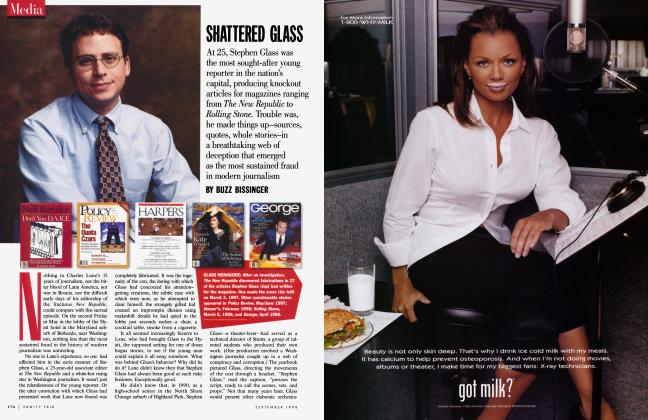
WOW! ROBERT SAM ANSON, with his hatchet job ["The Devil and Jeffrey MacDonald," July], has now joined Joe McGinniss, Janet Cooke, and Stephen Glass in the pantheon of writers who fake their research and then write false articles for money. Amazingly, in a case that is unusually well documented in court documents, Freedom of Information Act releases, and sworn witness statements, Anson was peculiarly unable to utilize those sources for facts. Instead, he was quick to seize, and even enlarge upon, tired old myths about my case, almost all of which have originated from prosecution sources or Joe McGinniss's pen, and which have been disproved time and again. (While Anson was writing his pathetic litany of falsehoods and innuendo, the Vanity Fair fact checkers were seriously inquiring about the make of the car in a photograph.)
Anson had a chance to do a real investigative piece. Too bad for the truth that he chose that pathetic low road, the gossip highway, the pat-the-nicegovernment-prosecutor-on-the-back-andcollect-the-check style of hack writing. Shame on him.
Oh, and, Mr. Anson, one more thing: when you fake research, perhaps you should learn what your role model, Joe McGinniss W&S it Clifford Irving?), already learned—you need to get at least something correct, or everyone will know. My eyes are hazel—not your mythical "ice blue." Or perhaps you knew, but liked blue better for your fanciful version of the facts?
CONTINUED ON PAGE 120
CONTINUED FROM PAGE 114
JEFFREY R. MACDONALD, M.D. Sheridan, Oregon
ROBERT SAM ANSON REPLIES: As usual, Jeffrey MacDonald is an articulate advocate. And, as usual, MacDonald leaves a few things out. Like the fact that the evidence presented against him at trial was overwhelming and that, according to one of his own attorneys, some of the most damning words came out of his own mouth. Per well-developed practice, he also neglects to mention that the chief "real killers' he's been pointing hisfinger at for nearly three decades were long ago cleared of any culpability by one of the most exhaustive criminal investigations in U.S. history. Last, but hardly least, MacDonald— whose unsuccessful appeals record is also one of the most exhaustive in U.S. history—fails to note that he was convicted of triple homicide in 1979, and that, despite the obvious enticements since, not one of hisjurors has ever expressed any public reservations about the verdict.
HAVING FOLLOWED with interest the saga of Jeffrey MacDonald since the murder of his wife and children made sensational news, I find that Robert Sam Anson's superb review of the case begs comparison of MacDonald to O. J. Simpson. In both cases, influential persons were willing to defend the accused with the argument that such "charming" heroes and champions of their chosen professions could not be cold-blooded killers. In both cases shameless attorneys believed they could sow enough confusion and doubt in a juror's mind to forestall conviction. It worked for Simpson because of a racial backlash against the system of justice, and the fact that Judge Ito kicked off the jury the only person who might have held out for conviction, thereby dooming the prosecution.
I fear that Jeffrey MacDonald may get a new trial, since only one holdout against conviction would bring a hung jury, which could lead to his freedom, and I'm well aware of how clever attorneys can woo at least one out of 12 people to that effect. As a clinical psychiatrist with 29 years of experience, I have no doubt that Dr. MacDonald committed the murders and, like O. J. Simpson, is determined never to admit it.
JOSEPH I. STAPEN, M.D. Santa Barbara, California
MY WIFE AND I are natives of Fayetteville, North Carolina, where Jeff MacDonald committed his heinous crimes on his family. We read with great interest to see what kind of spin your magazine was going to put on this story. The last line told it all: "Never was there a tear." Jeff MacDonald is a classic example of a sociopathic Svengali. He has fooled many people, mostly females, into believing his demented story.
Those of us who remember that awful night of February 16, 1970, and the events that followed, know that MacDonald was the murderer and that the evidence was clear. Bringing in self-aggrandizing attorneys such as Alan Dershowitz only further reminds us of his guilt. This is one of the few times in the history of jurisprudence that money, high-powered lawyers, and fame haven't done the victims an injustice.
MARSHALL AND SAN DEE WAREN Fayetteville, North Carolina
Sinatra. Frankly
JONATHAN SCHWARTZ'S tribute to Frank Sinatra ["Swingin' on a Century," July] was brilliant. No one else has so clearly described the phenomenon he was.
Never stopping to think why, I just knew I liked Sinatra. I knew it was more than the man, more than the songs, even more than the voice. Now I understand why. It has always been so easy for writers to pick at parts and pieces of Sinatra and his life. But those aren't the stories that explain the magic.
As for Schwartz, he's got it right.
R. J. WALTERS Dallas, Texas
JONATHAN SCHWARTZ writes as wonderfully as he speaks and spins. I have been a Sinatra fan all my life, and my years of living in New York made me a Schwartz fan as well. I have enjoyed listening to him extol the virtues of the music itself. Thanks for the great article.
CHARLES SOMMER San Francisco, California
FRANK SINATRA is my favorite male vocalist, so I am charmed by the enthusiasm Jonathan Schwartz expresses for him. However, Schwartz's pronouncement that Sinatra is "the greatest interpretive musician that the United States has ever developed," a claim he calls "not negotiable," is irritating. Such sweeping commentary not only denigrates every other singer of any genre, but arrogantly repudiates the contributions of countless instrumentalists. What about Charlie Parker, Leonard Bernstein, and Miles Davis?
I like to believe that Frank Sinatra himself would deem Schwartz's assertion not only "negotiable" but indeed unctuous and uncouth.
GUY VESPOINT West Hollywood, California
War Wounds
AS A GERMAN CITIZEN who was born in 1953 and presently lives in New York, I read the article "The German Front," by David Margolick [June], with great interest.
It is easy to draw the picture of the ugly Germans over and over again. Do we call it "the American front" or a "blitzkrieg" when American companies buy their way into European corporations, when American culture, from the movies to McDonald's, invades Europe as well as the rest of the world? What is the purpose of the line "[Dieter is] like a German officer, doing his duty"? An officer, per se, does his duty, whether he is German, American, British, or French. As I learned, the office building of the von Holtzbrincks is "built on the site of a former Gestapo installation." What else should they do with the space today?
There is no doubt that the Holocaust was an irreversible catastrophe, the wounds of which can be healed only over several generations. But sorting out the facts from the general tone, I feel that the von Holtzbrincks have contributed more to that healing than the author of your article.
GERTRUD HUSSLA New York, New York
Monica Dearest
In an issue that chronicled the marriage of the Reagans, featured a devastating report from the violent region of Kosovo, and paid homage to the legendary Frank Sinatra, no article inspired more opinions—and sharpened knives—from Vanity Fair readers than July's six-page spread on Monica Lewinsky ("Who's That Girl?," by Christopher Hitchens). While Andrea Hamilton, of Tulsa, decided that photographer "Herb Ritts slipped a cog on this oneand Gina Horan, of Walnut Creek, California, questioned "the sanity of your editors" in featuring a "beret-wearing loser," Robin D. Cullip (Nashville, Tennessee) may have spoken the clearest and loudest for the 50-some correspondents when she wrote in her letter to the editor, "Simply amazing!"
Aline Bertelsen, of Tucson, made clear in her missive, "I have no idea what the piece says, and I refuse to even look at the pictures." Others, however, gave a thorough analytic reading of text and image alike. "The face that launched a thousand subpoenas?" asked Nashville's Stacy Carson. "Hardly. Just a mouth." "What, fellas?" Donna Federici, of Thousand Oaks, California, wrote. "No kneepads?" Alas, so much for the ego boost.
CORRECTIONS: On page 34 of August's "Contributors," we said that Wayne Lawson had been editor of The New York Times Book Review. He was, in fact, one of a staff of editors.
Letters to the editor should be sent with the writer's name, address, and daytime phone number to: Vanity Fair, 350 Madison Avenue, New York, New York 10017. Address electronic mail to vfmail@vf.com. The magazine reserves the right to edit submissions, which may be published or otherwise used in any medium. All submissions become the property of Vanity Fair.
Those submitting manuscripts, photographs, artwork, or other material to Vanity Fair for consideration should not send originals unless requested in writing to do so by Vanity Fair. All unsolicited materials must be accompanied by a self-addressed overnight-delivery envelope, postage paid. However, Vanity Fair is not responsible for unsolicited submissions.
Subscribers have complete access to the archive.
Sign In Not a Subscriber?Join Now


