


Sign In to Your Account
Subscribers have complete access to the archive.
Sign In Not a Subscriber?Join NowEditor's Letter
The Warrior Culture
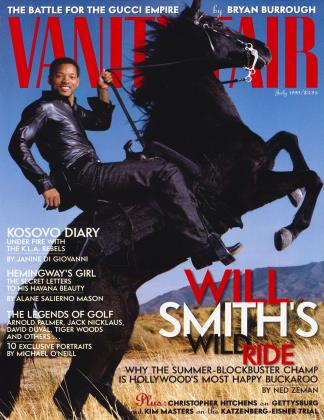
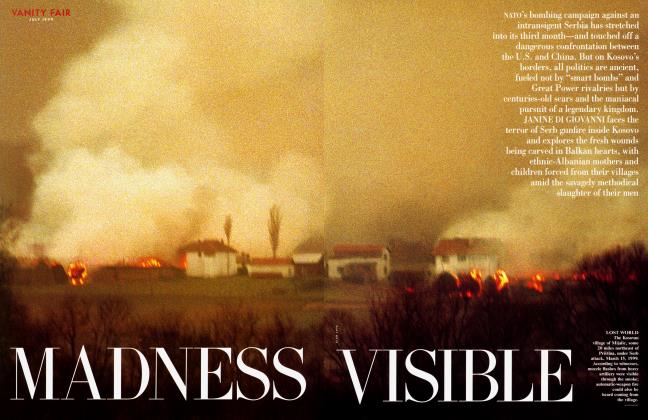
Wars, whether they're waged between nations, corporations, or individuals, are launched for myriad reasons— some of them rational. The results, however, invariably produce moments of breathtaking human misery, as Janine di Giovanni's report from Kosovo, "Madness Visible," on page 78, so vividly documents. This is di Giovanni's second tour of duty covering Balkan wars. She reported on the Bosnian disaster from 1992—and though the London Times correspondent faced gunpoint capture by Serb soldiers on this assignment with the elan of a war-weary veteran, she nevertheless struggled with her own anger and heartbreak as she witnessed the human tragedies scattered around her. Although the U.S. is leading NATO's bombing campaign for humanitarian reasons, the Allied assault has led to the destruction of at least one of the Kosovan villages it set out to defend, and to the by now infamous bombing of the Chinese Embassy in Belgrade. Talk about lunacy: the C.I.A.— which last year cost the taxpayers $26.7 billion—blames the snafu on out-of-date surveillance maps. Right after the bombing, I dispatched a V.F. assistant to the New York Public Library. In an hour, he returned with kabob stains on his shirt and a 1998 tourist map indicating which block the embassy was located on.
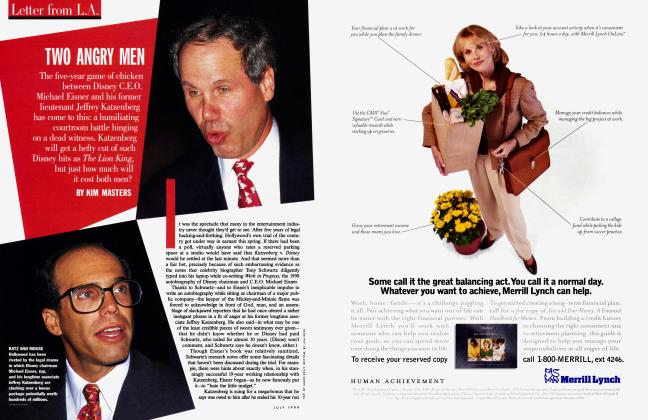
Soldiers have invented some gloriously indelible terms to describe the messy business of war: "snafu" (Situation Normal: All Fucked Up) was one of the more memorable coinages of World War II; Vietnam gave us "collateral damage" as a euphemism for unintended destruction. Kim Masters's report on the courtroom showdown capping Hollywood's bitterest grudge match since Lewis broke up with Martin is an object lesson in the latter. DreamWorks principal Jeffrey Katzenberg and his former employer Disney C.E.O. Michael Eisner have been skirmishing for five years over how big a bonus Disney owes Katzenberg for his stewardship of such hits as Aladdin and The Lion King. In "Two Angry Men," on page 56, Masters suggests that whatever money Eisner saves (or Katzenberg gains) as a result of their scorched-earth hearings, the damage to both men's reputations, and Disney's, has been considerable.
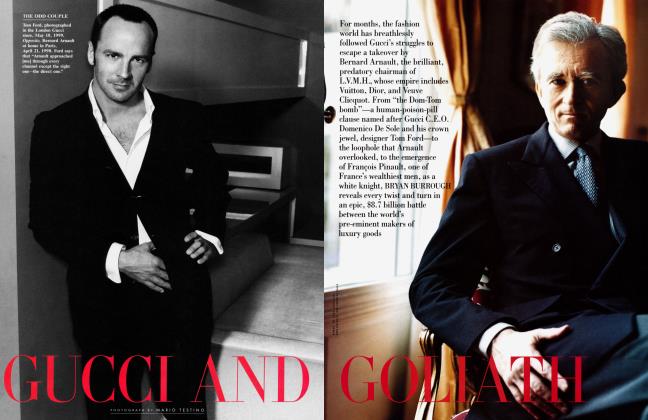
For a remarkable glimpse into the machinations of corporate warfare on the highest level, I direct you to the pages of Bryan Burrough's marvelous account of white-hot Gucci's five-month struggle to avoid being gobbled up by Bernard Arnault, the famed chairman of L.V.M.H., the luxury-goods empire that includes Vuitton, Dior, and Veuve Clicquot. It is quite simply one of the most engaging tales of a takeover battle since, well, Barbarians at the Gate, which Burrough co-authored.
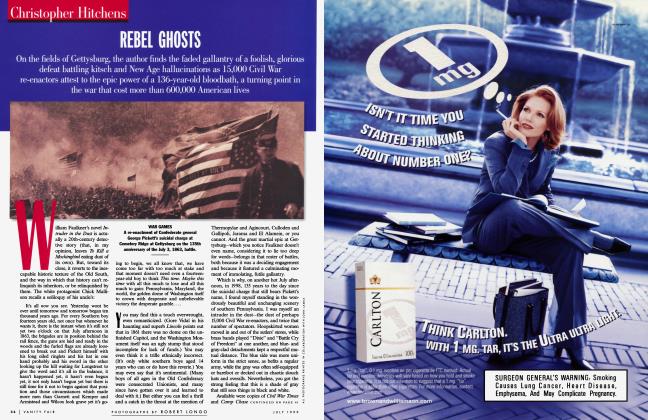
Last, but definitely not least, we have Christopher Hitchens taking a well-earned and doctor-advised break from covering our sitting president. In his report "Rebel Ghosts," on page 34, Hitchens taps into the legacy of a resounding military defeat. Just as the Serbs are still haunted by the 14th-century Battle of Kosovo, thousands of Civil War re-enactors can be found every July reliving the Battle of Gettysburg, the bloody birth of modem America, in which about 11,000 lives were lost. What Hitchens underlines by joining the dusty festivities on the 135th anniversary of the slaughter is that, in so many ways, defeat leaves a more powerful taste than victory.
GRAYDON CARTER
Subscribers have complete access to the archive.
Sign In Not a Subscriber?Join Now