

Sign In to Your Account
Subscribers have complete access to the archive.
Sign In Not a Subscriber?Join NowALL THINGS BRIGHT AND BEAUTIFUL
LETTER FROM NEW YORK
Brooke de Ocampo is perfectly positioned to write the book on 21st-century New York society. So she's done just that, with photographer Jonathan Becker, documenting the fabulous lives of her friends in Bright Young Things
EVGENIA PERETZ
Jonathan Becker, photographer and grudging new member of the International Best-Dressed list, is trying to find out how Brooke de Ocampo got to her "position." He doesn't mean position—as in perched on a pristine white sofa in her 2,400-square-foot Upper East Side apartment, where she is taking shelter from a midsummer downpour. He means position, a place so beautiful that the world looks marvelous from every angle; a place where the typical choice is between the divine and the genius; a place that has made de Ocampo so beloved that everybody—from Alexandre and Alexandra von Furstenberg to Michael and Tara Rockefeller to the bald electronic musician Moby— recently threw open their doors for her and let her catalogue all their objects for Bright Young Things, her lush, spot-on book about 21st-century Manhattan fabulousness, for which Becker took the pictures.
"Position?" de Ocampo says, as if it were the most absurd thing she'd ever heard. "What do you mean, position?"
"I mean, how did you come to know all these people and have everybody's confidence?" asks Becker, quite pleased with himself, as he makes one of several wobbly attempts to bring lit match to half-smoked cigar. "You're only 30 or something, right?" "/ don't know," she says curtly.
"I can t stand wearing someone else's old clothes. I had a hard enough time sharing clothes with my sisters."
Usually, de Ocampo, a native of Greenwich, Connecticut (who's actually 34), can merrily chirp away on just about any topic, and she tends to do so in an inexplicable South American accent. But Becker, a dandyish sort who brings to mind a scamptumed-inquisitor Sherlock Holmes, is up to something—and she isn't going to give in.
"What have you been doing all these years?" he continues.
"/ don't know."
"I mean, how did you meet these people? You didn't just go to school with them."
"I don't know!" she says, shooting a look at the little nuisance, who is now clouding up her living room with cigar smoke. "Look, I'm gregarious by nature," she says.
"So are a lot of people out there—they don't know anybodysays Becker, flashing his whatever-gets-you-through-the-day grin.
Becker looks as if he could go on teasing her for the rest of the afternoon. But the truth is, he knows very well what gave de Ocampo her position as cheerleader and mascot of young New York society, and when he speaks about her behind her back, it's clear how much he admires her for it. Unlike Becker, who, at age 45, is the first to admit he could use some organizational skills, de Ocampo is every inch a force of will, from the blond streaks that start at her regal Greenwich crown to the open toes of her Jimmy Choo stilettos.
To be sure, her resume hasn't a whiff of anything scrappy. She is the daughter of Robert Douglass, a lawyer and right-hand man to Nelson Rockefeller; she attended Taft boarding school and Duke University; she has worked at Vogue, Ralph Lauren, Sotheby's, and Harper's Bazaar; she married a really hot Argentinean investment banker named Emilio Ocampo. Nevertheless, unlike many of the subjects of her book, de Ocampo has no department-store magnate on her family tree, no horse-breeding dad. Instead, she has a brain that tracks data with the efficiency of a Palm Pilot, and a turbocharged determination that pulses through her birdlike limbs even when she's performing tasks as dull as tidying up her living room—or, as she puts it, "fluffing." Which is perhaps how she and Becker were able to deliver Bright Young Things just four months after Assouline agreed to publish it.
De Ocampo took on Bright Young Things soon after giving birth to twin girls (she already had a 15-month-old daughter). Her hope was that such a project would keep her from becoming just another Upper East Side mom. "My husband was traveling a lot for business. I wanted to keep my life so that I felt that I was interesting," says de Ocampo. "I didn't give myself enough credit, because I didn't think being a mom was worthy in its own right. I needed an outlet of some sort."
As it happened, de Ocampo had a passion for pretty things, and the two coincided nicely with Bright Young Things, a title taken from a 1920s phrase used to describe a group of London pleasure-seekers including Diana Cooper, Evelyn Waugh, and the Mitford sisters. De Ocampo also drew inspiration from a classic in the genre of society reportage, Vogue's Book of Houses, Gardens, People. Written by Valentine Lawford, with photographs by Horst and a foreword by Diana Vreeland, that book brought to life the grand style of the 1960s elite—the Carter Burdens, the Cy Twomblys, the Duke and Duchess of Windsor, Doris Duke, Pauline de Rothschild, and Emilio Pucci. Now out of print, it remains the definitive document of postwar glamour. Vintage-book stores, which sell it for as much as $600, can't keep it on the shelf. Designers routinely use it for inspiration. As for de Ocampo, she has always found it "amusing."
Bright Young Things is amusing, toopartly for the differences it reveals be tween today's turnof-the-century style and the blueblood charms of Vogue's Book of Houses, Gardens, People. For one, the people who make up Bright Young Things are mostly Friends of Brooke's—and "don't call them aristocrats, they're meritocrats," she says. This roll call includes Eliza Reed Bolen, who works for her stepfather, Oscar de la Renta; Aerin Lauder, captain of the junior-varsity society team, and her sister, Jane, both powerhouses at Estee Lauder, the family business; "Miller sister" Alexandra von Fiirstenberg, the inspiration behind the return of her mother-inlaw Diane's wrap dress; and Conde Nast editors Plum Sykes, Marina Rust, and Patricia Herrera. Thrown into the mix are assorted artists and dabblers, such as painter Alessandro Twombly (Cy Twombly's son), filmmaker Andrew Lauren (who knew?), that ubiquitous man of the brush (and Moby pal) Damian Loeb, and Kentucky heiress Lulu de Kwiatkowski, doing what appears to be an imitation of a Druid in repose.
The rigidity of the era documented by Lawford and Horst just doesn't cut it with today's B.Y.T's. "The generation of our mothers had to follow a tighter set of rules," de Ocampo says. "Our motto is like, Be whatever or whoever you want to be. Just be it or do it well. I feel there's a much greater sense of confidence in people's own individuality. The sense of the eclectic is much more prevalent."
"My mother calls our decorating style 'Early Attic, Late Cellar,'" Tara Rockefeller tells Brooke de Ocampo.
As the book makes clear, matchy-matchy is strictly for cheeseballs in the year 2000. De Ocampo's friends like to think of themselves as jet-set scavengers, picking up masks from Bali and arrowheads from Wyoming, and leaving no African antelope skull to rest in peace.
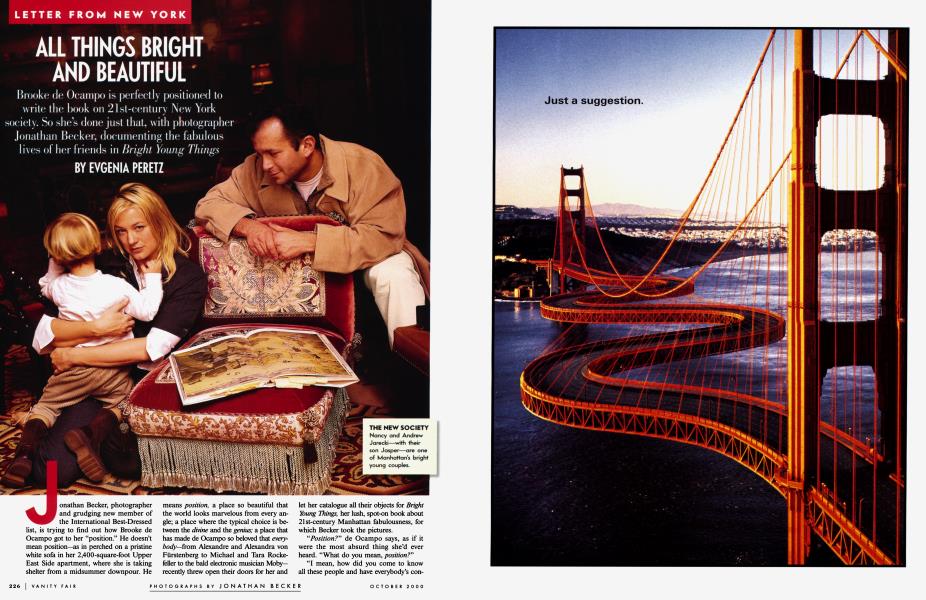
To de Ocampo, one couple from Bright Young Things—Nancy and Andrew Jarecki —just might represent the height of this amalgamated chic for the dot-com era. Andrew is the creator of Moviefone (777FILM), which he sold to AOL for $400 million in stock—and still runs. Nancy, who hails from Kansas society, likes to paint when she is not minding her two sons or serving as the super-chilled-out guidance counselor to young society damsels. As de Ocampo puts it, "She's so earthy and normal." The Jareckis' Caribbean island, Guana, has been a haven for Hollywood speed-dialers, including the late CAA agent Jay Moloney. And they are best friends with fellow Manhattan parents Ethan Hawke and Uma Thurman.
When not on Guana, the Jareckis are in their mock-Tudor apartment—shown off to good effect in Bright Young Things—which is nestled in an Upper East Side co-op designed in 1906 by the renowned Charles Platt Jr. After seven contractors and a year of chipping away at ugly green paint and scraping the linoleum floors, the Jareckis got to work imprinting it with a style that could rightly be called millennial, with its mishmash of the centuries. The 19th-century Hunsinger chairs in the living room are upholstered with silk dalmatics; the diningroom table, which seats 22, is in the style of Henry VIII; the banquette sofas are more de nos jours, designed by Nancy herself.
"It's a calm, peaceful time.... So our generation is much more inwardfocused, on their wellbeing, on the well-being of their families."
For Tara and Michael Rockefeller, another couple lovingly documented by de Ocampo and Becker, history casts a long shadow indeed. A modem Renaissance man who has recently gone dot-com himself with a company called Active Media, Michael was named after his uncle who went missing in 1961 on an excursion to New Guinea. Their Gramercy Park building, incorporated in 1883 as the Gramercy Family Hotel, is part of the oldest surviving coop in the city. Several of their pieces have been inherited from his grandfather Nelson Rockefeller's famous Fifth Avenue salon, which was decorated by the legendary 1930s designer Jean-Michel Frank. Tara, who did the whole Far East thing before getting married, accumulated many of the apartment's odd finds. "With the mix of periods and provenances in our apartment today, my mother calls our decorating style 'Early Attic, Late Cellar,'" she tells de Ocampo. But, as one might expect from the Rockefeller name, Deco pieces sit side by side with Oriental treasures—such as two terracotta horses from the Tang dynasty—with a staid dignity.
Where the Rockefellers' apartment is reserved, the SoHo pied-a-terre of Sebastian and Peggy Guinness is dizzyingly cosmopolitan. The furniture has been collected from Brazil, China, Bali, and Spain, and the place is chockablock with exotica—Tibetan religious totems, Indonesian textiles, and Amazon Indian feather headpieces and masks. While this all may sound mildly pretentious, the stuff of their home is actually an accurate reflection of the Guinnesses' worldly existence. Peggy, de Ocampo tells us, is a Mellon and was born in America, raised in France, and spent her 20s in Sao Paulo, Brazil, where she came upon the stones (tanzanite, citrine, tourmaline) that would inspire the jewelry she designs. Sebastian, a filmmaker, lives most of the year in a converted monastery on top of a mountain in northern Spain, and is in the midst of a five-year documentary on Indonesia. Which might explain the whimsical purple velvet dinner jacket and trousers he's wearing in the pages of Bright Young Things: they were cut from an Indonesian ikat, which basically means "piece of fabric."
But the nomadic-tribesman look doesn't do it for everybody. To Alexandra von Fiirstenberg, who lives with her husband, Alexandre, and baby, Talita, on the 22nd floor of a modern high-rise, the old weird stuff is kind of gross. "I can't stand wearing someone else's old clothes," says the duty-free heiress. "I had a hard enough time sharing clothes with my sisters."
The apartment, which has been in the Miller family for 15 years, has been home to each of the Miller sisters at one time or another—and now it's Alexandra's turn. The art is strictly 20th-century American— Andy Warhol, Ross Bleckner, Peter Beard. The furniture is primarily Ralph Lauren. Each room is a spanking-clean white, and the Alexes insist they stay that way: guests must take off their shoes before entering. (Yes, even the Manolos.)
What does all this mean to de Ocampo? That the here and now is where it's at. Sure, she can get a little nostalgic at times, but that won't cloud her rosy view of the way people in her set live now. "We look back on the 60s and we see how cool Pucci was and how cool the fashions were and their great hair and platform shoes, and Studio 54, and none of us see, because none of us knew, the drugs, you know, the problems," she says. "[Now] it's a calm, peaceful time. There has not been a war, and anytime you get a war you get, like, major social kind of revolutions. So our generation is much more inward-focused, on their well-being, on the well-being of their families."
She could go on with the pep rally, but it seems she has touched a nerve with her co-author.
"I have to admit, I had a resentment about this," says Becker, who is of a slightly earlier generation than de Ocampo and her fellow Bright Young Things. "Naturally, I'm going to get over it, but aren't they bothered by being just concerned with well-being? We were always concerned with other things. It may have all been bullshit, but there was always distraction."
"And causes to fight for," de Ocampo adds, somewhat facetiously.
"Or whatever," he says, defeated.
Becker may have the wisdom of experience behind him, but then again, he has been struggling to do a book for 20 years—and it wasn't until Brooke steamrollered into his life that he was able to pull it off. When asked why he didn't do it earlier—and by himself—he replies, "I don't know. But it has something to do with me. And my lack of what they used to call stick-to-itiveness. But Brooke has it in spades."
"Stick-to-itiveness," de Ocampo says. Suddenly her eyes light up. "It's a great word! I don't care what they call it, but that's the perfect word for it." And de Ocampo ends the day with one more thing to be happy about.
Subscribers have complete access to the archive.
Sign In Not a Subscriber?Join Now


