


Sign In to Your Account
Subscribers have complete access to the archive.
Sign In Not a Subscriber?Join NowTHE NEW ESTABLISHMENT STOCK INDEX
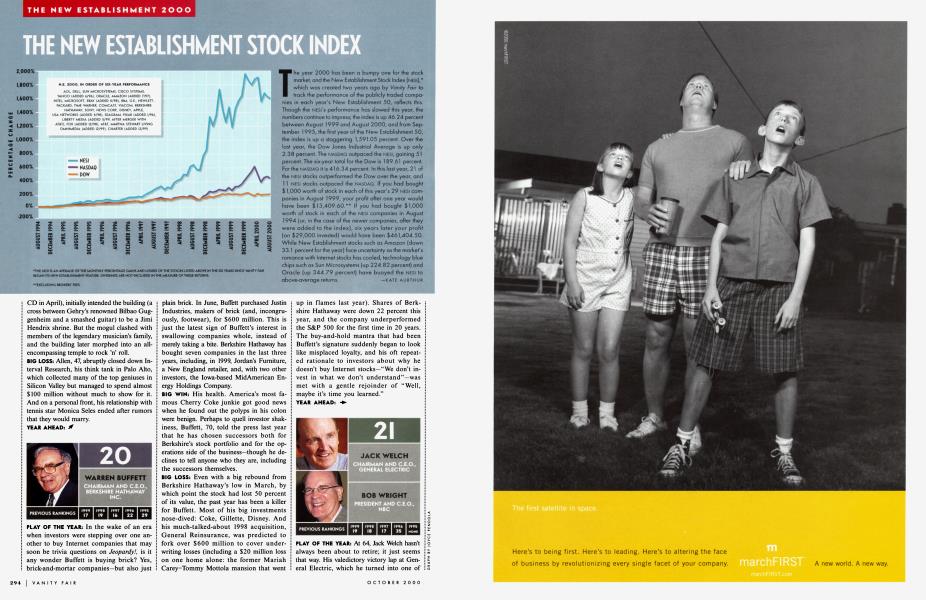
'THE NESI IS AN AVERAGE OF THE MONTHLY PERCENTAGE GAINS AND LOSSES OF THE STOCKS USTED ABOVE {N THE SIX YEARS SINCE VANITY FAIR BEGAN US NEW ESTABLISHMENT FEATURE. DNIDENDS ARE NOT UNCLUDED N THE MEASURE OF THESE RETURNS.
EXCLUDING BROKERS' FEES.
The year 2000 has been a bumpy one for the stock market, and the New Establishment Stock Index (NESl),* which was created two years ago by Vanity Fair to track the performance of the publicly traded companies in each year's New Establishment 50, reflects this. Though the NESl's performance has slowed this year, the numbers continue to impress; the index is up 46.24 percent between August 1999 and August 2000, and from September 1995, the first year of the New Establishment 50, the index is up a staggering 1,591.05 percent. Over the last year, the Dow Jones Industrial Average is up only 2.38 percent. The NASDAQ outpaced the NESI, gaining 51 percent. The six-year total for the Dow is 189.61 percent. For the NASDAQ it is 416.34 percent. In this last year, 21 of the NESl stocks outperformed the Dow over the year, and 11 NESl stocks outpaced the NASDAQ. If you had bought $ 1,000 worth of stock in each of this year's 29 NESl companies in August 1999, your profit after one year would have been $13,409.60.** If you had bought $1,000 worth of stock in each of the NESl companies in August 1994 (or, in the case of the newer companies, after they were added to the index), six years later your profit (on $29,000 invested) would have been $461,404.50. While New Establishment stocks such as Amazon (down 33.1 percent for the year) face uncertainty as the market's romance with Internet stocks has cooled, technology blue chips such as Sun Microsystems (up 224.82 percent) and Oracle (up 344.79 percent) have buoyed the NESl to above-average returns.
KATE AURTHUR
Subscribers have complete access to the archive.
Sign In Not a Subscriber?Join Now