


Sign In to Your Account
Subscribers have complete access to the archive.
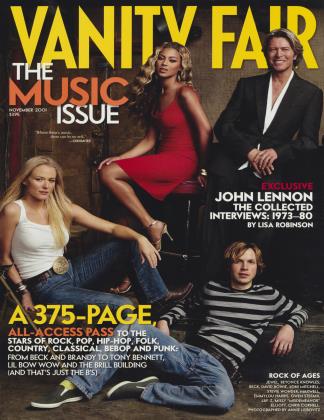
Sign In Not a Subscriber?Join NowFrom the prose of Leonard Cohen to the pose of Rod Stewart, from the cerebral cool of Max Roach to the heartfelt heat of Lucinda Williams, from the country lore of Johnny Cash to the urban myth of Deborah Harry, from the mix of DJ Shadow to the max of U2, it's a straight 55 shots to a music portfolio that resonates with sound.
From the prose of Leonard Cohen to the pose of Rod Stewart, from the cerebral cool of Max Roach to the heartfelt heat of Lucinda Williams, from the country lore of Johnny Cash to the urban myth of Deborah Harry, from the mix of DJ Shadow to the max of U2, it's a straight 55 shots to a music portfolio that resonates with sound.
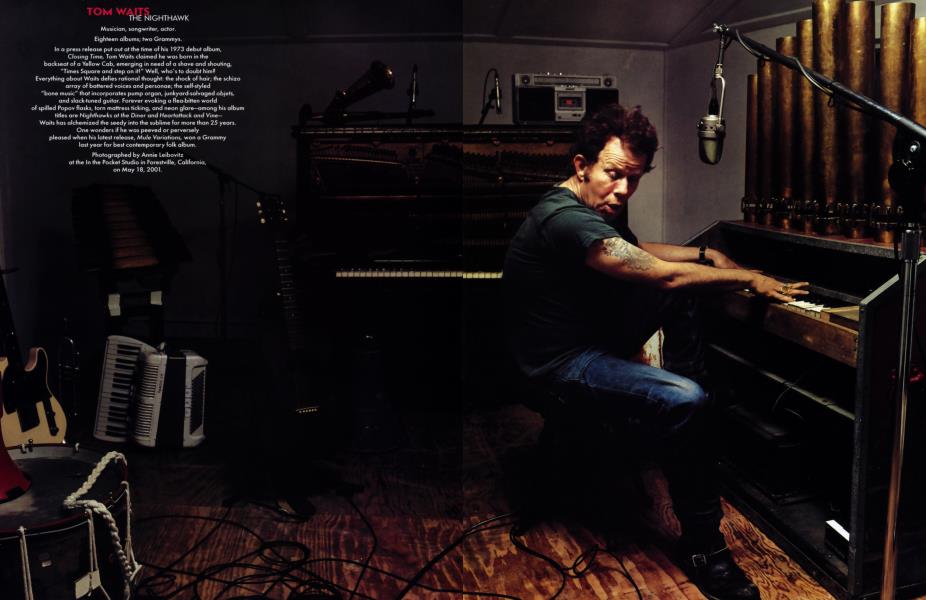
In a press release put out at the time of his 1973 debut album, Closing Time, Tom Waits claimed he was born in the backseat of a Yellow Cab, emerging in need of a shave and shouting, "Times Square and step on it!" Well, who's to doubt him? Everything about Waits defies rational thought: the shock of hair; the schizo array of battered voices and personae; the self-styled "bone music" that incorporates pump organ, junkyard-salvaged objets, and slack-tuned guitar. Forever evoking a flea-bitten world of spilled Popov flasks, torn mattress ticking, and neon glare—among his album titles are Nighthawks at the Diner and Heartattack and VineWaits has alchemized the seedy into the sublime for more than 25 years. One wonders if he was peeved or perversely pleased when his latest release, Mule Variations, won a Grammy last year for best contemporary folk album.
Photographed by Annie Leibovitz at the In the Pocket Studio in Forestville, California, on May 18, 2001.
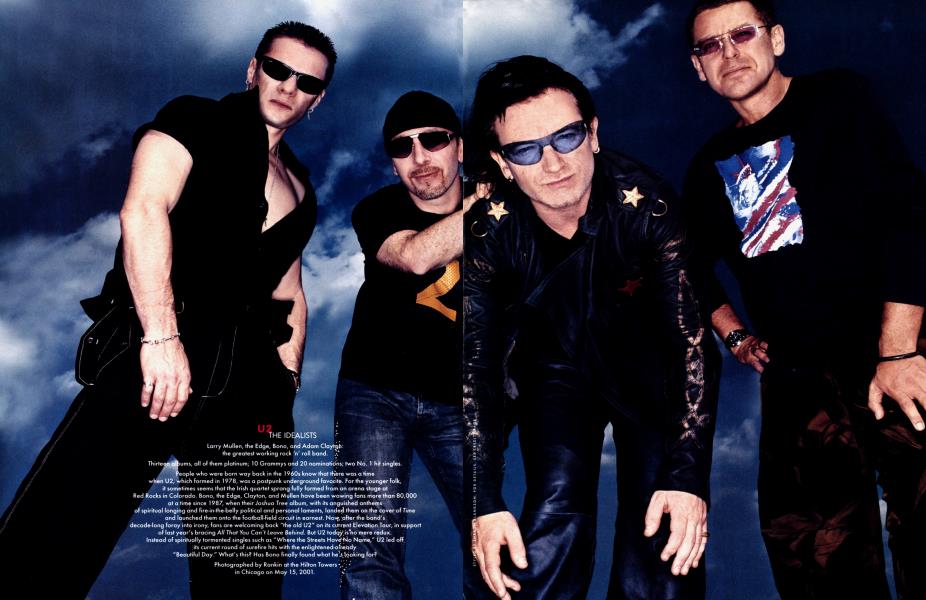
People who were born way back in the 1960s know that there was a time when U2, which formed in 1978, was a postpunk underground favocite. For the younger folk, it sometimes seems that the Irish quartet sprang fully formed from an arena stage at Red Rocks in Colorado. Bono, the Edge, Clayton, and Mullen have been wowing fans more than 80,000 at a time since 1987, when their Joshua Tree album, with its anguished anthems of spiritual longing and fire-in-the-belly political and personal laments, landed them on the cover of Time and launched them onto the football-field circuit in earnest. Now, after the band's decade-long foray into irony, fans are welcoming back "the old U2" on its current Elevation Tour, in support of last year's bracing All That You Can't Leave Behind. But U2 today is no mere redux. Instead of spiritually tormented singles such as "Where the Streets Have No Name," U2 led off its current round of surefire hits with the enlightened-already "Beautiful Day." What's this? Has Bono finally found what he's looking for?
Photographed by Rankin at the Hilton Towers in Chicago on May 15, 2001.
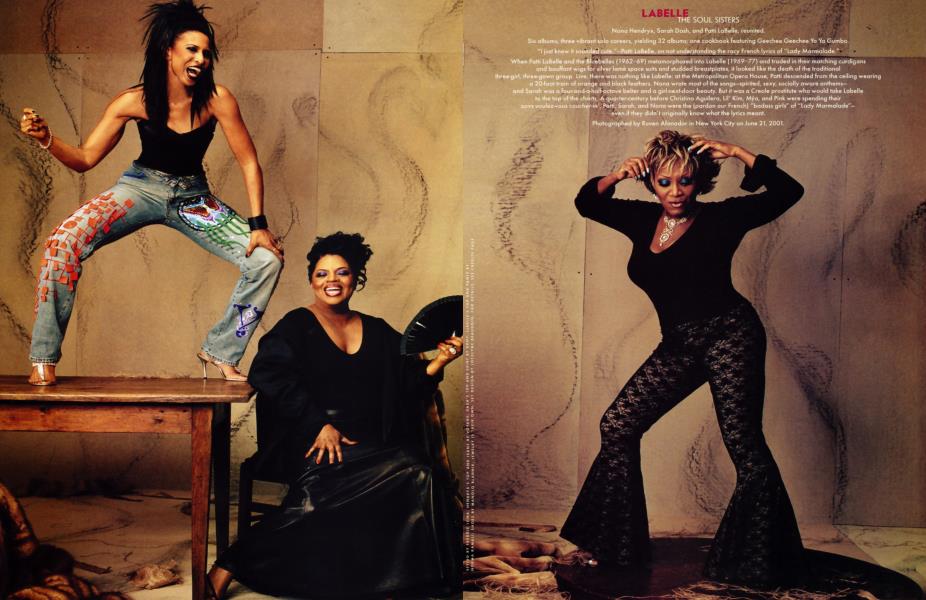
"I just knew it sounded cute"—Patti LaBelle, on not understanding the racy French lyrics of "Lady Marmalade."
When Patti LaBell and Bluebells (1962-69) metamorphosed into Labelle (1969-77) and traded in their matching cardigans and bouffant wigs for silver lamé space suits and studded breastplates, it looked like the death of the traditional three-girl, three-gown group. Live, there was nothing like Labelle: at the Metropolitan Opera House, Patti descended from the ceiling wearing a 20-foot train of orange and block feathers. Nona wrote most of the songs—spirited, sexy, socially aware anthems—and Sarah was four-and-a-half octave belter and a girl-next-door beauty. But it was a Creole prostitute who would take Labelle to the top of the charts. A quarter-century before Christina Aguilera, Lil' Kim, Mya, and Pink were spending their soir voulez-vous coucher-in', Patti, Sarah, and Nona were the (pardon our French) "badass girls" of "Lady Marmalade"—even if they didn't originally know what the lyrics meant.
Photographed by Ruven Afanador in New York City on June 21, 2001.
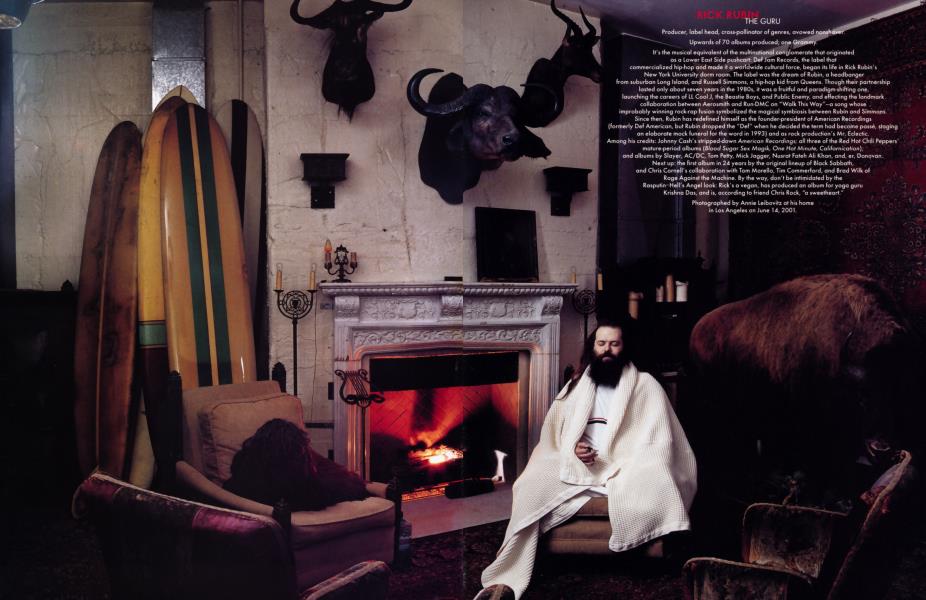
It's the musical equivalent of the multinational conglomerate that originated as a Lower East Side pushcart: Def Jam Records, the label that commercialized hip-hop and made it a worldwide cultural force, began its life in Rick Rubin's New York University dorm room. The label was the dream of Rubin, a headbanger from suburban Long Island, and Russell Simmons, a hip-hop kid from Queens. Though their partnership lasted only about seven years in the 1980s, it was a fruitful and paradigm-shifting one, launching the careers of LL Cool J, the Beastie Boys, and Public Enemy, and effecting the landmark collaboration between Aerosmith and Run-DMC on "Walk This Way"—a song whose improbably winning rock-rap fusion symbolized the magical symbiosis between Rubin and Simmons. Since then, Rubin has redefined himself as the founder-president of American Recordings (formerly Def American, but Rubin dropped the "Def" when he decided the term had become passe, staging an elaborate mock funeral for the word in 1993) and as rock production's Mr. Eclectic. his credits: Johnny Cash's stripped-down American Recordings; all three of the Red Hot Chili Peppers' mature-period albums (Blood Sugar Sex Magik, One Hot Minute, Californication); and albums by Slayer, AC/DC, Tom Petty, Mick Jagger, Nusrat Fateh Ali Khan, and, er, Donovan. Next up: the first album in 24 years by the original lineup of Black Sabbath, and Chris Cornell's collaboration with Tom Morello, Tim Commerford, and Brad Wilk of Rage Against the Machine. By the way, don't be intimidated by the Rasputin-Hell's Angel look: Rick's a vegan, has produced an album for yoga guru Krishna Das, and is, according to friend Chris Rock, "a sweetheart."
Photographed by Annie Leibovitz at his home in Los Angeles on June 14, 2001.
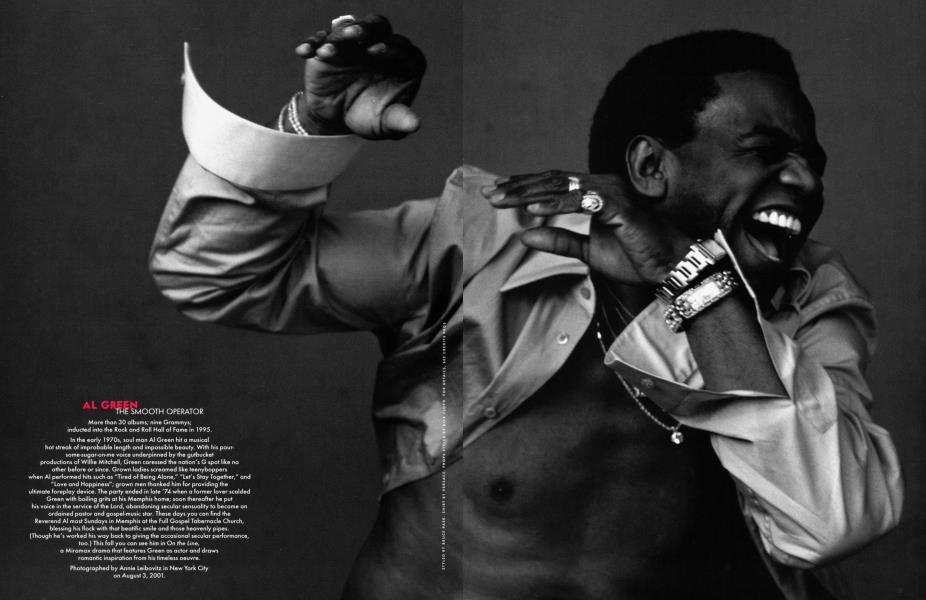
In the early 1970s, soul man Al Green hit a musical hot streak of improbable length and impossible beauty. With his pour-some-sugar-on-me voice underpinned by the gutbucket productions of Willie Mitchell, Green caressed the nation's G spot like no other before or since. Grown ladies screamed like teenyboppers when Al performed hits such as "Tired of Being Alone," "Let's Stay Together," and "Love and Happiness"; grown men thanked him for providing the ultimate foreplay device. The party ended in late '74 when a former lover scalded Green with boiling grits at his Memphis home; soon thereafter he put his voice in the service of the Lord, abandoning secular sensuality to become an ordained pastor and gospel-music star. These days you can find the Reverend Al most Sundays in Memphis at the Full Gospel Tabernacle Church, blessing his flock with that beatific smile and those heavenly pipes. (Though he's worked his way back to giving the occasional secular performance, too.) This fall you can see him in On the Line, a Miramax drama that features Green as actor and draws romantic inspiration from his timeless oeuvre.
Photographed by Annie Leibovitz in New York City on August 3, 2001.
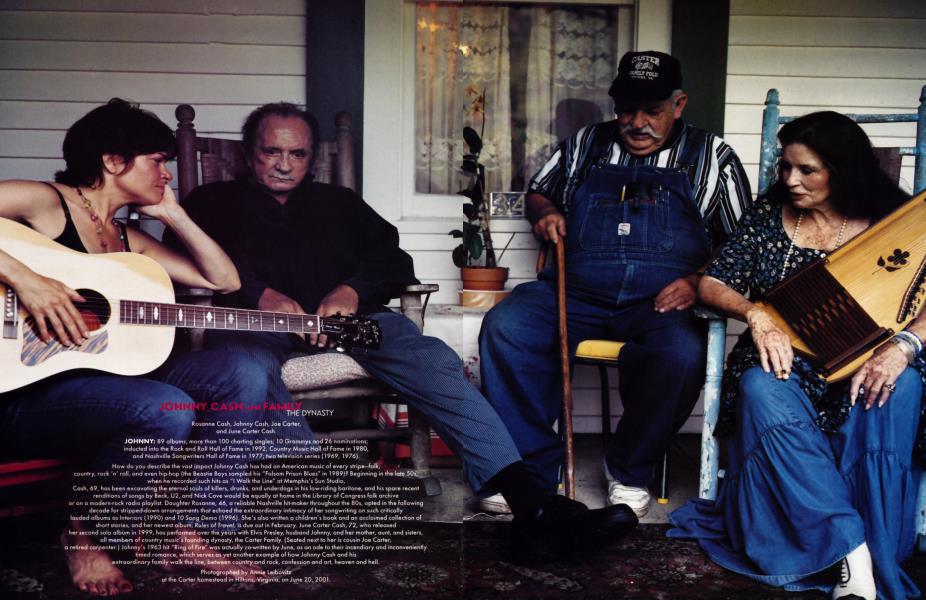
How do you describe the vast impact Johnny Cash has had on American music of every stripe—folk, country, rock 'n' roll, and even hip-hop (the Beastie Boys sampled his "Folsom Prison Blues" in 1989)? Beginning in the late 50s, when he recorded such hits as "I Walk the Line" at Memphis's Sun Studio, Cash, 69, has been excavating the eternal souls of killers, drunks, and underdogs in his low-riding baritone, and his spare recent renditions of songs by Beck, U2, and Nick Cave would be equally at home in the Library of Congress folk archive or on a modern-rock radio playlist. Daughter Rosanne, 46, a reliable Nashville hit-maker throughout the 80s, opted in the following decade for stripped-down arrangements that echoed the extraordinary intimacy of her songwriting on such critically lauded albums as Interiors (1990) and 10 Song Demo (1996). She's also written a children's book and an acclaimed collection of short stories, and her newest album, Rules of Travel, is due out in February. June Carter Cash, 72, who released her second solo album in 1999, has performed over the years with Elvis Presley, husband Johnny, and her mother, aunt, and sisters, all members of country music's founding dynasty, the Carter Family. (Seated next to her is cousin Joe Carter, a retired carpenter.) Johnny's 1963 hit "Ring of Fire" was actually co-written by June, as an ode to their incendiary and inconveniently timed romance, which serves as yet another example of how Johnny Cash and his extraordinary family walk the line, between country and rock, confession and art, heaven and hell.
Photographed by Annie Leibovitz at the Carter homestead in Hiltons, Virginia, on June 20, 2001.
They're the thinking woman's answer to Britney, Christina, Jessica, and Mandy. Little surprise that Ambrosia Parsley, of the wonderfully original group Shivaree, got the title for their debut album, I Oughtta Give You a Shot in the Head for Making Me Live in This Dump, from a line in Green Acres. Parsley (her real name) has a flair for infusing hillbilly life with cleverness, Lucille Ball comedy, and self-deprecation (a foreign concept in the music industry). It's a credit to Nelly Furtado's hipster-Tinkerbell charm that "I'm Like a Bird," arguably the pop anthem of 2001, was, in Furtado's mind, practically an afterthought. It was not only the last song she wrote for her album Whoa, Nelly!, it was also the quickest. Born in British Columbia of Portuguese descent, she delivers an international funky sound that struts in and out of hip-hop, trip-hop, bossa nova, and reggae. Leona Naess, with her fresh-scrubbed looks, pedigree (her father is the Norwegian shipping magnate Arne Naess and her former stepmother is Diana Ross), and seemingly effortless talent, may be the Gwyneth Paltrow of the music industry. Often compared to Edie Brickell and Liz Phair, Naess, on her easy-breezy, enormously catchy first album, Comatised, takes chick-in-the-bathtub music into the realm of hope and possibility. Her best songs—about charming rogues and flaky jerks—put young-female heartache into perspective: it's miserable, yet kind of fun. After Kina broke away from the R&B girl group Brownstone, just when ghetto fabulousness was starting to grow its gold-studded nails, she moved fearlessly into pop with a raw-nerved rock edge. Drawing on influences that range from Parliament to Led Zeppelin, she's not afraid to belt out the defiant declaration once reserved for the Alanis Morissettes of this world.
Photographed by Annie Leibovitz in New York City on April 4, 2001.
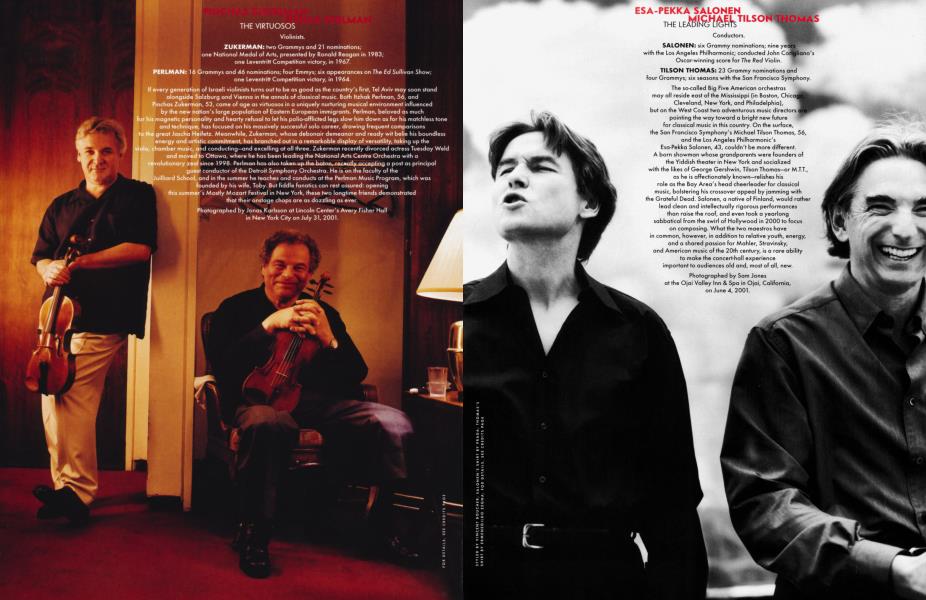
If every generation of Israeli violinists turns out to be as good as the country's first, Tel Aviv may soon stand alongside Salzburg and Vienna in the annals of classical music. Both Itzhak Perlman, 56, and Pinchas Zukerman, 53, came of age as virtuosos in a uniquely nurturing musical environment influenced by the new nation's large population of Eastern European immigrants. Perlman, beloved as much for his magnetic personality and hearty refusal to let his polio-afflicted legs slow him down as for his matchless tone and technique, has focused on his massively successful solo career, drawing frequent comparisons to the great Jascha Heifetz. Meanwhile, Zukerman, whose debonair demeanor and ready wit belie his boundless energy and artistic commitment, has branched out in a remarkable display of versatility, taking up the viola, chamber music, and conducting—and excelling at all three. Zukerman recently divorced actress Tuesday Weld and moved to Ottawa, where he has been leading the National Arts Centre Orchestra with a revolutionary zeal since 1998 Perlman has also taken up the baton, recently accepting a post as principal guest conductor of the Detroit Symphony Orchestra. He is on the faculty of the Juilliard School, and in the summer he teaches and conducts at the Perlman Music Program, which was founded by his wife, Toby. But fiddle fanatics can rest assured: opening this summer's Mostly Mozart Festival in New York, these two longtime friends demonstrated that their onstage chops are as dazzling as ever.
Photographed by Jonas Karlsson at Lincoln Center's Avery Fisher Hall in New York City on July 31, 2001.
The so-called Big Five American orchestras may all reside east of the Mississippi (in Boston, Chicago. Cleveland, New York, and Philadelphia), but on the West Coast two adventurous music directors are pointing the way toward a bright new future for classical music in this country. On the surface, the San Francisco Symphony's Michael Tilson Thomas, 56, and the Los Angeles Philharmonic's Esa-Pekka Salonen, 43, couldn't be more different. A born showman whose grandparents were founders of the Yiddish theater in New York and socialized with the likes of George Gershwin, Tilson Thomas—or M.T.T., as he is affectionately known—relishes his role as the Bay Area's head cheerleader for classical music, bolstering his crossover appeal by jamming with the Grateful Dead. Salonen, a native of Finland, would rather lead clean and intellectually rigorous performances than raise the roof, and even took a yearlong sabbatical from the swirl of Hollywood in 2000 to focus on composing. What the two maestros have in common, however, in addition to relative youth, energy, and a shared passion for Mahler, Stravinsky, and American music of the 20th century, is a rare ability to make the concert-hall experience important to audiences old and, most of all, new.
Photographed by Sam Jones at the Ojai Valley Inn & Spa in Ojai, California, on June 4, 2001.
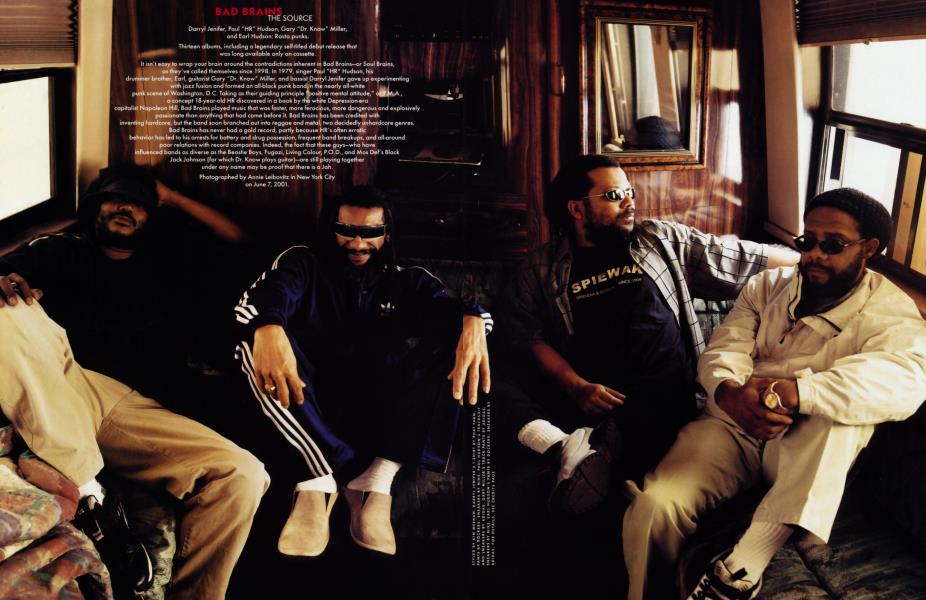
It isn't easy to wrap your brain around the contradictions inherent in Bad Brains—or Soul Brains, as they've called themselves since 1998. In 1979, singer Papl "HR" Hudson, his drummer brother, Earl, guitarist Gary "Dr. Know" Miller, and bassist Darryl Jenifer gave up experimenting with jazz fusion and formed an all-black punk band in the nearly all-white punk scene of Washington, D.C. Taking as their guiding principle positive mental attitude," of P.M.A., a concept 18-year-old HR discovered in a book by the white Depression-era capitalist Napoleon Hill, Bad Brains played music that was faster, more ferocious, more dangerous and explosively passionate than anything that had come before it. Bad Brains has been credited with inventing hardcore, but the band soon branched out into reggae and metal, two decidedly unhardcore genres. Bad Brains has never had a gold record, partly because HR's often erratic behavior has led to his arrests for battery and drug possession, frequent band breakups, and all-around poor relations with record companies. Indeed, the fact that these guys—who have influenced bands as diverse as the Beastie Boys, Fugazi, Living Colour, P.O.D., and Mos Def's Black Jack Johnson (for which Dr. Know plays guitar)—are still playing together, under any name may be proof that there is a Jah.
Photographed by Annie Leibovitz in New York City on June 7, 2001.
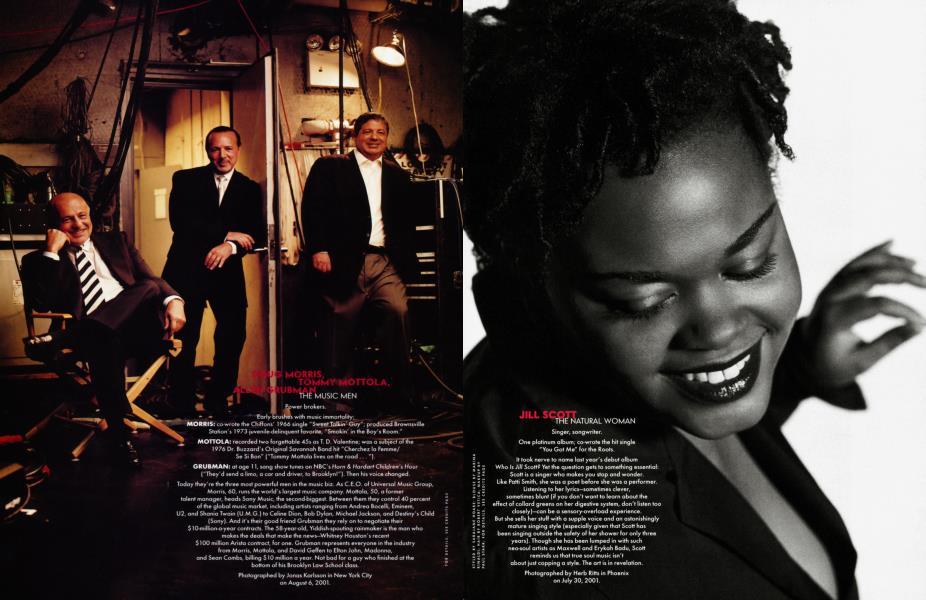
Today they're the three most powerful men in the music biz. As C.E.O. of Universal Music Group, Morris, 60, runs the world's largest music company. Mottola, 50, a former talent manager, heads Sony Music, the second-biggest. Between them they control 40 percent of the global music market, including artists ranging from Andrea Bocelli, Eminem, U2, and Shania Twain (U.M.G.) to Celine Dion, Bob Dylan, Michael Jackson, and Destiny's Child (Sony). And it's their good friend Grubman they rely on to negotiate their $10-million-a-year contracts. The 58-year-old, Yiddish-spouting rainmaker is the man who makes the deals that make the news—Whitney Houston's recent $100 million Arista contract, for one. Grubman represents everyone in the industry from Morris, Mottola, and David Geffen to Elton John, Madonna, and Sean Combs, billing $10 million a year. Not bad for a guy who finished at the bottom of his Brooklyn Law School class.
Photographed by Jonas Karlsson in New York City on August 6, 2001.
It took nerve to name last year's debut album Who Is Jill Scott? Yet the question gets to something essential: Scott is a singer who makes you stop and wonder. Like Patti Smith, she was a poet before she was a performer. Listening to her lyrics—sometimes clever, sometimes blunt (if you don't want to learn about the effect of collard greens on her digestive system, don't listen too closely)—can be a sensory-overload experience. But she sells her stuff with a supple voice and an astonishingly mature singing style (especially given that Scott has been singing outside the safety of her shower for only three years). Though she has been lumped in with such neo-soul artists as Maxwell and Erykah Badu, Scott reminds us that true soul music isn't about just copping a style. The art is in revelation.
Photographed by Herb Ritts in Phoenix on July 30, 2001.
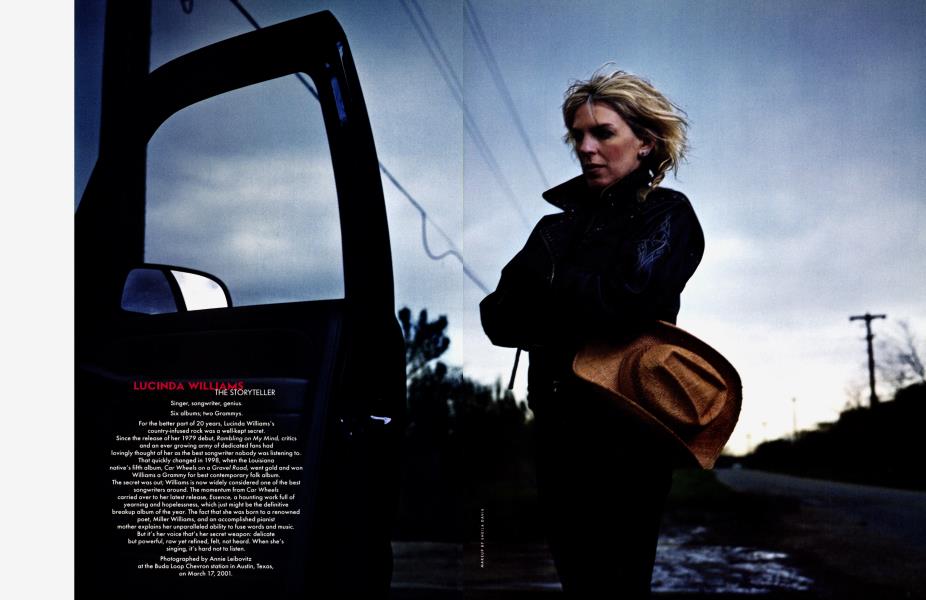
For the better part of 20 years, Lucinda Williams's country-infused rock was a well-kept secret. Since the release of her 1979 debut, Rambling on My Mind, critics and an ever growing army of dedicated fans had lovingly thought of her as the best songwriter nobody was listening to. That quickly changed in 1998, when the Louisiana native's fifth album, Car Wheels on a Gravel Road, went gold and won Williams a Grammy for best contemporary folk album. The secret was out; Williams is now widely considered one of the best songwriters around. The momentum from Car Wheels carried over to her latest release, Essence, a haunting work full of yearning and hopelessness, which just might be the definitive breakup album of the year. The fact that she was born to a renowned poet, Miller Williams, and an accomplished pianist mother explains her unparalleled ability to fuse words and music. But it's her voice that's her secret weapon: delicate but powerful, raw yet refined, felt, not heard. When she's singing, it's hard not to listen.
Photographed by Annie Leibovitz at the Buda Loop Chevron station in Austin, Texas, on March 17, 2001.
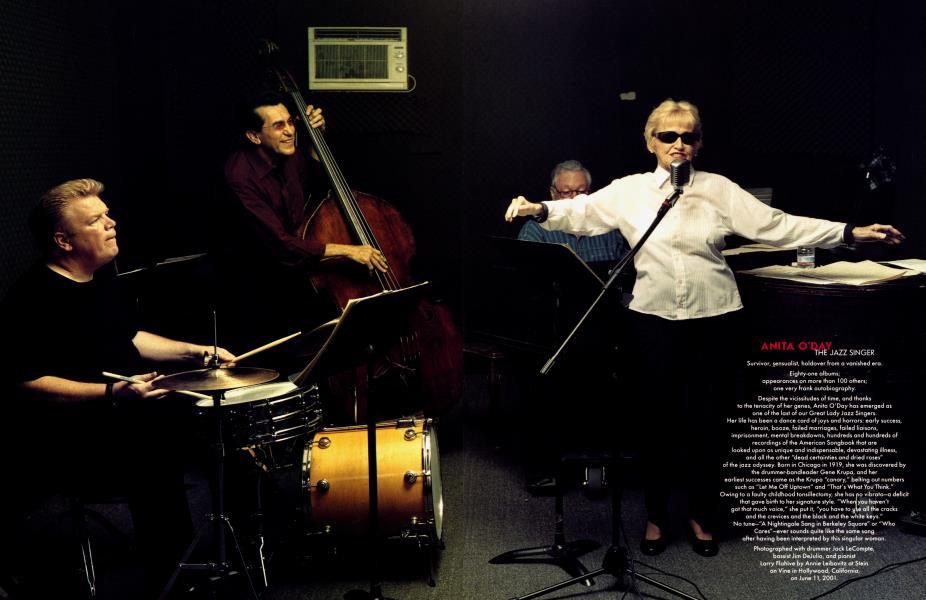
Despite the vicissitudes of time, and thanks to the tenacity of her genes, Anita O'Day has emerged as one of the last of our Great Lady Jazz Singers. Her life has been a dance card of joys and horrors: early success, heroin, booze, failed marriages, failed liaisons, imprisonment, mental breakdowns, hundreds and hundreds of recordings of the American Songbook that are looked upon as unique and indispensable, devastating illness, and all the other "dead certainties and dried roses" of the jazz odyssey. Born in Chicago in 1919, she was discovered by the drummer-bandleader Gene Krupa, and her earliest successes came as the Krupa "canary," belting out numbers such as "Let Me Off Uptown" and "That's What You Think." Owing to a faulty childhood tonsillectomy, she has no vibrato—a deficit to a faulty childhood tonsillectomy, she has no vibrato—a that gave birth to her signature style. "When you haven't t that much voice," she put it, "you have to use all the cracks got that much voice," she put it, "you have to use all the cracks and the crevices and the black and the white keys." No tune—"A Nightingale Sang in Berkeley Square" or "Who Cares"—ever sounds quite like the same song after having been interpreted by this singular woman.
Photographed with drummer Jack LeCompte, bassist Jim DeJulio, and pianist Larry Flahive by Annie Leibovitz at Stein on Vine in Hollywood, California, on June 11, 2001.
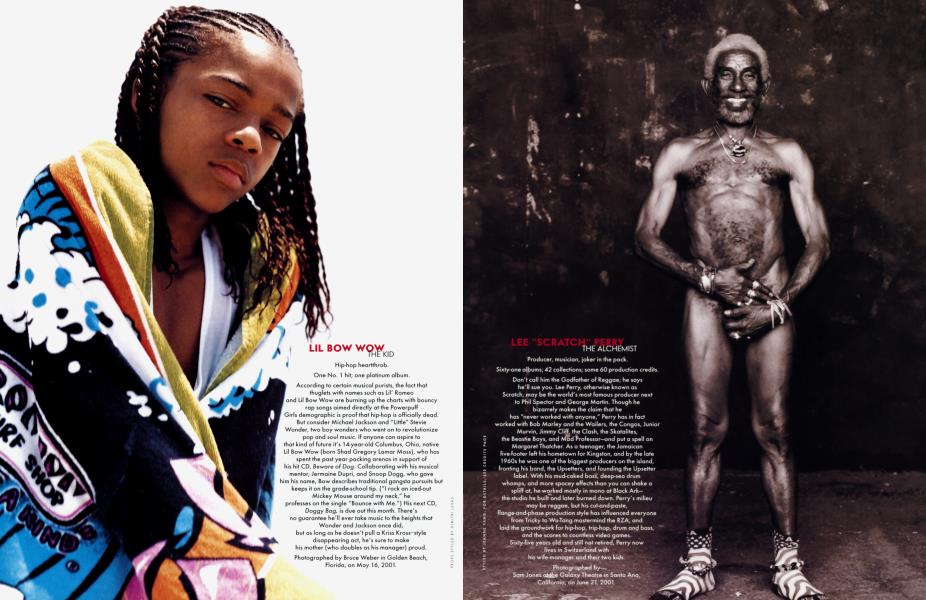
According to certain musical purists, the fact that thuglets with names such as Lil' Romeo and Lil Bow Wow are burning up the charts with bouncy rap songs aimed directly at the Powerpuff Girls demographic is proof that hip-hop is officially dead. But consider Michael Jackson and "Little" Stevie Wonder, two boy wonders who went on to revolutionize pop and soul music. If anyone can aspire to that kind of future it's 14-year-old Columbus, Ohio, native Lil Bow Wow (born Shad Gregory Lamar Moss), who has spent the past year packing arenas in support of his hit CD, Beware of Dog. Collaborating with his musical mentor, Jermaine Dupri, and Snoop Dogg, who gave him his name, Bow describes traditional gangsta pursuits but keeps it on the grade-school tip. ("I rock an iced-out Mickey Mouse around my neck," he professes on the single "Bounce with Me.") His next CD, Doggy Bag, is due out this month. There's no guarantee he'll ever take music to the heights that Wonder and Jackson once did, but as long as he doesn't pull a Kriss Kross-style disappearing act, he's sure to make his mother (who doubles as his manager) proud.
Photographed by Bruce Weber in Golden Beach, Florida, on May 16, 2001.
Don't call him the Godfather of Reggae; he says he'll sue you. Lee Perry, otherwise known as Scratch, may be the world's most famous producer next to Phil Spector and George Martin. Though he bizarrely makes the claim that he has "never worked with anyone," Perry has in fact worked with Bob Marley and the Waiters, the Congos, Junior Murvin, Jimmy Cliff, the Clash, the Skatalites, the Beastie Boys, and Mad Professor—and put a spell on Margaret Thatcher. As a teenager, the Jamaican five-footer left his hometown for Kingston, and by the late 1960s he was one of the biggest producers on the island, fronting his band, the Upsetters, and founding the Upsetter label. With his mud-caked bass, deep-sea drum whomps, and more spacey effects than you can shake a spliff at, he worked mostly in mono at Black Ark—the studio he built and later burned down. Perry's milieu may be reggae, but his cut-and-paste, flange and-phase production style has influenced everyone from Tricky to Wu-Tang mastermind the RZA, and laid the groundwork for hip-hop, trip-hop, drum and bass, and the scores to countless video games. Sixty-five years old and still not retired, Perry now lives in Switzerland with his wife-manager and their two kids.
Photographed by Sam Jones at the Galaxy Theatre in Santa Ana, California, on June 21, 2001.
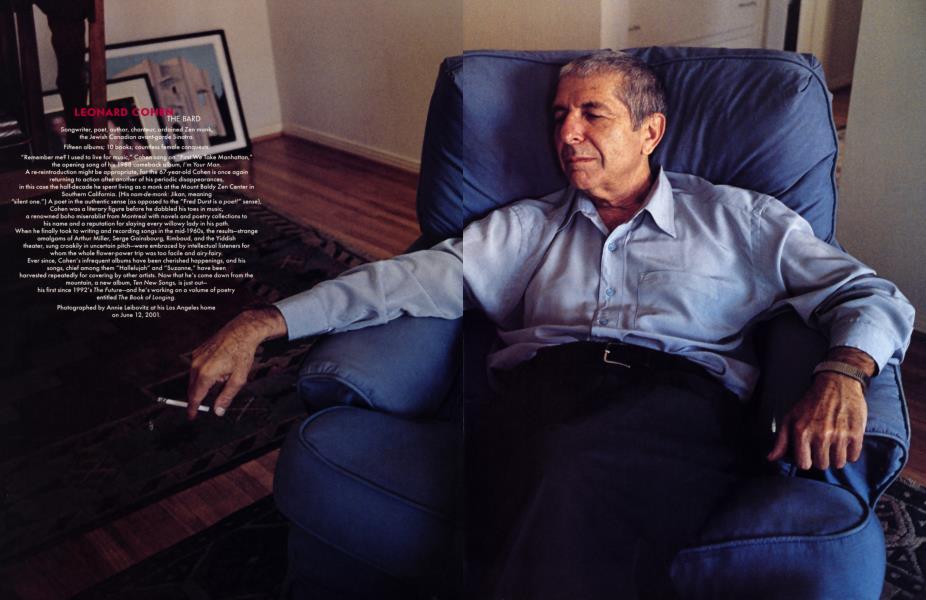
"Remember me? I used to live for music," Cohen sang on "First We Take Manhattan," the opening song of his 1988 comeback album, I'm Your Man. A re-reintroduction might be appropriate, for the 67-year-old Cohen is once again returning to action after another of his periodic disappearances, in this case the half-decade he spent living as a monk at the Mount Baldy Zen Center in Southern California. (His nom-de-monk: Jikan, meaning "silent one.") A poet in the authentic sense (as opposed to the "Fred Durst is a poet!" sense), Cohen was a literary figure before he dabbled his toes in music, a renowned boho miserablist from Montreal with novels and poetry collections to his name and a reputation for slaying every willowy lady in his path. When he finally took to writing and recording songs in the mid-1960s, the results—strange amalgams of Arthur Miller, Serge Gainsbourg, Rimbaud, and the Yiddish theater, sung croakily in uncertain pitch—were embraced by intellectual listeners for whom the whole flower-power trip was too facile and airy-fairy. Ever since, Cohen's infrequent albums have been cherished happenings, and his songs, chief among them "Hallelujah" and "Suzanne," have been harvested repeatedly for covering by other artists. Now that he's come down from the mountain, a new album, Ten New Songs, is just out—his first since 1992's The Future—and he's working on a volume of poetry entitled The Book of Longing.
Photographed by Annie Leibovitz at his Los Angeles home on June 12, 2001.
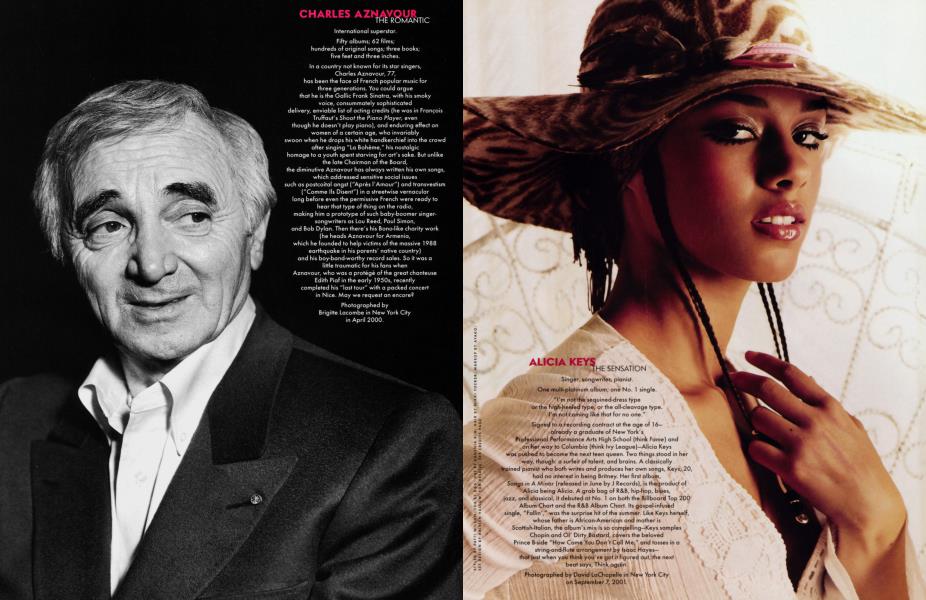
In a country not known for its star singers, Charles Aznavour, 77, has been the face of French popular music for three generations. You could argue that he is the Gallic Frank Sinatra, with his smoky voice, consummately sophisticated delivery, enviable list of acting credits (he was in François Truffaut's Shoot the Piano Player, even though he doesn't play piano), and enduring effect on women of a certain age, who invariably swoon when he drops his white handkerchief into the crowd after singing "La Bohème," his nostalgic homage to a youth spent starving for art's sake. But unlike the late Chairman of the Board, the diminutive Aznavour has always written his own songs, which addressed sensitive social issues such as postcoital angst ("Apres l'Amour") and transvestism ("Comme Ils Disent") in a streetwise vernacular long before even the permissive French were ready to hear that type of thing on the radio, making him a prototype of such baby-boomer singer-songwriters as Lou Reed, Paul Simon, and Bob Dylan. Then there's his Bono-like charity work (he heads Aznavour for Armenia, which he founded to help victims of the massive 1988 earthquake in his parents' native country) and his boy-band-worthy record sales. So it was a little traumatic for his fans when Aznavour, who was a protege of the great chanteuse Edith Piaf in the early 1950s, recently completed his "last tour" with a packed concert in Nice. May we request an encore?
Photographed by Brigitte Lacombe in New York City in April 2000.
"I'm not the sequined-dress type or the high-heeled type, or the all-cleavage type. I'm not coming like that for no one."
Signed to a recording contract at the age of 16—already a graduate of New York's Professional Performance Arts High School (think Fame) and on her way to Columbia (think Ivy League)—Alicia Keys pushed to become the next teen queen. Two things stood in her way, though: a surfeit of talent, and brains. A classically pianist who both writes and produces her own songs, Keys, 20, had no interest in being Britney. Her first album, Songs in A Minor (released in June by J Records), is the product of Alicia being Alicia. A grab bag of R&B, hip-hop, blues, and classical, it debuted at No. 1 on both the Billboard Top 200 Album Chart and the R&B Album Chart. Its gospel-infused "Fallin'," was the surprise hit of the summer. Like Keys herself, whose father is African-American and mother is Scottish-ltalian, the album's mix is so compelling—Keys samples Chopin and Ol' Dirty Bastard, covers the beloved Prince B-side "How Come You Don't Call Me," and tosses in a string-and-flute arrangement by Isaac Hayes—that just when you think you've got it figured out, the next beat says, Think again.
Photographed by David LaChapelle in New York City on September 7, 2001.
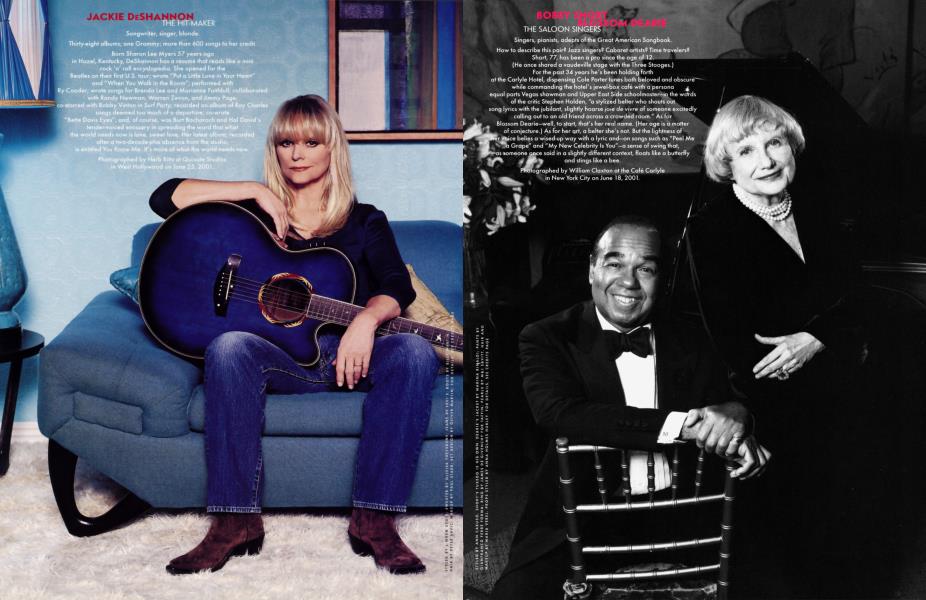
Born Sharon Lee Myers 57 years in Hazel, Kentucky, DeShannon has a résumé that reads like a mini rock 'n' roll encyclopedia. She opened for the Beatles on their first U.S. tour; wrote "Put a Little love in Your Heart" and "When You Walk in the Room"; performed with Ry Cooder; wrote songs for Brenda lee and Marianne Faithfull; collaborated with Randy Newman, Warren Zevon, and Jimmy Page; co-starred with Bobby Vinton in Surf Party; recorded on album of Ray Charles songs deemed too much of a departure; co-wrote "Bette Davis Eyes"; and, of course, was Burt Bacharach and Hal David's tender-voiced emissary in spreading the word that what the world needs now is love, sweet love. Her latest album, recorded after a two-decade-plus absence from the studio, is entitled You Know Me. It’s more of what the world needs now.
Photographed by Herb Rim of Quixote Studios in West Hollywood on June 25, 2001.
How to describe this pair? Jazz singers? Cabaret artists? Time travelers? Short, 77, has been a pro since the age of 12. (He once shared a vaudeville stage with the Three Stooges.) For the past 34 years he's been holding forth at the Carlyle Hotel, dispensing Cole Porter tunes both beloved and obscure" while commanding the hotel's jewel-box cafe with a persona equal parts Vegas showman and Upper East Side schoolmaster—in the words of the critic Stephen Holden, "a stylized belter who shouts out song lyrics with the jubilant, slightly hoarse joie de vivre of someone excitedly calling out to an old friend across a crowded room." As for Blossom Dearie—well, to start, that's her real name. (Her age is a matter of conjecture.) As for her art, a belter she's not. But the lightness of Per voice belies a wised-up way with a lyric and—on songs such as "Peel Me a Grape" and "My New Celebrity Is You"—a sense of swing that, Is someone once said in a slightly different context, floats like a butterfly and stings like a bee.
Photographed by William Claxton at the Cafe Carlyle in New York City on June 18, 2001.
Moments after she came out of the womb, her mother and manager,Sonja Norwood, proclaimed, "I have just given birth to a star!" But don't hold that against Brandy. It's to this performer's credit that she fulfilled the prophecy without a shred of obnoxiousness, and that, at age 22, she manages to be both wildly popular and a throwback to a more innocent time, when talents were honed and gently packaged, not trussed up and rammed down our throats. At age two she was singing in a local church in Mississippi, where her father was director of music. At 10, fueled by the spirit of her idol, Whitney Houston circa "How Will I Know?," she found herself belting onstage alongside Little Richard. By 14 she had a record deal, and by 15 she had an album that eventually went quadruple-platinum. But wait, there's more: a modeling contract with Cover Girl; a made-for-television movie, Double Platinum, co-starring Diana Ross; her own show on UPN, Moesha, about a girl not unlike herself; a hit movie, I Still Know What You Did Last Summer; and, as a feather in her cap, a Grammy for her 1999 duet with Monica, "The Boy Is Mine," the smoothest, coolest catfight ever set to music. She is currently recording her new album, due out in November.
Photographed by Herb Ritts in Los Angeles on June 11, 2001.
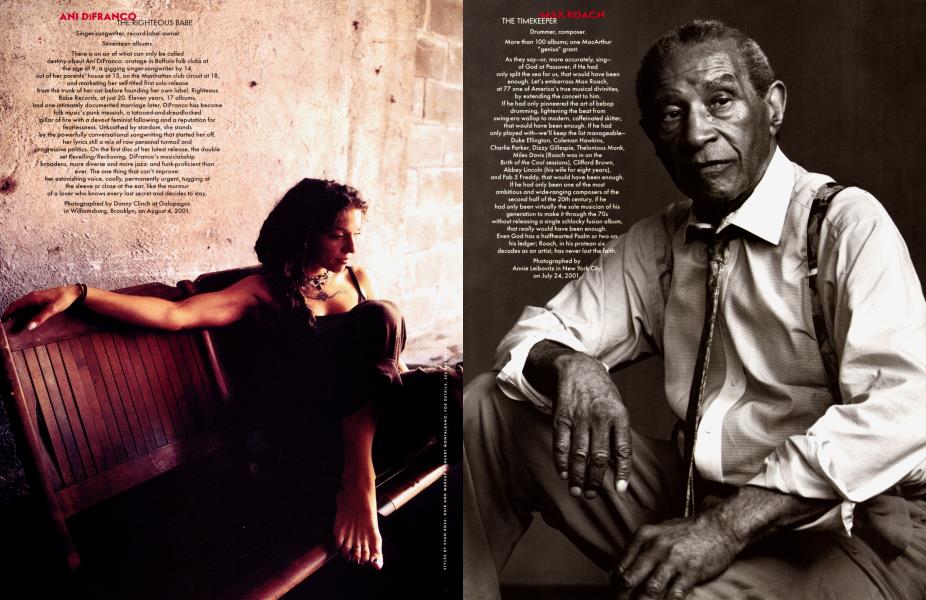
There is an air of what can only be called destiny about Ani DiFranco: onstage in Buffalo folk clubs at the age of 9, a gigging singer-songwriter by 14, out of her parents' house at 15, on the Manhattan club circuit at 18, and marketing her self-titled first solo release from the trunk of her car before founding her own label, Righteous Babe Records, at just 20. Eleven years, 17 albums, and one intimately documented marriage later, DiFranco has become folk music's punk messiah, a tatooed-and-dreadlocked pillar of fire with a devout feminist following and a reputation for fearlessness. Unscathed by stardom, she stands he powerfully conversational songwriting that started her off, her lyrics still a mix of raw personal turmoil and progressive politics. On the first disc of her latest release, the double set Revelling/Reckoning, DiFranco's musicianship broadens, more diverse and more jazz- and funk-proficient than ever. The one thing that can't improve: her astonishing voice, coolly, permanently urgent, tugging at the sleeve or close at the ear, like the murmur of a lover who knows every last secret and decides to stay.
Photographed by Danny Clinch at Galapagos in Williamsburg, Brooklyn, on August 4, 2001.
As they say—or, more accurately, sing—of God at Passover, if He had only split the sea for us, that would have been enough. Let's embarrass Max Roach, at 77 one of America's true musical divinities, by extending the conceit to him. If he had only pioneered the art of bebop drumming, lightening the beat from swing-era wallop to modern, caffeinated skitter, that would have been enough. If he had only played with—we'll keep the list manageable—Duke Ellington, Coleman Hawkins, Charlie Parker, Dizzy Gillespie, Thelonious Monk, Miles Davis (Roach was in on the Birth of the Cool sessions), Clifford Brown, Abbey Lincoln (his wife for eight years), and Fab 5 Freddy, that would have been enough. If he had only been one of the most ambitious and wide-ranging composers of the second half of the 20th century, if he had only been virtually the sole musician of his generation to make it through the 70s without releasing a single schlocky fusion album, that really would have been enough. Even God has a halfhearted Psalm or two on his ledger; Roach, in his protean six decades as an artist, has never lost the faith.
Photographed by Annie Leibovitz in New York City on July 24, 2001.
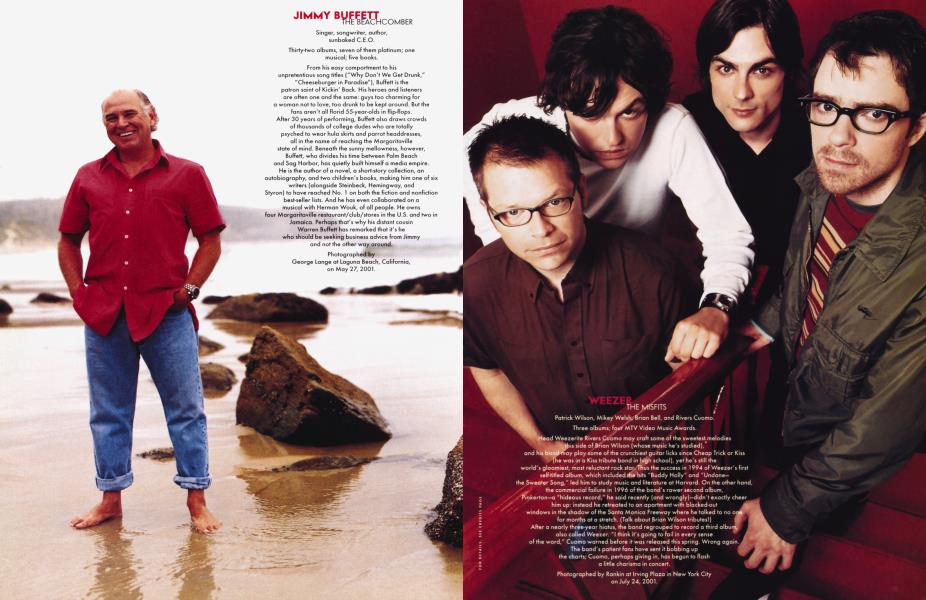
From his easy comportment to his unpretentious song titles ("Why Don't We Get Drunk," "Cheeseburger in Paradise"), Buffett is the patron saint of Kickin' Back. His heroes and listeners are often one and the same: guys too charming for a woman not to love, too drunk to be kept around. But the fans aren't all florid 55-year-olds in flip-flops. After 30 years of performing, Buffett also draws crowds of thousands of college dudes who are totally psyched to wear hula skirts and parrot headdresses, all in the name of reaching the Margaritaville state of mind. Beneath the sunny mellowness, however, Buffett, who divides his time between Palm Beach and Sag Harbor, has quietly built himself a media empire. He is the author of a novel, a short-story collection, an autobiography, and two children's books, making him one of six writers (alongside Steinbeck, Hemingway, and Styron) to have reached No. 1 on both the fiction and nonfiction best-seller lists. And he has even collaborated on a musical with Herman Wouk, of all people. He owns four Margaritaville restaurant/club/stores in the U.S. and two in Jamaica. Perhaps that's why his distant cousin Warren Buffett has remarked that it's he who should be seeking business advice from Jimmy and not the other way around.
Photographed by George Lange at Laguna Beach, California, on May 27, 2001
Head Weezerite Rivers Cuomo may craft some of the sweetest melodies de of Br an Wilson (whose music he's studied), and his band may play some of the crunchiest guitar licks since Cheap Trick or Kiss (he was in a Kiss tribute band in high school), yet he's still the world's gloomiest, most reluctant rock star. Thus the success in 1994 of Weezer's first self-titled album, which included the hits "Buddy Holly" and "Undone—the Sweater Song," led him to study music and literature at Harvard. On the other hand, the commercial failure in 1996 of the band's rawer second album, Pinkerton—a "hideous record," he said recently (and wrongly)—didn't exactly cheer him up: instead he retreated to an apartment with blacked-out I windows in the shadow of the Santa Monica Freeway where he talked to no one for months at a stretch. (Talk about Brian Wilson tributes!) After a nearly three-year hiatus, the band regrouped to record a third album, also called Weezer. "I think it's going to fail in every sense I of the word," Cuomo warned before it was released this spring Wrong again. 1 The band's patient fans have sent it bobbing up the charts; Cuomo, perhaps giving in, has begun to flash a little charisma in concert
Photographed by Rankin at Irving Plaza in New York City on July 24, 2001.
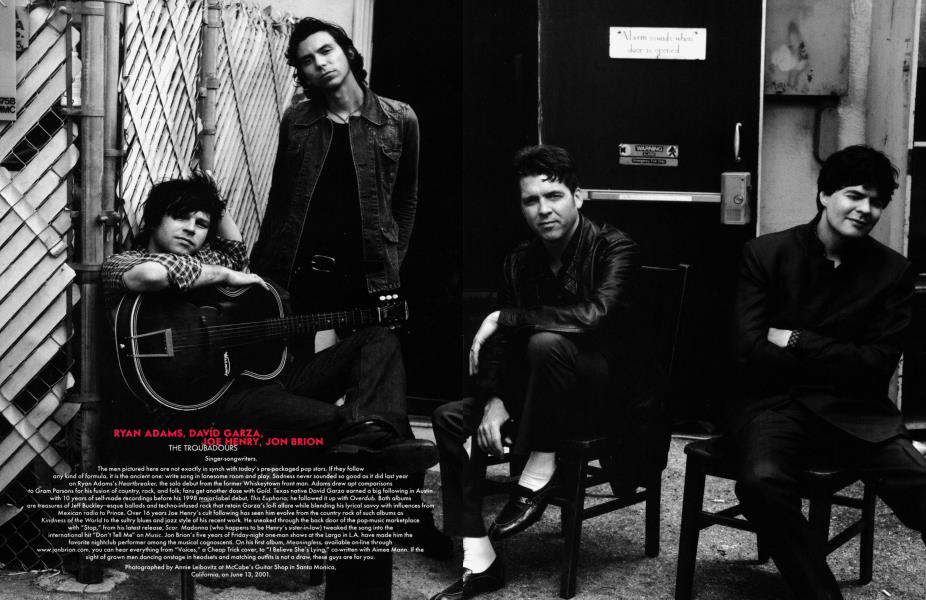
The men pictured here are not exactly in synch with today's pre-packaged pop stars. If they follow any kind of formula, it is the ancient one: write song in lonesome room and play. Sadness never sounded so good as it did last year on Ryan Adams's Heartbreaker, the solo debut from the former Whiskeytown front man. Adams drew apt comparisons to Gram Parsons for his fusion of country, rock, and folk; fans get another dose with Gold. Texas native David Garza earned a big following in Austin with 10 years of self-made recordings before his 1998 major-label debut, This Euphoria; he followed it up with Overdub. Both albums are treasures of Jeff Buckley-esque ballads and techno-infused rock that retain Garza's lo-fi allure while blending his lyrical savvy with influences from Mexican radio to Prince. Over 16 years Joe Henry's cult following has seen him evolve from the country rock of such albums as Kindness of the World to the sultry blues and jazz style of his recent work. He sneaked through the back door of the pop-music marketplace with "Stop," from his latest release, Scar. Madonna (who happens to be Henry's sister-in-law) tweaked the song into the international hit "Don't Tell Me" on Music. Jon Brion's five years of Friday-night one-man shows at the Largo in L.A. have made him the favorite nightclub performer among the musical cognoscenti. On his first album, Meaningless, available on-line through www.jonbrion.com, you can hear everything from "Voices," a Cheap Trick cover, to "I Believe She's Lying," co-written with Aimee Mann. If the sight of grown men dancing onstage in headsets and matching outfits is not a draw, these guys are for you.
Photographed by Annie Leibovitz at McCabe's Guitar Shop in Santa Monica, California, on June 13, 2001.
At age 11, Shakira was kicked out of her school choir because her voice was too strong. At 13, the exotic, lissome beauty left her coastal village for Bogota with dreams of becoming a model. Instead, she scored a record contract and a role on the popular soap-opera El Oasis. Eleven years and five albums later (not to mention a tabloid-fodder romance with Antonio de la Rúa, the son of Argentina's president), she is the most popular female singer in all of Latin America. Her love songs are unconventional and witty, full of self-analysis and irony—"I offer you my waist / And my lips should you want to kiss them / I offer you my madness / And the few neurons I have left"—and her voice owes more to the jagged little trills of Alanis Morrisette and the get-if-while-you-can emotion of Janis Joplin than to the Tejano stylings of Selena or the urban pop of Jennifer Lopez. With the release this month of Laundry Service, her first English-language album, Shakira may well prove to be Colombia's greatest legal export.
Photographed by David LaChapelle in Los Angeles on August 9, 2001.
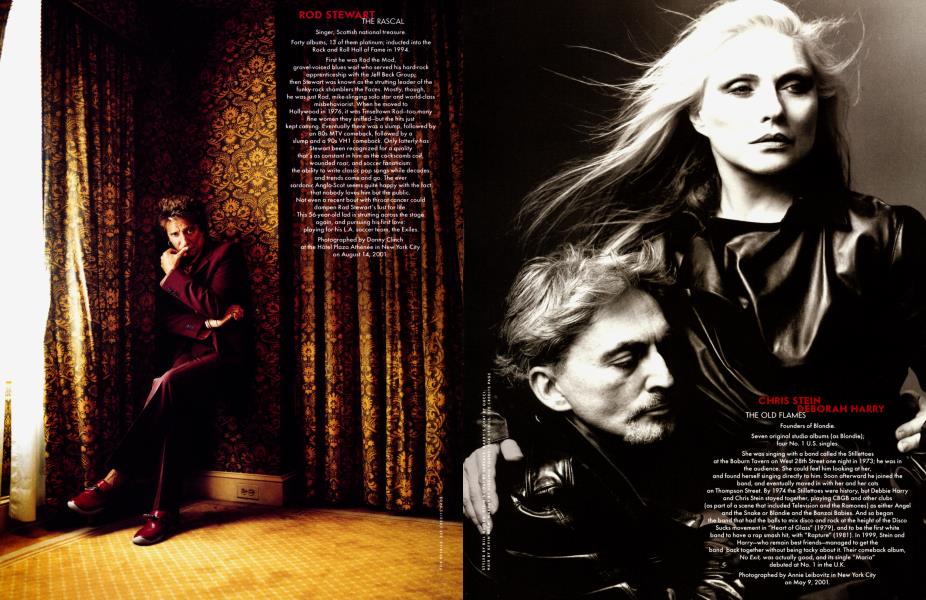
First he was Rod the Mod, gravel-voiced blues waif who served his hard-rock apprenticeship with the Jeff Beck Group; then Stewart was known as the strutting leader of the funky-rock shamblers the Faces. Mostly, though, was just Rod, mike-slinging solo star and world-class misbehaviorist. When he moved to Hollywood in 1976, it was Tinseltown Rod—too many fine women they sniffed—but the hits just coming. Eventually there was a slump, followed by an 80s MTV comeback, followed by a slump and a 90s VH1 comeback. Only latterly has Stewart been recognized for a quality that's as constant in him as the cockscomb coif, wounded roar, and soccer fanaticism: the ability to write classic pop songs while decades and trends come and go. The ever sardonic Anglo-Scot seems quite happy with the fact that nobody loves him but the public. Not even a recent bout with throat cancer could dampen Rod Stewart's lust for life. This 56-year-old lad is strutting across the stage again, and pursuing his first love: playing for his L.A. soccer team, the Exiles.
Photographed by Danny Clinch at the Hotel Plaza Athenee in New York City on August 14, 2001.
She was singing with a band called the Stillettoes at the Boburn Tavern on West 28th Street one night in 1973; he was in the audience. She could feel him looking at her, and found herself singing directly to him. Soon afterward he joined the band, and eventually moved in with her and her cats on Thompson Street. By 1974 the Stillettoes were history, but Debbie Harry and Chris Stein stayed together, playing CBGB and other clubs part of a scene that included Television and the Ramones) as either Angel and the Snake or Blondie and the Banzai Babies. And so began the band that had the balls to mix disco and rock at the height of the Disco Sucks Movement in "Heart of Glass" (1979), and to be the first white band to have a rap smash hit, with "Rapture" (1981). In 1999, Stein and Harry—who remain best friends—managed to get the band back together without being tacky about it. Their comeback album, No Exit was actually good, and its single "Maria" debuted at No. 1 in the U.K.
Photographed by Annie Leibovitz in New York City on May 9, 2001.
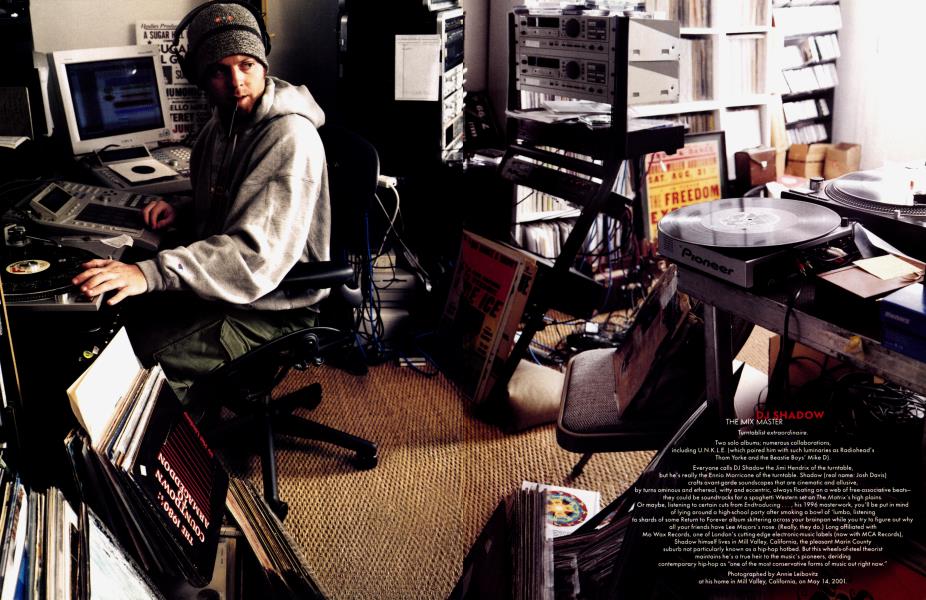
Everyone calls DJ Shadow the Jimi Hendrix of the turntable, but he's really the Ennio Morricone of the turntable. Shadow (real name: Josh Davis) crafts avant-garde soundscapes that are cinematic and allusive, by turns ominous and ethereal, witty and eccentric, always floating on a web of free-associative beats—they could be soundtracks for a spaghetti Western set on The Matrix's high plains. Or maybe, listening to certain cuts from Endtroducing ... , his 1996 masterwork, you'll be put in mind of lying around a high-school party after smoking a bowl of 'lumbo, listening to shards of some Return to Forever album skittering across your brainpan while you try to figure out why all your friends have Lee Majors's nose. (Really, they do.) Long affiliated with Mo Wax Records, one of London's cutting-edge electronic-music labels (now with MCA Records), Shadow himself lives in Mill Valley, California, the pleasant Marin County suburb not particularly known as a hip-hop hotbed. But this wheels-of-steel theorist maintains he's a true heir to the music's pioneers, deriding contemporary hip-hop as "one of the most conservative forms of music out right now."
Photographed by Annie Leibovitz at his home in Mill Valley, California, on May 14, 2001.
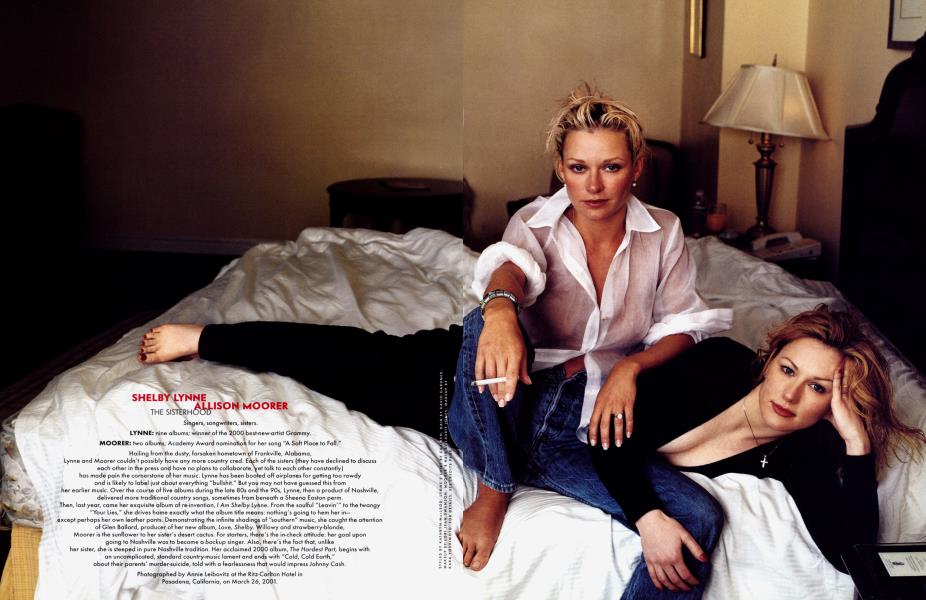
Hailing from the dusty, forsaken hometown of Frankville, Alabama, Lynne and Moorer couldn't possibly have any more country cred. Each of the sisters (they have declined to discuss each other in the press and have no plans to collaborate, yet talk to each other constantly) has made pain the cornerstone of her music. Lynne has been booted off airplanes for getting too rowdy and is likely to label just about everything "bullshit." But you may not have guessed this from her earlier music. Over the course of five albums during the late 80s and the 90s, Lynne, then a product of Nashville, delivered more traditional country songs, sometimes from beneath a Sheena Easton perm. Then, last year, came her exquisite album of re-invention, I Am Shelby Lynne. From the soulful "Leavin'" to the twangy "Your Lies," she drives home exactly what the album title means: nothing's going to hem her in—except perhaps her own leather pants. Demonstrating the infinite shadings of "southern" music, she caught the attention of Glen Ballard, producer of her new album, Love, Shelby. Willowy and strawberry-blonde, Moorer is the sunflower to her sister's desert cactus. For starters, there's the in-check attitude: her goal upon going to Nashville was to become a backup singer. Also, there's the fact that, unlike her sister, she is steeped in pure Nashville tradition. Her acclaimed 2000 album, The Hardest Part, begins with an uncomplicated, standard country-music lament and ends with "Cold, Cold Earth," about their parents' murder-suicide, told with a fearlessness that would impress Johnny Cash.
Photographed by Annie Leibovitz at the Ritz-Carlton Hotel in Pasadena, California, on March 26, 2001.
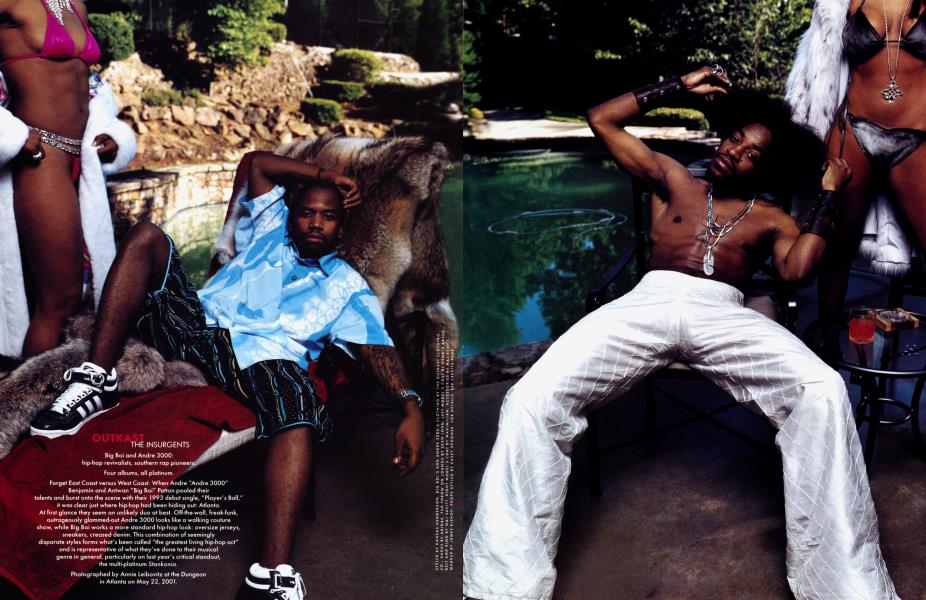
Forget East Coast versus West Coast. When Andre "Andre 3000" Benjamin and Antwan "Big Boi" Patton pooled their talents and burst onto the scene with their 1993 debut single, "Player's Ball," it was clear just where hip-hop had been hiding out: Atlanta. At first glance they seem an unlikely duo at best. Off-the-wall, freak-funk, outrageously glammed-out Andre 3000 looks like a walking couture show, while Big Boi works a more standard hip-hop look: oversize jerseys, sneakers, creased denim. This combination of seemingly disparate styles forms what's been called "the greatest living hip-hop act" and is representative of what they've done to their musical genre in general, particularly on last year's critical standout, the multi-platinum Stankonia.
Photographed by Annie Leibovitz at the Dungeon in Atlanta on May 22, 2001.
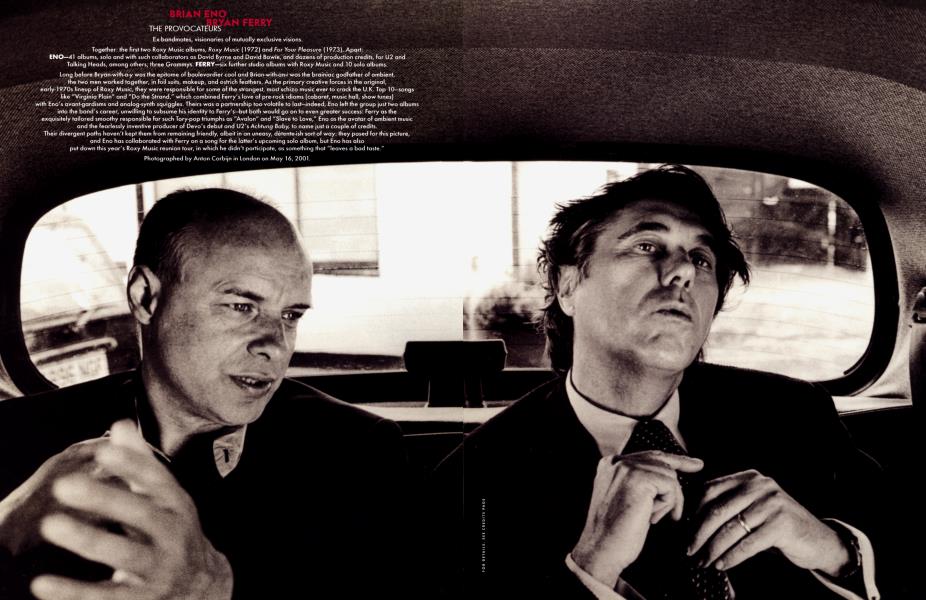
Long before Bryan-with-a-y was the epitome of boulevardier cool and Brian-with-an-i was the brainiac godfather of ambient, the two men worked together, in foil suits, makeup, and ostrich feathers. As the primary creative forces in the original, early-1970s lineup of Roxy Music, they were responsible for some of the strangest, most schizo music ever to crack the U.K. Top 10—songs like "Virginia Plain" and "Do the Strand," which combined Ferry's love of pre-rock idioms (cabaret, music hall, show tunes) with Eno's avant-gardisms and analog-synth squiggles. Theirs was a partnership too volatile to last—indeed, Eno left the group just two albums into the band's career, unwilling to subsume his identity to Ferry's—but both would go on to even greater success: Ferry as the exquisitely tailored smoothy responsible for such Tory-pop triumphs as "Avalon" and "Slave to Love," Eno as the avatar of ambient music and the fearlessly inventive producer of Devo's debut and U2's Achtung Baby, to name just a couple of credits. Their divergent paths haven't kept them from remaining friendly, albeit in an uneasy, detente-ish sort of way: they posed for this picture, and Eno has collaborated with Ferry on a song for the latter's upcoming solo album, but Eno has also put down this year's Roxy Music reunion tour, in which he didn't participate, as something that "leaves a bad taste."
Photographed by Anton Corbin in London on May 16, 2001.
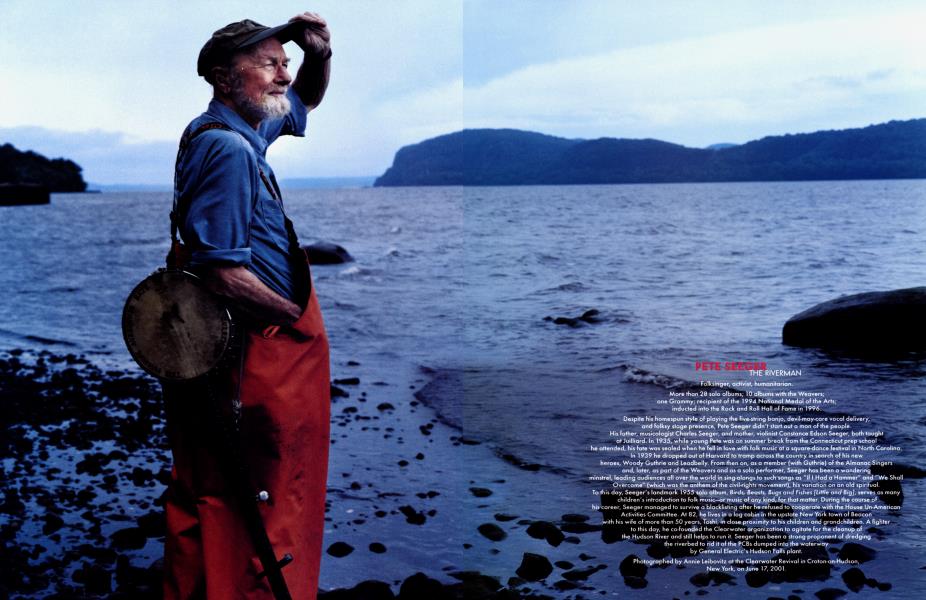
Despite his homespun style of playing the five-string banjo, devil-may-care vocal delivery, and folksy stage presence, Pete Seeger didn't start out a man of the people. His father, musicologist Charles Seeger, and mother, violinist Constance Edson Seeger, both taught at Juilliard. In 1935, while young Pete was on summer break from the Connecticut prep school he attended, his fate was sealed when he fell in love with folk music at a square-dance festival in North Carolina. In 1939 he dropped out of Harvard to tramp across the country in search of his new heroes, Woody Guthrie and Leadbelly. From then on, as a member (with Guthrie) of the Almanac Singers and, later, as part of the Weavers and as a solo performer, Seeger has been a wandering minstrel, leading audiences all over the world in sing-alongs to such songs as "If I Had a Hammer" and "We Shall Overcome" (which was the anthem of the civil-rights movement), his variation on an old spiritual. To this day, Seeger's landmark 1955 solo album, Birds, Beasts, Bugs and Fishes [Little and Big], serves as many children's introduction to folk music—or music of any kind, for that matter. During the course of his career, Seeger managed to survive a blacklisting after he refused to cooperate with the House Un-American Activities Committee. At 82, he lives in a log cabin in the upstate New York town of Beacon with his wife of more than 50 years, Toshi, in close proximity to his children and grandchildren. A fighter to this day, he co-founded the Clearwater organization to agitate for the cleanup of the Hudson River and still helps to run it. Seeger has been a strong proponent of dredging the riverbed to rid it of the PCBs dumped into the waterway by General Electric's Hudson Falls plant.
Photographed by Annie Leibovitz at the Clearwater Revival in Croton-on-Hudson, New York, on June 17, 2001.
Subscribers have complete access to the archive.
Sign In Not a Subscriber?Join Now


