
Sign In to Your Account
Subscribers have complete access to the archive.
Sign In Not a Subscriber?Join NowSeptember on our minds; calling out Christopher Hitchens; cheers for those other firefighters; beatifying Bill Gates; memories of Mainbocher; so very Harry!; Prince Charles’s court of appalls; and more
September on our minds; calling out Christopher Hitchens; cheers for those other firefighters; beatifying Bill Gates; memories of Mainbocher; so very Harry!; Prince Charles’s court of appalls; and more
September on our minds; calling out Christopher Hitchens; cheers for those other firefighters; beatifying Bill Gates; memories of Mainbocher; so very Harry!; Prince Charles’s court of appalls; and more
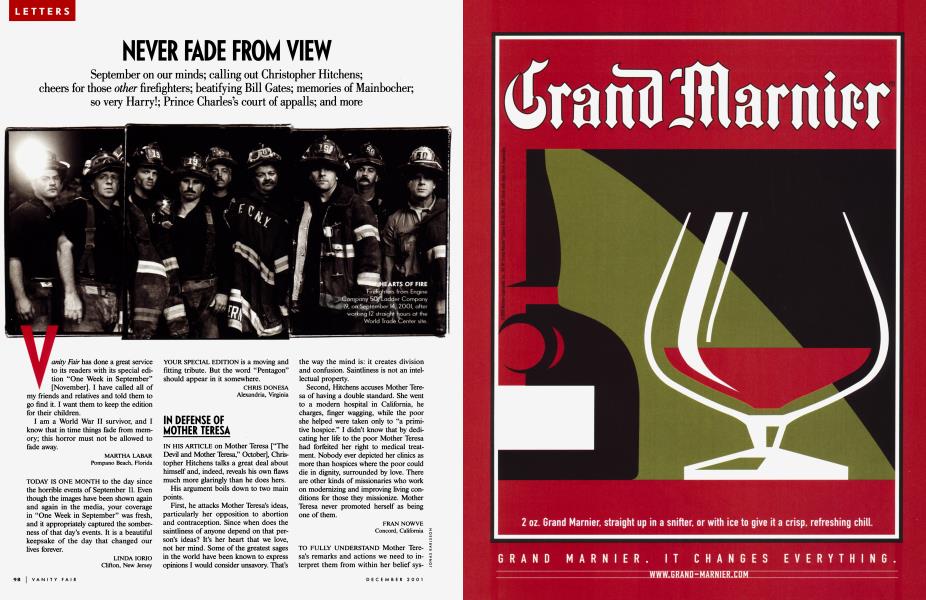
Vanity Fair has done a great service to its readers with its special edition “One Week in September” [November]. I have called all of my friends and relatives and told them to go find it. I want them to keep the edition for their children.
I am a World War II survivor, and I know that in time things fade from memory; this horror must not be allowed to fade away.
MARTHA LABAR Pompano Beach, Florida
TODAY IS ONE MONTH to the day since the horrible events of September 11. Even though the images have been shown again and again in the media, your coverage in “One Week in September” was fresh, and it appropriately captured the somberness of that day’s events. It is a beautiful keepsake of the day that changed our lives forever.
LINDA IORIO Clifton, New Jersey YOUR SPECIAL EDITION is a moving and fitting tribute. But the word “Pentagon” should appear in it somewhere.
CHRIS DONESA Alexandria, Virginia
IN DEFENSE OF MOTHER TERESA
IN HIS ARTICLE on Mother Teresa [“The Devil and Mother Teresa,” October], Christopher Hitchens talks a great deal about himself and, indeed, reveals his own flaws much more glaringly than he does hers.
His argument boils down to two main points.
First, he attacks Mother Teresa’s ideas, particularly her opposition to abortion and contraception. Since when does the saintliness of anyone depend on that person’s ideas? It’s her heart that we love, not her mind. Some of the greatest sages in the world have been known to express opinions I would consider unsavory. That’s the way the mind is: it creates division and confusion. Saintliness is not an intellectual property.
Second, Hitchens accuses Mother Teresa of having a double standard. She went to a modem hospital in California, he charges, finger wagging, while the poor she helped were taken only to “a primitive hospice.” I didn’t know that by dedicating her life to the poor Mother Teresa had forfeited her right to medical treatment. Nobody ever depicted her clinics as more than hospices where the poor could die in dignity, surrounded by love. There are other kinds of missionaries who work on modernizing and improving living conditions for those they missionize. Mother Teresa never promoted herself as being one of them.
FRAN NOWVE Concord, California
TO FULLY UNDERSTAND Mother Teresa’s remarks and actions we need to interpret them from within her belief system. Hitchens’s statement about himself—“I am an atheist”—classifies him as an outsider. When Mother Teresa said the greatest threat to world peace was abortion, I understood her to be referring to root attitudes that are common in her views of both war and abortion: there is not peace in the world because we do not “love our neighbors as ourselves.” We do not value all lives equally. Mother Teresa believed that life begins at conception.
I’m not defending her beliefs, but to leave Hitchens’s attack unchallenged is to do this woman and ourselves a great disservice. We can be peacemakers in our world by being better listeners and seeking to better understand what others believe. There will be much less misconception, from our personal relationships to our global ones, and, consequently, fewer battles.
JOY SOLTIS Bellevue, Washington
HAVING SPENT A WEEK in Calcutta, India, to pick up my beautiful daughter from an orphanage, I am greatly offended by Hitchens’s article. As if his book about Mother Teresa, The Missionary Position, weren’t offensive enough, he chooses again to drag her memory and service to the people of Calcutta through the mud. The anger and vendetta he carries against Mother Teresa is perplexing; where did such hatred originate, and why does he continue to carry it? Anyone who has spent any time in Calcutta should admire and support the beatification of Mother Teresa simply because she chose to live in such a city. It is hauntingly beautiful and mysterious, but it is in indescribable disrepair, and so many of its people are among the poorest in the world. I would like to see Mr. Hitchens take some of the negative energy he targets at Mother Teresa, move to Calcutta, and care for the hundreds of thousands of babies in orphanages and the people dying on the streets. Since he is an atheist, he can’t be beatified, but helping others may make him feel better about himself.
DINA L. BADOLATO Vancouver, Washington
KINGS OF THE FOREST
Sebastian Junger’s “The Burning Season” [October] took me back to an earlyspring afternoon in 1962 at Camp LeJeune, North Carolina, where I was just completing active duty in the Marine Corps. Emergency was declared, and our entire company was loaded onto buses and driven six hours to a roadhead debarkation point. We piled off, were issued our gear, and spent the rest of the night fighting a forest fire in a swamp—slogging a mile through darkness, swamp muck, and thigh-deep water to the fire line. Here, after charging our 60-pound back pumps, we would play a stream of water on flames that were consuming tree trunks, low-lying branches, and shrubbery sticking above the water. All night long, we had to continuously slog back to base to exchange pumps. Surreal.
We were not in the danger faced by Junger’s smoke jumpers and hotshot crews, but I will say I have never been so drained, so utterly exhausted. Not rowing varsity crew at college, not even during the most grueling elements of Marine Corps boot camp.
LEE GAILLARD Philadelphia, Pennsylvania
I WAS BOTH ENTERTAINED by and grateful for Junger’s fine article about our nation’s fire-fighting crews. He painted a compelling and accurate portrait of the expertise, courage, sweat, and blood that go into defending the resources that many take for granted.
I had only one minor cringe, regarding an assertion he makes. In discussing the evolution of fire-fighting programs and technology during the 20th century, Junger says that the United States Forest Service’s “funding from Washington became effectively unlimited, and remains so to this day.”
My parents have worked, in different capacities, for the U.S.F.S. since 1980. My father fought fires (and re-planted the land afterward) during the early 80s, and my mother still works as a “lookout” in Northern California’s Shasta-Trinity Forest.
During fire season, my mother practically lives up in her tower on the top of a winding mountain chain, watching over hundreds of thousands of acres of land. She studies remote land that she’s learned like the back of her hand for smoke, lightning, or flames. She surveys weather patterns, directs (via radio) crews who are driving or flying into land for which there is no accurate map, and serves as a communication point for crews already on the ground. She doesn’t sleep when lightning is expected, and during long fires will stay up in the tower until it’s all pretty much over.
Each year, funding for the U.S.F.S. lookouts is cut, towers are closed for good, and my mother ends the fire season not knowing whether “her tower” will be funded when the fires start again in late spring. Her work hasn’t the danger or grit of the ground crews’, smoke jumpers’, or hotshots’, but it’s still a crucial part of the defense, and it remains jeopardized.
Bravo for an otherwise wonderful piece.
JENNY SLATER Alameda, California
THE GLIMPSE JUNGER gave us into the heroic lives of men and women bravely fighting wildfires was truly inspiring. The firefighters are paragons of valor, altruism, and fortitude, admirably protecting life while others malevolently destroy it.
BRIEN COMERFORD Glenview, Illinois
WILL THE REAL SAINT PLEASE STAND UP
EXCUSE ME? BILL GATES is concerned about the Third World, “where 40,000 people die every day from preventable diseases and the typical income is less than a dollar a day,” and yet he is living in a $109.5 million, 37,000-square-foot lakeside mansion, “which he now thinks isn’t big enough” [“The New Establishment 2001,” October]? Maybe I should consider him a saint, like ... Mother Teresa.
KENYA HOLMES Waikoloa, Hawaii
MAIN INSPIRATION
YOUR ARTICLE ABOUT designer Mainbocher [“The Mark of Mainbocher,” by Laura Jacobs, October] brought back precious memories. My grandmother Vivian Tumage was bom in 1905 in South Carolina and had an unusual style. I recall a lady of immaculate dress, decorum, attitude, and grace. She was always up to something grand.
Eventually, she had the means to own her own Mainbocher. She kept her treasure wrapped in tissue paper, however, and, as a seamstress, spent hours trying to emulate Main’s style in an attempt to create her own version of his original. It was a navy-and-white shirtwaist, with a nautical motif. I have a photograph of her in this dress, helping me blow out candles on my third birthday. How I loved her then. I certainly miss that proper lady every day of my life. I still hear her admonitions, as well as her gracious praise playing over and over in my memory.
These steps I cannot follow.
VIVIAN TURNAGE LEESE Kitty Hawk, North Carolina
NO TROUBLE WITH HARRY
I AM AN EIGHTH-GRADE student at Winslow Township Middle School. I picked up your magazine at my library when I saw the cover with Harry Potter on it. After reading the article [“Something About Harry,” by Leslie Bennetts, October], I realized the film might really be good. Before, I thought no film could live up to the greatness of the books.
CONTINUED ON PAGE 118
CONTINUED FROM PAGE 102
How did you get so much detailed information on this production? The closeup interviews with J. K. Rowling and the cast had the answers to every question in my mind. I never knew how much time and effort (and money) went into this film. Thank you.
ANDREW RICHARDSON Mrs. Schultz’s sixth-period writing class Atco, New Jersey
COMEDY OF MANNERS
YOU CAN DRESS THEM UP, but you can’t take them out! Here’s hoping the tacky comments made at H.R.H.’s bash didn’t come tumbling out of the mouths of only American guests [“A Court of His Own,” by Bob Colacello, October]. Joan Rivers’s speech would have been enough to drop my jaw and turn my cheeks crimson, and I’m hardly a prude [“Your Royal Highness, milords and ladies, fashionistas, and you lucky bitches who married well”]. Denise Hale, begging to be let inside Highgrove to nose around—when it was obviously never the intent of her host—should receive the award for “Pushiest American,” hands down. I’m no fan of the royals, but I assume H.R.H. can stomach some of these clods because they hand him great gobs of cash for his many good causes, for which I do applaud them all.
MICHELLE C. HUFFER Boyds, Maryland
LIKE THE PARTIES thrown by two previous Princes of Wales, George IV and Edward VII, which were attended by hangers-on and assorted mistresses, the dinners given by Prince Charles were appropriately populated by members of the Second Wives’ Club, namely Mercedes Bass and Begum Inaara; the much-married Lily Safra, Denise Hale, and the aforementioned Begum Inaara’s mother, Renate Thyssen-Henne; and a foulmouthed comedienne, Joan Rivers.
What a motley crew.
MOHAMED JANTAN Seattle, Washington
WHO-DUNNE-ITS
I GOT CHILLS when I read Dominick Dunne’s theory that Chandra Levy possibly rode to her doom on the back of a motorcycle [“Crime After Crime,” October]. I don’t think it is a stretch to say that Mr. Dunne’s crime reporting in your magazine is the best of its kind in print today. I also don’t think it is a stretch to say Mr. Dunne has made a real difference in bringing some cases to light—the Skakel case most notably. Frankly, I’m hooked.
PHIL PERRIER Los Angeles, California
WHAT DUNNE COULD possibly find admirable about “the way he [Allen Grubman] is sticking by his daughter [Lizzie Grubman]” is a mystery to anyone who has any sense of right and wrong. Blaming a victim of his petulant and irresponsible daughter for “assuming the risks” of being in a public place where she could mow him down and run from the scene doesn’t fit into any standard of decent behavior. No one would find this admirable.
Admirable would be to encourage her to own up to her responsibility, make amends, and develop the moral character that would prevent her from committing such acts in the future.
Grubman, as “a wildly successful showbusiness lawyer,” and his daughter should be held to a higher standard of behavior by virtue of their privilege and education, not a lower one.
SUSAN TORRES Malibu, California
I'M GOOD ENOUGH, I'M SMART ENOUGH...
I JUST CAME UPON the article about Paolo Zampolli and the picture of him in Cipriani’s [“Ze-e E-e-encredible Paolo!,” by Nancy Jo Sales, October].
The quote accompanying the picture— “When people meet me, they love me. When they know me, they are jealous”—is pure genius. I am going to copy it and paste it in my bedroom—on my vanity mirror, of course! What a wonderful daily affirmation. I roared with delight when I read it, and look forward to the ride home to read the rest of the magazine.
STEPHANIE DE GOUVEIA Toronto, Ontario
ONCE UPON A TIME
ON MONDAY, SEPTEMBER10, I Stopped at my local market for diet root beer and succumbed once again to the lure of glossy magazines along Impulse Aisle. I bought the October Vanity Fair, even though I wasn’t particularly attracted to the Harry Potter cover. I perused the masthead, as I do every month, identifying the people who could be my co-workers and counterparts. I felt a healthy envy for those who do what I do, but at the epicenter of magazine journalism. I had just returned to Washington, D.C., from a Sunday spent wandering the streets of the West Village, wondering if New York was already saturated with ripening talent, slotted to fill their bosses’ shoes in a decade’s time.
A little deflated, I continued thumbing through pages until I arrived at the Editor’s Letter [“Whoa! I’m Getting Paid for This?,” by Graydon Carter]. Reflections of a once green New Yorker questioning his worth and his future, afraid of being exposed and expelled. His youthful fears that New York was far too clever a place, and he not spectacular enough. It was exactly the liniment I needed to both soothe my worry and stimulate my resolve. I re-discovered the unbridled enthusiasm that I feel when I go to work every day. As he talked of hungry, driven twentysomethings, my determination mounted from “I think I can” optimism to an “If I can make it there ...” crescendo.
The next day was Tuesday. I woke with a renewed determination to shine at work, my goal of becoming a Manhattanite in full view. By the time my elevator arrived on the eighth floor of the National Geographic Society building, news of the attack and rumors were already swirling. We sat stunned in the projection room, watching the diabolical acts unfold. By 10:30 A.M. we were spilling onto the streets, staring alternately at the deadly sky and our malfunctioning cell phones.
Since then, I have been riveted by broadcast news. I have been revolted by the relative ease with which the people around me have gone back to their daily routines. I have tried to sleep in the midst of helicopters and fighter jets patrolling the skies above my brownstone. On television I see the blaring scar in Lower Manhattan. I know people who know people among the missing. But I have tom the Editor’s Letter from the October edition. It reminds me that, although New York now holds its breath, one day soon it will be revived with the spirit and pace that make it extraordinary. And that there is a place for me there.
BRONWYN L. BARNES Washington, D.C.
AFTER READING the Editor’s Letter, I was saddened by the overt optimism you expressed for your colleagues and your work. It occurred to me that until September 11 we all lived in the “good old days.”
MAUD CABOT Boston, Massachusetts
Letters to the editor should be sent electronically with the writer’s name, address, and daytime phone number to letters@vf.com. Letters to the editor will also be accepted via fax at 212-286-4324. All requests for back issues should be sent to FAIR@neodata.com. All other queries should be sent to vfmail@vf.com. The magazine reserves the right to edit submissions, which may be published or otherwise used in any medium. All submissions become the property ofVanity Fair.

Subscribers have complete access to the archive.
Sign In Not a Subscriber?Join Now


