





Sign In to Your Account
Subscribers have complete access to the archive.
Sign In Not a Subscriber?Join NowCONTRIBUTORS
The author of Lush Life, the 1996 biography of jazz composer Billy Strayhom, David Hajdu turned his attention to folk music for his second book, Positively 4th Street: The Lives and Times of Joan Baez, Bob Dylan, Mimi Baez Farina and Richard Farina (Farrar, Straus and Giroux), which is excerpted in this issue. His five years of research had Hajdu cooking and making pottery with Baez. As for Dylan, who turns 60 this year, "it's almost impossible to process now that he was once an unknown kid, inventing himself," says Hajdu. "Our culture seems obsessed with the myth of the loner, the solitary visionary. But real life is arabesque and messy." In the May 1999 issue, Hajdu wrote about the relationship between Strayhom and Duke Ellington.
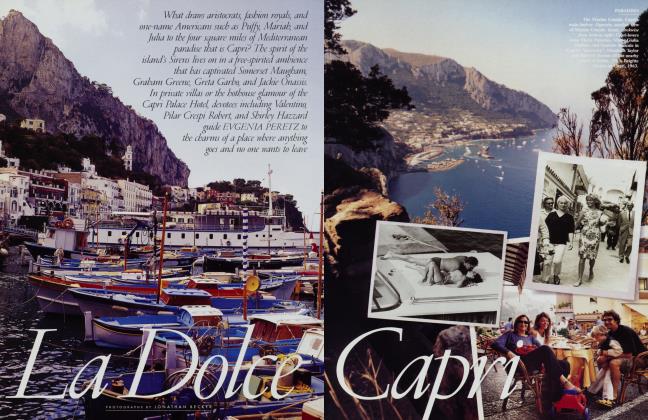
One of the biggest challenges contributing editor Evgenia Peretz faced in reporting about Capri is that the Italian island stands for everything that doing work does not: relaxation and a worry-free existence. "There were moments when I thought I must have appeared to be a neurotic, corporate stress case, showing up with my notebooks and microcassettes, ready to conduct 'interviews,' " Peretz says. "I quickly learned that none of it was very Capri." On the other hand, the island's laid-back vibe made meeting people easy. "If there's someone you want to meet, you can pretty much just show up at their villa," she says, "and there they are, hanging out in the garden, waiting to take you in."
According to James Atlas, who attended the annual World Economic Forum in Davos, Switzerland, "It's not until you see David Rockefeller and Oprah trudging through the snow that it begins to dawn on you that this is not a normal environment." Over the past 30 years, the conference has become ground zero for kings, presidents, activists, scientists, professors, and business moguls alike to discuss global issues. "It stretched my imagination," says Atlas, who is the author of Bellow: A Biography and founding editor of the Lipper/Viking Penguin Lives Series. "I felt like a tourist in the great world."
CONTINUED ON PAGE 58
CONTINUED FROM PAGE 56
The first time contributing photographer Jonathan Becker visited the Italian island of Capri was 15 years ago—and he stayed six weeks longer than he had planned. "It is seductively otherworldly and it licenses decadence," says Becker, who on page 196 captures the Mediterranean paradise that for decades has attracted the world's most alluring celebrities, aristocrats, and playboys. It is also a place where anything goes, and judging from Becker's recollections of "the sparkling azure sea, nightblooming jasmine, rambling villas, and hidden paths," it's no wonder so many find Capri so difficult to leave.
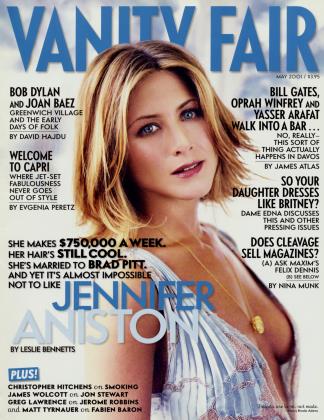
In recent months, contributing editor Leslie Bennetts has profiled a number of Hollywood's leading ladies, including Julianne Moore, Catherine ZetaJones, and Kate Hudson. In Jennifer Aniston, this month's cover subject, Bennetts found an actress without attitude or pretension. "I think Jennifer has made a determined effort not to let fame, fortune, and marriage to Brad Pitt turn her into a different kind of person," says Bennetts. "She is very conscious of her influence, particularly on young women, and wants to use it constructively."
In Dance with Demons (Putnam), which is excerpted on page 122, Greg Lawrence explores the life of Broadway director and choreographer Jerome Robbins, whose stormy career included productions of On the Town, Gypsy, The King ami I, and Peter Pan, in addition to the naming of names to the House Un-American Activities Committee during the McCarthy era. This excerpt chronicles Robbins's pitched battles with his collaborators on West Side Story and Fiddler on the Roof, which were ferocious to the point that, Lawrence says, it "raises the question of how we are to weigh his artistic achievements against the human cost he exacted over the years because of his aggressive perfectionism and apparent cruelty." Lawrence has previously worked with ballerina Gelsey Kirkland on three books, including the 1986 best-seller Dancing on My Grave.
CONTINUED ON PAGE 62
CONTINUED FROM PAGE 58
"It is a rare day when you see an apartment and think, I could just bring my toothbrush and move right in," says editor-atlarge Matt Tyrnauer about the minimalist loft of designer Fabien Baron, whom he profiles on page 176. "Baron's threedimensional design work recalls Mies van der Rohe's clean lines, attention to detail, and interest in expensive materials," says Tyrnauer, who happens to be a neo-Miesian modernist himself. "Baron is an extraordinarily intuitive designer, and he never seems to repeat himself." Also, on page 116, Tyrnauer nominates veteran NBC Nightly News correspondent Robert Hager to Vanity Fair's Hall of Fame.
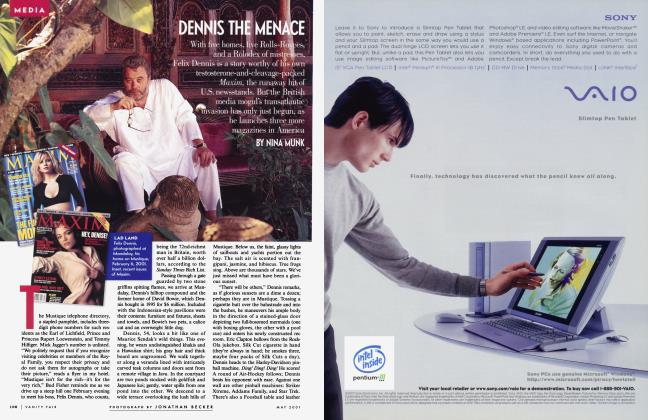
Before profiling British publisher Felix Dennis, Nina Munk had never read Maxim, Stuff, or any other of his "lad" and popular-culture magazines. Now, she admits, "I've really grown to like Maxim. It's not trying to pretend it's something it's not, and I admire that." For her article, which starts on page 108, Munk visited Dennis at two of his five homes— his Caribbean island retreat on Mustique and his estate in Warwickshire, England. "He was bombastic and crass and egomaniacal and fearless and brilliant no matter where he was or who he was with," says Munk. "It was probably one of the most fun stories that I've reported in the decade or so that I've been a business journalist." Munk is a frequent contributor to Forbes, Fortune, and The New York Times Magazine.
Fabien Baron, who shot his new SoHo loft for this issue, has variously been a magazine art director, photographer, and designer of everything from furniture to Calvin Klein fragrance bottles to Prada advertisements. His ultra-minimalist home required little lifestyle adjustment. "I don't own anything. I have books, cameras, and pictures, that's it." Of all his creative outlets, Baron says, his favorite may be the one no one ever sees: his landscape photography. "It's a bit like therapy. I'm in my own little world, no phones and no clients. I don't even print them. I look at the contacts, edit it, put it in the box, and move on."
Subscribers have complete access to the archive.
Sign In Not a Subscriber?Join Now

