




Sign In to Your Account
Subscribers have complete access to the archive.
Sign In Not a Subscriber?Join NowFOR DETAILS, SEE CREDITS PAGE
RETURN TO HOGWARTS
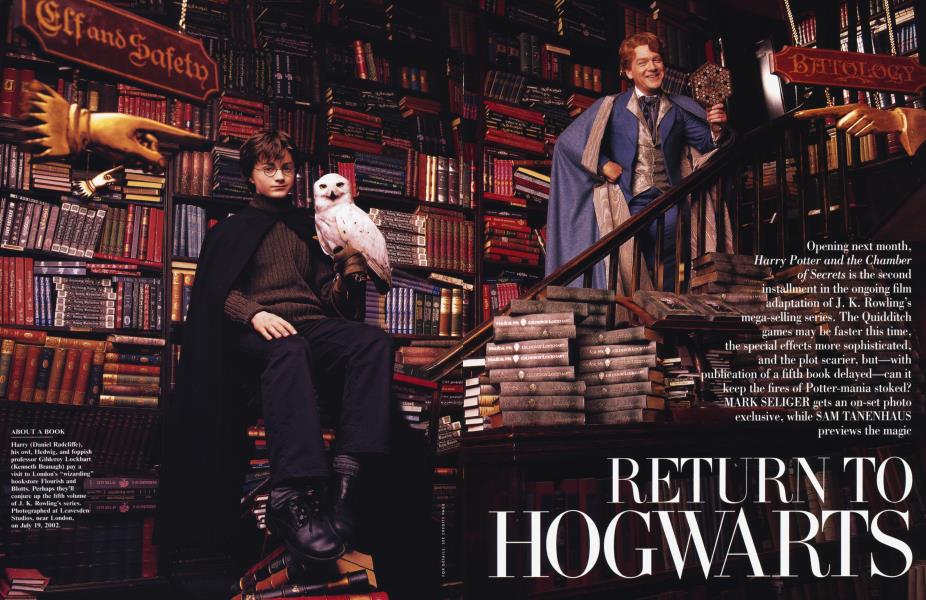
Opening next month Harry Potter and the Chamber of Secrets is the second installment in the ongoing film adaptation of J. K. Rowling's mega-selling series. The Quidditch games may be faster this time, the special effects more sophisticated, and the plot scarier, but—with publication of a fifth book delayed—can it keep the fires of Potter-mania stoked? MARK SELIGER gets an on-set photo exclusive, while SAM TANENHAUS previews the magic
MARK SELIGER
SAM TANENHAUS
It's becoming an annual rite for the millions hooked on our era's signature coming-of-age epic: in November, Warner Bros, will release Harry Potter and the Chamber of Secrets, the second entry in its scrupulous, ongoing adaptation of J. K. Rowling's prodigiously best-selling series about an orphan sent to an English boarding school for wizards. Chris Columbus, who directed the new film as well as last year's Harry Potter and the Sorcerer's Stone, promises more action this time and a scarier story. "Some dismiss The Chamber of Secrets as their least favorite" in the series, he says, because the plot is less complexly layered than some of the others. "But it's the most cinematic of all the books. It delivers amazing action sequences, amazing set pieces. I was ravenous to do it." The narrative is also eerily attuned to our anxious, post-9/11 moment: a fanatical terrorist, hiding somewhere in the Hogwarts School of Witchcraft and Wizardry, means to purge it of "Mudbloods" (those whose pedigree is less than 100 percent wizard); pupils, one by one, are frozen into stone. It falls to Harry and his two sidekicks—the feisty redhead Ron Weasley and the saucy bookworm Hermione Granger— to unmask the villain even as the hero matches wits, not to mention wands, with Hogwarts rival Draco Malfoy and his band of creepy snobs.
A year ago, when the debut film was released, Potter-mania was at its peak. The Britain-wide search for an actor to play Harry, culminating in the selection of Daniel Radcliffe, had rivaled David O. Selznick's intense quest for the perfect Scarlett O'Hara. By the time The Sorcerer's Stone opened, two months and five days after September 11, all of Hollywood was rooting for this parable of good and evil to point the way toward box-office deliverance. And it came: $129.5 million worth of tickets sold in the first week, obliterating records set by Star Wars: Episode I—The Phantom Men- ace and The Lost World: Jurassic Park; the movie ultimately won honors as the highestgrossing film of 2001. O.K., so some critics groused that the adaptation Columbus had fashioned, while gold-plated, was also mechanical and wingless. And where, they wondered, were the truly mind-bending special effects of Star Wars and The Lord of the Rings? Even Quidditch, the airborne game of polo-cum-lacrosse that Harry and his schoolmates play atop speeding broomsticks, struck some as earthbound. There will be more visual candy in the new film, Columbus says. "I gave the effects people more time.... I wanted Quidditch to be twice as good, twice as fast. I wanted fullblown fighting scenes."
But, as before, the idea is not to soup up the novels but to translate them faithfully to the screen. Why tamper with a winning formula? The Chamber of Secrets may be, as Columbus says, "the orphan of the series," but it has sold a staggering 40 million copies worldwide—15 million in the U.S.A. and Canada. For devotees, the vast majority of them children, the books have attained the sacredness of scripture. Some carry a virtual map of Rowling's amazingly detailed universe in their heads. Not an audience primed for auteurist monkeying, thank you. Indeed, much of the fun in last year's film was in simply seeing Rowling's world made concrete, particularly the towers, turrets, and secret passageways of Hogwarts, the thousand-year-old Eton of the sorcery crowd. "It's like Potter Land here," says Columbus of Leavesden Studios, an hour outside London, where both films were shot. "We treat it as if it's a real place. We want it to feel real. We don't want it to feel so fanciful that it doesn't exist." The approach is working, to judge from the reactions of the busloads of schoolchildren plainly enthralled when they tour the set, and of the many others who have written to the director, telling him "Hogwarts feels like a real school they could go to." It all begins, Columbus claims, in his "perfect collaboration" with Rowling. "For every book she's written, there's another book of knowledge" in her head, he says, and he taps that knowledge often, via phone and E-mail. "She can give you the entire history of the Whomping Willow," he explains, referring to the tree Harry and Ron smash into when they arrive for the new school year in a flying car.
Duplicating last year's box-office numbers won't be easy. Warner Bros.' careful game plan called for The Chamber of Secrets to ride the crest of excitement generated by Rowling's latest novel. But after four consecutive years in which a new No. 1 best-seller bubbled up as dependably as a brew in Snape's Potions class, two summers have come and gone with no new novel in sight, leaving her minders worried that for Rowling's addicted followers—now older and testier—the spell might be broken. Alas, it's no simple task for even the most diligent artist to conjure up "product" on command. And consider the fairy-tale turn Rowling's life has taken. Years of obscurity, struggle, and single-mom-hood have abruptly yielded fame and wealth on an improbable scale. Throw in a new husband and the problems of furnishing a recently purchased mansion in Scotland and it's no wonder Scholastic Inc., Rowling's U.S. publisher, keeps pushing back the publication date for book number five. June 2003, the publisher's outside guess a few months ago, now looks unlikely unless Rowling completes the manuscript soon. ("We don't know when she's going to finish," Scholastic admitted recently.)
By then the third film, Harry Potter and the Prisoner of Azkaban, will be in production under a new director, Alfonso Cuaron (whose credits include The Little Princess as well as Y Tu Mama Tambien). Columbus, who helped choose his successor, will be staying on as a producer, joining David Heyman. "I want to make sure the transition is smooth," Columbus explains. "We've been together for two years. I don't want the attitude on the set to change."
This sense of stewardship is shared by the entire Potter team, which includes screenwriter Steve Kloves and a cast headed by all-star returnees Dame Maggie Smith as Professor McGonagall, Alan Rickman as the glowering Professor Snape, Robbie Coltrane as the animal-loving half-giant Hagrid, and Richard Harris as the twinkling headmaster Dumbledore. The addition of Kenneth Branagh (he beat out Hugh Grant) as the fawning, foppish Gilderoy Lockhart, a teacher of Defense Against the Dark Arts, should offer comic rewards. And those are just the human players. In addition to the flying car and the Whomping Willow, says Heyman, "you meet a writhing basilisk, huge spiders, and Dobby," a computer-generated "house-elf." But this is a children's world, and the true stars remain the three young leads, who each have the cumulative experience of nearly 300 days on the job: Radcliffe (who turned 13 last summer), Rupert Grint (14), and the delightful Emma Watson (12). All are edging into pubescence, their images fixed yet evolving before our eyes—another aspect of Harry Potter's "magicking," its enchanting brand of alchemy.
Subscribers have complete access to the archive.
Sign In Not a Subscriber?Join Now


