

Sign In to Your Account
Subscribers have complete access to the archive.
Sign In Not a Subscriber?Join NowTHE BALLAD OF PEGGY LEE
JAMES GAVIN
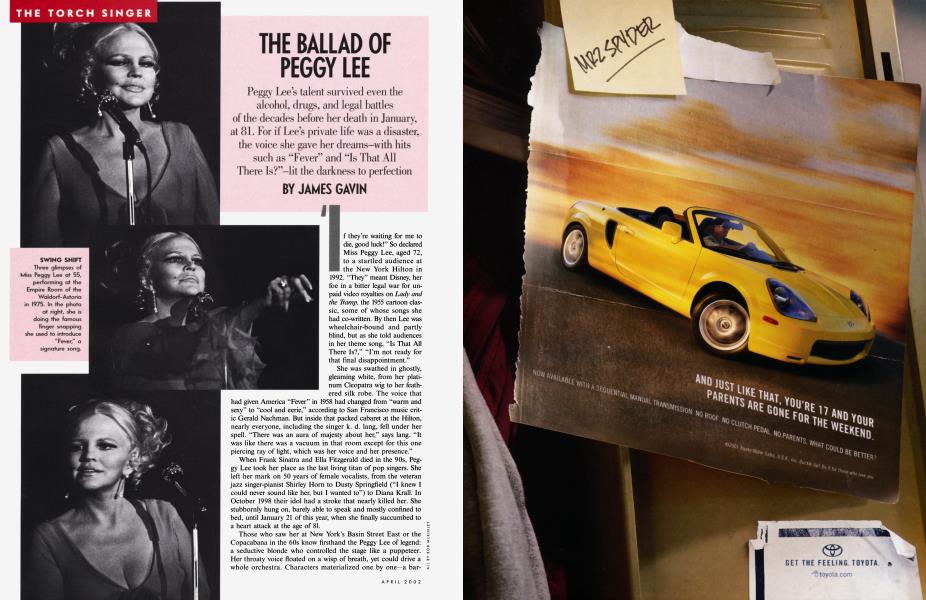
Peggy Lee's talent survived even the alcohol, drugs, and legal battles of the decades before her death in January, at 81. For if Lee’s private life was a disaster, the voice she gave her dreams-with hits such as “Fever’ and “Is That All There Is?”—lit the darkness to perfection
THE TORCH SINGER
'If they’re waiting for me to die, good luck!” So declared Miss Peggy Lee, aged 72, to a startled audience at the New York Hilton in 1992. “They” meant Disney, her foe in a bitter legal war for unpaid video royalties on Lady and the Tramp, the 1955 cartoon classic, some of whose songs she had co-written. By then Lee was wheelchair-bound and partly blind, but as she told audiences in her theme song, “Is That All There Is?,” “I’m not ready for that final disappointment.”
She was swathed in ghostly, gleaming white, from her platinum Cleopatra wig to her feathered silk robe. The voice that had given America “Fever” in 1958 had changed from “warm and sexy” to “cool and eerie,” according to San Francisco music critic Gerald Nachman. But inside that packed cabaret at the Hilton, nearly everyone, including the singer k. d. lang, fell under her spell. “There was an aura of majesty about her,” says lang. “It was like there was a vacuum in that room except for this one piercing ray of light, which was her voice and her presence.”
When Frank Sinatra and Ella Fitzgerald died in the 90s, Peggy Lee took her place as the last living titan of pop singers. She left her mark on 50 years of female vocalists, from the veteran jazz singer-pianist Shirley Horn to Dusty Springfield (“I knew I could never sound like her, but I wanted to”) to Diana Krall. In October 1998 their idol had a stroke that nearly killed her. She stubbornly hung on, barely able to speak and mostly confined to bed, until January 21 of this year, when she finally succumbed to a heart attack at the age of 81.
Those who saw her at New York’s Basin Street East or the Copacabana in the 60s know firsthand the Peggy Lee of legend: a seductive blonde who controlled the stage like a puppeteer. Her throaty voice floated on a wisp of breath, yet could drive a whole orchestra. Characters materialized one by one—a barroom vamp on the make, an indomitable housewife, a faded woman exposing her loneliness. Grady Tate, the drummer who worked with Lee for more than 20 years, compared her to Billie Holiday: “Peggy had that nasty, laid-back, demented, sultry, incredibly funky sound that Lady Day had. But it was Lady with another lady on top of it.”
Many of Lee’s shows included one of her favorite songs, “The Folks Who Live on the Hill,” Jerome Kern and Oscar Hammerstein’s reverie about a country couple’s journey into the sunset. The former Norma Deloris Egstrom of Jamestown, North Dakota, gave up that dream to live like a star. In her twilight years, Peggy Lee’s “home on a hilltop high” was a mansion in Bel Air, with a winding staircase and the frozen perfection of a museum. Nearly everything was peach or beige. Two Peggy Lee marionettes sat in a corner of the sparsely furnished living room, looking toward a wall cabinet that held her hundreds of orchestrations by top arrangers, stacked in numbered envelopes protected by Ziploc bags.
Arriving at the house in January 1999, I was greeted by Lee’s only child, Nicki Lee Foster, a large woman with a brown shag hairdo and weary eyes. She explained that her mother was comatose and could see no one. Nicki had left California in the 70s to live in Idaho with her children; now Lee’s illness had brought her back. Hung in the dining room were etchings Nicki had done as a young woman—a calling she abandoned to become Lee’s personal assistant. “I didn’t want to ever have to try and follow in my mother’s footsteps,” she said. “That’s too big a shoe to fill.” She showed me the first-floor office. On the walls were 12 Grammy nominations (Lee won 2, for “Is That All There Is?” and for lifetime achievement), framed letters from Frank Sinatra, and inscribed photos of Albert Schweitzer, the Dalai Lama, and Louis Armstrong. In the garden were pink Peggy Lee roses, named in her honor by the American Rose Society.
Is that all there is?, Lee must have wondered. In July 1998, I had tried interviewing her by phone for the booklet of a reissue of her 1963 album Mink Jazz. Already bedridden, she offered little more than a vague “I don’t remember.” But when I mentioned her 1953 composition “Where Can I Go Without You?,” Lee’s gauzy voice turned to steel. “Will I be given credit for that?,” she asked, revealing the spark behind her music and her will to live. As Robert Richards, an illustrator who lived and worked with her in the 70s, told me, “Peggy operates on anger, and the minute you can get her angry you’ve got her attention.”
'Look,” Lee told Kathy Larkin of the New York Daily News in I 1983, “my stepmother hit me here, in the face, with a metalLi ended razor strap. And here”—Lee touched the top of her head—“that’s where she hit me with a heavy cast-iron skillet.” Jazz singer Mark Murphy, who knew her in the late 50s, when they both recorded for Capitol, says, “I got to believe that Peggy Lee was actually a big doll that this woman had invented to escape being so miserable.” In her 1989 memoir, Miss Peggy Lee, she recalled the sight of her Scandinavian mother in a coffin, dead of complications from diabetes in 1924, when Lee was four. Her father, a railroad worker, married a German woman who, Lee said, beat and humiliated her. She escaped into a dream-world. At 14 came the inspiration to be a singer. “Something told me that’s how it would be,” she said.
Renamed Peggy Lee at a radio station in Fargo, North Dakota, she scuffled for years until the King of Swing, bandleader Benny Goodman, hired her in 1941. Her first hit came a year later, when Lee—a stunning white girl with rainwater skin and upswept honey-blond hairvoiced the cry of a defiant black woman, “Why Don’t You Do Right?,” written by a Chicago blues singer, Lil Green. Singing it with the bluesy wail of Billie Holiday and a swing feel inspired by Count Basie, Lee added an intimacy of her own.
Her storybook world turned sour as Dave Barbour's fondness for liquor developed into full-blown alcoholism.
Lee soon began directing her gaze at Dave Barbour, Goodman’s wavy-haired guitarist, whom she married in 1943, shortly before quitting the band. They built a little house in Hollywood and had Nicki. “It was like a novel,” says their close friend the singer Margaret Whiting, who recalls the young Lee “improvising and singing a song as if she loved every note of it, every word of it.” Needing money, Lee signed in 1944 with Capitol, and, with Barbour as composer, she wrote and recorded a string of hits—“It’s a Good Day,” “I Don’t Know Enough About You,” and her comedic samba, “Manana,” which hit No. 1 in 1948.
Her storybook world turned sour as Barbour’s fondness for liquor developed into full-blown alcoholism. In 1951 he asked Lee for a divorce, and she was devastated. Louis Berg of the New York Herald Tribune encountered a changed Peggy Lee. “This canary reveals herself to be as nervous as a cat,” he wrote in 1951. “Her hands tremble, she puffs incessantly on a cigarette, holds herself under control with visible effort.” Stories of her drinking begin around then.
Two years later, on her album Black Coffee, Lee created a milestone of jazz torch singing. By then she was back on the charts: a year earlier she had taken a Rodgers and Hart waltz, “Lover,” and whipped it into a Latin frenzy with congas, bongos, and her smoldering voice. That side, made for Decca, won her the adoration of musicians and the clout to record whatever she wanted, from R&B to Chinese love poems. In 1955 she wrote lyrics for Walt Disney’s Lady and the Tramp. As the voices of a flirty ex-show dog, the Siamese cats, and a human, Lee provided unforgettable catchphrases: “What a dogH “We are Siamese, if you please.”
That same year, her dark side emerged in Pete Kelly’s Blues, a movie melodrama which Dragnet’s Jack Webb directed and starred in. Lee played a fragile alcoholic singer in a 20s speakeasy. She was nominated for an Oscar for best supporting actress, but she never got another film offer. In later years she blamed this on rumors of her alcoholism, which she denied, none too convincingly. “She did have a problem with alcohol,” admits Nicki. “Both of my parents did.”
In 1988, Lee filed suit against Disney over Lady and the Tramp, and eventually received a settlement of $2.3 million.
Any TV viewer of the day knew the Peggy Lee vibe—warm, mellow, and slightly boozy. Her languor made her seem all the sexier. At Ciro’s, the Hollywood nightclub, songwriter Arthur Hamilton watched male customers perspire as Lee purred love songs in a dewy voice. “She was like the other woman in every couple that was there,” he says. Back at her apartment with Hamilton, Lee clowned and read her original haiku poetry. Like most people, the composer adored her sense of humor. But when he began raving about her onstage witchcraft, she froze. “I don’t want to talk about her anymore,” she said.
Lee’s sexual aggressiveness in those days, especially with musicians, was no secret. But it had a prudish underside, for she married three of her conquests. In all cases, her career—which “completely consumed her,” says Mark Murphy—got in the way. In 1953 she wed and divorced movie tough guy Brad Dexter, suggesting later that he couldn’t handle being Mr. Lee. Three years later she nabbed Dewey Martin, the screen hunk whose skimpy costumes in The Big Sky and Land of the Pharaohs had made him a Hollywood lust object. Lee was so afraid of his temper, according to Robert Richards, that one night she sat at the dinner table wearing a football helmet. In 1964 she was married for the last time, to Jack Del Rio, a handsome but unexceptional percussionist whom she made her conductor. (“Isn’t he cute?’'’ she asked audiences.)
Men and career left little room for motherhood. “There were tremendous amounts of time when Mom just wasn’t available,” says Nicki, who was raised by a nanny. Lee tried to compensate by throwing lavish birthday parties for her daughter, inviting Hollywood children Nicki barely knew. But one pianist recalls Lee coming home after work, musicians in tow, and waking Nicki up to make food and drinks. “It was not a very happy scene,” he says. According to Murphy, Nicki had a genuine gift for drawing, but at 19 she opted to marry a dancer and TV producer, Dick Foster, with whom she had three children. Her relationship with her mother was strained from then on.
'Fever,” the sultry Top 10 hit of 1958 that helped prompt Lee’s return to Capitol, also helped make her the queen of Basin Street East, where she headlined in the 60s. By then, the pressures of stardom had banished the carefree spirit Margaret Whiting had known. Lee pored over The Science of Mind, a metaphysical bible by her guru, Ernest Holmes, who held that mind and prayer could control everything. But neither that book nor the four statues of Saint Francis of Assisi in her Bel Air garden could soothe a woman whom Grady Tate called “the most hypochondriacal person I’ve ever known.”
Singing was no longer a breeze, either. “Putting together a show was like invading France,” said the late Lou Levy, the sexy gray-haired pianist and conductor whose brief affair with Lee in the 60s heated up their onstage chemistry. In a loose-leaf binder, Lee noted every word, gesture, and lighting cue. Rehearsals, Levy said, were “endless and sometimes excruciating.”
In the dressing room, the cool blonde pumped up her energy by creating an atmosphere of complete anxiety. Her hairdresser and assistant Kathy Levy—who for six years was Mrs. Lou Levy—scurried around giving Miss Lee vitamin B12 shots and spraying the dressing room with Arpege, the singer’s favorite scent. At her makeup table, Norma Deloris painstakingly turned herself into Peggy Lee, gluing on huge false eyelashes and applying thick foundation and peach lipstick. Kathy Levy did Lee’s hair as instructed, pinning on lemony wigs and falls, then squeezed her ample figure into a tight, Jell-O-hued dress. All the while Lee sipped cognac and alternated between puffs on a cigarette and snorts of air from “Charlie,” the respirator she traveled with after contracting double pneumonia in 1961.
Moments before the show, her musicians were summoned to join hands with her in a circle and pray. Lee kissed them one by one, murmuring inspirational key words: “Power.” “Burn.” “Love.” Then she pumped herself up with rage. Once, she picked a fight with one of her drummers, who was also her lover, over his playing, then concluded her attack with “And who was that girl in the red dress?”
After a drumroll and a big introduction—Ladies and gentlemen, Basin Street East proudly presents ... Miss PEGGY LEE!— she floated out, cheered on by the likes of Judy Garland, Frank Sinatra, Joan Crawford, and Sophia Loren, and spun a web of illusory stagecraft to rival Marlene Dietrich’s. Her snapping fingers glowed in pink at the start of “Fever.” Her feathers fluttered mysteriously, blown by a small fan inside the piano. Out of this dreamworld came singing of such honesty and directness that, to one critic, Lee sounded “as if she were singing to the man she loves in bed.” Every note seemed effortless, every tempo swung. “She mastered the art of economy,” says Artie Butler, who conducted Lee’s melancholy album, Norma Deloris Egstrom from Jamestown, North Dakota, in 1972. “She knew exactly what to leave out.” The reviews were seldom less than raves.
In 1969, public television aired a documentary, NET Presents Miss Peggy Lee, about the making of one of her shows. She had not aged gracefully. Nearly 50, Lee wore yellow pigtails tied with pink yarn, and her face was stretched into a nearly expressionless mask that recalled the septuagenarian Mae West. She had filled her repertoire with so many songs about despair and aging that one journalist called her “Our Lady of Sadness.”
In the documentary, Lee rehearsed a Brechtian cabaret piece, half spoken and half sung, that questioned the meaning of life. Deadpan, she recalled watching her childhood house burn down, her first trip to the circus, the great love that came and went. Her conclusion: “Let’s break out the booze and have a ball / If that’s all there is.” Recording “Is That All There Is?” in the studio with its writers, Jerry Leiber and Mike Stoller, Lee became so fixated on the words that she did 36 takes. Only the last satisfied her, but the engineer had failed to record it. Enraged, she refused to do another, and Leiber and Stoller spent weeks editing the others into a finished version. Capitol rejected it as overlong and arty, but Lee used her dwindling clout to demand the record’s release. That fall, “Is That All There Is?” hit No. 11 and won Lee her first Grammy.
She was back on top, and she moved into the last of the grand old New York supper clubs, the Waldorf-Astoria’s Empire Room. With her platinum hair as swirled and layered as a wedding cake, Lee sang such current songs as “You Make Me Feel Like a Natural Woman,” along with her by then nostalgic hits.
The show would continue in her suite, where she sat regally in bed, greeting such friends as Doris Duke and Cary Grant. “Here was Peggy, completely made up, with the hairdo from the show, all dressed in frilly and feathery stuff, with a blanket pulled up to her breasts, and the big long nails,” says Robert Richards. “She would gingerly nibble on this chicken sandwich, and tell you that the crusts had been removed. You’d have to have come from a place like North Dakota to have this totally Hollywood vision of yourself.”
At her makeup table, Norma Deloris painstakingly turned herself into Peggy Lee with huge false eyelashes, thick foundation, and peach lipstick.
Richards later moved into Lee’s home to work with her on an ultimately aborted project for the Japanese market, a line of bedding imprinted with her drawings of flowers. He found himself in the twilight zone. Lee liked to stay in bed for weeks in an ice-cold house—as she worked on the script for a film that would star her as Gabrielle Dupont, the seductive mistress of Debussy. A growing intake of Valium didn’t prevent her from terrorizing the help. “If Peggy had had a staff of 150 people, she could have kept every one of them on the point of a nervous breakdown,” Richards says. One ex-secretary, Betty Jungheim, was hit with a frivolous $22 million lawsuit for “slander, negligence, misconduct, fraud, and conversion.”
Capitol had dropped her, and her live shows were losing their footing as well. Onstage at the Fairmont in San Francisco, her pearl necklace broke, and the heavily sedated singer got on her hands and knees, groping for the pearls. “The room went to dead silence,” says Richards. “All of a sudden this man got up and said, ‘You were the American dream. What’s happening to you?’ Although she didn’t show a reaction, I think that it profoundly disturbed her.”
That idea seemed to haunt Lee’s last big chance as a recording artist: Mirrors, an album of Leiber-and-Stoller art songs, made for A&M in 1975. The project reflected her courage, but it also troubled her, and she reacted in a typical way. “She would get angry at Jerry,” Stoller says. “Then she wouldn’t talk to him. She would say, ‘I won’t record if he comes to the session.’ And then she would become angry at me.” Mirrors also shook Lee’s middleaged audience, while critics called it pretentious and overblown. In 1976 the Waldorf dropped her, but she didn’t leave gracefully. Near the end of her last engagement she exited an elevator with Richards on her way to the Empire Room. He saw Lee’s heel catch in the hem of her gown. She slid, but didn’t hit the floor, and the show went on. Within weeks she had filed a $15 million lawsuit against the Hilton hotels and Johnson Wax Co., claiming that the accident had left her partially deaf, blind, and paralyzed and had broken her back teeth, causing a huge loss in income.
In fact, she continued to work, although the houses were seldom full. Lee’s lawyers pressed Richards to testify about her “accident.” He refused. In 1982 the case was settled for a reported $325,000—a pittance, after years of legal costs. A bigger blow came the next year, when Lee opened on Broadway in Peg, a self-pitying one-woman show that closed after five performances.
"It was like there was a vacuum in that room except for this one piercing ray of light, which was her voice and her presence."
No failure could stop her. In 1985 excitement greeted the announcement that Lee was returning to New York to play the Ballroom, an intimate cabaret theater in Chelsea. The club seated about 200, and the stage could accommodate only a quintet. Arriving in a wheelchair, Lee seemed angry not to find another Empire Room. Although she could walk unassisted, she made Greg Dawson, the club’s owner, build her a ramp from the dressing room to the nearby stage, and insisted he replace the club’s top-notch sound system. “She claimed she had the ears of a bat and was even the subject of a special sound study at U.C.L.A.,” recalls Dawson. “Bad sound, she claimed, could cause her to vomit or faint—possibly in the middle of a show. That was how she initially dealt with me—the subtle, never exactly stated threat that she couldn’t perform or might have to cancel unless such and such happened. Then came my hearing her rehearse the first time, and I nearly died. She sounded terrible! I thought, She’s lost it. This is going to be a disaster.”
It wasn’t. “Nothing, it appears, can infringe upon Peggy Lee’s ability to vocalize wisdom, wit, romance, and understanding,” wrote Stuart Troup in Newsday. For five weeks Lee gave two concert-length shows a night to sellout crowds. She played there five times in 1990. Offstage, she talked about her “angels,” reminding everyone that in 1961, during her bout with pneumonia, she had died and come back to life. She dressed in saintly white and banished sad songs from her repertoire, even singing “Is That All There Is?” for laughs. “We used to make fun that she was trying to rewrite her life with her as the Mother of God,” says her guitarist John Chiodini.
But Norma Deloris, it seemed, was too painful for her to confront. As nurses wheeled her into the operating room for bypass surgery in 1985, Lee became frantic when they tried to remove her nail polish and false eyelashes. “She was having a fit!” says her granddaughter Holly Foster-Wells, who was by her side. “They did take her eyelashes off, but I put her big movie-star glasses on her. She wanted to be a star even in open-heart surgery.”
In 1995, Lee rose from her sickbed to open for Mel Torme at the JVC Jazz Festival in New York. One friend recalls Lee’s fear: “She was worried if she could make it vocally. She was afraid that she was a has-been.” As Lee struggled toward her chair at center stage in Carnegie Hall, the ovation was thunderous. Stephen Holden of The New York Times described her voice that night as a “wobbly murmur,” but acknowledged that her magic hadn’t died. Lee and Torme repeated the show at the Hollywood Bowl. That was Peggy Lee’s last major performance.
But a long-awaited triumph was in store. In 1988, sales of the Lady and the Tramp videotape had reached an estimated $90 million. Lee filed suit against Disney, claiming she had not received more than $4,500. She battled Disney for years and eventually received a settlement of $2.3 million.
As her health kept deteriorating, Lee took solace in her favorite passages from The Life and Teachings of the Masters of the Far East. Her family never expected her to survive her stroke or the coma that followed. But shortly before I visited the house, Nicki had entered her mother’s bedroom to find her singing. “Didn't necessarily make sense, but it sounded great,” she said.
Subscribers have complete access to the archive.
Sign In Not a Subscriber?Join Now


