Sign In to Your Account
Subscribers have complete access to the archive.
Sign In Not a Subscriber?Join NowCONTRIBUTORS
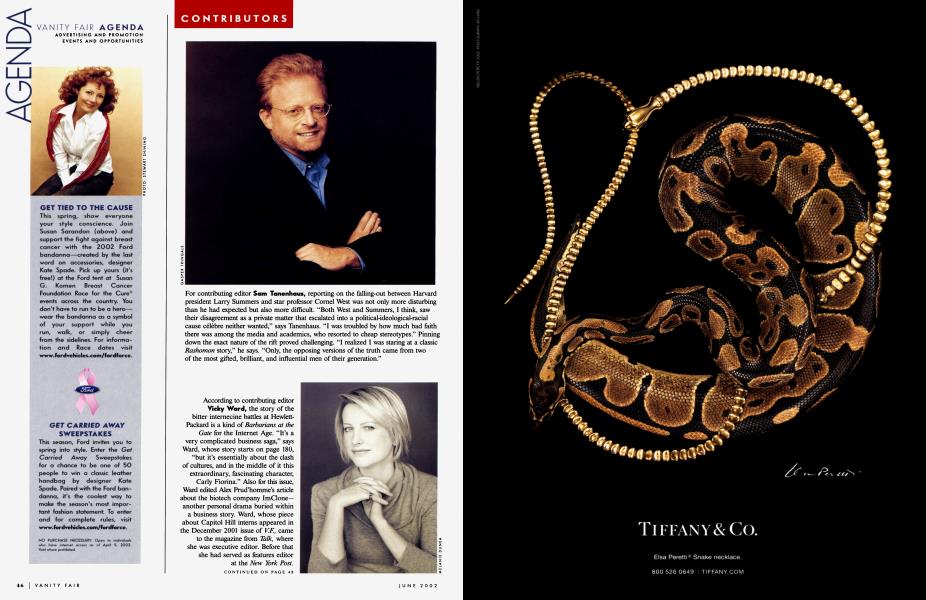
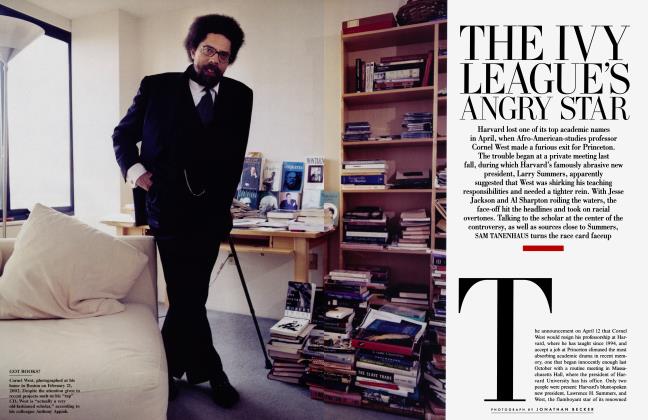
For contributing editor Sam Tanenhaus, reporting on the falling-out between Harvard president Larry Summers and star professor Cornel West was not only more disturbing than he had expected but also more difficult. "Both West and Summers, I think, saw their disagreement as a private matter that escalated into a political-ideological-racial cause celebre neither wanted," says Tanenhaus. "I was troubled by how much bad faith there was among the media and academics, who resorted to cheap stereotypes." Pinning down the exact nature of the rift proved challenging. "I realized I was staring at a classic Rashomon story," he says. "Only, the opposing versions of the truth came from two of the most gifted, brilliant, and influential men of their generation."
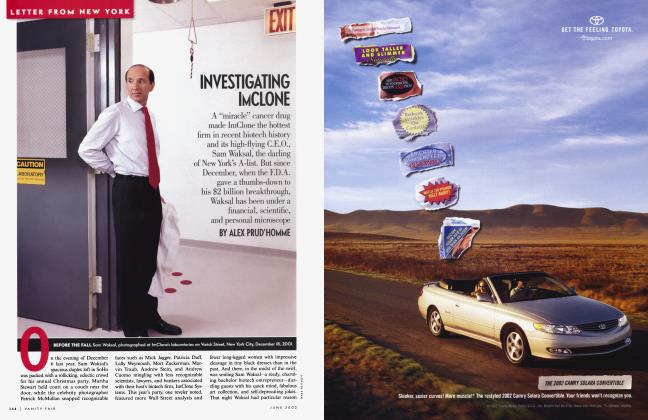
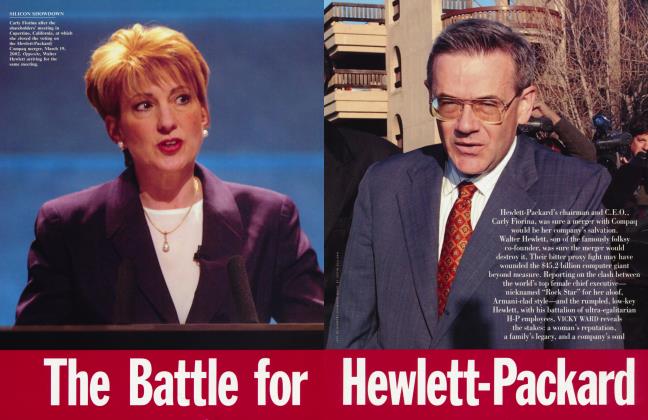
According to contributing editor Vicky Ward, the story of the bitter internecine battles at HewlettPackard is a kind of Barbarians at the Gate for the Internet Age. "It's a very complicated business saga," says Ward, whose story starts on page 180, "but it's essentially about the clash of cultures, and in the middle of it this extraordinary, fascinating character, Carly Fiorina." Also for this issue, Ward edited Alex Prud'homme's article about the biotech company ImClone— another personal drama buried within a business story. Ward, whose piece about Capitol Hill interns appeared in the December 2001 issue of V.F., came to the magazine from Talk, where she was executive editor. Before that she had served as features editor at the New York Post.
CONTINUED ON PAGE 48
CONTINUED FROM PAGE 46
For her story on page 113 about former Harvard Business Review editor Suzy Wetlaufer's fall from grace (with a little help from G.E.'s former C.E.O. Jack Welch), contributing editor Susanna Andrews found herself in uncharted waters. "Most of the stories I've done have been about men behaving badly," says Andrews. "You almost never see prominent women behaving as recklessly as Suzy Wetlaufer— they've worked too hard to get where they are." Ultimately, Andrews had mixed feelings about her subject. "I was riveted by Wetlaufer's confidence and sheer chutzpah, but I was also pained by the desperation that underlies this story— basically the tale of a woman who had achieved so much but couldn't control her inner Monica Lewinsky."
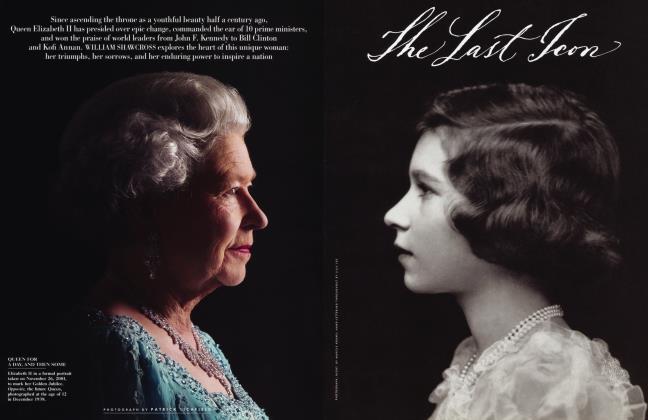
William Shawcross, whose piece on Queen Elizabeth's 50th jubilee begins on page 204, observed the monarch at length while serving as presenter and associate producer of Queen and Country, a four-part BBC documentary. "In public, it's not often evident that she can be quite funny," he says. "In private, she laughs a lot." Shawcross believes the monarchy has come through the turbulence of Princess Diana's divorce and death. "The public's underlying affection was clear in the massive crowds that turned out when the Queen Mother died a few weeks ago." Shawcross wrote an accompanying volume for Queen and Country (Simon & Schuster). A previous book, Deliver Us from Evil, focused on U.N. peacekeeping.
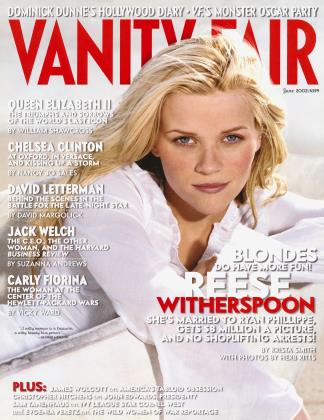
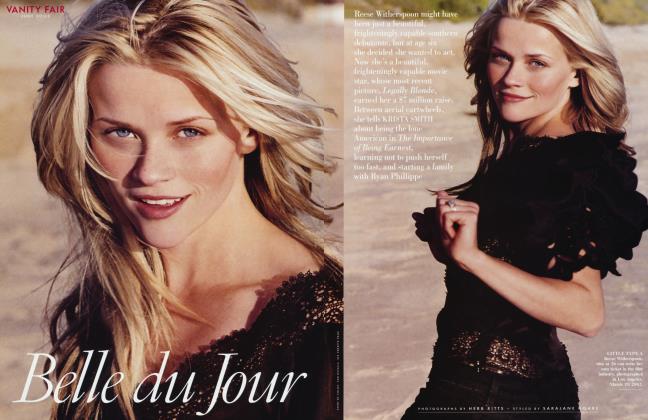
West Coast editor Krista Smith has written countless celebrity spotlights and has been instrumental in putting together the past eight Hollywood issues, but this month she writes her first cover story, on rising star Reese Witherspoon. "Reese is a hybrid of Jodie Foster and Holly Hunter," says Smith. "She is a quirky southern girl with fierce talent." Like Witherspoon, who achieved true leading-lady status with last year's Legally Blonde, Smith has taken to the upgrade with ease. "Because this was my freshman run as a writer and her first solo Vanity Fair cover, Reese and I both realized that we were in this together, and I couldn't have imagined a more terrific start."
CONTINUED ON PAGE 50
CONTINUED FROM PAGE 48
"My work this month reminded me why I so love contributing to Vanity Fair," says photographer Jonathan Becker, whose pictures in this issue range from the forefront of academia to the glamour of Hollywood. First, Becker traveled to Boston, where he photographed Harvard University professor Cornel West, one of America's most important African-American scholars. Then it was on to Hollywood, where Becker (here with Wendy Stark and Anjelica Huston) captured the stars at V.F's Oscar party. Meanwhile, this spring brings the publication of his books Studios by the Sea (a collaboration with special correspondent Bob Colacello about Hamptons artists, which began as a V.F article) and Bright Young Things: London, with Brooke de Ocampo.
Despite many years spent covering the music scene, contributing editor Lisa Robinson still has plenty of enthusiasm for the music. Robinson, who considers over 250 CDs (and listens to about 100) before reporting on noteworthy new albums in her Hot Tracks column, says, "Even though it was an ungodly hour of the morning, when I heard music from Eminem's new record I was so excited that for days afterwards I was practically stopping strangers in the street to tell them about it." Contrary to those who feel that there is no good music anymore, Robinson, who is instrumental in putting together V.F. 's music-issue cover and portfolio, says, "There's a lot of great new music out there—as long as you don't listen to it with old ears."
Herb Ritts's career has spanned two decades and has extended into music videos and commercials, but it's always a pleasure returning to his First love—celebrity portraiture— especially with someone as carefree as Reese Witherspoon. "She made it all worthwhile," says Ritts, who'd wanted to shoot her since witnessing her charms at this year's Golden Globes. "As an actress, she's only scratched the surface of her talent, and I like being able to work with someone at that beginning." It reminded him of his experience with another rising star whom he photographed near the start of his own career, in the early 80s. "Madonna didn't even know what was happening to her, but she walked into the shoot with a confidence and style all her own, much like Reese did."
CONTINUED ON PAGE 52
CONTINUED FROM PAGE 50
Assistant art director Lisa Kennedy, a Washington, D.C., native and a graduate of the Art Institute of Chicago, has been on the V.F. staff for almost five years. Responsible for designing Fanfair, the arts-and-culture section of the magazine, Kennedy comes from a long line of designand publishing-oriented people. Her great-grandfather was the publisher of the Medford Mail Tribune (an Oregon newspaper for which he won a Pulitzer Prize). Her grandmother was on staff at Life magazine for its first years. Her grandfather was an architect, and her uncle works in advertising. "Altogether, design has certainly been strongly encouraged in my family," says Kennedy.
Notables as varied as Eartha Kitt, Robert Evans, Ben Stiller, Kathleen Turner, Philip Johnson, and the Rock have gone mano a mano with contributing editor George Wayne and have lived to tell the tale. "The best interviews are when the subjects are game for the outrageous badinage, those adept at the art of parry and the no-holds-barred give-and-take," says the Jamaican-born Wayne. "And the inimitable T.C. [that's Tony Curtis, this month's Q&A subject] was one such class act. It's one reason why he's truly a legend of Hollywood." Wayne's reputation for leaving no question unasked is what has made him a V.F. contributor for almost 10 years. "I hope to serve for 20 more," he says.
Contributing editors Richard Rushfield (left) and Adam Leff return to the Hamptons with this month's Intelligence Report, on page 168. The Los Angeles-based duo keep on top of East Coast developments through their "constant tracking of the 174 identified National Trends," which allows them to "assess these things without ever leaving the Coffee Bean." Their trend consultancy, Monkey Zero L.L.C., was relaunched in March despite the work of their enemies, who include, they report, "the staff of the Cultured Class frozen-yogurt house, the maitre d' at Le Dome, and the diabolical Christina Ricci."
FOR DETAILS, SEE CREDITS PAGE
Subscribers have complete access to the archive.
Sign In Not a Subscriber?Join Now


