Sign In to Your Account
Subscribers have complete access to the archive.
Sign In Not a Subscriber?Join NowPhotographs by Annie Leibovitz, with Jonas Karlsson, Helmut Newton, Mark Seliger, and Art Streiber
Photographs by Annie Leibovitz, with Jonas Karlsson, Helmut Newton, Mark Seliger, and Art Streiber
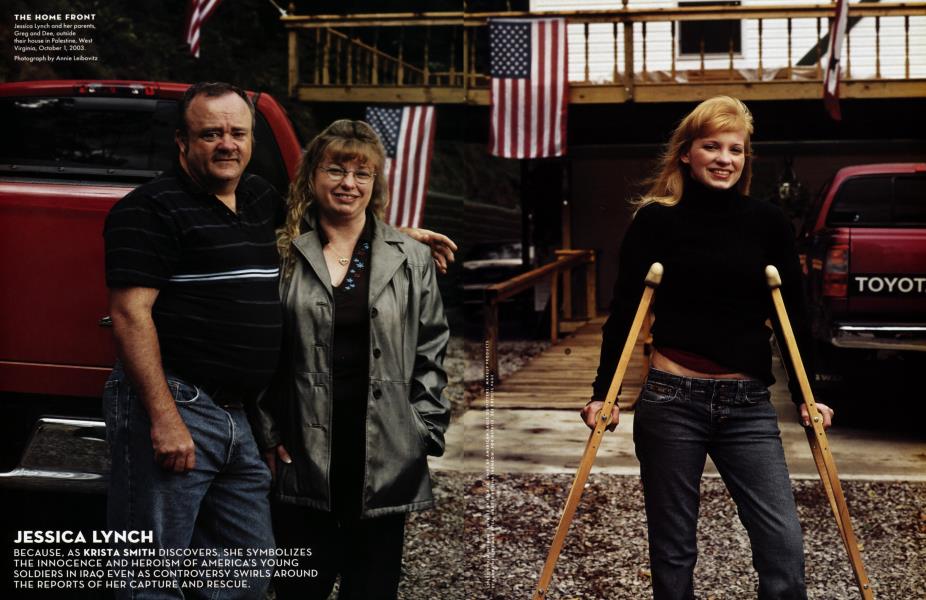 THE HOME FRONT Jessica Lynch and her parents, Greg and Dee, outside their house in Palestine, West Virginia, October 1, 2003.
Poster Girl For The 200,000 American Soldiers Who Served In Iraq This Year, Private Jessica Lynch Leads The Lineup, While Her Former Boss, General Tommy Franks, Remains The Model Of A Cigar-chomping Warrior, And Simon Wiesenthal, At 94, Hunted Some Of History's Worst Villains. The Triumphantly Conservative Fox News Team Shared The Airwaves With A Battalion Of Gays; Pixar And Sofia Coppola Stormed The Big Screen; Roger Clemens, Like Andy Roddick, Turned Balls Into Guided Missiles. From American Idol's A-team To The Designers Of Seventh Avenue, Peace Be With Them All.
For a few tense weeks last spring, Jessica Lynch was the war in Iraq's most famous soldier. Captured near Nasiriyah on March 23, she spent 10 days behind enemy lines before being rescued by a team of army rangers, navy SEALS, and Marines. While initial accounts of her ordeal emphasized her battlefield valor and the bravery of her rescuers, subsequent reports were more skeptical. Whatever the truth, Private Jessica Lynch, the Pentagon's poster girl for the Iraq war, is now retired at age 20 and living with her parents, Greg and Dee, and her sister, Brandi, in the Palestine, West Virginia, home where she grew up.
Your first impulse upon seeing Jessica Lynch is to take her in your arms and protect her, but you quickly realize that she can handle herself just fine. Dressed in jeans and a T-shirt, she's a cute blonde with a big smile, but she's also frail. At five feet two, Wirt County's 2000 Miss Congeniality weighs only 99 pounds, a significant improvement over the 70 she weighed at the time of her rescue but still shy of her goal. Her physical therapist playfully calls Brandi, Jessica's healthy 18-year-old sister, J.Lo and tiny Jessica J.Non-Lo.
Jessica takes 18 pills a day: 10 in the morning, 2 in the afternoon, and 6 at night. She undergoes physical therapy for two hours daily, five days a week, and she has trouble sleeping at night, when the pain is at its worst. She has no feeling in her left foot and wears K-Swiss tennis shoes that have been specially made to accommodate the brace on her left leg. Her body is a landscape of healed wounds. One scar zigzags across her scalp, and another, much deeper scar, on her upper right forearm, marks the spot where she may have been shot.
Jessica is determined to walk again without her crutches, and so far she has managed more than 30 steps. Watching her navigate the Lynches' living room, you can see her steely resolve. Each step is a challenge, but she never complains, and no one makes a fuss. She's a country girl, after all, and a soldier.
On March 23, 2003, at the height of the Iraqi conflict, the U.S. Army's 507th Maintenance Company, a noncombat support unit, ran into an ambush just outside Nasiriyah. Shortly after, 18 members of the unit were listed as missing in action, among them 19-year-old Jessica Lynch. Two days later, residents of Elizabeth, West Virginia, held a candlelight vigil for Jessica, which was shown on national television. On April 1 the U.S. military mounted a rescue operation. Trailed by a CentCom film crew, Special Operations forces descended upon Saddam Hussein Hospital near Nasiriyah and spirited Private Lynch away. Within hours, footage of the heroic breakout was running on CNN. It was front-page news across the country.
Eventually, 11 of Lynch's comrades were reclassified from missing in action to killed in combat. One of them was Private Lori Piestewa, a 23-year-old single mother of two from Arizona, the first Native American female ever to die in combat while serving in the U.S. armed forces. She was Jessica's best friend.
On April 2, Jessica was flown eight hours to Landstuhl Regional Medical Center, in Germany. The press by now was in a frenzy. The Washington Post reported that she had fought to the finish, firing at the enemy until she ran out of ammunition. There were reports that her wounds were the result of extensive torture. Three days later, her parents, together with Brandi and her brother, Greg junior, traveled to Germany to be at her side. Newsweek put Jessica on the cover of its April 14 issue, and People followed a week later. On April 18 the military announced that Jessica Lynch could not recall the events surrounding her capture.
But on May 18 the BBC questioned whether the Pentagon had hyped the heroic rescue. The left-leaning British newspaper The Guardian went further, calling the episode "one of the most stunning pieces of news management yet conceived." Critics accused the U.S. of deliberately focusing on a minor human-interest story in an effort to avoid difficult questions about what exactly was going on in Iraq.
There are two versions of the rescue story. The first begins when an Iraqi lawyer named Mohammed Odeh al-Rehaief visits his wife, a nurse, at Saddam Hussein Hospital. Surprised at the number of military personnel there, he learns that an American female is being held captive. He sneaks past a sleeping guard and into the cardiac unit where he sees a Fedayeen-militia member slap Jessica twice. Appalled, he treks six miles to the nearest American camp, reports what he has seen, and agrees to return in order to draw maps and gather more details.
In the second story, a young Iraqi doctor who had cared for Jessica since her arrival at the hospital arranges to transfer her to the Americans in an ambulance, only to see the ambulance come under American fire and have to return to the hospital. According to this version, the Fedayeen militia had pulled out days earlier, making the cinematic rescue unnecessary.
On July 22, Jessica Lynch returned home and was awarded the Purple Heart, the Bronze Star, and the Prisoner of War Medal. Exactly one month later she was given a temporary medical retirement, which provides her with a monthly stipend and continued access to military medical facilities.
The state of West Virginia held a welcome-home parade in her honor, and L.E.I., a brand of jeans sold at J.C. Penney, sent dozens of pairs to Jessica when the company found out that it was her favorite brand. She has received thousands of cards and gifts from well-wishers, but couldn't accept some of them at first because military regulations prohibit service members from taking gifts worth more than $250. To this day, there's a jail cell in Elizabeth overflowing with an estimated 30,000 packages from strangers.
This fall, a representative of Governor Bob Wise's office went to the Lynch house to present Jessica with several options for a personalized license plate. The governor also offered to fly her to Walter Reed Army Medical Center in Washington, D.C., for a checkup, but Jessica prefers to make the six-hour drive with her family in a rented van so that they can also use it to get around and maybe visit a nearby mall.
Greg Lynch Sr., 43, and Dee Lynch, 41, have been married for more than 20 years and look as if they are still very much in love. The screen saver on their home computer shows the two of them hugging and smiling. Greg and Dee met in high school, and the property where they live has been in his family for years. He's a self-employed truckdriver, and his rig, with a giant yellow ribbon affixed to its grill, is parked in front of the house. He intended to join the army after high school but got married instead.
Their children viewed the military as a way to pay for college and see the world. Greg junior, 21, is a specialist in the army stationed in Kentucky. Before her capture, Jessica—who played softball and basketball in high school, belonged to Future Farmers of America, and wanted to be a kindergarten teacher—had re-enlisted; she was supposed to be serving in Hawaii at this time. Brandi was planning to enter the army this August, but Jessica wouldn't hear of it, and Brandi is going to a local college in January.
As soon as her retirement became official, the networks began aggressively pursuing the Jessica Lynch story, going to great lengths to secure an exclusive interview. Viacom's CBS offered her a TV movie, a book deal, and an MTV-sponsored concert in her hometown. NBC's Katie Couric reportedly sent her patriotic books, and ABC's Diane Sawyer presented her with a locket. Jessica refused interview after interview, and so far the public has heard her speak only once, at her homecoming.
Eventually, ABC scored the exclusive. Diane Sawyer will air a prime-time interview with Jessica on Veterans Day, November 11. Jessica will appear the following morning on the Today show with Katie Couric, and on the 14th she will pay David Letterman a visit. NBC has already produced a movie of the week. The network couldn't get the rights to Jessica's story, so it instead bought story rights from Mohammed Odeh al-Rehaief. (Al-Rehaief was flown to the U.S. with his wife and daughter on April 10, was granted asylum on the 28th, and signed a book deal with HarperCollins for a reported $500,000.)
Instead of letting television take liberties with her story in exchange for big cash, Jessica opted to cooperate on a biography written by Rick Bragg, the Pulitzer Prize-winning reporter who resigned from The New York Times this summer amid controversy over his use of uncredited stringers. Alfred A. Knopf is said to have paid an advance of about a million dollars, which Lynch and Bragg will split evenly, with Lynch retaining all the royalties. The book, titled / Am a Soldier, Too, will have a first run of 500,000 and will be sold in truck stops and grocery stores as well as traditional outlets. According to Knopf spokesman Paul Bogaards, "Her memory is intact and her recall of events during the ambush and after informs the narrative. This is a book that will finally give us a first-person account of what happened."
West Virginia has a population of a little under two million people. Seventy-five percent of state residents graduate from high school, but only 15 percent go on to earn bachelor's degrees. Dotted with small towns, it's a land of 4-H and pie-baking contests, and as you enter Lynch territory, flags, ribbons, and homemade signs of support surround you. Nestled between two hills, Jessica's childhood home offers breathtaking views in front and back.
An enormous yellow bow made from sheet metal adorns the huge tree at the edge of the Lynches' property and has become a tourist stop for those curious enough to brave the rural one-lane road. Their dog, Cody, a "Heinz 57" mutt, lounges on the porch or under one of the two pickup trucks in the gravel driveway. Out front, an American flag, a state flag, and a PO.W. flag fly from a pole.
The interior of the house, thanks to more than $50,000 in donations from friends and family, has been remodeled and is now wheelchair-accessible. The rooms are full of angel figurines, seasonal decorations, and family photos. One wall is lined with the three Lynch children's high-school-graduation portraits.
The walls of Jessica's bedroom are hung with pictures and souvenirs from her time in the military. There's a special photograph and prayer commemorating her fallen comrade Lori Piestewa. On her bedpost sit her Special Ops Barbie and Ken dolls. The color scheme of her room matches a beautiful maroon blanket that Jessica received from the actress Jennifer Love Hewitt, who visited her twice at the hospital in Washington, D.C.
Having been through war, captivity, and a media maelstrom, Jessica Lynch is trying to figure out who she is and what she wants out of life, not unlike most other 20-yearolds in America. She's warm and friendly and, together with her family, has handled the attention and controversy she has attracted with dignity and grace. Though she's still grieving the loss of her comrades, it's clear that she is focused on the future. She has a long life ahead of her.
On Jessica's bedside table, there's a photo of her fiance, army sergeant Ruben Contreras Jr., who was also part of Jessica's battalion during the war and who is currently stationed at Fort Bliss, in Texas. Contreras's term expires in August 2004, and he and Jessica are planning to get married shortly thereafter in his hometown of Colorado Springs, Colorado. If there's one thing Jessica's sure of, it's this: she will walk down that aisle.
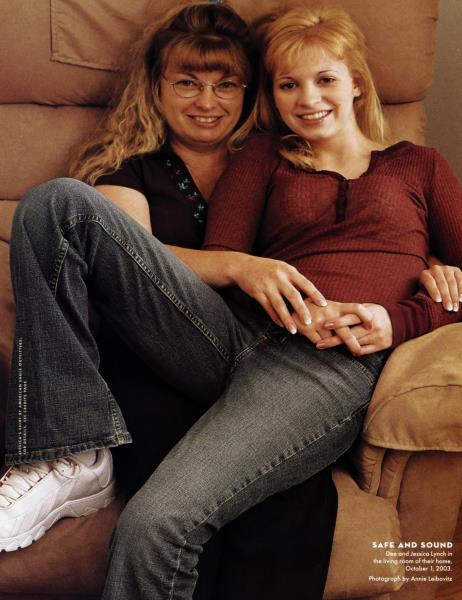 SAFE AND SOUND Dee and Jessica Lynch in the living room of their home, October 1, 2003.
Because, as Krista Smith discovers. She symbolizes the innocence and heroism of America's young soldiers in Iraq even as controversy swirls around the reports of her capture and rescue.
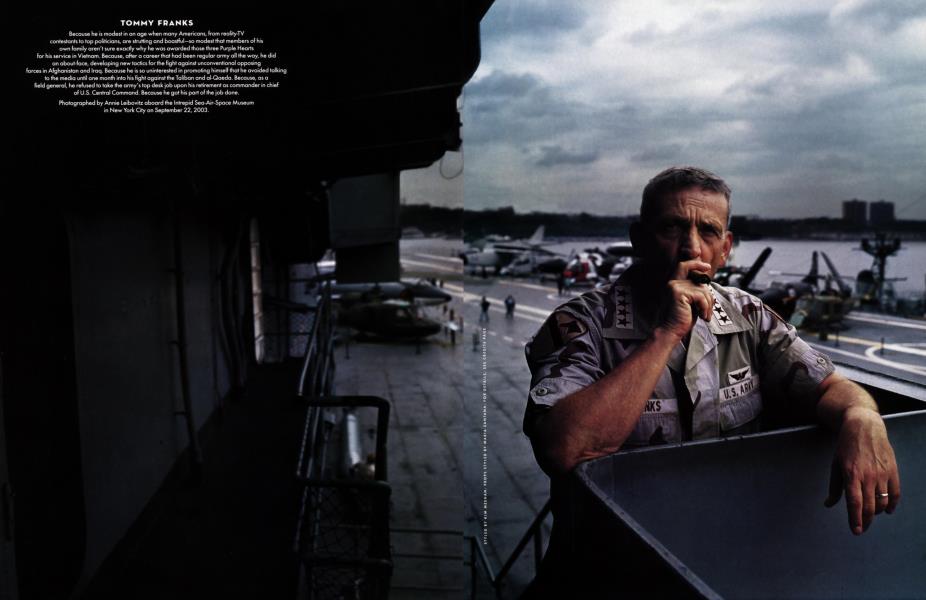
Because he is modest in an age when many Americans, from reality-TV contestants to top politicians, are strutting and boastful—so modest that members of his own family aren't sure exactly why he was awarded those three Purple Hearts for his service in Vietnam. Because, after a career that had been regular army all the way, he did an about-face, developing new tactics for the fight against unconventional opposing forces in Afghanistan and Iraq. Because he is so uninterested in promoting himself that he avoided talking to the media until one month into his fight against the Taliban and al-Qaeda. Because, as a field general, he refused to take the army's top desk job upon his retirement as commander in chief of U.S. Central Command. Because he got his part of the job done.
Photographed by Annie Leibovitz aboard the Intrepid Sea-Air-Space Museum in New York City on September 22, 2003.
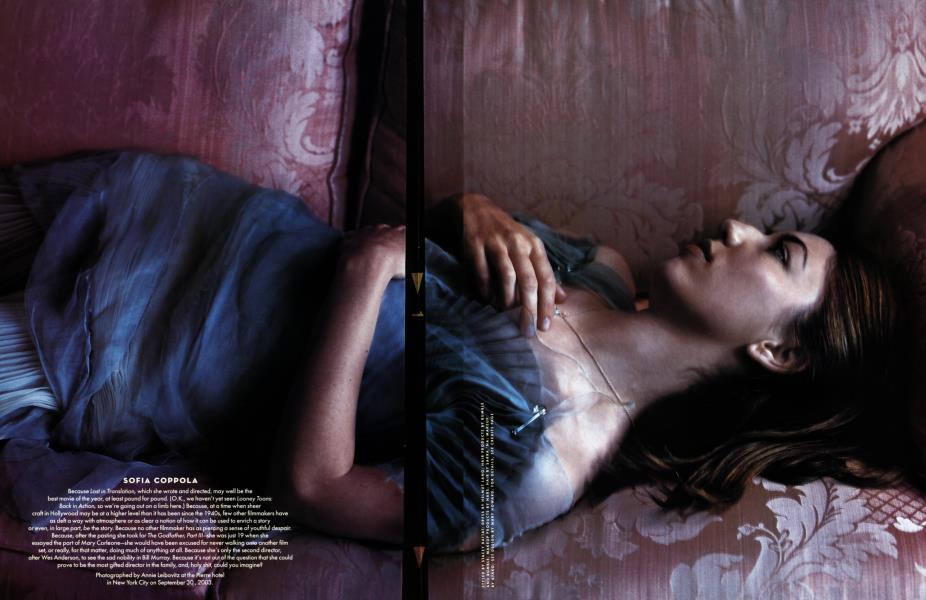
Because Lost in Translation, which she wrote and directed, may well be the best movie of the year, at least pound for pound. (O.K., we haven't yet seen Looney Toons: Back in Action, so we're going out on a limb here.) Because, at a time when sheer craft in Hollywood may be at a higher level than it has been since the 1940s, few other filmmakers have as deft a way with atmosphere or as clear a notion of how it can be used to enrich a story or even, in large part, be the story. Because no other filmmaker has as piercing a sense of youthful despair. Because, after the pasting she took for The Godfather, Part III—she was just 19 when she essayed the part of Mary Corleone—she would have been excused for never walking onto another film set, or really, for that matter, doing much of anything at all. Because she's only the second director, after Wes Anderson, to see the sad nobility in Bill Murray. Because it's not out of the question that she could prove to be the most gifted director in the family, and, holy shit, could you imagine?
Photographed by Annie Leibovitz at the Pierre hotel in New York City on September 30,2003.
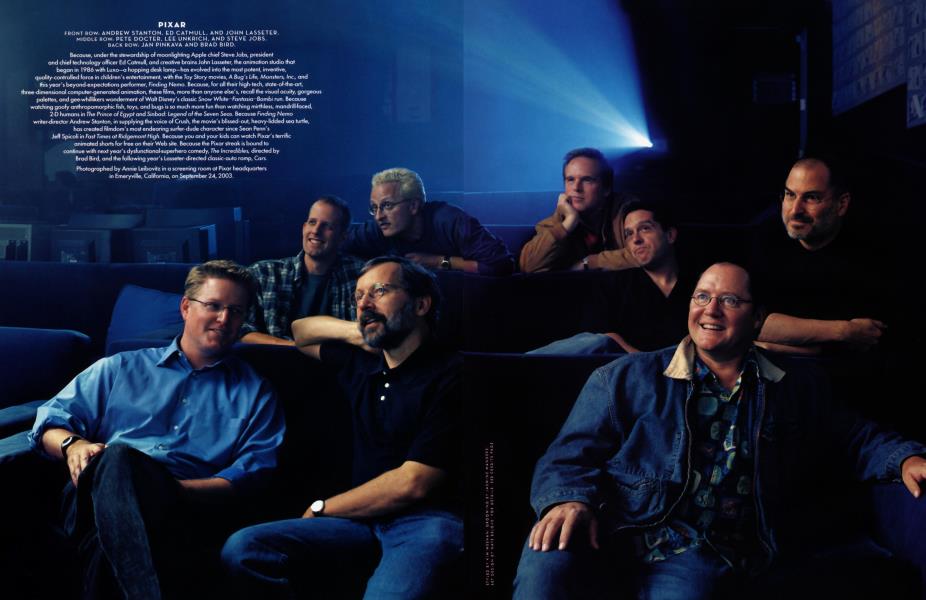
FRONT ROW: ANDREW STANTON. ED CATMULL. AND JOHN LASSETER. MIDDLE ROW: PETE DOCTER. LEE UNKRICH. AND STEVE JOBS. BACK ROW: JAN PINKAVA AND BRAD BIRD.
Because, under the stewardship of moonlighting Apple chief Steve Jobs, president and chief technology officer Ed Catmull, and creative brains John Lasseter, the animation studio that began in 1986 with Luxo—a hopping desk lamp—has evolved into the most potent, inventive, quality-controlled force in children's entertainment, with the Toy Story movies, A Bug's Life, Monsters, Inc., and this year's beyond-expectations performer, Finding Nemo. Because, for all their high-tech, state-of-the-art, three-dimensional computer-generated animation, these films, more than anyone else's, recall the visual acuity, gorgeous palettes, and gee-whillikers wonderment of Walt Disney's classic Snow White-Fantasia-Bambi run. Because watching goofy anthropomorphic fish, toys, and bugs is so much more fun than watching mirthless, mandrill-faced, 2-D humans in The Prince of Egypt and Sinbad: Legend of the Seven Seas. Because Finding Nemo writer-director Andrew Stanton, in supplying the voice of Crush, the movie's blissed-out, heavy-lidded sea turtle, has created filmdom's most endearing surfer-dude character since Sean Penn's Jeff Spicoli in Fast Times at Ridgemont High. Because you and your kids can watch Pixar's terrific animated shorts for free on their Web site. Because the Pixar streak is bound to continue with next year's dysfunctional-superhero comedy, The Incredibles, directed by Brad Bird, and the following year's Lasseter-directed classic-auto romp, Cars.
Photographed by Annie Leibovitz in a screening room at Pixar headquarters in Emeryville, California, on September 24, 2003.
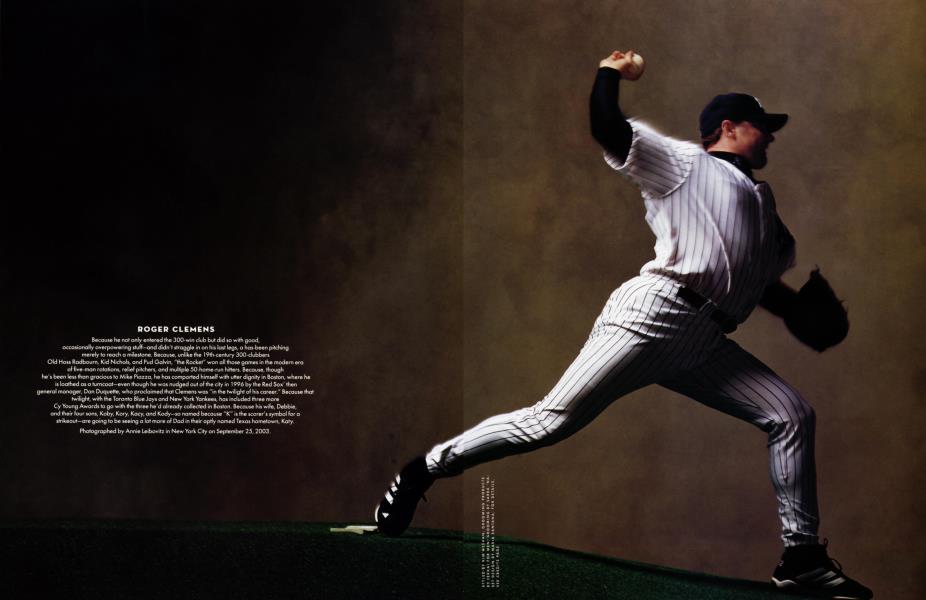
Because he not only entered the 300-win club but did so with good, occasionally overpowering stuff—and didn't straggle in on his last legs, a has-been pitching merely to reach a milestone. Because, unlike the 19th-century 300-clubbers Old Hoss Radbourn, Kid Nichols, and Pud Galvin, "the Rocket" won all those games in the modem era of five-man rotations, relief pitchers, and multiple 50-home-run hitters. Because, though he's been less than gracious to Mike Piazza, he has comported himself with utter dignity in Boston, where he is loathed as a turncoat—even though he was nudged out of the city in 1996 by the Red Sox' then general manager, Dan Duquette, who proclaimed that Clemens was "in the twilight of his career." Because that twilight, with the Toronto Blue Jays and New York Yankees, has included three more Cy Young Awards to go with the three he'd already collected in Boston. Because his wife, Debbie, and their four sons, Koby, Kory, Kacy, and Kody—so named because "K" is the scorer's symbol for a strikeout—are going to be seeing a lot more of Dad in their aptly named Texas hometown, Katy.
Photographed by Annie Leibovitz in New York City on September 25, 2003.
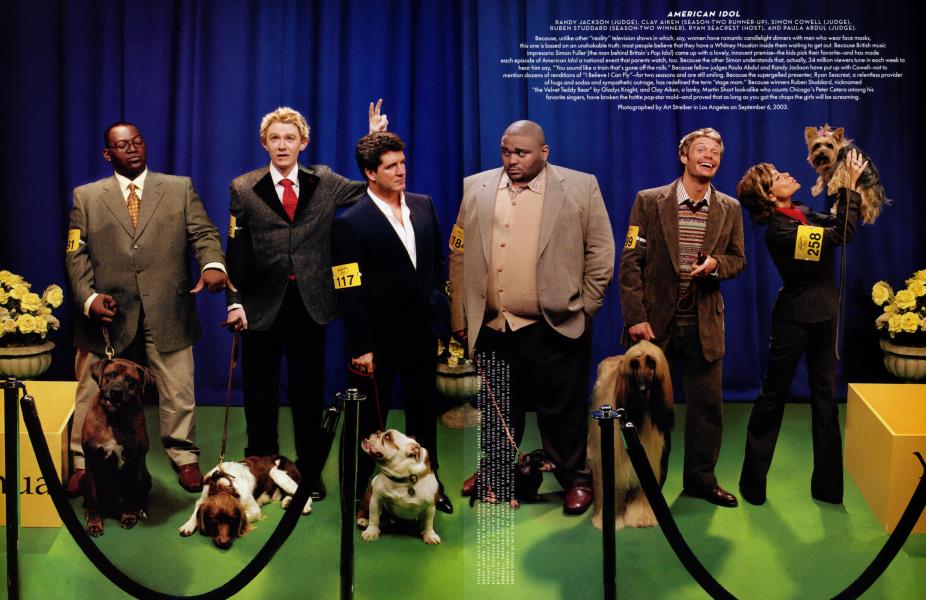
RANDY JACKSON (JUDGE). CLAY AIKEN (SEASON-TWO RUNNER-UP). SIMON COWELL (JUDGE). RUBEN STUDDARD (SEASON-TWO WINNER). RYAN SEACREST (MOST). AND PAULA ABDUL (JUDGE).
Because, unlike other "reality" television shows in which, say, women have romantic candlelight dinners with men who wear face masks, this one is based on an unshakable truth: most people believe that they have a Whitney Houston inside them waiting to get out. Because British music impresario Simon Fuller (the man behind Britain's Pop Idol) came up with a lovely, innocent premise—the kids pick their favorite—and has made each episode of American Idol a national event that parents watch, too. Because the other Simon understands that, actually, 34 million viewers tune in each week to hear him say, "You sound like a train that's gone off the rails." Because fellow judges Paula Abdul and Randy Jackson have put up with Cowell—not to mention dozens of renditions of "I Believe I Can Fly"—for two seasons and are still smiling. Because the supergelled presenter, Ryan Seacrest, a relentless provider of hugs and sodas and sympathetic outrage, has redefined the term "stage mom." Because winners Ruben Studdard, nicknamed "the Velvet Teddy Bear" by Gladys Knight, and Clay Aiken, a lanky, Martin Short look-alike who counts Chicago's Peter Cetera among his favorite singers, have broken the hottie pop-star mold—and proved that as long as you got the chops the girls will be screaming.
Photographed by Art Streiber in Los Angeles on September 6, 2003.
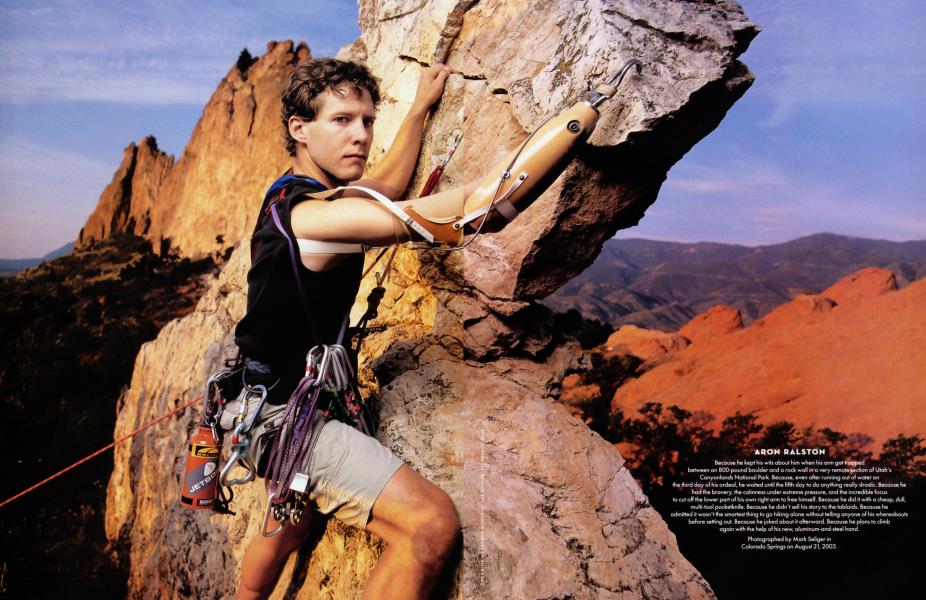
Because he kept his wits about him when his arm got trapped between an 800-pound boulder and a rock wall in a very remote section of Utah's Canyonlands National Park. Because, even after running out of water on the third day of his ordeal, he waited until the fifth day to do anything really drastic. Because he had the bravery, the calmness under extreme pressure, and the incredible focus to cut off the lower part of his own right arm to free himself. Because he did it with a cheap, dull, multi-tool pocketknife. Because he didn't sell his story to the tabloids. Because he admitted it wasn't the smartest thing to go hiking alone without telling anyone of his whereabouts before setting out. Because he joked about it afterward. Because he plans to climb again with the help of his new, aluminum-and-steel hand.
Photographed by Mark Seliger in Colorado Springs on August 21, 2003.
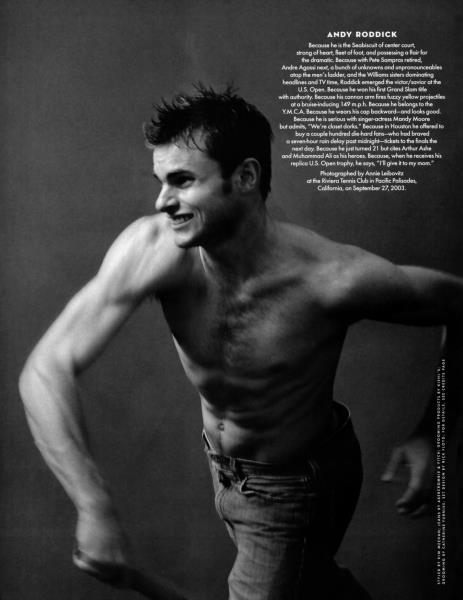
Because he is the Seabiscuit of center court, strong of heart, fleet of foot, and possessing a flair for the dramatic. Because with Pete Sampras retired,
Andre Agassi next, a bunch of unknowns and unpronounceables atop the men's ladder, and the Williams sisters dominating headlines and TV time, Roddick emerged the victor/savior at the U.S. Open. Because he won his first Grand Slam title with authority. Because his cannon arm fires fuzzy yellow projectiles at a bruise-inducing 149 m.p.h. Because he belongs to the Y.M.C.A. Because he wears his cap backward—and looks good.
Because he is serious with singer-actress Mandy Moore but admits, "We're closet dorks." Because in Houston he offered to buy a couple hundred die-hard fans—who had braved a seven-hour rain delay past midnight—tickets to the finals the next day. Because he just turned 21 but cites Arthur Ashe and Muhammad Ali as his heroes. Because, when he receives his replica U.S. Open trophy, he says, "I'll give it to my mom."
Photographed by Annie Leibovitz at the Riviera Tennis Club in Pacific Palisades, California, on September 27, 2003.
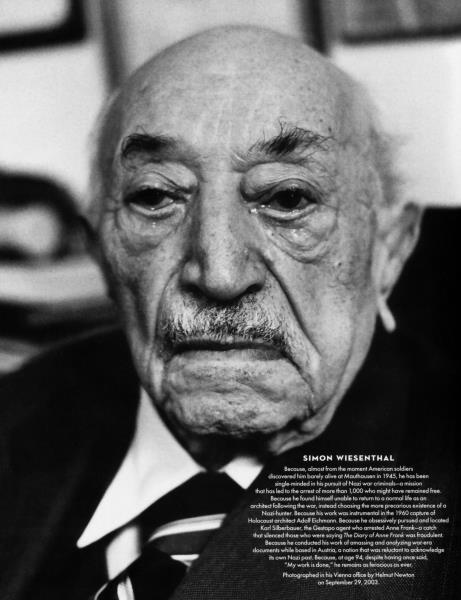
Because, almost from the moment American soldiers discovered him barely alive at Mauthausen in 1945, he has been single-minded in his pursuit of Nazi war criminals—a mission that has led to the arrest of more than 1,000 who might have remained free. Because he found himself unable to return to a normal life as an architect following the war, instead choosing the more precarious existence of a Nazi-hunter. Because his work was instrumental in the 1960 capture of Holocaust architect Adolf Eichmann. Because he obsessively pursued and located Karl Silberbauer, the Gestapo agent who arrested Anne Frank—a catch that silenced those who were saying The Diary of Anne Frank was fraudulent. Because he conducted his work of amassing and analyzing war-era documents while based in Austria, a nation that was reluctant to acknowledge its own Nazi past. Because, at age 94, despite having once said, "My work is done," he remains as ferocious as ever.
Photographed in his Vienna office by Helmut Newton on September 29, 2003.
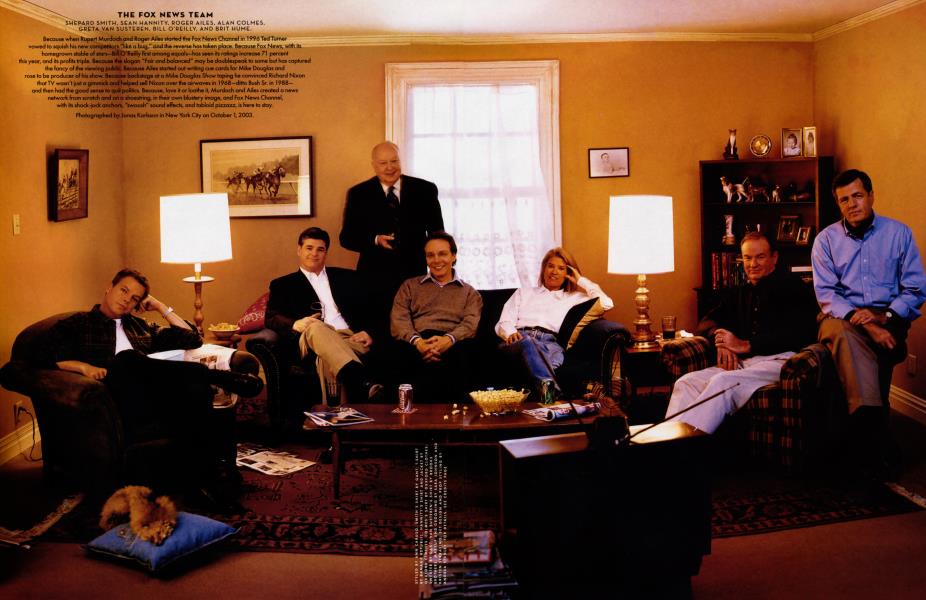
SHEPARD SMITH. SEAN HANNITY. ROGER AILES. ALAN COLMES, GRETA.VAN SUSTEREN. BILL O'REILLY. AND BRIT HUME.
Because when Rupert Murdoch and Roger Ailes started the Fox News Channel in 1996 Ted Turner vowed to squish his new competitors "like a bug," and the reverse has taken place. Because Fox News, with its homegrown stable of stars—Bill O'Reilly first among equals—has seen its ratings increase 71 percent this year, and its profits triple. Because the slogan "Fair and balanced" may be doublespeak to some but has captured the fancy of the viewing public. Because Ailes started out writing cue cards for Mike Douglas and rose to be producer of his show. Because backstage at a Mike Douglas Show taping he convinced Richard Nixon that TV wasn't just a gimmick and helped sell Nixon over the airwaves in 1968—ditto Bush Sr. in 1988— and then had the good sense to quit politics. Because, love it or loathe it, Murdoch and Ailes created a news network from scratch and on a shoestring, in their own blustery image, and Fox News Channel, with its shock-jock anchors, "swoosh" sound effects, and tabloid pizzazz, is here to stay.
Photographed by Jonas Karisson in New York City on October 1, 2003.
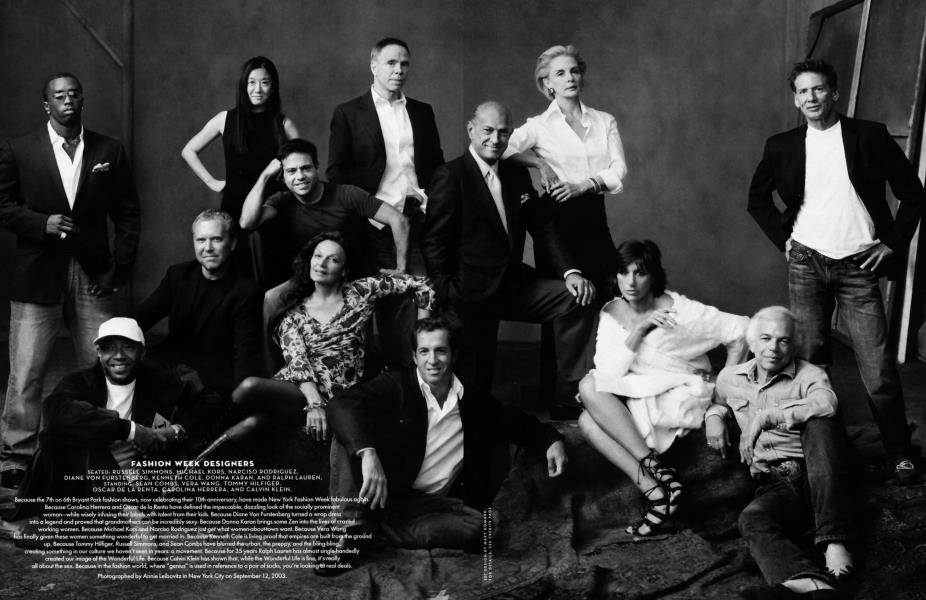
SEATED: RUSSELL SIMMONS. AEL KORS, NARCISO RODRIGUEZ. DIANE VON FURSTENBERG, KENNE/M COLE, DONNA KARAN. AND RALPH LAUREN. STANDING: SEAN COMBS, VERA WANG. TOMMY HILFIGER, OSCAR DE LA RENTA. CAROLINA HERRERA, AND CALVIN KLEIN.
Because the 7th on 6th Bryant Park fashion shows, now celebrating their 10th anniversary, have made New York Fashion Week fabulous again. Because Carolina Herrera and Oscar de la Renta have defined the impeccable, dazzling look of the socially prominent woman—while wisely infusing their labels with talent from their kids. Because Diane Von Furstenberg turned a wrap dress into a legend and proved that grandmothers can be incredibly sexy. Because Donna Karan brings some Zen into the lives of crazed working women. Because Michael Kors and Narciso Rodriguez just get what women-about-town want. Because Vera Wang has finally given these women something wonderful to get married in. Because Kenneth Cole is living proof that empires are built from the ground up. Because Tommy Hilfiger, Russell Simmons, and Sean Combs have blurred the urban, the preppy, and the bling-bling, creating something in our culture we haven't seen in years: a movement. Because for 35 years Ralph Lauren has almost single-handedly created our image of the Wonderful Life. Because Calvin Klein has shown that, while the Wonderful Life is fine, it's really all about the sex. Because in the fashion world, where "genius" is used in reference to a pair of socks, you're looking tit real deals.
Photographed by Annie Leibovitz in New York City on September 12, 2003.
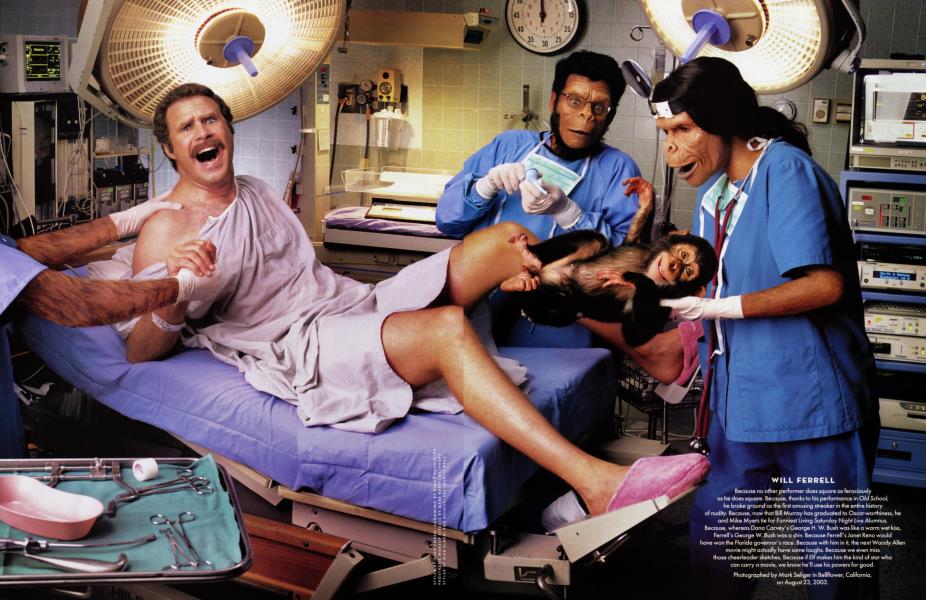
Because no other performer does square as ferociously as he does square. Because, thanks to his performance in Old School, he broke ground as the first amusing streaker in the entire history of nudity. Because, now that Bill Murray has graduated to Oscar-worthiness, he and Mike Myers tie for Funniest Living Saturday Night Live Alumnus. Because, whereas Dana Carvey's George H. W. Bush was like a warm wet kiss, Ferrell's George W. Bush was a shiv. Because Ferrell's Janet Reno would have won the Florida governor's race. Because with him in it, the next Woody Allen movie might actually have some laughs. Because we even miss those cheerleader sketches. Because if Elf makes him the kind of star who can carry a movie, we know he'll use his powers for good.
Photographed by Mark Seliger in Bellflower, California, on August 23, 2003.
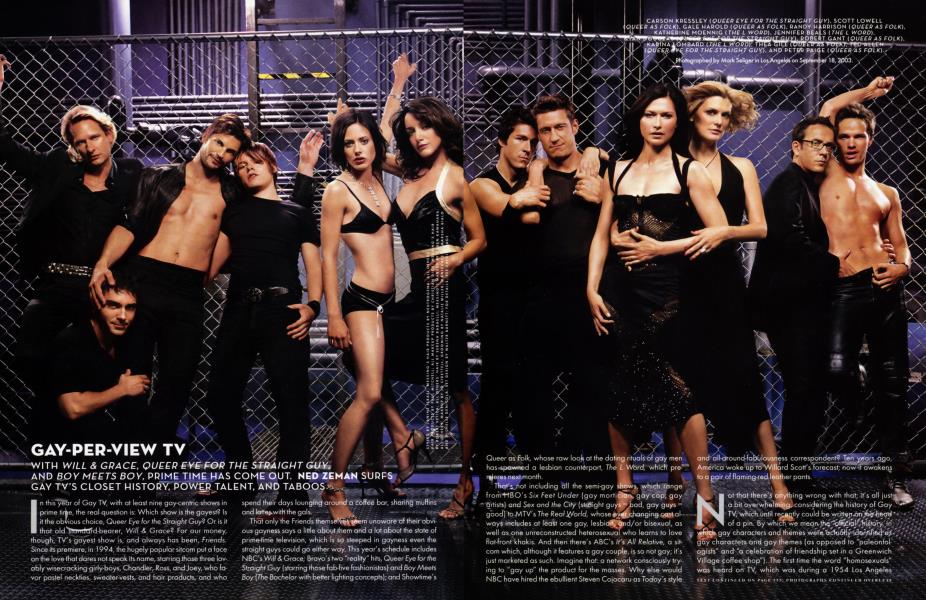
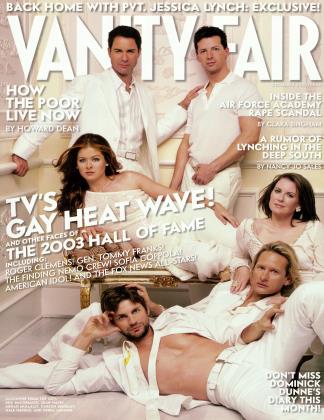
WITH WILL & GRACE, QUEER EYE FOR THE STRAIGHT GUY, AND BOY MEETS BOY, PRIME TIME HAS COME OUT. NED ZEMAN SURFS GAY TV'S CLOSET HISTORY. POWER TALENT, AND TABOOS
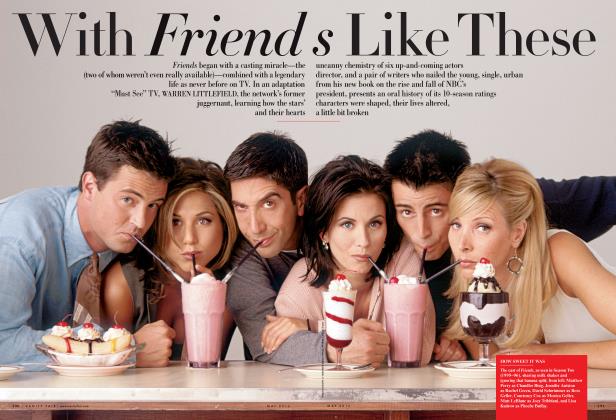
In this year of Gay TV, with at least nine gay-centric shows in prime time, the real question is: Which show is the gayest? Is it the obvious choice, Queer Eye for the Straight Guy? Or is it that old'STUmJaTd-bearer, Will & Grace? For our money, though, TV's gayest show is, and always has been, Friends. Since its premiere, in 1994, the hugely popular sitcom put a face on the love that dares not speak its name, starring those three lovably wisecracking girly-boys, Chandler, Ross, and Joey, who favor pastel neckties, sweater-vests, and hair products, and who spend their days lounging around a coffee bar, sharing muffins and lattes-with the gals.
That only the Friends themselves seem unaware of their obvious gayness says a little about them and a lot about the state of prime-time television, which is so steeped in gayness even the straight guys could go either way. This year's schedule includes NBC's Will & Grace, Bravo's two "reality" hits, Queer Eye for the Straight Guy (starring those fab-five fashionistas) and Boy Meets Boy (The Bachelor with better lighting concepts); and Showtime's Queer as folk, whose raw Iook at the dating rituals of gay men has spawned a lesbian counterpart, The L Word, which premieres next month.
That's not including all the semi-gay shows, which range from HBO's Six Feet Under (gay mortician, gay copy, gay artists) and Sex and the City (straight guys = bad, gay guys = good) to MTV's The Real World, whose every changing cast always includes at least one gay, lesbian, and/or bisexual, as well as one unreconstructed heterosexual who learns to love flat-front khakis. And then there's ABC's It's AIl Relative, a sit com which, although it features a gay couple, is so not gay; it's just marketed as such. Imagine that: a network consciously trying to "gay up" the product for the masses. Why else would NBC have hired the ebullient Steven Cojocaru as Today's style and aII-around-fabulousness correspondent? Ten years ago, America woke up Willard Scott's forecast; now it awakens too pair of flaming-red leather pants.
Not that there's anything wrong with that; it's all just a bit overwhelming, considering the history of Gay TV, which until rely could be written on the head of a pin. By which we mean the "official" history in which gay characters and themes were actually identified as gay characters and gay themes (as opposed to "paleontologists" and "a celebration of friendship set in a Greenwich Village coffee-shop"). The first time the word "homosexuals" was heard on TV, which was during a 1954 Los Angeles talk show, it was followed by the words "and the problems they present," according to The Prime-Time Closet, a 2002 book by TV historian Stephen Tropiano. The h-word resurfaced, in 1973, when Marcus Welby, M.D., treated a man with the "illness," and when retirement-home residents were butchered by bloodthirsty lesbians on Police Woman.
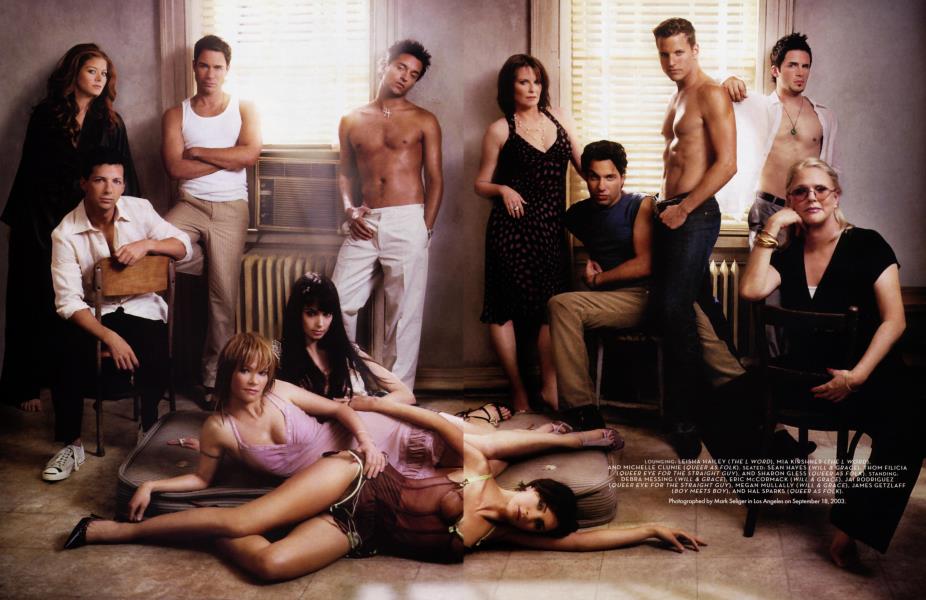
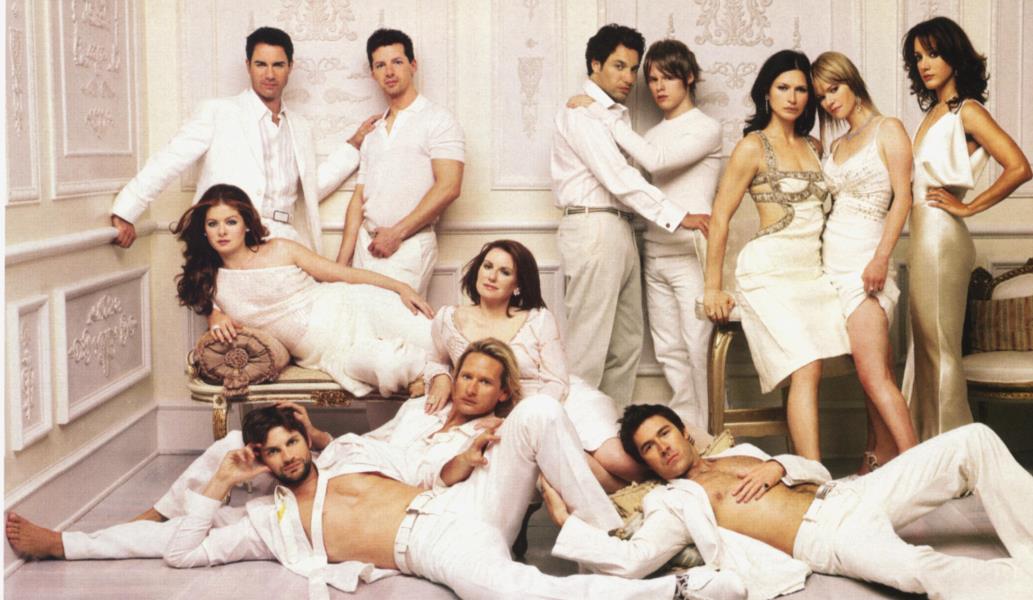 WILDE PARTY Lounging, left to right: Debra Messing, Gale Harold, Carson Kressley, Megan Mullally, Kyan Douglas. Standing, left to right: Eric McCormack, Sean Hayes, Thom Filicia, Randy Harrison, Karina Lombard, Leisha Hailey, Jennifer Beals. Photographed in Los Angeles by Mark Seliger on September 18, 2003.
But Gay TV's unofficial history—that's another story, one that pre-dates even The Andy Griffith Show, which gave us Don Knotts's fey Barney Fife and Jack Dodson's Howard Sprague, that lovable "confirmed bachelor." That epithet could also have been bestowed upon The Beverly Hillbillies' supercilious banker, Mr. Drysdale (not to mention his tightly wound, butch, suit-wearing assistant, Jane Hathaway, played by Nancy Kulp), and should have described every male castaway on Gilligan's Island: Gilligan (girly-boy, platonic adoration for actresses, musicals), the Skipper (a "bear," in current gay argot), the Professor (fastidious, indifferent to horny babes), and Thurston Howell III (ascots, swishing). During this era a real, live confirmed bachelor—Paul Lynde—was in plain, screaming sight as the center square of The Hollywood Squares.
See also: Felix Unger (The Odd Couple). See also: Jan Brady (The Brady Bunch). See also: Eddie Munster (The Munsters). Mostly, though, see Batman. Replete with cape, tights that showcased interesting bulges, and the Caped Crusader's doe-eyed little buddy, Robin, Batman was a festival of unconsummated man-love. Although willfully ironic, the show's homoeroticism grew so fraught, and the Dynamic Duo was spending so much time together in the Bat Cave, that the producers decided to send in a new character, Batgirl, who promptly became the loneliest woman in Gotham City.
Only in the late 70s did gay characters stop barking at fire hydrants and bludgeoning the elderly. Here we recall Archie Bunker's gay drinking buddy, Steve, and Billy Crystal's gay quarterback on Soap, albeit with mixed emotions. Jodie Dallas—the Billy Crystal character—spent most of his screen time dreaming and scheming about a sex-change operation. The 80s and early 90s brought little relief from stereotypes, but much hand-wringing from the family-values crowd, usually because of gay kisses—on Thirtysomething and Melrose Place—that ultimately never aired. Even after Ellen finally came out, in 1997, we never saw her actually being a lesbian, literally speaking.
Although Will & Grace certainly validated and commercialized gay chic, the legwork was done by the less risk-averse, cable networks— specifically HBO, MTV, and Showtime, which have routinely produced gay characters (Sex and the City's Active Stanford Blatch; The Real World's non-fictive Pedro Zamora and Danny Roberts, among others; many, many characters indulging in explicit gay canoodling on Undressed, all of which appealed to that most coveted demographic— the 18-to-24s). Credit also goes to England's Channel 4, whose original Queer as Folk series, which premiered in 1996, spawned the American version. Still, few would have predicted that straight men across America would favor five take-no-prisoner stylists over JAG.
Former talent agent Michael Ovitz, it turns out, was wrong only in degree. There is a "gay mafia" in Hollywood; it doesn't exist to foil embittered, old heterosexuals, though. Anyone who disputes the existence of a gay mafia obviously wasn't invited to the annual guy-centric Valentine's Day party thrown by producers Kevin Williamson (Dawson's Creek) and Dan Jinks (American Beauty). In TV, especially, many or most of today's best producers happen to be gay: Williamson, Darren Star (Sex and the City), Alan Ball (Six Feet Under), and David Crane (Friends). That all of these producers have fostered gay material is as understandable as it is vital. Collectively, and despite their liberal bona tides, TV's Big Three straight guys— John Wells, Aaron Sorkin, and David E. Kelley—currently offer only one gay series regular, ER's Dr. Weaver, who "became" a lesbian only after six straight seasons, as it were.
For all its progress and self-congratulation, Gay TV remains a muddle of contradictions. While Grace has banged every stud in town, rarely do we see Will's boyfriends, who don't seem to be so keen on the whole touching thing. (Maybe they know that Eric McCormack, in the grand tradition of straight actors playing gay guys, is always giving interviews about his wife and kids.) Notwithstanding their incessant sex patter, neither Will nor his mincing sidekick, Jack, ever seems to get any. Of all the gay fashionistas in New York, why did Queer Eye for the Straight Guy select one (the ubiquitous Carson Kressley) whose "taste" suggests Barbara Mandrell at the Sands circa 1972? And given the multitude of Bachelors and Bachelorettes who get it on in the hot tub each week, why were the Boy Meets Boy contestants contractually forbidden to do the same? And why was James, the grandprize hunk on that series, shown mostly embracing Andra, his female best friend? (And since we're asking, why was Dani Behr, the obviously Aussie female host, always referring to the contestants as "mates" and their dormitory as the "mates' house" if nobody was doing any mating?) Twenty years from now, will we look back on this period as we now look at, say, Good Times and The Jeffersons, with their Jive Talkers and Sassy Black Maids?
But maybe we're making too much of the whole Gay TV thing. Let's just sit back and enjoy America's favorite night of comedy, NBC's "Must-See-TV Thursday":
8:00 P.M., Friends: In the opening scene, a visibly excited Chandler allows Joey to caress his thigh. Later, Joey is unable to seal the deal with Rachel, who compounds his impotence via a kick in the testicles. Meanwhile, Ross visits a spray-tanning salon.
8:30, Scrubs: In the opening scene, our randy male doctors make six homoerotic jokes, then spend the rest of the episode wondering whether a night out together constitutes a "man-date"—that is, when they're not tending to their patient, a gay man plenty healthy enough to suggest a little "man-on-man action."
9:00, Will & Grace: In the opening scene, while ironing flat-front khakis, Will asks himself, "What is it about putting metal to cotton that makes me feel like a man?" Cue Jack, who flits in on tiptoe, ballerina-style. In his underpants.
9:30, Coupling: During a funeral, the three female leads taunt the three males—"Don't we make a lovely threesome?" After alluding to the "lesbian thing," one of the women says, "I would definitely sleep with her." Later, two of the men hold hands.
The evening ends with two commercials. The first features male models strutting to the altered lyrics of the Frank Loesser showstopper "Standing on the Comer, Watching All the Guys Go By." The product? Old Navy jeans. The second commercial promotes tomorrow night's "Fabulous Friday," which, thanks to NBC's partnership with Bravo, features Queer Eye for the Straight Guy.
Gay TV is here, and the revolution will be televised.
Subscribers have complete access to the archive.
Sign In Not a Subscriber?Join Now


