



Sign In to Your Account
Subscribers have complete access to the archive.
Sign In Not a Subscriber?Join NowLETTER FROM THE ROAD
UNEASY RIDERS
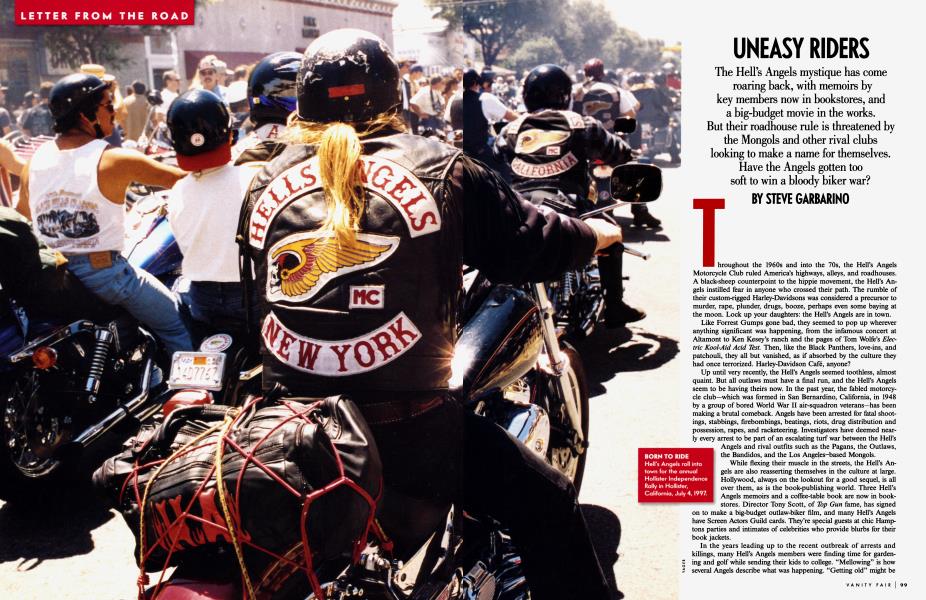
The Hell's Angels mystique has come roaring back, with memoirs by key members now in bookstores, and a big-budget movie in the works. But their roadhouse rule is threatened by the Mongols and other rival clubs looking to make a name for themselves. Have the Angels gotten too soft to win a bloody biker war?
STEVE GARBARINO
Throughout the 1960s and into the 70s, the Hell's Angels Motorcycle Club ruled America's highways, alleys, and roadhouses. A black-sheep counterpoint to the hippie movement, the Hell's Angels instilled fear in anyone who crossed their path. The rumble of their custom-rigged Harley-Davidsons was considered a precursor to murder, rape, plunder, drugs, booze, perhaps even some baying at the moon. Lock up your daughters: the Hell's Angels are in town.
Like Forrest Gumps gone bad, they seemed to pop up wherever anything significant was happening, from the infamous concert at Altamont to Ken Kesey's ranch and the pages of Tom Wolfe's Electric Kool-Aid Acid Test. Then, like the Black Panthers, love-ins, and patchouli, they all but vanished, as if absorbed by the culture they had once terrorized. Harley-Davidson Cafe, anyone?
Up until very recently, the Hell's Angels seemed toothless, almost quaint. But all outlaws must have a final run, and the Hell's Angels seem to be having theirs now. In the past year, the fabled motorcycle club—which was formed in San Bernardino, California, in 1948 by a group of bored World War II air-squadron veterans—has been making a brutal comeback. Angels have been arrested for fatal shootings, stabbings, firebombings, beatings, riots, drug distribution and possession, rapes, and racketeering. Investigators have deemed nearly every arrest to be part of an escalating turf war between the Hell's Angels and rival outfits such as the Pagans, the Outlaws, the Bandidos, and the Los Angeles-based Mongols.
While flexing their muscle in the streets, the Hell's Angels are also reasserting themselves in the culture at large. Hollywood, always on the lookout for a good sequel, is all over them, as is the book-publishing world. Three Hell's Angels memoirs and a coffee-table book are now in bookstores. Director Tony Scott, of Top Gun fame, has signed on to make a big-budget outlaw-biker film, and many Hell's Angels have Screen Actors Guild cards. They're special guests at chic Hamptons parties and intimates of celebrities who provide blurbs for their book jackets.
In the years leading up to the recent outbreak of arrests and killings, many Hell's Angels members were finding time for gardening and golf while sending their kids to college. "Mellowing" is how several Angels describe what was happening. "Getting old" might be another way of putting it. But as they were settling back, priding themselves on being, as one member puts it, "the top of the food chain" in the outlaw world, other bikers started gunning for them. And so, over the last year, the Hell's Angels have been re-emerging from their used-parts shops and tattoo parlors like grizzlies coming out of hibernation.
Are they still tough enough? Does a bear shit in the woods?
n the evening of the annual End of I I Summer Party, held at the clubhouse of the Hell's Angels' Oakland chapter-one of the oldest and most notorious of their strongholds—men in flannel shirts, denim jackets, and black leather vests are lugging beer kegs the size of their barrel-like chests. In the back courtyard several members are taking hits of nitrous oxide. The Angels enjoy the "helium high" they get from sucking on balloons filled with the gas—a given at every party.
The sky is a dreamy pink and blue, a contrast to this bleak stretch of Oakland macadam on Foothill Boulevard where, a few blocks from Angels headquarters, crack dealers do business. The clubhouse is dead center in a poor black neighborhood of housing projects.
A police car pulls up in front of the clubhouse, where roughly 80 flame-painted Harley-Davidson choppers and threewheeled custom motorcycles are lined up. Cisco, the longtime president of the Oakland chapter, rises from a chair outside the entrance and walks over to the car.
Smiling, avoiding eye contact, the young police officer asks, "Expecting any trouble from the Mongols?"
Cisco leans into the passenger window. "Naw," he says in his rusted radiator of a voice. His shoulder-length black hair, parted in the middle, falls into his face.
"I heard a Mongol lives around here," says the policeman.
"I wouldn't know," says Cisco, taking out his new cellular phone. He asks the cop to help him figure it out; they start tinkering with it.
The Mongols are a mostly Hispanic L.A.-based motorcycle club that has lately been brawling with the Angels. The two factions clashed last April at a Harrah's casino in Nevada. When the dust cleared, three Mongols were dead. Shortly thereafter, one Angel was fatally shot off his Harley-Davidson in the California desert. There have been no arrests in either case. Numerous postings on the Hell's Angels Web site (www. hells-angels.com) have claimed a Mongol was responsible.
"YOU HAVE AN ORGANIZATION THAT, BY ITS VERY ESSENCE AND CORE, AUTHORIZES KIDNAPPING, BEATINGS, EXTORTION, ROBBERY."
The young cop tries to ease Cisco back to the topic of the Mongols, saying, "Is it just hype created by the media?"
"I dunno," says Cisco.
The officer drives off. Cisco returns to his perch. The Doors' "Roadhouse Blues" plays inside. Nobody is drinking alcohol yet, despite the Angels' reputation for herculean partying. In fact, many of the club members don't drink at all, including Cisco, whose real name is Elliot Valderrama.
An East L.A.-raised Filipino with a Fu Manchu, Cisco is not as well known as the original Oakland-chapter presidentconvict turned memoirist Ralph "Sonny" Barger—and he seems to like it that way.
Barger is something of a celebrity. He was the levelheaded antihero of Hunter S. Thompson's seminal 1966 book, Hell's Angels: A Strange and Terrible Saga, and a major character in David and Albert Maysle's Gimme Shelter, the documentary of the Rolling Stones' Altamont concert in 1969, where the Angels provided security. (With its four deaths, Altamont was a grim reply to the Woodstock concert earlier that year.) At the time of Cisco's End of Summer Party, Barger is on a publicity tour, promoting his second book, Rulin' High, Livin' Free (Morrow), a collection of essays.
Cisco has no book plans, but he has acted in films, such as Bram Stoker's Dracula, and counts himself a close friend of motorcycle enthusiast and actor Mickey Rourke's. He owns a movie-set-and-prop company, but his main occupation is the Angels. When Cisco is informed that the photographer accompanying me to the party is actress Lisa Marie, who played Vampira in Tim Burton's Ed Wood, he takes a trip down memory lane: "Man, I used to jack off to Vampira on her old TV show! She was so fucking hot."
By 11 P.M., the number of choppers parked outside the clubhouse has increased to roughly 500. Police cars cruise by at regular intervals. Cisco is everywhere—"politicizing," as he calls it. Members of the Devil Dolls, an all-girl biker club, show up on their choppers.
Inside, the liquor is flowing at last. About 600 revelers move through the rooms. Perhaps only 150 men in the throng are wearing the Hell's Angels "colors." The Angels never talk about numbers. When asked how many their ranks include, they like to say, "Enough." As one member puts it, "It's for the police to find out and us to know. They get paid to watch us have a good time." Police have placed the number at 10,000. The figure is likely closer to 20,000, not counting Angels chapters in Argentina, Denmark, South Africa, Australia, Bohemia, Liechtenstein, Italy, and Greece, to name a few. You'll know it, though, if you're in the presence of Angels. They usually wear their patches.
On the clubhouse's dance floor, a rhythm-and-blues band is playing "Caledonia," and couples are doing the Hell's Angels shuffle, picked up from Grateful Dead concerts of yore. Most of the action is taking place in the adjoining standingroom-only Wall of Shame room, where mug shots of current and deceased members line the walls and two women, thinlipped and unsmiling, in G-strings, writhe in a steel cage to AC/DC's "You Shook Me All Night Long." Revelers stick bills between the dancers' butt cheeks and cheer them on. No Hell's Angels members are participating in this, as if it would be somehow undignified. The middle-aged "mamas" seem to be into it more than anyone else in the crowd. Spurred on by boyfriends and husbands, two mamas climb into the cage and start to get very busy with the dancers, rousing the crowd. "Get it! Get it!" somebody yells. One stripper seems to feign orgasm.
Later, two good-looking young women, Tina and Heather, stand near the nitrousoxide tanks, holding balloons. Tina is wearing a white tank top that displays her tattoo "sleeves." She has a black Cleopatra haircut and eyeglasses. Heather, who looks like the actress Parker Posey except for the vinyl pants and biker boots, says, "These guys are our knights in shining armor." She explains that she comes from a "stereotypically snobbish East Coast family. I grew up as the princess, and I still have that lifestyle." I mention that some Angels have been known to "gangbang" strangers and have gone to prison on rape and sexual-assault charges. "That was the 60s—that's in the past," Heather says. She turns out to be the girlfriend of a Hell's Angels chapter president. We move on.
There is an almost chivalrous level of respect shown by the Angels to any woman at the party. That is, until an incident breaks out in the courtyard later in the evening.
A short-haired, jolly-faced Angel in his early 40s, who has been manning the nitrous-oxide tanks, is showing wear, perhaps from sucking down one balloon too many. When a middle-aged mama pushes through the crowd to get to the tank, this jolly-faced Angel lashes out. His fist connects with her face—twice. The mama flies back into the crowd. "I said, Get back, woman!" he says.
A non-Angel who tries to intervene gets slammed in the face. It happens so quickly. And then it's over. When another Angel tells him of the incident, Cisco looks disappointed. "Man, that isn't cool," he says, shaking his head. "I'm going to have to talk to him." He heads toward the courtyard.
"I WENT UP TO A GUY FROM THE SATAN'S SLAVES AND ASKED HIM, 'HAVE YOU SEEN KESEY?' AND HE SAID, 'YOU SAY I'M KIND OF GREASY?"
At 1:30 A.M., there's a raffle. Cisco is the M.C. I look around the room. A senior Angel is asleep by the wall, perhaps dreaming of roadkill on a spit. I see peg legs, prosthetic hands, ears with missing lobes, and fake eyeballs.
To get past the doors of a Hell's Angels clubhouse is an arduous task. You must have an in. For me, it was Mickey Rourke, who advised me not to even think about writing a story. He knows the Angels from various films. "It's a lose-lose situation," said Rourke. "If you write just one thing that disrespects the club, you will get a major-league ass-kicking."
The Angels gave me permission to visit the clubhouse and asked me to give my pitch in front of a dozen senior members. There were guacamole and chips on a coffee table. Not one Angel was drinking. A young prospect was handing out bottles of springwater.
Rules were laid down: HAMC (Hell's Angels Motorcycle Club) could not be referred to as a "gang." No Mongols or other "motorcycle club" members could be interviewed for the story. No tape recorders. Notepads occasionally. After a halfdozen "observational" trips to Oakland, I was permitted to take notes and bring a photographer.
From his Upper East Side apartment, Tom Wolfe describes his first encounter with the outlaw club. "The Hell's Angels were giving the only public party they had ever sponsored," he says. "It was in the Haight-Ashbury at a Czech social club. There was a tremendous lineup of chopped hogs outside. I went in and my hand was stamped with 'When We Do Right, No One Remembers. When We Do Wrong, No One Forgets.' Ken Kesey was supposed to be there with some of the Merry Pranksters. I went up to a guy from the Satan's Slaves and asked him, 'Have you seen Kesey?' And he said, 'You say I'm kind of greasy?' And I said, 'You misunderstand. I mean the writer.' And he said, 'You say you're kind of a fighter?' I kind of walked sideways away from the guy. I was wearing a suit, but no necktie—my one nod toward disrespectability. There was a kissing booth, holding the most big-ass, hairiest Hell's Angel I've ever seen in my life."
Wolfe's encounters with the tribe occurred in 1966. Lately, they have been winning back their bad reputation.
It began in late February of 2002, at a motorcycle-and-tattoo exposition sponsored by the Hell's Angels and held in a Long Island catering hall. Ten vanloads of rival Pagans rolled up. Pagans, who consider Long Island their turf, forced their way inside. One Pagan was fatally shot and 10 others were wounded as 1,000 people—including women and children—fled. Five bikers were shot, Five were stabbed, and two suffered heart attacks during the attack. (The Hell's Angels' cholesterol levels must boggle the mind.) Seventy-five bikers were arrested— 73 Pagans and two Hell's Angels, one of whom was a suspect in the shooting. The arresting officers had to link together three sets of handcuffs to restrain the hands of the beefier suspects.
Less than a month later, a South Philadelphia tattoo parlor owned by a Pagan leader was firebombed. No one was injured. Police believe it was destroyed in retaliation for the Long Island fracas.
In Toronto, a top Hell's Angels member was killed five days later in a shoot-out with police. He was part of the Nomads, an elite Hell's Angels unit whose members travel the country looking to open new chapters. Nine days later, in Montreal, a close associate of the Hell's Angels' was shot three times while dining in a sushi restaurant. It was a drive-by attack. Two men with ties to the rival Bandidos gang were arrested for that one.
Also in March, in Ventura County, California, national Hell's Angels leader George Christie Jr. agreed to a plea bargain on drug and false-tax-return charges. The remainder of the charges were dropped. The original charges alleged that, through his tattoo parlor, Christie had sold stolen prescription drugs. The investigation took five years and resulted in a 132-count indictment. With a grand-jury hearing that lasted eight months, the case cost taxpayers as much as $1.5 million. Christie faced seven years in prison and got off with three years' probation.
In Laughlin, Nevada, in April, three bikers were killed and a dozen were injured in a Hell's Angels-Mongols brawl at a Harrah's casino during an annual motorcycle rally called the River Ride. About 500 people were held for questioning. A videotape that the police now have shows a Hell's Angel shooting one of the Mongols to death.
About an hour after the brawl, a 28year-old Hell's Angels member was shot from behind as he was riding near Ludlow, California. Police have made no arrests in the case.
In the ongoing nationwide mayhem, seven Hell's Angels were busted in raids on Long Island clubhouses and their homes in May, in conjunction with the beating and robbery of a former member. Investigators seized financial records, a machine gun, shotguns, $130,000 in cash, as well as other paraphernalia, including a massive steel "death's head." The victim was robbed of his jewelry, and had his tattoos inked over inside a Hell's Angels clubhouse.
That same month, Montreal Hell's Angels leader Maurice "Mom" Boucher was found guilty of first-degree murder in the 1997 deaths of two prison guards and of the attempted murder of a third.
On May 30, in Calvert County, Maryland, two Hell's Angels prospects and a bystander were injured outside a bar, the Oasis, in a drive-by shooting. Police believe the shots might have been meant to discourage the Angels from establishing a Maryland chapter. Police arrested a member of the Pagans who was found with a loaded .25-caliber handgun in his left boot.
On June 9, a Hell's Angels member was fatally shot in Cave Creek, Arizona, while sitting outside the Coyote Wild Bar & Grill. Police believe it might have been related to the Mongols-Angels turf battle.
On June 29, near Laconia, New Hampshire, two Hell's Angels prospects were shot from behind while on their bikes. Miraculously, both men drove themselves to the hospital, where they were treated for their wounds. No suspects were arrested.
And in Laconia, on June 30, police questioned several Hell's Angels after the beating of a man at Weirs Beach. The victim has not filed a complaint. Police believe the man had made remarks to the bikers.
The next day, in Minnesota, a Hell's Angel was charged with raping and kidnapping a 25-year-old woman. The woman alleged that she was raped twice at the Angels clubhouse after she was given a "special drink" that left her "partly paralyzed." The charges were later dropped.
Also in Minnesota, police charged the same man with laundering money from a drug-distribution ring. Court papers said the Angel and his wife conspired to distribute methamphetamine and cocaine.
On November 26, when George Christie Jr. filed a claim against the Ventura County Fair for its refusal to let club members on the grounds while wearing their colors last summer—a violation of the fair's dress code, which forbade "gang" attire— Christie argued that the Hell's Angels are not a gang but a motorcycle enthusiasts' group.
On September 19, Raymond Dwyer, the Angel on trial for killing a Pagan member at the catering-hall shoot-out on Long Island last February, was acquitted of murder and convicted on a lesser, third-degree weapon-possession charge. Dwyer had been facing up to 130 years in prison. The court ultimately decided he had killed the Pagan in self-defense.
"God bless the United States of America and God bless the Hell's Angels Motorcycle Club," said Dwyer in a written statement.
The Hell's Angels like to compare themselves to other fraternal organizations such as the Elks and the Rotary Club. They say they're just a group of men who happen to share an interest in motorcycles. Some chapters raise money for underprivileged children and hold holiday toy drives. George Christie Jr., for one, runs a martial-arts class for delinquent kids; he even carried the torch for the Los Angeles Olympics in 1984. In the process of reporting this story, I heard a dozen tales of good deeds from those who have been helped by the Angels. One thankful woman told of Angels' taking her to the hospital after a bicycle fall; a man spoke of Angels' repairing his broken-down car on a highway at night.
Law-enforcement officials certainly don't go along with this view. J. P. Wilson, a detective based in Phoenix, said the Angels are now involved in an "official war." "It's virtually everyone against the Hell's Angels," he said, "and they're feeling the pressure." He stated that the Vagos, the Bandidos, the Pagans, the Outlaws, and the Mongols have banded together to close the Angels' doors for good.
Tim McKinley, a recently retired F.B.I. agent based on the West Coast, investigated the Hell's Angels for 20 years. "Some would say that they are not all convicted felons—and that's true," he says. "And some would say that not all are involved in criminal activity—which I would say is nonsense. Let's remember that this is the Hell's Angels. Back in the midto latter 60s, there was a drug called angel dust. Back then it was called D.O.A., or Dust of the Angels. They created and manufactured it and sold it. The Rotary Club has never offered Rotary dust. It's still an organization that, when they expel someone, the very least the person gets is a severe beating and the removal of tattoos with wire brushes and electric drills. The Rotary Club does not do that, I'm sorry. You have an organization that, by its very essence and core, authorizes kidnapping, beatings, extortion, robbery."
HIS FIST CONNECTS WITH HER FACE-TWICE. THE MAMA FLIES BACK INTO THE CROWD. "I SAID, GET BACK, WOMAN!" HE SAYS.
He adds, however, that some chapters are "clean," or else have few members involved in crime. He blames most of the violent crimes on prospects—the gofers or pledges who want to be Angels. "Prospects operate like they're carrying their balls around in a wheelbarrow," he says. "They have to demonstrate they have what it takes. But most prospects don't get what it takes. What the Hell's Angels are looking for [in would-be members] is the ability to get it done without violence. But if it takes violence, then they need to be able to do it."
McKinley, who now practices family law in the Bay Area, concedes that the group's chapter presidents are "uniformly smart. Many are book-smart and people-smart." And he agrees with the Angels who say the press hasn't always done right by them. "They haven't had good experiences with the media," he says. "People focus on the negative points, rather than their significance to modern culture."
McKinley came away from his years among the Angels with some sympathy for them. "An unholy percentage of them were abused as children, their mothers abandoned them—which can be devastating to an individual," he says. "One guy was locked in a closet by his uncle and became deathly afraid of spiders due to it. It's a survival instinct. And now they're being experimented on by the media again. Unfortunately, it's like mixing gasoline with a match, which, as a common rule, isn't good."
In his dealings with the Angels, McKinley says, he found them to be a lot like the people who are trying to put them in jail. "I found it jarringly hard to acknowledge that listening to them at either their clubhouse or a party was like listening to a law-enforcement party, with the exception of the presence of drugs," he says. "And some of the Angels' taste in music is a lot better."
And the renewed presence of the Hell's Angels, he says, is a fact: "Like never before, this past year has been the worst in violent activity, and it's going to get worse still."
Chuck Zito was once the president of the Hell's Angels' Nomads chapter in New York. A onetime bodyguard for Charlie Sheen, Liza Minnelli, and Sylvester Stallone, and a cast member of Oz, the HBO prison drama, Zito has written a memoir, Street Justice. He takes offense at certain Hell's Angels stereotyping.
"I get mad [that] because I'm wearing a Hell's Angels jacket I'm stereotyped as this drug dealer," he says. "I've never put anything bad into my body.... If you sell drugs in our chapter [New Rochelle City], you're out of the club. That way we don't have to worry about one man bringing the whole club down. As far as the drug thing, it's nothing but a myth, something that sells papers, keeps the F.B.I. and these other agencies going.
"We have members who can't even pay their fucking $15-a-week dues. So if we had all this drug money, we'd have nothing to worry about, man. We have families to support." Zito concedes, however, that there's often one "Joe Schmo" in any given chapter who "sells his drugs and keeps his money and spends it on himself. And then we all suffer from it. We get that stigma that we're all into it. The reality is, we don't make money for the club, and the club doesn't make money for us. I'm not going to deny that there have been people in the club who have sold drugs. But when they get caught, it's the Hell's Angels, not Joe Schmo, who are blamed."
But if one Angel gets in trouble with the law—or if an Angel is attacked by an outsider—it is the duty of his fellow Angels to bail him out or take revenge. That's their code. "Wouldn't you do that for your brother," asks Cisco, "even if he was at fault?"
Other misconceptions: As for the old days in which the saying "Let's go make a mama" was uttered without a thought, the Angels claim that many women who have charged them with rape were consenting in their actions. Members claim they attract women, who get drunk, agree to have sex, often with multiple partners, and then regret it. In his memoir, Hell's Angel, Barger writes, "Women. Old ladies. Babes. Chicks. Can't live without them, can't use their bones for soup." Feminists will never appreciate the Angels. To earn your "red wings" means that you have "eaten a girl on her period." To earn your "black wings" is to have been with "a black girl."
"The main thing is, you don't wanna fuckin' touch somebody else's girlfriend or wife," says Zito. "You break that rule and you're going out. You're down the road and in bad standing. And you're gonna get beaten besides. We don't lie and we don't fuckin' steal from each other. And that's why we're better than everybody else."
Sustaining a marriage is another matter. "It puts a strain on your relationship," says Zito. "A year after I became a Hell's Angel, my wife and I divorced. It was, to her: Either them or me."
Do they beat their "old ladies"? That topic is what allegedly caused the Angels to stomp Hunter S. Thompson on Labor Day 1966, according to Sonny Barger. After witnessing an Angel named Junkie George slap his "old lady" and then kick his dog, Thompson, according to Barger, protested, saying, "Only punks slap their old ladies and kick dogs." That led to, as Barger puts it, "a couple of us kicking him around." He writes, "He was bleeding, broken up, and sobbing."
Thompson recalls the incident differently. From his Woody Creek, Colorado, home, he says the beating had to do with the Angels' feeling "used and abandoned" by him. "[When the book was coming out,] I showed them the jacket, and they didn't like it. I didn't like it, either. The cover showed a model dressed as a Hell's Angel. Then they saw the price on the book, which was $4.95, and they wanted half of the earnings. I had become a sort of press spokesperson for them ... I introduced them to reporters and to cops. I was one of them, in a way. When I told them that I couldn't join, I guess they felt that I had rejected them, and it changed our relationship.... I couldn't join them because then I would be bound to their rules, and I wouldn't be able to write a straight book."
Thompson sustained a broken rib and facial bruises in the 1966 stomping. Today he partially blames himself: "I was never afraid of them, but I was always very, very wary. Toward the end, though, I got a little too relaxed. I got too casual."
Barger, in his memoir, asserts that, as a fight was brewing with the cops in California, a frightened Thompson "jumped into the trunk of his car." Writes Barger, "I never had too much more to say to him after that."
Thompson laughs off the hiding-inthe-trunk allegation. "That's ridiculous," he says. "I may have locked myself in my car to sleep at times. Who's going to hang around a bonfire for 12 hours?" He says he still admires the Angels: "I've rarely been around any group with such intense loyalty. It was almost insane."
Women I met who enjoy the company of Angels suffer from an obvious case of thrill addiction. And yet to spend any time with the Angels can be as dull as sitting in a barbershop in Duluth. With their oversize TV screens and pinball machines, Angels clubhouses are no different from your local tavern. In the daytime, several prospects loiter outside the Oakland clubhouse, smoking cigarettes. A member or two who might have had problems with their old ladies may be found sleeping upstairs. But the Loft, a second home to Cisco and Angels members, has the feeling of a royal court. Here, prospects run to light Cisco's cigarettes. Two young women— both wearing schoolgirl skirts—also rush to serve his every need; one wears pigtails. Enclosed by chain-link and barbedwire fences, the Loft houses a collection of 2,000 or so vintage records. Downstairs is a modern kitchen equipped with cooking islands. Cisco leads me to a garage next door. "I'm going to make it into a kind of dungeon, with chains hanging from the ceiling," he says. "I'm not really into S&M, but it'll look kind of cool."
This is Cisco's domain. After he makes a joke, I say, laughingly, "You're insane/" Perhaps, like Thompson, I am getting too casual. "No, man!" an Angel tells me pointedly. "You don't say that to Cisco! Cisco, he ain't insane, man. Not Cisco. No way is Cisco insane."
I SAY, LAUGHINGLY, "YOU'RE INSANE!" "NO, MAN!" AN ANGEL TELLS ME POINTEDLY "YOU DON'T SAY THAT TO CISCO!... HE AIN'T INSANE."
One summer night, a week before he is set to go to Westchester County jail—for violating an order of protection by calling his ex-wife and childhood sweetheart on September 11—Chuck Zito invites me to an Aerosmith concert. Zito, estranged from his wife of 25 years and ousted from the house that he built (he had taken a masonry course during a sixyear prison term), is living at the chapter's clubhouse.
At the concert, you can spot Zito's "brothers in the crowd of roughly 11,000— backstage, in the V.I.P. box, front and center, mere inches from Steven Tyler's bare feet, their skull insignia stitched to their denim-jacketed backs. They stand out like pirates in the suburban Long Island crowd: the Hell's Angels, "New Roc City" chapter. On this night it is Altamont lite; the Angels are guests, not bouncers, and nobody dies.
There is Shorty, an anvil of a man who runs a tattoo parlor upstate and may have been a blacksmith in another life. And Lobo, with his grin and braid. And, most important, there is Zito. Zito, a 49-yearold former boxer and martial-arts expert, stands, arms crossed, directly in front of the stage as his pals in Aerosmith are joined by Kid Rock and a still-active RunDMC (before the murder of its D.J., Jam Master Jay) to duke it out on their 1986 hit collaboration, "Walk This Way."
After the show, Zito is swarmed at the cookout by fans, mostly young women who might have walked out of The Sopranos. Big hair, bomber jackets, and tight Guess jeans. Zito's admirers outnumber those of Kid Rock, who has joined the Angels for a few beers. "Bob," as the Angels call him—it's his real first name— appears comfortable allowing Zito the spotlight.
"What I like most about the Hell's Angels," Kid Rock says, "is they police themselves. Yeah, they police themselves."
Shorty approaches me, smiling. "This is for the record: I got a blow job from Tiger Woods last week. You can print that. He really did blow me." (Yes, Shorty is joking.)
A tarted-up young woman gives Zito a kiss good-bye and saunters away. "Can I have a burger with that shake?" he says.
Soon the Angels are revving up their Harleys. Destination: Scores, the Manhattan men's club where, in 1998, Zito famously slugged Jean-Claude Van Damme, knocking him out of his chair. Just past midnight, they're seated in a private area of this Midtown strip club, feasting on steak au poivre and chicken Marsala, finishing up the meal with espressos. Girls in neon-hued spandex micromini dresses pass the table, but the Angels seem oblivious to them. They're talking about the outlaw bikers' greatest enemy. Not Mongols. Nor Pagans. Nor Bandidos. Not the F.B.I.
But deer.
"I ride the yellow line up the Taconic State Parkway," says Lobo, describing his route home to Peekskill, New York.
"You don't see a deer until they're literally through you," adds Shorty, who takes the same route.
Zito isn't listening. "1 single-handedly made this place," he says. The bill is comped; Zito leaves a hefty tip.
I ask the Angels about the "runs" chronicled in Thompson's book. The drinking and drugging. The girls. The run-ins with the cops. The Mexican standoffs. The campouts. Only Shorty seems part of that anymore. "I went on a run to Laconia and got bit up [by mosquitoes] like a motherfucker!"
"LIKE NEVER BEFORE, THIS PAST YEAR HAS BEEN THE WORST IN VIOLENT ACTIVITY, AND IT'S GOING TO GET WORSE STILL."
Zito is laughing. "Camping in the fucking woods? We stay at fucking A-list hotels. We eat at the finest of restaurants." When he's pulled over for speeding in his Corvette, he says, cops ask for his autograph. "This is the Hell's Angels two thousand motherfucking two!" Zito says.
The question lingers: How has the most feared motorcycle club seemingly become an underdog in a world of nearly anonymous Mongols, Pagans, Bandidos, Outlaws, Grim Reapers, Henchmen, Boozefighters, Kinsmen, Satan's Slaves, Warlocks, Iron Horsemen, Gypsy Jokers, and Wheels of Soul?
Zito says it's cyclical. "It's just history repeating itself. Whether it's 1971 or 2001, every 5 or 10 years there's a problem. It cools down, and in another 10 years there'll be a problem."
The larger theory I come away with is that for the past couple of decades the Hell's Angels have been riding on their mystique, which has endured despite their dwindling numbers. Their legend rankles the less well-known clubs, some of which have been steadily building their memberships in an attempt to hold the world title.
Following all the recent violence, the Angels are making efforts to rebuild as their members retire or die off. If the Oakland chapter is any gauge, the average Angel's age must be 50. But they are as slow in handing out "patches" as they have always been. It's not for lack of a few good men. The number of those who want to join the Angels would seem to be at an all-time high. That said, Angels laugh off the notion that you have to kill someone to become a member.
"There's no initiation," says Zito. "You gotta be 21 and have a Harley-Davidson. That's how you start. It's a hang-out process. You get to know us, we get to know you, however long it takes. You don't have to prove anything to us." Most important, he says, you have to be strong-willed, even more so than physically strong. "You gotta be a man first before you're anything in life. You gotta be somebody who sticks up for what you believe in.... If you don't know how to fight when you come into the club, by the time you become a Hell's Angel, you will."
Some senior Hell's Angels members, however, seem weary of living up to the hype. For the annual July 4 rally at Hollister, California the small town that inspired The Wild One, the classic 1954 biker movie—Cisco arrives in a car. He says he doesn't really like two-wheeling these days. He stays at a hotel in an outlying town, going to the annual event only to make "a showing." When I ask Cisco after the fourday weekend if he had fun, he says, "Same old, same old." Police in Hollister had beefed up their security and dressed their force in swAT-team outfits. There were concerns that the Mongols were going to be there and that all hell would break loose. Aside from 64 arrests on relatively minor charges during the four-day rally, it went without a hitch. Ice-cream carts jingled in sync with revving motorcycles. No pillaging, no rumbling.
And not all the Hell's Angels welcome the kind of press attention and celebrity hobnobbing that members such as Zito are attracting of late. Not that anyone complains out loud. "They know they'd get a punch in the face," says Zito.
On the night of Zito's book-release party, held at the China Club in Manhattan, at least 200 members show up from all over the country, lining their bikes up near Times Square, creating traffic jams and photo opportunities for the gawking tourists outside. Doormen wave the bikers into the club ahead of the black-suited hipsters and cocktail-dress cuties. The club has roped off two V.I.P. areas for highranking Angels and celebrity drop-ins. Shorty sits on a banquette, nursing a drink and talking golf. Disco balls spin monotonously. Trays of shrimp on a stick pass by, lowered to tables by jaded waiters. By the time the hired Elvis impersonator gyrates his way through his last number, no celebrities have shown up—no Liza, no Charlie, no Sean, no Cher.
Zito scans the room, appearing more pissed by the minute. But look! The seas part as a familiar face is led through the crowd. It's a secondary cast member from The Sopranos: Federico Castelluccio, "the ponytail guy," as one onlooker puts it. A scene has been avoided yet again. All is calm with the Hell's Angels.
But not quite. As this story closes, a news flash: A Hell's Angel was shot in the lower abdomen outside a bar in El Cajon, California, near a Hell's Angels clubhouse. Another man on the scene was stabbed to death. The incident was reportedly related to the ongoing Mongols-Angels feud. And so the Hell's Angels roll on, with some of its members enjoying their status and others paying the price for riding with the baddest motorcycle club on earth.
Subscribers have complete access to the archive.
Sign In Not a Subscriber?Join Now


