






Sign In to Your Account
Subscribers have complete access to the archive.
Sign In Not a Subscriber?Join NowBUTTERFIELD 8 CALLS BACK
BOOKS
The famously contrarian humorist gets serious about introducing new readers to John O'Haras 1935 New York classic, BUtterfield 8, which will be reissued next month by the Modern Library
FRAN LEBOWITZ
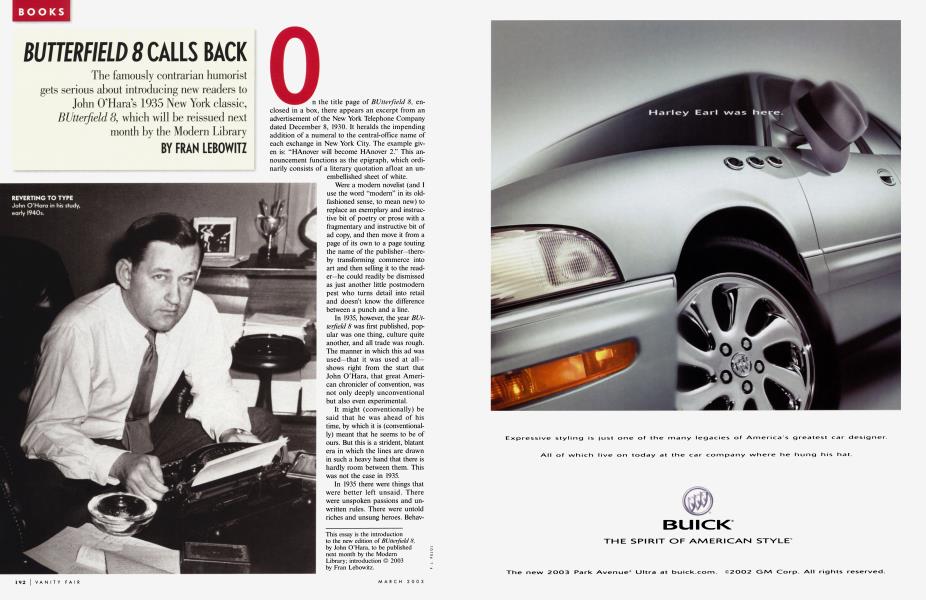
On the title page of BUtterfield 8, enclosed in a box, there appears an excerpt from an advertisement of the New York Telephone Company dated December 8, 1930. It heralds the impending addition of a numeral to the central-office name of each exchange in New York City. The example given is: "HAnover will become HAnover 2." This announcement functions as the epigraph, which ordinarily consists of a literary quotation afloat an unembellished sheet of white.
Were a modern novelist (and I use the word "modern" in its oldfashioned sense, to mean new) to replace an exemplary and instructive bit of poetry or prose with a fragmentary and instructive bit of ad copy, and then move it from a page of its own to a page touting the name of the publisher—thereby transforming commerce into art and then selling it to the reader—he could readily be dismissed as just another little postmodern pest who turns detail into retail and doesn't know the difference between a punch and a line.
In 1935, however, the year BUtterfield 8 was first published, popular was one thing, culture quite another, and all trade was rough. The manner in which this ad was used—that it was used at allshows right from the start that John O'Hara, that great American chronicler of convention, was not only deeply unconventional but also even experimental.
It might (conventionally) be said that he was ahead of his time, by which it is (conventionally) meant that he seems to be of ours. But this is a strident, blatant era in which the lines are drawn in such a heavy hand that there is hardly room between them. This was not the case in 1935.
In 1935 there were things that were better left unsaid. There were unspoken passions and unwritten rules. There were untold riches and unsung heroes. Behavior could be unbecoming. Behavior could be unseemly. Behavior could be unforgivable. Behavior could be unforgiven.
This essay is the introduction to the new edition of BUtterfield 8, by John O'Hara, to be published next month by the Modern Library; introduction © 2003 by Fran Lebowitz.
In 1935 the Dow Jones Industrial Average closed at 144.13, indicating not only the effects of the Great Depression but also, no less significantly, that this was a period of very little outsider trading. In 1935, only two years had passed since the end of Prohibition, which had itself lasted 13 years and which had, among its many other accomplishments, an oddly democratizing effect on what had customarily been the entirely covert nature of conduct governing the illicit sexual practices of the American upper classes.
If every bar is illegal, then no bar is public. An unlawful bar, a speakeasy, is not by a long shot a private club; no one, after all, ever mistook Tommy Guinan's Chez Florence for the Union League. But that was precisely the point. There were times one would prefer not to run into those whom one might, in general, otherwise prefer. Hence, it allowed for the expansion of a certain kind of slumming, and the addition of what was literally, and in more ways than one, some new blood.
The sexual practices referred to above were no different from those available today, or yesterday, or, in fact, any day. Adultery, homosexuality, et cetera, et cetera, in all their many variations and permutations, are as close to timeless as it is possible to get. Sexual desire is an animal impulse; the human element is perception. How an act or hankering is perceived at the time it is committed or felt is what gives human sexuality its affect, that special little twist. Guilt, secrecy, admiration, revulsion, joy, and despair—these are reactions in anticipation of reaction, and these can date, can be matters of fashion.
The American upper classes referred to above were, in actuality, somewhat different from those available today, although not as different as the more egalitarian among you might like to imagine. Class distinctions were, in 1935, both more and less visible than those existing today, and class distinctions were, without question, a primary concern of John O'Hara's. This was not simply because of his own social aspirations, but also because O'Hara understood better than any other American writer how class can both reveal and shape character, how profound the superficial can be, and how clothes can truly make the man. Fitzgerald usually gets the credit for this, but Fitzgerald gives too much credit to cash.
The first two sentences of BUtterfield 8 are as follows: "On this Sunday morning in May, this girl who later was to be the cause of a sensation in New York, awoke much too early for her night before. One minute she was asleep, the next she was completely awake and dumped into despair." The name of the girl is Gloria Wandrous and she has awakened in what used to be known as "a strange man's apartment." "Strange" meant new, rather than irregular, and the connotation was sexual. This particular man, Weston Liggett, is, in fact, the very picture of regularity, of orthodoxy and decorum. This is immediately established by O'Hara's description of the household goods that Gloria Wandrous examines as she tours Liggett's large apartment. The photographs are of horses, of horse shows, of a yacht, of an eight-oared shell. A full and total account is given of the clothing and posture of a certain young oarsman. The word "furniture" is preceded by the word "family."
PROHIBITION ALLOWED FOR THE EXPANSION OF A CERTAIN KIND OF SLUMMING.
Gloria Wandrous has encountered in her young life at least two strange men, who were strange meaning irregular, irregular meaning deviant. Pedophilia and its consequences were not the common (and I use the word "common" in both its senses) literary subjects in 1935 that they are today, where one can only call their trite ubiquity abusive.
But there is a difference between a shocking display and a shocking truth, and the difference is not familiarity but sensibility, that long-forgotten component of that long-forgotten attribute, talent. A reading or rereading of this book by anyone of any age will make that eminently clear.
Rereading a novel, especially one first encountered in youth, does not merely mean reading it again. It also means reassessing not only the book but, additionally, one's original impression of it at a time when one was most originally impressionable. John O'Hara was 29 years old when he wrote BUtterfield 8, which was around 1934. I was about 13 years old the first time I read it, which was around 1964. Understandably, I did not, at the time, think of it as a young man's book. Now, alas, I do.
At 13, I did not question its worldly, even world-weary tone, and was in no position to be annoyed by its rather determined show of in-theknow savoir faire, its callow fervor to appear intimate with every aspect of the low life of the highborn and the high life of the lowborn.
But neither did I, at 13, have anywhere near a full appreciation of O'Hara's true sophistication, his genuine civility, his inherent ability to discern, to apprehend, to empathize. His exceptional alertness to what was far from admirable in those he was so disparaged for admiring. His impeccable understanding of what brutal use can be made of impeccable behavior, of how closely the cut of a suit can approximate the cut of a knife.
At 13, I was not aware that what was so unusual, so estimable, so provocative about the 29-year-old John O'Hara was not his knowingness but his knowledge. Now, at last, I am. □
Subscribers have complete access to the archive.
Sign In Not a Subscriber?Join Now
