Sign In to Your Account
Subscribers have complete access to the archive.
Sign In Not a Subscriber?Join NowROUND UP THE CATTLE!
While the mainstream media regurgitate an official fantasy of George W. Bush as Gary Cooper, the president's loyal press guard has turned its guns on any threat to that cowboy image, including Helen Thomas, Walter Cronkite, and the BBC. The author exposes the biggest bullies in the herd
JAMES WOLCOTT
Film critic John Simon once pooh-poohed the notion that a West Coast colleague, notorious for the praise he spread like ballpark mustard on the most pedestrian movies, had been "bought" by the Hollywood studios.
"Why should they pay for something that they can have for free?" Simon sensibly asked.
The same rhetorical question could be raised regarding the docile performance of the Washington press corps and most of the mainstream media during the overture to the second Gulf War, or what some have christened "Dubya Dubya II." Mark Hertsgaard's scathing account of the fawning press Ronald Reagan enjoyed during his presidency was titled On Bended Knee. Since September 11, much of the press has dropped to both knees before George W. Bush to take dictation. A popular, raucous Webzine doesn't hesitate to label such genuflectors as "media whores" {Media Whores Online, that is, "the site that set out to bring the media to their knees, but found they were already there").
Yet this colorful insult may do an injustice. If the press has given Bush and his Cabinet a horsey-back ride, it isn't because they're paid submissives. They're not prostitutes, they're pushovers.
Even pushovers should show some pride. On March 6, 2003, President Bush held a rare press conference to prepare the country for war against Iraq. It was a solemn, hollow piece of absurdist theater. Members of the press were marched into the room two by two, like schoolchildren on a field trip to the planetarium. Departing from precedent, the president refused to entertain a random volley of questions; instead, he chose reporters from a prepared list, the resulting colloquy so stilted that he couldn't resist blurting out at one embarrassing
juncture that the entire evening was "scripted." As Matt Taibbi explained in a damning column in New York Press, the White House press corps collaborated in this charade, behaving as if they were being operated by remote control. "In other words," he wrote, "not only were reporters going out of their way to make sure their softballs were pre-approved, but they even went so far as to act on Bush's behalf, raising their hands and jockeying in their seats in order to better give the appearance of a spontaneous news conference." Reporters from powerful breakfast papers humbled themselves, The New York Times's David Sanger "meekly sitting his ass back down" (Taibbi) when Bush ignored his question. He ignored a lot of questions that dreamy night, his eyes straying to his cue cards as his mind wandered into the clouds.
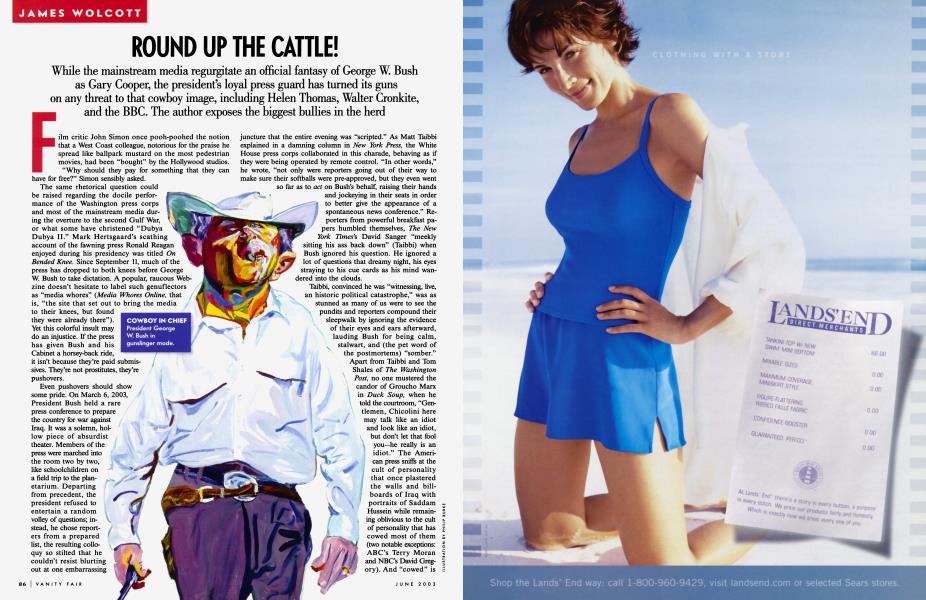
Taibbi, convinced he was "witnessing, live, an historic political catastrophe," was as stunned as many of us were to see the pundits and reporters compound their sleepwalk by ignoring the evidence of their eyes and ears afterward, lauding Bush for being calm, stalwart, and (the pet word of the postmortems) "somber." Apart from Taibbi and Tom Shales of The Washington Post, no one mustered the candor of Groucho Marx in Duck Soup, when he told the courtroom, "Gentlemen, Chicolini here may talk like an idiot and look like an idiot, but don't let that fool you—he really is an idiot." The American press sniffs at the cult of personality that once plastered the walls and billboards of Iraq with portraits of Saddam Hussein while remaining oblivious to the cult of personality that has cowed most of them (two notable exceptions: ABC's Terry Moran and NBC's David Gregory). And "cowed" is the word. Bush's cult of personality is based on a rawhide image of masculinity as carefully storyboarded and marketed as an old Marlboro Man campaign. Now that the Marlboro Man has coughed up a lung, Bush has the heroic sunset all to himself.
From the time they first entered the White House, Ronald Reagan's advisers knew that foreign policy was politically treacherous territory for their boss. Years of rash statements ... had earned Reagan a reputation as a trigger-happy extremist.... Defusing the President's cowboy image thus became a top and enduring priority for Reagan's men.
—Mark Hertsgaard, On Bended Knee.
Bush and his advisers have gone the opposite route, giving his cowboy image regular infusions of cactus juice. After two terms of Bill Clinton, a voluminous policy wonk and voluptuary who could sweet-talk any
topic into submission, it was time for a tough but compassionate hombre in town who spoke plain and shot true. Bush's aging sidekick, Dick Cheney, told Tim Russert on Meet the Press, "The notion that the president is a cowboy ... as a Westerner, I think that's not necessarily a bad idea. I think the fact of the matter is he cuts to the chase. He is very direct and I find that very refreshing." Frequent photo ops of Bush clearing brush from his Ponderosa homestead in Crawford, Texas ("With all the time the president has spent clearing brush," a puzzled Dana Milbank asked in The Washington Post, "how is it possible that there is still any brush left on his ranch?"), and his famous comment about bringing Osama bin Laden to frontier justice ("There's an old poster out West, as I recall. It said, WANTED: DEAD OR ALIVE") inspired an endless series of editorial cartoons showing a bowlegged president squinting under a 10gallon hat at some varmint. When it came to evil, he was hell-bent for leather.
The city slickers in the press swallowed this line like largemouth bass. William Schneider, a once respected political analyst who has become an inane poll watcher for CNN, wrote in the National Journal, "Talk tough and carry a big stick, but act with prudence. It's Reagan diplomacy with a Bush twist—just right for an Ivy League cowboy." Journalism's poet of the Pecos is Howard Fineman, who yodels from the pages of Newsweek and his many pundit appearances on MSNBC. He has been foremost in painting George Bush as the white knight on horseback casting a long, lean shadow down the dusty trail to Baghdad. No sooner had Bush's zombie convention of a press conference ended than Fineman could be heard caroling on Hardball, "If he's a cowboy he's the reluctant warrior, he's Shane ... because he has to protect his family." Fineman, alas, is no scholar of the sagebrush genre. Alan Ladd's repentant gunslinger wasn't protecting his family; he was strapping on the holster to defend the family for whom
Bush responded to a query from Helen Thomas with a Method actor's battery of mannerisms.
he worked as a hired hand. He also made it a point of honor never to be the first to draw. It was the bad guys and yellowbellies who went for their guns to get a jump on decent folk. Shane's personal code and Bush's doctrine of pre-emption occupy clashing moral universes.
President Bush is no more of a genuine cowboy (roping steers, farting by the campfire) than Ronald Reagan was. In fact, he's further removed from reality. Reagan was an actor who played cowboys in movies and became a politician. Bush is a politician who pretends to be a cowboy in order to remind us of Reagan when he was president. Reagan represented Hollywood. Bush represents an imitation of Hollywood, the TV spm-off of the hit movie. His being a double copy—a Warholian fake of a fake—hasn't kept the press from rolling out a red carpet for every Bush production, including the liberation of Iraq. "This is a president who likes his stories upbeat, his plotlines simple and his villains clearly marked," wrote Tamara Lipper and the unavoidable Howard Fineman in Newsweek on the eve of "Shock and Awe," a fan letter which promoted the president from actor in chief to Orson Welles auteur: star, screenwriter, director, producer. (As real bullets were about to fly, Lipper-Fineman cutely punned that the war plan was Bush's "shooting script.") Read the following paragraph and marvel at what passes for adult journalism in a major newsweekly:
The president loves regular order, especially now. He's been traveling less, which means more time for breakfast and dinner with First Lady Laura. Karen Hughes, his original "mother hen" adviser, is back to vet his speeches. ("You look good in that tie," she
told him before his Oval Office speech. "It's very powerful.") Ever the runner, Bush now is fighting age as well as war: he's given up sweets so he can lose weight and improve his treadmill pace. "You don't know what six pounds can do to a running time," he told an aide.
So any famished Iraqis can take solace in knowing that they'll be able to shave valuable minutes off their daily jog, once strength returns to their legs.
In the thick of this lemon-scented tripe is a snapshot of Bush's Heisman Trophy stance in stiff-arming the press: "No fan of the media, he couldn't hide a smirk as the White House pool was hustled into— and quickly out of—a cabinet meeting without being given the chance to ask « a question." Suckers! Some luminaries | in the corps are unable to conceal their own smirk of condescension toward the poor saps in the White House pool. 3 Washington-watchers such as Fineman, -NBC's Andrea Mitchell, and CNBC's 5 Larry Kudlow often nod with admiration * at how leakproof, tight-puckered, poker" faced, and closely huddled this adminis½ tration is, how unswervingly it stays "on message." It doesn't take a graduate degree in mass communication to grasp that all propaganda is based upon a primitive "staying on message," boiling complicated issues down to a bumper-sticker slogan or menacing threat. What was Goebbels's "Big Lie" technique but an infernal application of staying on message? "If Bush has doubts, they're not visible," Newsweek intoned on March 31, and a front-page profile in USA Today soon after let us know that Bush doesn't want any doubting Thomases or weak Willies around him: "He has a special epithet for members of his own staff who worry aloud.
He calls them 'handwringers.'" Jesus on the cross gave way to doubt, but Bush and his prayer circle are made of sterner stuff.
The press in this country has never I identified less with the underdog I and pandered more to the top pedigrees. The arrogance of the Bush administration is mirrored in the arrogance of the elite media, which preens even as it prostrates itself. TV punditry, with its exclusive skybox view, has genetically modified all political coverage. Bulbousego'd cable-news hosts, celebrity reporters, and political operatives posing as experts are far less interested in prying information loose than in popping off with their own stale insights and psychic-hot-line predictions (stale because they all breathe the same rarefied air). Why bother posing questions if you already think you know all the answers? In the past, sage journalists such as Walter Lippmann and James Reston may have been compromised by proximity to power, honoring a gentleman's agreement with those they covered. As the innocuous, meaningless details of the Newsweek article typify, White House beat reporters don't come anywhere near hollering distance of the decision-making process; Fineman and company are more like trick-or-treaters, filling their bags with sweets doled out by the help. They're grateful for any trifle.
Under the Nixon administration, nosy reporters and hostile commentators, newspaper editors, and TV producers would get a hot earful over the phone from the White House. The worst offenders—Daniel Schorr, Mary McGrory—landed on a secret "Enemies List." A Nixonian note was struck early in the Bush administration when Press Secretary Ari Fleischer warned a reporter that his question about Jenna Bush's underage-drinking citation "had been noted in the building." Compared with the lashings of distemper that came out of the collective peabrain of Howard Hunt, G. Gordon Liddy, Chuck Colson, and John Mitchell (who once threatened to put Katharine Graham's "tit in a big fat wringer"), however, Fleischer's admonition was Nixon lite, about as fear-inducing as Mel Cooley trying to get the Alan Brady writers to stop horsing around on The Dick Van Dyke Show. (Fleischer even resembles a younger Mel Cooley, by which I intend no disrespect to the memory of Richard Deacon.) The truth is that the Bush team doesn't need to nutcrack the press, because they've got so many loudmouths in the media to do the job for them. These journalistic turncoats func-
Since September II, much of the press has dropped to both knees before George W. Bush to take dictation.
tion as the auxiliary police of the opinion realm, goon squads whose weapons are ridicule, phony indignation, and ostracism. Consider the case of Helen Thomas, outlaw granny.
Those of us relegated to sitting in the non-assigned seats at the rear of the cramped room, or to sit in a window sill or stand along the walls were not only seldom recognized from the podium, but were generally ignored and not infrequently the butt of rude jokes and behavior by the press corps "elites." (The uniform exception was Helen Thomas, dean of the press corps, the consummate professional who remains in her front-and-center seat in the press room to this day.)
—Nicholas F. Benton, former White
House correspondent (Falls Church News-Press, January 16, 2003).
Eighty-two years old, Helen Thomas has been covering White House briefings and presidential press conferences since the heady days of President Kennedy. For nearly 40 years, Thomas was White House correspondent for U.P.I. (resigning in 2000 when it was sold to the Reverend Sun Myung Moon's Unification Church). Aged, frumpy, a bit grumpy, Thomas is a throwback in this telegenic age, an unglamorous reminder of a more civic era. Retired as a correspondent, Thomas writes a column for the Hearst syndicate, but has been allowed to retain her front-row seat at briefings as a matter of courtesy and tradition. If her Casey Stengel tenure has made her a familiar fixture, her persistent, frank questioning has made her a pest to presidents and their minders. (She and Sam Donaldson were Reagan's most dogged inquisitors.) None, however, has expressed his annoyance more nakedly than Bush the Son. In the press conference previous to the one on March 6, he responded to a query from Thomas about the separation of church and state with a Method actor's battery of mannerisms; the camera recorded him staring, twitching, pursing his lips, and at one point nearly crossing his eyes like Anthony Perkins at the end of Psycho. When she presumed to interrupt his platitudinous reply, he said with a cobra smile, "I didn't get to finish my answer, in all due respect."
Thomas committed a greater act of blasphemy when she told an interviewer that George Bush was the worst president in American history, a remark she partially recanted, saying it was too early to render a complete verdict since there's always the hope of "redemption." It was too little, too late: her anti-Bush quote had been duly noted in the building, put on her permanent record, and filed with the principal. When Bush held his March 6 press conference, it was payback time. Not only was Thomas denied her customary seat and the opportunity to ask the first question, she was never called upon, period. (Also blackballed was Mike Allen of The Washington Post, the second time in a row the Post had been blanked for displeasing His Majesty.) The president's petty snub was followed by an ugly pile-on whose purpose was to kick Thomas to the curb permanently, as if she were a bag lady who had slipped past security.
The gang attack was led by loyalists at Fox News, National Review Online, and the New York Post, who dependably swarm into action at the first head nod from Republican higher-ups. (A Republican National Committee group E-mail singled out Thomas for targeting.) A few days after the comatose press conference, Fox News White House correspondent James Rosen finkily sided with the president against a fellow journalist with a gem of sophistry wrapped in a tissue of sanctimony. Noting that the president sped through 21 questions in under an hour, devoting three minutes to each answer, Rosen ruminated, "Most Americans would be happy to let their president speak for three minutes in response to any question they asked. One can only imagine how many fewer questions would have been asked had he picked on Helen Thomas." Yes, one can only imagine. Fox's Brit Hume was more ad hominem, comparing Thomas to "a nutty aunt in the attic" and claiming that the reason Ari Fleischer calls on her during White House briefings is CONTINUED ON PAGE 97 CONTINUED FROM PAGE 90 that her questions are so "outrageous and over the top" that it creates a sympathetic backlash in favor of the administration. In his New York Post column, written between donuts, John Podhoretz bragged about roiling a panel discussion by slagging Thomas—"the ancient White House pseudo-reporter"—as a has-been who ought to be carted "to an old-age home." New York Post colleague Michelle Malkin, beating a tight deadline before her next pedicure, climbed in with her own column to chide, "Shame, shame, shame on Helen Thomas."
Why such a major to-do over such a minor nuisance? If Helen Thomas is really the useful foil Hume contends she is, why not just plop her in the front row of Bush's next recital and let him tee off on her?—deflect her pesky question with a Reaganesque sigh, a head tilt, and a pithy, rehearsed catchphrase that would bury her under a roomful of chuckles? I'll tell you why. Because to a bully it feels better to punish someone than to finesse them. At the radical core of modern conservatism burns a dictatorial lust to lash out at any deviator who doesn't attend choir practice. Either sing our hymn or zip your lips. Even those senior statesmen of journalism who have retired aren't spared this partisan vigilantism.
[Walter Cronkite] believes the agendas of other countries should be considered when making decisions about the defense of Americans, even when those agendas are based on greed and petty politics. I strongly disagree.
—Bill O'Reilly (the Daily News, March 24, 2003).
What was Goebbels's "Big Lie" technique but an infernal application of staying on message?
'A war against Iraq is not only morally wrong, it will be an unmitigated disaster"? Sorry, no, I disagree. -"Point-Counterpoint: The War on Iraq" {The Onion, March 27, 2003).
he 86-year-old Walter Cronkite, who I left the anchor chair of the CBS EveI ning News in 1981, had the temerity to make a speech at Drew University this March deploring the arrogance of the Bush administration's foreign policy and urging a more conciliatory, multilateral approach. Well, you simply don't get away with that sort of sane, wise nonsense these days without it sticking up someone's nose, and it went straight into Bill O'Reilly's dragon nostril. In his weekly column, written between soulful examinations of his fan mail, the host of Fox News's O'Reilly Factor and his own radio gabfest labeled Cronkite an "internationalist," a nasty term in Bushistan. "Call me a jingoist," wrote O'Reilly (O.K., you're a jingoist), "but your family's security is more important to me than German Chancellor Gerhard Schroeder's political career." Nice touch, that "your family"—as if O'Reilly weren't concerned with his own family's security but is selflessly looking out for ours (unlike Cronkite, who doesn't care if we all die). He wasn't content to excoriate Cronkite as a namby-pamby sauerkraut-lover, but sought to blacken his broadcasting legacy as worst he could.
Some background. On February 27, 1968, Cronkite told CBS viewers that the American military campaign in Vietnam was "mired in stalemate": "To say that we are close to victory today is to believe, in the face of the evidence, the optimists who have been wrong in the past." Cronkite's dire summation was a kidney punch to President Johnson, who understood that the cause was now lost: "If I've lost Cronkite," he was quoted as saying, "I've lost middle America." Not since Cronkite's CBS mentor and colleague Edward R. Murrow lifted Senator Joe McCarthy by the skunk tail for public inspection had one TV broadcast reflected such a fateful climate change in public opinion.
Clearing his throat loud enough to scatter geese, O'Reilly begs to differ. With immaculate hindsight, he argues that we shouldn't give "Uncle Walter," as he calls him, undue credit. "The truth is that Cronkite said little while the Vietnam War raged out of control in the 1960s.... His conversion came very late in that deadly game." Ah, the things that seep out from the radioactive landfill of O'Reilly's no-spin zone. First off, unlike the ayatollah of A1 Foxeera, Cronkite was a nightly-news anchor who rarely editorialized (that was Eric Sevareid's sententious task); his "conversion" came from leaving the anchor desk and seeing with his own eyes in Vietnam that the war was unwinnable. The implication that by not speaking up sooner "in that deadly game" Cronkite was somehow culpable for thousands of lives lost is rich coming from O'Reilly. Where, pray tell, was he when the war was raging? On a student deferment, like so many of his fellow chickenhawks. He played football and worked for the school paper at Marist College, spent his junior year at the University of London in 1969-70, then returned to Marist to rejoin the grid squad. Which is not to say Vietnam didn't haunt him too. "In the early 90s," he wrote recently, "I decided to go to Vietnam myself to have a look around," thereby arriving in country a mere quartercentury or so after Cronkite.
Mopping up domestic opposition is WLM only part of the mission of the ITI American media's Elite Republican Guard. Cunning enemies from afar, too, are trying to mess with our minds and confuse Kmart shoppers with words and images quarantined by our own press. During Dubya Dubya II, I spent hours glued to BBC World Service through the technological wonder of satellite radio. Uncluttered by commercials, promos, martial theme music, pointless banter at the anchor desk, and the flying shrapnel of quick-cut montages to which most TV is addicted, BBC World Service is a sonic beacon, its fast-breaking
y.
coverage fortified with valuable input from scholars, historians, and military analysts (usually far more pungent and precise than the retired officers employed by American networks). The increased penetration of BBC radio and TV news, carried here on a number of NPR and PBS stations, has been met with Fierce resistance from writer and blogger Andrew Sullivan.
A former redcoat, the British-born, Oxford-educated, gay, Tory Catholic has
O'Reilly labeled Cronkite an "internationalist," a nasty term in Bushistan.
become as zealous as the late Roy Cohn in sniffing out subversives wherever he finds them, which is usually wherever he points his nose. Before the war against Iraq began, Sullivan warned of enemies within who would stop at no metaphor or flaming-baton trick to undermine American resolve and values. He flung the highly charged phrase "Fifth Column" at suspected traitors, fellow travelers, and wormy professors who always blame America first—you know, the usual suspects. To Yankee Doodle Andy, the BBC has emerged as the chief propaganda arm of the enemy without, the "Tokyo Rose" of the desert war, whose initials now stand for Baghdad Broadcasting Corporation. As the indispensable Bob Somerby on the watchdog Web site Daily Howler has documented, at least one of Sullivan's examples of BBC bias is incorrect or an outright fib. When facts are faulty, escalate the rhetoric. On March 26, Sullivan wrote in his daily blog:
Remember one of the key elements, we're Finding out, in this battle is the willingness
of the Iraqi people to stand up to the Saddamite remnants.... What the BBC is able to do, by broadcasting directly to these people, is to keep the Iraqi people's morale as far down as possible, thereby helping to make the war more bloody, thereby helping discredit it in retrospect. If you assume that almost all these reporters and editors are anti-war, this BBC strategy makes sense. They're a military player. And they are objectively pro-Saddam.
It is this kind of writing and reasoning that conFirms the prudence of Howell Raines's decision to punt Sullivan's saucy butt out of the pages of The New York Times Magazine. Understand the import of what he is alleging. The former editor of The New Republic is accusing the BBC of having slanted the war from the gloomiest angle in a deliberate ploy to prolong the conflict, boost the casualty toll, and undercut the coalition.
"Objectively pro-Saddam" (ironic seeing the sort of dishonest formulation that Orwell deplored spouted by an avowed Orwell devotee like Sullivan), the BBC v • intentionally discouraged
Iraqis from opposing the fedayeen in order to advance its own anti-American agenda. If the BBC is | a "military player" assist-
"1 ing coalition foes, why not
bomb its control center at Bush House in London? Didn't American jets fire missiles into Iraqi TV offices in Baghdad? A selection of prominent American journalists countenanced the raid, some wondering why it hadn't happened sooner, never mind that it violated the Geneva Convention the U.S. professes to care about when it suits our interests. Nor was there any outcry apart from CBS MarketWatch when Financial reporters from A1 Jazeera were evicted from the New York Stock Exchange presumably in retaliation for the airing of American RO.W. footage on their network. The apparent targeting of A1 Jazeera's offices in Baghdad, which resulted in the death of correspondent Tariq Ayoub, and the disputed attack on the Palestine Hotel, which took the lives of two journalists, roused far greater outrage in the international media than they did here. But why expect American journalists to stand up for foreign broadcasters when they don't stand up for themselves or their own colleagues at home? They don't stand up to anybody in authority.
Their knees must be locked.
Subscribers have complete access to the archive.
Sign In Not a Subscriber?Join Now


